
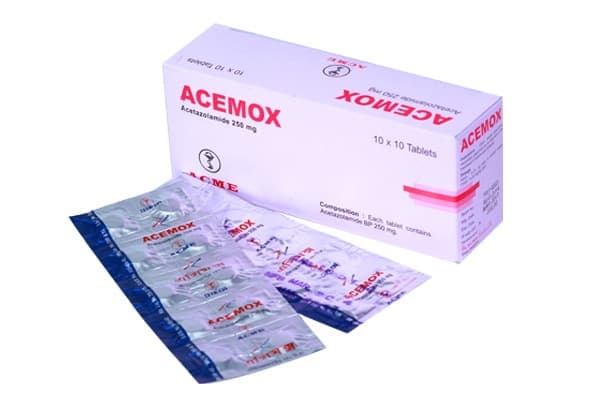

Medicine overview
Indications of Acemox
Acemox is a carbonic anhydrase inhibitor used as adjunctive (add-on) therapy for several conditions, with the strength of evidence varying by indication:
FDA-approved / established uses
- Glaucoma: Adjunctive treatment of chronic open-angle glaucoma, secondary glaucoma, and short-term preoperative management of acute angle-closure glaucoma, by lowering intraocular pressure.
- Epilepsy: Adjunctive therapy (used together with other anticonvulsants) for centrencephalic epilepsies, including certain generalized (petit mal/absence) and mixed seizure patterns.
- Edema: Adjunctive treatment of edema due to congestive heart failure and drug-induced edema.
- Acute mountain sickness (altitude sickness): Prevention and reduction in severity of symptoms of acute mountain sickness in individuals undertaking rapid ascent to high altitude.
Commonly used off-label (not FDA-approved but supported by clinical practice/literature)
- Idiopathic intracranial hypertension (pseudotumor cerebri) to reduce cerebrospinal fluid production.
- Periodic paralysis syndromes (hypokalemic/hyperkalemic) in selected patients.
- Metabolic alkalosis in critically ill patients, as an adjunct.
Note: Acemox is always used as an adjunct in epilepsy and edema; it is not intended as sole/first-line therapy for these conditions.
Composition
Each tablet of Acetazolamide commonly contains 250 mg of acetazolamide as the active ingredient, along with standard pharmaceutical excipients such as binders, fillers, and disintegrants. Sustained-release capsule formulations (typically 500 mg) and a sterile injectable powder form also exist internationally, though tablets are the form most widely available in Bangladesh.
Description
Acemox is a sulfonamide derivative that acts as a carbonic anhydrase inhibitor. Unlike antibacterial sulfonamides, it has no significant antibacterial activity but strongly inhibits the enzyme carbonic anhydrase in the eye, kidney, brain, and other tissues.
By inhibiting carbonic anhydrase, Acemox reduces the formation of aqueous humor in the eye (lowering intraocular pressure), promotes renal excretion of sodium, potassium, bicarbonate, and water (mild diuretic effect), and reduces excessive abnormal neuronal discharge in the central nervous system.
Therapeutic Class
Carbonic anhydrase inhibitor; sulfonamide derivative (non-antibacterial); used as an anti-glaucoma agent, anticonvulsant adjunct, diuretic, and altitude-sickness prophylactic.
Pharmacology
Acetazolamide is a potent, specific, non-competitive inhibitor of the enzyme carbonic anhydrase, which catalyzes the reversible reaction involving hydration of carbon dioxide and dehydration of carbonic acid.
- Ocular effect: Inhibition of carbonic anhydrase in the ciliary processes of the eye decreases the secretion of aqueous humor, resulting in a drop in intraocular pressure.
- Renal effect: Inhibition of carbonic anhydrase in the renal proximal tubule reduces reabsorption of bicarbonate, sodium, and water, producing a mild diuretic and alkalinizing effect on urine, and can lead to metabolic acidosis with prolonged use.
- CNS effect: The anticonvulsant action is thought to relate to carbonic anhydrase inhibition in the brain, which may retard abnormal, paroxysmal, excessive discharge from neurons.
- Altitude sickness: Induced metabolic acidosis stimulates ventilation, improving oxygenation and reducing symptoms of acute mountain sickness.
Pharmacokinetics: Acetazolamide is well absorbed orally, is not metabolized, and is excreted unchanged by the kidneys, largely within 24 hours.
Dosage & Administration of Acemox
Glaucoma
| Type | Adult Dose |
|---|---|
| Chronic open-angle glaucoma | 250 mg to 1 g per day, usually in divided doses; doses above 1 g/day give no additional benefit |
| Secondary glaucoma / preoperative acute angle-closure glaucoma | 250 mg every 4 hours, or 250 mg twice daily short-term; in acute cases, an initial 500 mg dose followed by 125-250 mg every 4 hours |
Epilepsy (adjunctive)
Total daily dose of 8 to 30 mg/kg in divided doses; optimum range is usually 375-1000 mg daily. When added to existing anticonvulsant therapy, start at 250 mg once daily and titrate as needed.
Edema (congestive heart failure / drug-induced)
250-375 mg once daily in the morning (approximately 5 mg/kg); best results are often obtained with intermittent dosing (alternate days, or two days on/one day off) to avoid reduced diuretic response.
Acute mountain sickness
500-1000 mg daily in divided doses; the higher dose is preferred for rapid ascent. Start dosing 24-48 hours before ascent and continue for at least 48 hours after arrival at high altitude (or longer if symptoms persist).
Administration
Tablets may be taken with or without food; taking with food may reduce stomach upset. Tablets can be crushed and mixed with soft food (e.g., applesauce) or a flavored syrup for patients who have difficulty swallowing. See Renal/Hepatic notes under Precautions and Special Populations.
Administration of Acemox
Acemox tablets are given by mouth, with or without food. Extended-release capsule forms (where available) are typically taken once or twice daily and should be swallowed whole, not chewed or crushed. Adequate fluid intake is recommended during therapy to reduce the risk of kidney stone formation.
Interaction of Acemox
The following are well-documented, clinically significant interactions with Acemox:
- High-dose aspirin (salicylates): Concomitant use can cause severe toxicity, including anorexia, tachypnea, lethargy, metabolic acidosis, coma, and death; avoid combination or use with extreme caution and close monitoring.
- Phenytoin: Acemox may increase serum phenytoin levels and increase the risk of osteomalacia with long-term combined use.
- Primidone: Acemox may decrease serum primidone concentrations.
- Other carbonic anhydrase inhibitors (e.g., topiramate, zonisamide, dorzolamide): Additive effects and increased risk of severe acid-base and electrolyte disturbances; concurrent use is generally not advisable.
- Lithium: Acemox increases renal excretion of lithium, which may reduce its therapeutic effect.
- Cyclosporine: May increase cyclosporine blood levels.
- Amphetamines, quinidine, methenamine: Alkalinization of urine by Acemox reduces urinary excretion of amphetamine and quinidine (enhancing their effect) and can prevent the antiseptic action of methenamine.
- Antidiabetic agents: Acemox can alter blood glucose control; monitor glucose closely in diabetic patients.
- Sodium bicarbonate: Concurrent use increases the risk of renal calculus (kidney stone) formation.
Contraindications
Acetazolamide is contraindicated in patients with:
- Known hypersensitivity to Acetazolamide or to any component/excipient of the formulation (including cross-reactivity risk in patients with prior severe sulfonamide allergy).
- Hyponatremia and/or hypokalemia (depressed sodium and/or potassium levels).
- Marked (severe) renal disease or renal failure.
- Marked (severe) hepatic disease, or cirrhosis, due to risk of precipitating hepatic encephalopathy.
- Adrenal (suprarenal) gland failure/insufficiency.
- Hyperchloremic acidosis.
- Long-term use in chronic non-congestive (chronic) angle-closure glaucoma, since it may permit organic angle closure to occur while masking symptoms by lowering intraocular pressure.
Side Effects of Acemox
Side effects of Acemox range from common and generally mild to rare but serious:
Common
- Paresthesias (tingling/numbness), particularly of the fingers, toes, and around the mouth - usually mild and dose-related.
- Fatigue, drowsiness, malaise, headache.
- Loss of appetite, nausea, vomiting, altered taste, diarrhea.
- Increased urination (mild diuretic effect).
Less common / serious
- Metabolic acidosis and electrolyte disturbances (hypokalemia, hyponatremia) - see Contraindications/Precautions.
- Kidney stone (renal calculus) formation.
- Blood disorders: aplastic anemia, agranulocytosis, leukopenia, thrombocytopenia (rare but require monitoring with prolonged use).
- Liver dysfunction, including rare cholestatic jaundice or fulminant hepatic necrosis.
- Hypersensitivity/skin reactions: urticaria, photosensitivity, and rarely Stevens-Johnson syndrome or toxic epidermal necrolysis.
- Hearing disturbances, tinnitus.
- Transient myopia; rarely, choroidal effusion/detachment after ocular surgery.
Pregnancy & Lactation
Pregnancy: Acemox has shown teratogenic effects (limb defects) in animal reproduction studies. Acemox should be used during pregnancy only if clearly needed and the potential benefit justifies the potential risk to the fetus; consult a physician before use in pregnancy.
Lactation: It is not well established whether Acemox passes into breast milk in clinically significant amounts. Because of the potential for adverse effects in a nursing infant, a decision should be made, in consultation with a physician, whether to discontinue nursing or discontinue Acemox, taking into account the importance of the drug to the mother.
Precautions & Warnings
Sulfonamide hypersensitivity: Although Acemox is not an antibacterial sulfonamide, rare but fatal reactions similar to those seen with antibacterial sulfonamides (Stevens-Johnson syndrome, toxic epidermal necrolysis, fulminant hepatic necrosis, agranulocytosis, aplastic anemia) have occurred; discontinue immediately if signs of hypersensitivity appear.
Electrolyte and acid-base disturbances: Acemox can cause hyponatremia, hypokalemia, and metabolic acidosis, especially with prolonged use. Periodic monitoring of serum electrolytes is recommended.
Renal calculi: Adequate hydration is recommended during therapy to reduce the risk of kidney stone formation.
Blood dyscrasias: Baseline and periodic complete blood counts are recommended with prolonged therapy because of the (rare) risk of aplastic anemia and other blood disorders.
Hepatic/renal impairment: Use with caution and at reduced doses in mild-to-moderate impairment; contraindicated in severe impairment (see Contraindications).
CNS effects: May cause drowsiness, fatigue, or transient myopia; patients should be cautious when driving or operating machinery until they know how they respond to Acemox.
Pulmonary disease: Use with caution in patients with pulmonary obstruction or emphysema, where alveolar ventilation may be impaired.
Chronic angle-closure glaucoma: See Contraindications regarding long-term use.
Overdose Effects of Acemox
Symptoms of Acemox overdose may include electrolyte imbalance, metabolic acidosis, drowsiness, and central nervous system disturbances. There is no specific antidote.
In case of suspected overdose, seek immediate medical attention or contact emergency services/a poison control center right away. Treatment is symptomatic and supportive, typically in a hospital setting, and may include monitoring and correction of serum electrolytes (particularly potassium) and blood pH. Acemox is removed by dialysis, which may be considered if overdose is complicated by renal failure. Do not attempt to manage a suspected overdose at home.
Storage Conditions
Store at room temperature (below 30°C), away from light and moisture. Keep out of reach of children.
Use In Special Populations
Pediatric use: The safety and effectiveness of Acemox in pediatric patients have not been formally established for all indications, though it is used clinically (e.g., for glaucoma and epilepsy) under medical supervision with weight-based dosing. Growth retardation has been reported with long-term use in children, thought to be related to chronic acidosis; growth should be monitored.
Geriatric use: Elderly patients, especially those with reduced renal function, are at greater risk of severe metabolic acidosis. Dosing should generally start at the lower end of the recommended range, with attention to renal, hepatic, and cardiac function.
Renal impairment: Use with caution in mild-to-moderate impairment (reduced effectiveness and increased risk of acidosis); contraindicated in severe renal disease.
Hepatic impairment: Use with caution; contraindicated in severe hepatic disease/cirrhosis due to risk of hepatic encephalopathy.
Duration Of Treatment
Duration of Acemox therapy depends on the indication and clinical response, and should be determined by the prescribing physician. For altitude sickness prevention, treatment is typically short-term (started 1-2 days before ascent, continued for 48 hours or more at altitude). For chronic conditions such as glaucoma or epilepsy, treatment may be long-term, with periodic monitoring of electrolytes, renal function, and blood counts. Long-term use for chronic non-congestive angle-closure glaucoma is not recommended (see Contraindications).
Drug Classes
Carbonic anhydrase inhibitor (non-antibacterial sulfonamide derivative); antiglaucoma agent; anticonvulsant adjunct; diuretic.
Mode Of Action
Acetazolamide works by inhibiting the enzyme carbonic anhydrase, which normally catalyzes the conversion of carbon dioxide and water into carbonic acid (and its dissociation into bicarbonate and hydrogen ions). By blocking this enzyme in the eye, Acetazolamide reduces aqueous humor production and lowers intraocular pressure. In the kidney, inhibition of carbonic anhydrase reduces bicarbonate reabsorption, producing a mild diuretic and urine-alkalinizing effect and a tendency toward metabolic acidosis. In the central nervous system, this same mechanism is believed to raise the seizure threshold, and the resulting mild metabolic acidosis stimulates respiration, which is useful in preventing altitude sickness.
Pregnancy
C
Pediatric Uses
Acemox safety and efficacy have not been formally established in pediatric patients for most indications per product labeling; however, it is used in clinical practice (glaucoma, epilepsy, and pseudotumor cerebri) under close medical supervision, typically with weight-based (mg/kg) dosing. Long-term use in children has been associated with growth retardation (linked to chronic mild acidosis), so growth should be monitored during prolonged therapy. Use in children should only be under the direction of a pediatrician or pediatric specialist.
Frequently Asked Questions
Q: What is Acemox 250 mg Tablet used for?
A: Acemox 250 mg Tablet is used as an add-on treatment for certain types of glaucoma, epilepsy, and edema (fluid retention), and to prevent or reduce symptoms of altitude (mountain) sickness.
Q: Can I take Acemox 250 mg Tablet if I am allergic to sulfa antibiotics?
A: Acemox 250 mg Tablet is chemically related to sulfonamides. If you have had a severe allergic reaction to sulfa drugs in the past, tell your physician before starting Acemox 250 mg Tablet, since Acemox 250 mg Tablet is contraindicated in patients with known hypersensitivity to it or its components.
Q: Is Acemox 250 mg Tablet safe during pregnancy?
A: Acemox 250 mg Tablet has caused birth defects in animal studies, so it should be used during pregnancy only if clearly needed and the benefit outweighs the potential risk to the baby. Always consult your physician before using Acemox 250 mg Tablet if you are pregnant or planning pregnancy.
Q: What are the common side effects of Acemox 250 mg Tablet?
A: The most common side effects of Acemox 250 mg Tablet are tingling in the fingers, toes, or around the mouth, fatigue, drowsiness, loss of appetite, and increased urination. These are usually mild, but you should contact your physician if they are severe or persistent.
Q: How should I take Acemox 250 mg Tablet to prevent altitude sickness?
A: Acemox 250 mg Tablet is usually started 24 to 48 hours before ascending to high altitude and continued for at least 48 hours after arrival, as directed by your physician. Follow your prescribed dose exactly.
Q: What should I do if I think I have taken too much Acemox 250 mg Tablet?
A: If an overdose of Acemox 250 mg Tablet is suspected, seek immediate medical attention or contact emergency services/poison control right away. Do not try to treat an overdose at home.
Disclaimer
The information provided is accurate to the best of our knowledge, but it does not replace professional medical advice. We cannot guarantee its completeness or accuracy, and the absence of specific information about a drug should not be taken as an endorsement. We are not responsible for any consequences arising from this information, so please consult a healthcare professional for any concerns or questions.
