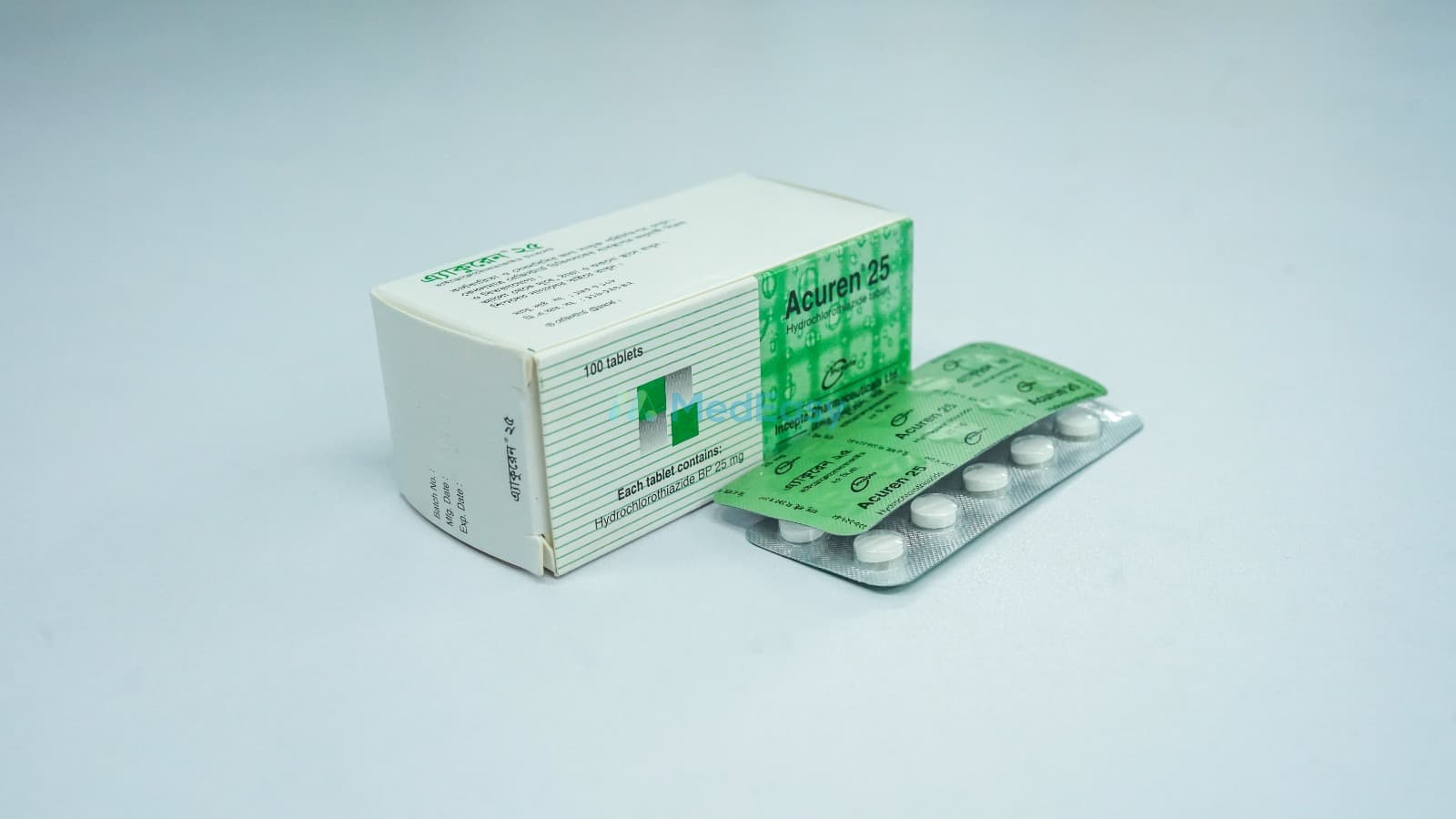
Edema associated with congestive heart failure, hepatic cirrhosis, premenstrual tension and oedema due to various forms of renal dysfunction (i.e. nephrotic syndrome, acute glomerulonephritis, chronic renal failure). Hypertension, either alone or as an adjunct to other antihypertensive drugs.
Theropeutic Class
Thiazide diuretics & related drugs
Pharmacology
Thiazides such as Acuren 25 mg promote water loss from the body (diuretics). They inhibit Na+/Cl- reabsorption from the distal convoluted tubules in the kidneys. Thiazides also cause loss of potassium and an increase in serum uric acid. Thiazides are often used to treat hypertension, but their hypotensive effects are not necessarily due to their diuretic activity. Thiazides have been shown to prevent hypertension-related morbidity and mortality although the mechanism is not fully understood. Thiazides cause vasodilation by activating calcium-activated potassium channels (large conductance) in vascular smooth muscles and inhibiting various carbonic anhydrases in vascular tissue.
Dosage & Administration of Acuren 25 mg
Adults-
For Edema: The usual adult dosage is 25 to 100 mg daily as a single or divided dose.For Control of Hypertension: The usual initial dose in adults is 25 mg daily given as a single dose. The dose may be increased to 50 mg daily, given as a single or two divided doses. Doses above 50 mg are often associated with marked reductions in serum potassium. In some patients (especially the elderly) an initial dose of 12.5 mg daily may be sufficient.
Infants and children-
For diuresis and for control of hypertension: The usual pediatric dosage is 1 to 2 mg/kg/day in single or two divided doses, not to exceed 37.5 mg per day in infants up to 2 years of age or 100 mg per day in children 2 to 12 years of age. In infants less than 6 months of age, doses up to 3 mg/kg/day in two divided doses may be required.
Dosage of Acuren 25 mg
Edema: initially 25 to 50 mg daily, reduced for maintenance if possible; maximum 100 mg daily.Hypertension: 25 mg daily, increased to 50 mg daily if necessary.Elderly: in some patients, especially the elderly an initial dose of 12.5 mg daily may be sufficient.Children: An initial dose for children has been 1 to 2 mg per kg body-weight in 2 divided doses. Infants under 6 months may need doses up to 3 mg per kg daily.
Interaction of Acuren 25 mg
Alcohol, barbiturates or narcotics: Co-administration may potentiate orthostatic hypotension. Oral and parenteral antidiabetic drugs may require adjustment of dosage with concurrent use. Other antihypertensive drugs may have an additive effect. Discontinuation of diuretic therapy 2-3 days before the initiation of treatment with an ACE inhibitor may reduce the likelihood of first-dose hypotension. The antihypertensive effect of the drug may be enhanced in the post-sympathectomy patient.Cholestyramine and colestipol resin: Absorption of Acuren 25 mg is impaired in the presence of anionic exchange resin. Single doses of either cholestyramine or colestipol resins bind the Acuren 25 mg and reduce its absorption from the gastrointestinal tract by up to 85% and 43%, respectively. Corticosteroids or ACTH may intensify any Thiazide-induced electrolyte depletion, particularly hypokalaemia. Pressor amines such as adrenaline may show decreased arterial responsiveness when used with Acuren 25 mg, but this reaction is not enough to preclude their therapeutic usefulness. Non-depolarising muscle relaxants such as tubocurarine may possibly interact with Acuren 25 mg to increase muscle relaxation. Non-steroidal anti-inflammatory drugs may attenuate the diuretic and antihypertensive effects of diuretics.Drug/laboratory tests: Because thiazides may affect calcium metabolism, Acuren 25 mg may interfere with tests for parathyroid function.
Contraindications
Anuria, hypersensitivity to Acuren 25 mg or to other sulphonamide-derived drugs, severe renal or hepatic failure, Addison’s disease, hypercalcemia, concurrent lithium therapy.
Side Effects of Acuren 25 mg
Gastro-intestinal system: Anorexia, gastric irritation, nausea, vomiting, cramps, diarrhoea, constipation, jaundice (intrahepatic cholestatic jaundice), pancreatitis, salivary gland inflammation. Central nervous system: Dizziness, vertigo, paraesthesiae, headache, yellow vision.Heamatological: Leucopenia, agranulocytosis, thrombocytopenia, aplastic anaemia, haemolytic anaemia.Cardiovascular: Hypotension, including orthostatic hypotension.Hypersensitivity: Purpura, photosensitivity, rash, urticaria, necrotising angiitis (vasculitis, cutaneous vasculitis), fever, respiratiory distress including pneumonitis and pulmonary oedema, anaphylactic reactions, toxic epidermal necrolysis.Metabolic: Hyperglycaemia, glycosuria, hyperuricaema, electrolyte imbalance including hyponatraemia and hypokalaemia.Renal: Renal dysfunction, interstitial nephritis, renal failure.Other: Muscle spasm, weakness, restlessness, transient blurred vision, impotence. Whenever side-effects are moderate to severe, thiazide dosage should be reduced or therapy was withdrawn.
Pregnancy & Lactation
Pregnancy: Evidence of fetal risk in Acuren 25 mg therapy is found, but it is indicated if benefits outweigh risks. Thiazides are indicated in pregnancy when edema is due to pathologic causes.Lactation: Neonatal side effects have been seen incase of Acuren 25 mg therapy and therefore it is not recommended.
Precautions & Warnings
Patients should be carefully monitored for signs of fluid and electrolyte imbalance (hyponatraemia, hypochloraemic alkalosis, hypokalaemia and hypomagnesaemia). It is particularly important to make serum and urine electrolyte determinations when the patient is vomiting excessively or receiving parenteral fluids. Warning signs or symptoms of fluid and electrolyte imbalance include: dryness of mouth, thirst, weakness, lethargy, drowsiness, restlessness, seizures, confusion, muscle pains or cramps, muscle fatigue, hypotension, oliguria, tachycardia, and gastro-intestinal disturbances such as nausea and vomiting. Hypokalaemia may develop, especially with brisk diuresis, when severe cirrhosis is present, or after prolonged therapy. Hypokalaemia can sensitise or exaggerate the response of the heart to the toxic effects of digitalis (e.g. increased ventricular irritability). Sensitivity reactions may occur in patients with or without history of allergy or bronchial asthma. Hypokalaemia may be avoided or treated in the adult by concurrent use of amiloride hydrochloride, a potassium conserving agent. It may also be avoided by giving potassium chloride or foods with a high potassium content. Diuretic-induced hyponatraemia is usually mild and asymptomatic. Dilutional hyponatraemia may occur in oedematous patients in hot weather; and, except in rare instances when hyponatraemia is life-threatening, appropriate therapy is water restriction rather than administration of salt. Thiazides may decrease serum protein bound iodine levels without signs of thyroid disturbances. Thiazides may decrease urinary calcium excretion, and may also cause intermittent and slight elevation of serum calcium in the absence of known disorders of calcium metabolism. Thiazides should be discontinued before carrying out tests for parathyroid function. When creatinine clearance falls below 30ml/min, thiazide diuretics become ineffective. Uraemia may be precipitated or increased by chlorothiazide. Cumulative effects of the drug may develop in patients with impaired renal function. If increasing uraemia and oliguria occur during treatment of renal disease, Acuren 25 mg should be discontinued. Thiazides should be used with caution in patients with impaired hepatic function or progressive liver disease, since minor alterations of fluid and electrolyte balance may precipitate hepatic coma. Hyperuricaemia may occur, or gout may be precipitated, in certain patients receiving thiazide therapy. Thaizide therapy may impair glucose tolerance. Increases in cholesterol and triglyceride levels may be associated with thiazide diuretic therapy. The possibility of exacerbation or activation of systemic lupus erythematosus has been reported. Latent diabetes may become manifest during thiazide administration.
Overdose Effects of Acuren 25 mg
The most common signs and symptoms observed are those caused by electrolyte depletion (hypokalaemia, hypochloraemia, hyponatraemia) and dehydration resulting from excessive diuresis. If digitalis has also been administered, hypokalaemia may accentuate cardiac arrhythmias. In the event of overdosage, symptomatic and supportive measures should be employed. If ingestion is recent, emesis should be induced or gastric lavage performed. Dehydration, electrolyte imbalance, hepatic coma and hypotension should be corrected by established methods. If required, give oxygen or artificial respiration for respiratory impairment.
Storage Conditions
Keep below 30°C temperature, away from light & moisture. Keep out of the reach of children.
Use In Special Populations
Elderly: in some patients specially the elderly an initial dose of 12.5 mg daily may be sufficient.Children: An initial dose for children has been 1 to 2 mg per kg body-weight in 2 divided doses. Infants under 6 months may need doses upto 3 mg per kg daily.
Drug Classes
Thiazide diuretics & related drugs
Mode Of Action
Thiazides such as Acuren 25 mg promote water loss from the body (diuretics). They inhibit Na+/Cl- reabsorption from the distal convoluted tubules in the kidneys. Thiazides also cause loss of potassium and an increase in serum uric acid. Thiazides are often used to treat hypertension, but their hypotensive effects are not necessarily due to their diuretic activity. Thiazides have been shown to prevent hypertension-related morbidity and mortality although the mechanism is not fully understood. Thiazides cause vasodilation by activating calcium-activated potassium channels (large conductance) in vascular smooth muscles and inhibiting various carbonic anhydrases in vascular tissue.
Pregnancy
Use in pregnancy: Thiazides cross the placental barrier and appear in cord blood. The use of Acuren 25 mg when pregnancy is present or suspected requires, therefore, that the benefits of the drug be weighed against possible hazards to the fetus. These hazards include fetal or neonatal jaundice, thrombocytopenia, and possibly other adverse reactions, which have occurred in the adult. The routine use of diuretics in otherwise healthy pregnant women with or without mild oedema is not recommended, because their use may be associated with hypovolaemia, increased blood viscosity and decreased placental perfusion.Use in breastfeeding mothers: Thiazides appear in breast milk. If use of the drug is deemed essential, the patient should stop breast-feeding.
Frequently Asked Questions
What is Acuren 25 mg used for?
Edema associated with congestive heart failure, hepatic cirrhosis, premenstrual tension and oedema due to various forms of renal dysfunction (i.e. nephrotic syndrome, acute glomerulonephritis, chronic renal failure). Hypertension, either alone or as an adjunct to other antihypertensive drugs.
What is the dosage of Acuren 25 mg?
Edema: initially 25 to 50 mg daily, reduced for maintenance if possible; maximum 100 mg daily.Hypertension: 25 mg daily, increased to 50 mg daily if necessary.Elderly: in some patients, especially the elderly an initial dose of 12.5 mg daily may be sufficient.Children: An initial dose for children has been 1 to 2 mg per kg body-weight in 2 divided doses. Infants under 6 months may need doses up to…
Anuria, hypersensitivity to Acuren 25 mg or to other sulphonamide-derived drugs, severe renal or hepatic failure, Addison’s disease, hypercalcemia, concurrent lithium therapy.
What precautions should be taken with Acuren 25 mg?
Patients should be carefully monitored for signs of fluid and electrolyte imbalance (hyponatraemia, hypochloraemic alkalosis, hypokalaemia and hypomagnesaemia). It is particularly important to make serum and urine electrolyte determinations when the patient is vomiting excessively or receiving parenteral fluids. Warning signs or symptoms of fluid and electrolyte imbalance include: dryness of mouth…
Is Acuren 25 mg safe during pregnancy and breastfeeding?
Pregnancy: Evidence of fetal risk in Acuren 25 mg therapy is found, but it is indicated if benefits outweigh risks. Thiazides are indicated in pregnancy when edema is due to pathologic causes.Lactation: Neonatal side effects have been seen incase of Acuren 25 mg therapy and therefore it is not recommended.
Disclaimer
The information provided is accurate to our best practices, but it does not replace professional medical advice. We cannot guarantee its completeness or accuracy. The absence of specific information about a drug should not be seen as an endorsement. We are not responsible for any consequences resulting from this information, so consult a healthcare professional for any concerns or questions.