
Key facts
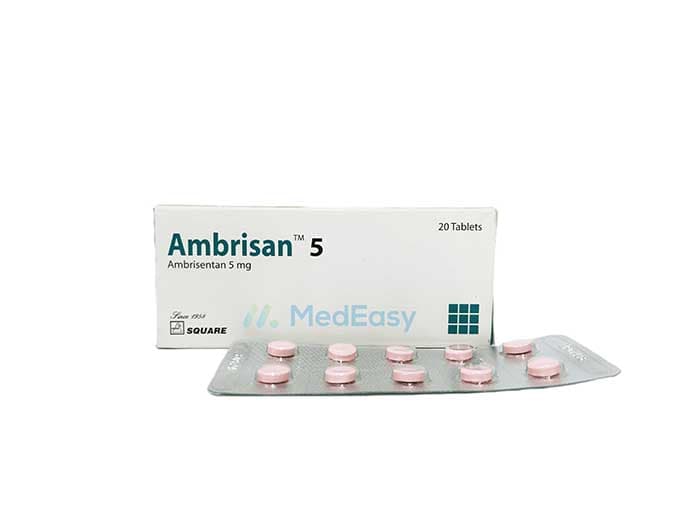
Ambrisan 5 mg Tablet is available on MedEasy for ৳368.92 per 10's Strip, with home delivery anywhere in Bangladesh. It is manufactured by Square Pharmaceuticals PLC. Its generic name is Ambrisentan.
- Pack sizes
- 10's Strip, 20's pack
- Prescription
- Required. Upload a valid doctor's prescription at checkout; a MedEasy pharmacist verifies it before dispatch.
- Delivery
- Home delivery across Bangladesh. Same-day delivery in Dhaka, Chattogram, Sylhet and Bogura city areas; 2-3 days elsewhere.
- Payment
- Cash on delivery, bKash, cards and mobile banking.
- Brand
- Ambrisan
- Generic name
- Ambrisentan
- Manufacturer
- Square Pharmaceuticals PLC.
- Form & strength
- Tablet 5 mg
- Availability
- In stock
- Authenticity
- Sourced from licensed suppliers and the manufacturer's authorised distributors in Bangladesh.

Medicine overview
Indications of Ambrisan
Ambrisan is indicated for the treatment of pulmonary arterial hypertension (PAH, WHO Group I) to improve exercise capacity and delay clinical worsening. Indications below are classified by strength of evidence.
Established / Approved Use
- Treatment of PAH in adults, including idiopathic and heritable PAH and PAH associated with connective tissue disease, to improve exercise capacity and delay clinical worsening.
Guideline-Supported Combination Therapy
- Ambrisan combined with a phosphodiesterase-5 (PDE5) inhibitor such as tadalafil is supported by clinical trial evidence for reducing the risk of clinical failure events and is recommended for appropriate patients in pulmonary hypertension treatment guidelines.
Not Indicated / Off-Label Caution
- Ambrisan is not indicated for, and is contraindicated in, pulmonary hypertension associated with idiopathic pulmonary fibrosis (see Contraindications).
- Use for other forms of pulmonary hypertension (WHO Groups II–V) is not supported by evidence and is not recommended outside specialist evaluation.
Composition
Each film-coated tablet contains Ambrisentan 5 mg or 10 mg as the active pharmaceutical ingredient, together with pharmaceutically acceptable excipients.
Description
Ambrisan is an orally administered, propanoic-acid class endothelin receptor antagonist (ERA) that is selective for the endothelin type A (ETA) receptor. It is used in the long-term management of pulmonary arterial hypertension (PAH) and is supplied as film-coated tablets for once-daily oral use.
Therapeutic Class
Ambrisan belongs to the therapeutic class of Endothelin Receptor Antagonists (ERAs), a group of pulmonary vasodilators used specifically in the management of pulmonary arterial hypertension.
Pharmacology
Ambrisentan selectively blocks the endothelin type A (ETA) receptor on vascular smooth muscle, inhibiting the vasoconstrictive and proliferative effects of endothelin-1 and thereby reducing pulmonary vascular resistance in patients with PAH.
Pharmacokinetics
- Protein binding: approximately 99%
- Metabolism: primarily glucuronidation and oxidative pathways
- Elimination half-life: approximately 15 hours
- Excretion: predominantly via bile/feces
Dosage & Administration of Ambrisan
Dosage of Ambrisan should be individualized and initiated only by physicians experienced in the management of pulmonary arterial hypertension.
| Indication | Population | Recommended Dose |
|---|---|---|
| Pulmonary arterial hypertension (monotherapy or in combination with a PDE5 inhibitor) | Adults | Initiate at 5 mg orally once daily; may be increased to 10 mg once daily if the lower dose is tolerated |
| Pulmonary arterial hypertension | Pediatric patients | Safety and efficacy not established; not recommended |
| Concomitant cyclosporine use | Adults | Limit Ambrisan to 5 mg once daily |
Hepatic Impairment
Not recommended in moderate-to-severe hepatic impairment or with clinically significant elevations in liver aminotransferases; use with caution and close monitoring in mild hepatic impairment.
Renal Impairment
No dose adjustment is generally required in mild-to-moderate renal impairment; data in severe renal impairment are limited, so use with caution.
Administration of Ambrisan
Ambrisan tablets should be swallowed whole with or without food, at approximately the same time each day. Tablets should not be split, crushed, or chewed.
Interaction of Ambrisan
Clinically significant interactions with Ambrisan include:
- Cyclosporine: Increases Ambrisan plasma exposure; limit dose to 5 mg once daily and monitor closely.
- Rifampin: May transiently increase Ambrisan exposure when therapy is initiated together; monitor closely during the first weeks of co-administration.
- Other PAH therapies (e.g., PDE5 inhibitors such as tadalafil or sildenafil): Deliberate combination use is supported by clinical evidence, but patients should be monitored for additive hypotension and fluid-related effects.
- Hormonal contraceptives: Because Ambrisan is contraindicated in pregnancy, use of a reliable non-hormonal or combined contraceptive method is advised.
Contraindications
Ambrisentan is contraindicated in:
- Pregnancy — boxed warning for embryo-fetal toxicity (see Pregnancy and Lactation).
- Idiopathic pulmonary fibrosis (IPF), including IPF with pulmonary hypertension, based on trial evidence of increased disease progression and hospitalization.
- Known hypersensitivity to Ambrisentan or any component of the formulation.
Side Effects of Ambrisan
Side effects reported with Ambrisan:
Common
- Peripheral edema/fluid retention
- Headache
- Flushing
- Nasal congestion, sinusitis, rhinitis
- Palpitations
- Dizziness
- Constipation
Less Common but Clinically Important
- Decreased hemoglobin/anemia (see Precautions)
- Liver enzyme elevation/hepatic injury (see Precautions)
- Decreased sperm count (see Precautions)
- Pulmonary edema in patients with underlying pulmonary veno-occlusive disease (see Precautions)
Pregnancy & Lactation
Ambrisan carries a boxed warning for embryo-fetal toxicity and is contraindicated in pregnancy; animal studies have shown teratogenic effects. Females of reproductive potential should have a negative pregnancy test before starting Ambrisan, use reliable contraception throughout treatment, and undergo monthly pregnancy testing per product labeling. If pregnancy occurs during treatment, Ambrisan should be stopped immediately and the prescribing physician contacted.
It is not known whether Ambrisan passes into breast milk. Because of the potential for serious adverse effects in a nursing infant, the decision to discontinue breastfeeding or discontinue the drug should be made with the physician, weighing the importance of treatment to the mother.
Precautions & Warnings
Ambrisan should be initiated and monitored only by a physician experienced in managing pulmonary arterial hypertension. Key precautions:
- Embryo-fetal toxicity: Boxed warning; see Contraindications and Pregnancy and Lactation.
- Hepatotoxicity: Liver injury has been reported with endothelin receptor antagonists as a class; periodic clinical assessment for signs/symptoms of liver injury (fatigue, nausea, jaundice, right upper-quadrant pain) is reasonable, with liver function testing if symptoms occur.
- Fluid retention/peripheral edema: Can occur, particularly in the first weeks of treatment; monitor closely in patients with underlying heart failure and manage (e.g., with diuretics) if significant.
- Decreased hemoglobin/anemia: Monitor hemoglobin/hematocrit, particularly early in treatment.
- Decreased sperm count: Reported with endothelin receptor antagonists as a class; counsel male patients on potential fertility effects.
- Pulmonary veno-occlusive disease (PVOD): If pulmonary edema develops after starting Ambrisan, evaluate for underlying PVOD before continuing therapy.
- Specialist management required: Given the need for pregnancy risk management and specialized monitoring, Ambrisan should not be initiated or managed in general-practice settings.
Overdose Effects of Ambrisan
Clinical experience with Ambrisan overdose is limited; based on its mechanism, overdose may be expected to cause hypotension. If overdose is suspected, seek immediate medical attention or contact emergency services/poison control. Management is supportive and symptomatic; there is no specific antidote, and hemodialysis is not expected to be effective due to high protein binding.
Storage Conditions
Store Ambrisan tablets at room temperature (below 30°C), away from light and moisture. Keep out of reach of children.
Use In Special Populations
Renal Impairment
No dosage adjustment generally required in mild-to-moderate impairment; data in severe impairment are limited, so use with caution.
Hepatic Impairment
Not recommended in moderate-to-severe hepatic impairment; use with caution and monitoring in mild impairment.
Elderly
No overall differences in safety/effectiveness observed in patients over 65 years, but caution is warranted given greater frequency of concomitant disease and other drug therapy.
Pediatric
Safety and efficacy of Ambrisan have not been established in pediatric patients.
Duration Of Treatment
Ambrisan is used as a long-term, ongoing therapy for pulmonary arterial hypertension; duration is determined by the treating specialist based on clinical response and tolerability. Treatment should not be stopped abruptly without medical advice, as discontinuation may be associated with worsening of PAH symptoms.
Drug Classes
Endothelin Receptor Antagonist (ERA) — propanoic-acid derivative class.
Mode Of Action
Ambrisentan selectively antagonizes the endothelin type A (ETA) receptor on vascular smooth muscle, blocking the vasoconstrictive and proliferative effects of endothelin-1, thereby reducing pulmonary vascular resistance and improving hemodynamics in PAH.
Pregnancy
X (contraindicated in pregnancy under the legacy FDA pregnancy category system)
Pediatric Uses
Safety and efficacy of Ambrisan have not been established in pediatric patients; use in children is not recommended outside specialized clinical settings.
Frequently Asked Questions
Q: What is Ambrisan 5 mg Tablet used for?
A: Ambrisan 5 mg Tablet is used to treat pulmonary arterial hypertension (PAH) in adults, improving exercise capacity and delaying clinical worsening of the disease.
Q: Can I take Ambrisan 5 mg Tablet during pregnancy?
A: No. Ambrisan 5 mg Tablet is contraindicated in pregnancy because it can cause serious birth defects. Women who can become pregnant must use effective contraception and have regular pregnancy tests while taking Ambrisan 5 mg Tablet.
Q: How should I take Ambrisan 5 mg Tablet?
A: Ambrisan 5 mg Tablet is taken by mouth once daily, with or without food, at the same time each day, usually starting at 5 mg and increased to 10 mg if tolerated.
Q: What are the most common side effects of Ambrisan 5 mg Tablet?
A: Common side effects include swelling of the legs/ankles, headache, flushing, nasal congestion, and dizziness. Contact your doctor if these are severe or persistent.
Q: Do I need any tests while taking Ambrisan 5 mg Tablet?
A: Yes. Your doctor may monitor blood counts (for anemia), liver function, and, for patients who can become pregnant, monthly pregnancy tests while on Ambrisan 5 mg Tablet.
Q: Can I stop Ambrisan 5 mg Tablet suddenly?
A: Do not stop Ambrisan 5 mg Tablet without consulting your physician, as sudden discontinuation may worsen pulmonary arterial hypertension symptoms.
Disclaimer
The information provided is accurate to the best of our knowledge, but it does not replace professional medical advice. We cannot guarantee its completeness or accuracy, and the absence of specific information about a drug should not be taken as an endorsement. We are not responsible for any consequences arising from this information, so please consult a healthcare professional for any concerns or questions.