
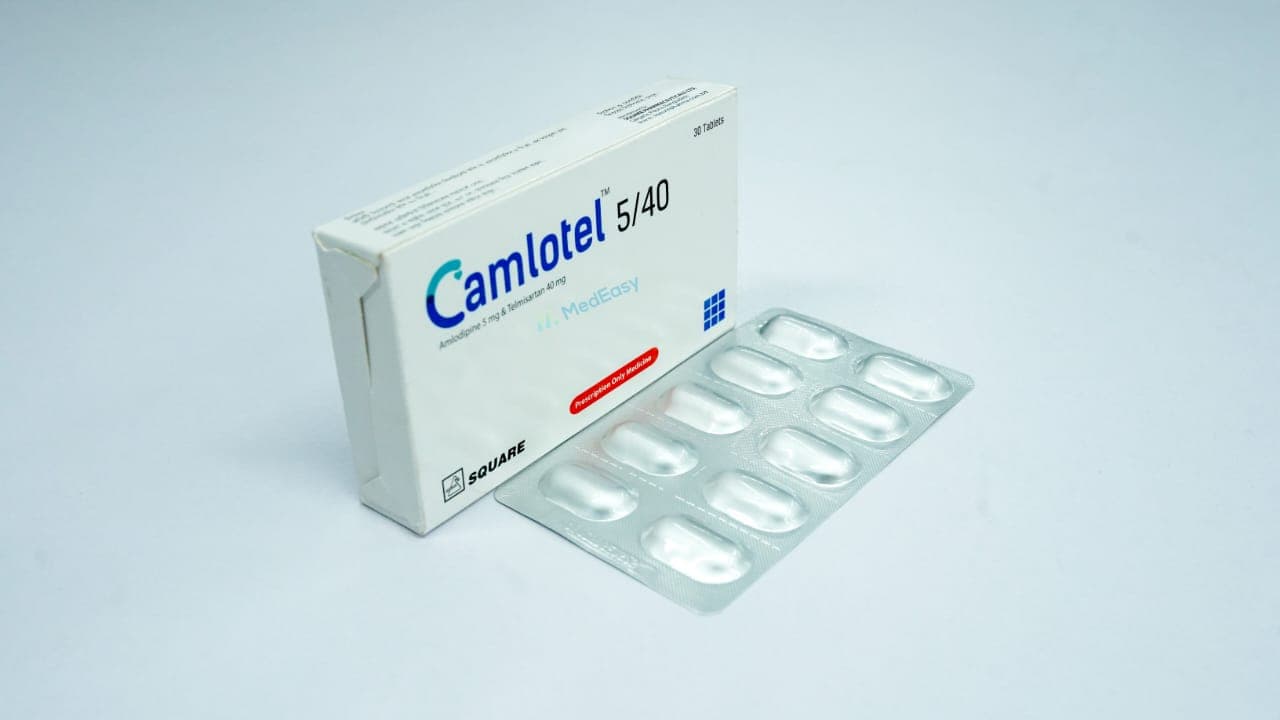

Medicine overview
Indications of Camlotel
Approved Indications
Camlotel is a fixed-dose combination of a calcium channel blocker (amlodipine) and an angiotensin II receptor blocker (telmisartan) that is indicated for the treatment of hypertension, either as:
- Initial therapy in patients whose blood pressure is likely to need multiple drugs to reach their blood pressure goal.
- Add-on/substitution therapy in patients who are not adequately controlled on amlodipine or telmisartan monotherapy alone.
Camlotel is not indicated as initial therapy for patients whose blood pressure may be controlled adequately with a single antihypertensive agent. Lowering blood pressure with Camlotel reduces the risk of fatal and non-fatal cardiovascular events, primarily strokes and myocardial infarctions.
Camlotel is not indicated for the initial management of hypertensive emergencies.
Composition
Amlodipine + Telmisartan tablets contain a fixed-dose combination of two active ingredients:
- Amlodipine (as amlodipine besylate) — a dihydropyridine calcium channel blocker.
- Telmisartan — an angiotensin II receptor blocker (ARB).
Amlodipine + Telmisartan is typically available in strength combinations such as 40/5 mg, 40/10 mg, 80/5 mg, and 80/10 mg (telmisartan/amlodipine), along with standard pharmaceutical excipients.
Description
Camlotel is an oral, once-daily, fixed-dose combination antihypertensive medicine that pairs a calcium channel blocker with an angiotensin II receptor blocker. Combining two agents with complementary mechanisms allows more patients to reach their blood pressure targets than either component alone, while generally causing less peripheral edema than amlodipine used by itself, because telmisartan's vasodilating effect on the venous side offsets amlodipine's arteriolar dilation.
Camlotel is intended for long-term, once-daily use in adults with hypertension, under the supervision of a physician.
Therapeutic Class
Camlotel belongs to the therapeutic class of antihypertensive combinations, specifically a Calcium Channel Blocker (dihydropyridine) + Angiotensin II Receptor Blocker (ARB) combination.
Pharmacology
Pharmacodynamics
Amlodipine + Telmisartan combines two complementary antihypertensive mechanisms:
- Amlodipine inhibits the transmembrane influx of calcium ions into vascular smooth muscle and cardiac muscle. It relaxes vascular smooth muscle, producing arteriolar vasodilation and a reduction in peripheral vascular resistance and blood pressure.
- Telmisartan selectively blocks the binding of angiotensin II to the AT1 receptor in vascular smooth muscle, blocking the vasoconstrictive and aldosterone-secreting effects of angiotensin II, which lowers blood pressure.
Pharmacokinetics
Amlodipine is slowly absorbed, with peak plasma concentrations reached in 6–12 hours and an elimination half-life of about 30–50 hours, allowing once-daily dosing. It is extensively metabolized in the liver. Telmisartan is rapidly absorbed, undergoes minimal hepatic metabolism, is eliminated almost entirely via biliary/faecal excretion, and has a long elimination half-life (over 20 hours). Co-administration in Amlodipine + Telmisartan does not significantly alter the individual pharmacokinetics of either component.
Dosage & Administration of Camlotel
Available Strengths
Camlotel tablets are typically supplied in the following telmisartan/amlodipine strength combinations: 40/5 mg, 40/10 mg, 80/5 mg, and 80/10 mg.
Dosing for Hypertension (Adults)
| Clinical situation | Recommended dose |
|---|---|
| Usual starting dose | Telmisartan/amlodipine 40 mg/5 mg once daily |
| Patients needing a larger initial reduction | 80 mg/5 mg once daily |
| Titration | Dose may be increased after at least 2 weeks, up to a maximum of 80 mg/10 mg once daily, based on blood pressure response |
| Patients switching from monotherapy | May be switched directly to a combination tablet containing an appropriate dose of the other component |
Most of the antihypertensive effect is generally seen within 2 weeks of starting or adjusting the dose.
Elderly (≥75 years) and Hepatic Impairment
Camlotel is not recommended for initial therapy in patients ≥75 years of age or in those with hepatic impairment; amlodipine 2.5 mg should be used as a starting dose in these patients, with slow titration.
Renal Impairment
No initial dosage adjustment of Camlotel is required in mild-to-moderate renal impairment; slower titration is advised in patients with severe renal impairment.
Pediatric Dosing
Safety and effectiveness of Camlotel in patients under 18 years of age have not been established (see Pediatric Uses).
Administration of Camlotel
Camlotel tablets should be taken orally, once daily, at approximately the same time each day, with or without food. Tablets should be swallowed whole with a glass of water and should not be crushed or chewed unless directed by a physician. It is important not to miss doses; if a dose is missed, the next dose should be taken at the regular time without doubling up, unless a physician advises otherwise. Camlotel should be taken exactly as prescribed and not stopped abruptly without medical advice, as blood pressure may rebound.
Interaction of Camlotel
Clinically Significant Drug Interactions
| Interacting drug/class | Effect when used with Camlotel |
|---|---|
| Other antihypertensive agents / drugs that lower blood pressure | Additive blood pressure–lowering effect; risk of symptomatic hypotension |
| NSAIDs (including selective COX-2 inhibitors) | May reduce the antihypertensive effect of Camlotel and increase the risk of renal impairment, particularly in volume-depleted or elderly patients |
| Potassium-sparing diuretics, potassium supplements, or potassium-containing salt substitutes | Increased risk of hyperkalemia due to the telmisartan component |
| Lithium | Reversible increases in serum lithium concentrations and toxicity; monitor lithium levels closely |
| Digoxin | Telmisartan can increase peak and trough digoxin concentrations; monitor digoxin levels |
| Strong CYP3A4 inhibitors (e.g., ketoconazole, itraconazole, ritonavir, diltiazem) | May increase amlodipine plasma concentrations, raising the risk of hypotension and edema |
| Strong CYP3A4 inducers (e.g., rifampin, carbamazepine) | May reduce amlodipine plasma concentrations and reduce antihypertensive effect |
| Simvastatin | Amlodipine increases simvastatin exposure; limit simvastatin to 20 mg daily when co-administered |
| Cyclosporine or tacrolimus | Amlodipine may increase trough concentrations of these agents; monitor levels |
| ACE inhibitors or other angiotensin receptor blockers (dual RAS blockade) | Increased risk of hypotension, hyperkalemia, and renal dysfunction with no added cardiovascular benefit; combination generally not recommended |
| Aliskiren | Contraindicated in patients with diabetes; not recommended in patients with renal impairment (see Contraindications) |
This list is not exhaustive. Patients should inform their physician or pharmacist about all prescription, over-the-counter, and herbal products being used before starting Camlotel.
Contraindications
Contraindications
- Known hypersensitivity to amlodipine, telmisartan, dihydropyridine calcium channel blockers, or any component of Amlodipine + Telmisartan.
- Pregnancy. Amlodipine + Telmisartan can cause injury and death to the developing fetus when used during pregnancy (see Pregnancy and Lactation); it must not be used in patients who are pregnant.
- Concomitant use with aliskiren in patients with diabetes mellitus — this combination is contraindicated due to an increased risk of hyperkalemia, hypotension, and renal impairment.
Side Effects of Camlotel
Common Side Effects
- Peripheral (ankle/leg) edema
- Dizziness
- Headache
- Flushing
- Fatigue
- Back pain
- Upper respiratory tract infection symptoms
Less Common but Clinically Important Effects
- Symptomatic hypotension
- Hyperkalemia (elevated blood potassium)
- Palpitations
Rare but Serious Effects
- Angioedema (swelling of the face, lips, tongue, or throat) — rare but potentially life-threatening; requires immediate medical attention
- Rhabdomyolysis
- Significant liver enzyme abnormalities/hepatic dysfunction
- Worsening angina or myocardial infarction, particularly after starting or increasing the dose in patients with severe obstructive coronary artery disease
Patients should seek prompt medical attention for swelling of the face/throat, difficulty breathing, severe dizziness/fainting, chest pain, or irregular heartbeat while taking Camlotel.
Pregnancy & Lactation
Pregnancy
Camlotel is contraindicated in pregnancy. Drugs that act directly on the renin-angiotensin system, such as the telmisartan component of Camlotel, can cause injury and death to the developing fetus, including oligohydramnios, fetal renal impairment, skeletal deformations, and death, when used during the second and third trimesters (and possibly the first trimester). If pregnancy is detected while taking Camlotel, it should be discontinued as soon as possible and the patient should contact her physician immediately to discuss alternative antihypertensive therapy. Women of childbearing potential should be counselled about this risk before starting Camlotel.
Lactation
It is not known whether the components of Camlotel pass into human breast milk. Because of the potential for serious adverse effects (including hypotension, hyperkalemia, and renal impairment) in a nursing infant, breastfeeding is generally not recommended while taking Camlotel; a physician should be consulted to weigh the benefits of breastfeeding against the potential risk, and to discuss alternative therapy if needed.
Precautions & Warnings
Fetal Toxicity Warning
Camlotel can cause fetal harm when administered during pregnancy. See Pregnancy and Lactation for full details; discontinue Camlotel as soon as pregnancy is detected.
Hypotension
Symptomatic hypotension may occur, particularly in patients who are volume- or salt-depleted (e.g., from diuretic therapy, dietary salt restriction, vomiting, or diarrhea). Correct volume depletion before starting Camlotel, or begin treatment under close medical supervision.
Hyperkalemia
The telmisartan component can cause hyperkalemia, especially in patients with renal impairment, diabetes, or heart failure, or in those taking potassium supplements, potassium-sparing diuretics, or salt substitutes containing potassium. Periodic monitoring of serum potassium is advised in at-risk patients.
Renal and Hepatic Impairment
Use with caution and titrate slowly in patients with renal or hepatic impairment; dose adjustment may be required (see Dosage and Administration and Use in Special Populations).
Dual Blockade of the Renin-Angiotensin System
Avoid combining Camlotel with an ACE inhibitor or another ARB, as this increases the risk of hypotension, hyperkalemia, and renal dysfunction without added cardiovascular benefit.
Ischemic Heart Disease
As with other calcium channel blockers, worsening angina or acute myocardial infarction can rarely occur after starting Camlotel or increasing its dose, particularly in patients with severe obstructive coronary artery disease.
Heart Failure
Use Camlotel with caution in patients with heart failure; the amlodipine component has been associated with increased reports of pulmonary edema in some patients with severe heart failure.
Camlotel should be used only under medical supervision, with regular blood pressure and, where indicated, renal function/electrolyte monitoring.
Overdose Effects of Camlotel
Overdose of Camlotel may cause marked hypotension, dizziness, tachycardia (from amlodipine), or bradycardia, with the possibility of shock and death. If overdose of Camlotel is suspected, seek immediate medical attention or contact emergency services/poison control right away. Do not attempt to manage a suspected overdose at home. Treatment is generally supportive, with monitoring of cardiac and respiratory function, blood pressure, and fluid/electrolyte status in a medical facility; because the components are highly protein-bound, hemodialysis is unlikely to be of significant benefit. Keep Camlotel out of reach of children to prevent accidental ingestion.
Storage Conditions
Store at room temperature (below 30°C), away from light and moisture. Keep out of reach of children.
Use In Special Populations
Elderly (≥65 years, especially ≥75 years)
Camlotel is not recommended as initial therapy in patients ≥75 years of age; treatment is typically started with amlodipine alone at a low dose (2.5 mg) due to reduced clearance and increased drug exposure in this age group, with slow titration to combination therapy as needed.
Renal Impairment
No initial dose adjustment is generally needed in mild-to-moderate renal impairment; slower titration and monitoring of renal function and potassium are advised in severe renal impairment.
Hepatic Impairment
Camlotel is not recommended as initial therapy in patients with hepatic impairment; treatment is typically started with a low dose of amlodipine alone, with careful titration.
Pediatric Use
The safety and effectiveness of Camlotel in pediatric patients have not been established (see Pediatric Uses).
Duration Of Treatment
Camlotel is generally intended for long-term, ongoing use as maintenance therapy for hypertension, since high blood pressure is a chronic condition requiring continuous control. Duration of treatment should be determined by the prescribing physician based on blood pressure response, tolerability, and overall cardiovascular risk; Camlotel should not be stopped abruptly without medical advice.
Drug Classes
Calcium Channel Blocker (dihydropyridine) + Angiotensin II Receptor Blocker (ARB) — fixed-dose antihypertensive combination
Mode Of Action
Amlodipine + Telmisartan lowers blood pressure through two complementary mechanisms acting on different points of vascular tone regulation:
- Amlodipine blocks L-type calcium channels in vascular smooth muscle, reducing calcium influx, which relaxes arteriolar smooth muscle and decreases peripheral vascular resistance.
- Telmisartan selectively and competitively blocks the AT1 receptor for angiotensin II, preventing angiotensin II–mediated vasoconstriction and aldosterone release, which lowers blood pressure and reduces sodium/water retention.
Because amlodipine primarily dilates arterioles while telmisartan reduces angiotensin II activity on both arterial and venous tone, the combination in Amlodipine + Telmisartan produces a more balanced blood pressure reduction and tends to reduce the peripheral edema commonly seen with amlodipine monotherapy.
Pregnancy
X
Pediatric Uses
The safety and effectiveness of Camlotel in patients under 18 years of age have not been established. Camlotel is therefore not recommended for use in children or adolescents. If antihypertensive therapy is required in a pediatric patient, this should be managed by a specialist physician using agents and doses with an established pediatric safety profile.
Frequently Asked Questions
Q: What is Camlotel 5mg +40 mg Tablet used for?
A: Camlotel 5mg +40 mg Tablet is a combination medicine used to treat high blood pressure (hypertension), either as an initial treatment in patients likely to need more than one blood pressure medicine, or when blood pressure is not adequately controlled with a single agent.
Q: Can I take Camlotel 5mg +40 mg Tablet if I am pregnant or planning to become pregnant?
A: No. Camlotel 5mg +40 mg Tablet is contraindicated in pregnancy because it can cause serious injury or death to the developing fetus. If you become pregnant while taking Camlotel 5mg +40 mg Tablet, stop the medicine and contact your physician immediately so you can be switched to a pregnancy-appropriate alternative.
Q: How should I take Camlotel 5mg +40 mg Tablet?
A: Take Camlotel 5mg +40 mg Tablet by mouth once daily, at about the same time each day, with or without food, and swallow the tablet whole with water. Do not stop taking it suddenly without talking to your doctor, even if you feel well, since high blood pressure often has no symptoms.
Q: What are the most common side effects of Camlotel 5mg +40 mg Tablet?
A: The most common side effects are swelling of the ankles or legs (peripheral edema), dizziness, headache, flushing, and back pain. Most are mild, but you should seek urgent medical care if you notice facial or throat swelling, severe dizziness, fainting, or chest pain.
Q: Can I take Camlotel 5mg +40 mg Tablet with other blood pressure medicines, NSAIDs, or potassium supplements?
A: Camlotel 5mg +40 mg Tablet can interact with other antihypertensives (added blood-pressure-lowering effect), NSAIDs like ibuprofen (reduced effect and possible kidney strain), and potassium supplements or potassium-sparing diuretics (risk of high blood potassium). Always tell your doctor and pharmacist about every medicine and supplement you take before and during treatment with Camlotel 5mg +40 mg Tablet.
Q: Is Camlotel 5mg +40 mg Tablet safe for elderly patients or those with liver or kidney problems?
A: Camlotel 5mg +40 mg Tablet should generally not be used as a starting treatment in patients 75 years or older or in those with liver problems; treatment is usually started with a low dose of one component alone and increased slowly. Patients with severe kidney impairment also need slower dose increases and monitoring. Your doctor will individualize your dose based on your health status.
Disclaimer
The information provided is accurate to the best of our knowledge, but it does not replace professional medical advice. We cannot guarantee its completeness or accuracy, and the absence of specific information about a drug should not be taken as an endorsement. We are not responsible for any consequences arising from this information, so please consult a healthcare professional for any concerns or questions.
