
8% Off
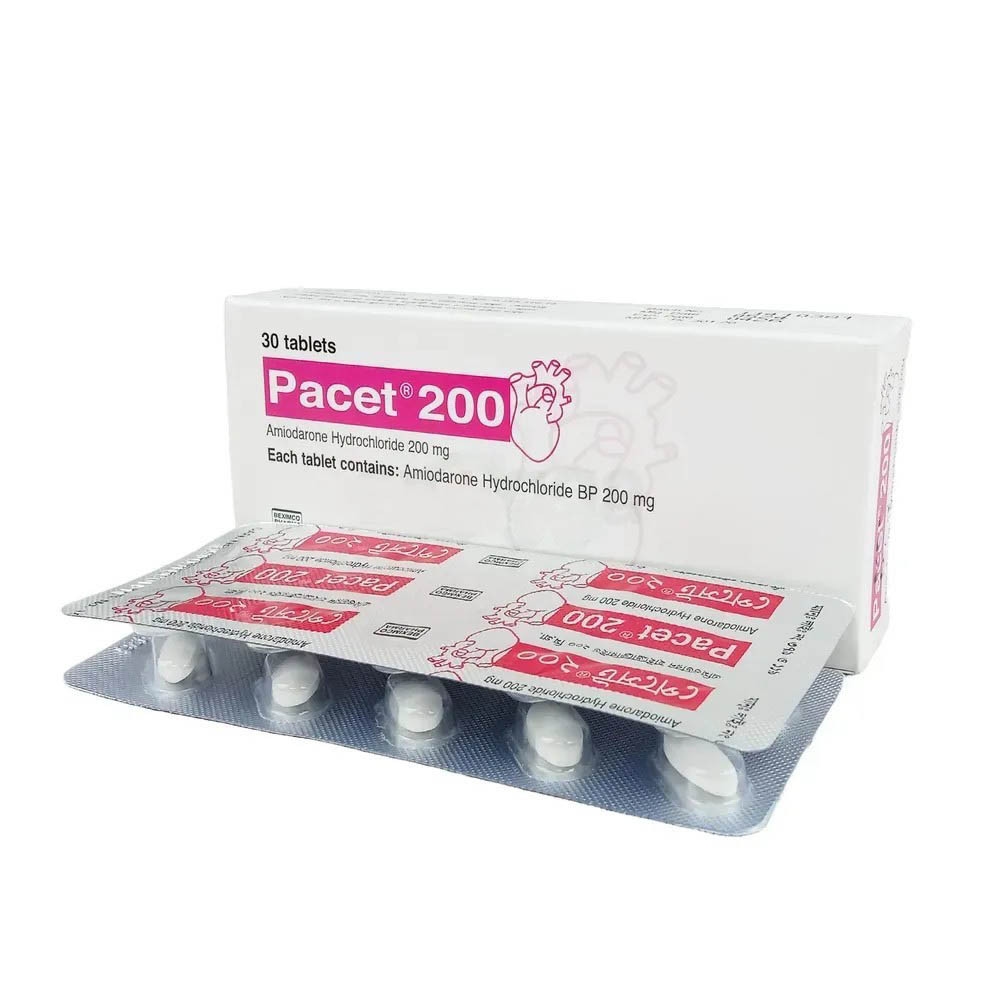
Pacet200 mg
Beximco Pharmaceuticals Ltd.
৳92.41
Add to cart


Cardiron is a Class III antiarrhythmic agent with a well-defined, evidence-graded set of uses:
Because of its extensive toxicity profile, Cardiron is generally reserved for serious, life-threatening arrhythmias rather than used as a first-line agent, and should be initiated and monitored by physicians experienced in treating such arrhythmias.
Each tablet of Amiodarone Hydrochloride typically contains 100 mg, 200 mg, or 400 mg of Amiodarone Hydrochloride USP as the active ingredient. An injectable form is also available, containing Amiodarone Hydrochloride 50 mg/mL for intravenous use, along with pharmaceutically acceptable excipients that vary by manufacturer.
Cardiron is a benzofuran derivative and a potent Class III antiarrhythmic drug used to treat and prevent certain types of serious, life-threatening irregular heartbeats (arrhythmias). It contains iodine as part of its molecular structure, which contributes both to its pharmacologic activity and to some of its characteristic adverse effects, particularly on thyroid function.
Cardiron is available as oral tablets for long-term maintenance therapy and as an intravenous solution for acute, in-hospital management of life-threatening ventricular arrhythmias. Due to its complex pharmacokinetics — including a very long elimination half-life — treatment with Cardiron requires careful dose titration and long-term clinical monitoring.
Cardiron belongs to the Class III antiarrhythmic drug category, though it also exhibits properties of Class I, II, and IV antiarrhythmic agents, making it a broad-spectrum antiarrhythmic.
Amiodarone Hydrochloride primarily blocks potassium channels, prolonging the cardiac action potential duration and the effective refractory period in atrial, nodal, and ventricular tissue (Class III effect). It also has additional actions:
Amiodarone Hydrochloride has slow, variable oral absorption (bioavailability approximately 35-65%), extensive tissue distribution (large volume of distribution due to high lipophilicity), and is metabolized in the liver via CYP3A4 and CYP2C8 to its active metabolite, desethylamiodarone. It has an exceptionally long and variable elimination half-life, ranging from approximately 25 to 110 days (average around 58 days), which explains both its delayed onset of full antiarrhythmic effect and the prolonged persistence of effects and interactions after discontinuation.
Dosing of Cardiron is individualized to the arrhythmia being treated and the patient's response, typically involving a loading phase followed by a lower maintenance dose because of its long half-life.
| Indication | Adult Dosing |
|---|---|
| Life-threatening ventricular arrhythmias (oral) | Loading: 800-1600 mg/day (in divided doses) for 1-3 weeks until initial response, then reduce to 600-800 mg/day for about 1 month; maintenance: lowest effective dose, often 400 mg/day (some patients maintained on 200 mg/day). |
| Life-threatening ventricular arrhythmias (intravenous, hospital setting) | Given as a loading infusion followed by step-down maintenance infusions per institutional/ACLS protocol, with continuous cardiac monitoring; total daily dose and infusion rate individualized. |
| Cardiac arrest with shockable rhythm (VF/pulseless VT) - ACLS use | Administered as an intravenous bolus per current ACLS protocol, with a repeat lower dose if the arrhythmia persists. |
| Atrial fibrillation (guideline-supported use) | Similar loading-then-maintenance oral strategy, individualized by the treating physician; lower maintenance doses (e.g., 100-200 mg/day) are often used long-term compared with ventricular arrhythmia dosing. |
Renal impairment does not typically require dose adjustment, as Cardiron is minimally renally eliminated. Hepatic impairment requires caution and closer monitoring, as Cardiron itself can be hepatotoxic. See Precautions and Warnings for mandatory baseline and periodic monitoring requirements.
Cardiron tablets may be taken with or without food, but should be taken consistently the same way (either always with food or always without) to minimize variability in absorption. Tablets should be swallowed whole; do not crush or chew unless directed by a physician.
The intravenous form of Cardiron must be administered only in a hospital or monitored setting equipped with continuous ECG and blood pressure monitoring, using an infusion pump and, when required, a central venous line for concentrations or durations exceeding peripheral-line limits, due to the risk of infusion-site reactions and hypotension.
Cardiron has numerous clinically significant drug interactions, in part because it inhibits CYP3A4, CYP2C9, CYP2D6, and P-glycoprotein, and because its very long half-life means interactions can persist for weeks after stopping the drug.
Given the breadth of interactions, any new medication should be reviewed by a physician or pharmacist before starting in a patient on Cardiron.
Amiodarone Hydrochloride is contraindicated in patients with:
Pregnancy: Cardiron can cause fetal harm, including fetal hypothyroidism, goiter, and developmental effects, based on its known pharmacology and reported human data. It should be used during pregnancy only if the potential benefit clearly justifies the potential risk to the fetus, and only when no safer alternative is appropriate. Use only under close physician supervision.
Lactation: Cardiron and its active metabolite are excreted into breast milk in substantial amounts, with a risk of infant thyroid dysfunction and other adverse effects. Breastfeeding is generally not recommended during Cardiron therapy; a physician should be consulted to weigh the risks and benefits and to consider alternatives.
Cardiron carries several boxed warnings and requires careful, ongoing monitoring:
Overdose of Cardiron may cause severe hypotension, bradycardia, heart block, and worsening of arrhythmias. There is no specific antidote. If an overdose of Cardiron is suspected, seek immediate medical attention or contact emergency services/a poison control center right away. Treatment in a hospital setting involves supportive care, continuous cardiac monitoring, and management of hemodynamic and rhythm complications; do not attempt to manage a suspected overdose at home.
Store at room temperature (below 30°C), away from light and moisture. Keep out of reach of children.
No specific dose adjustment of Cardiron is generally required in renal impairment, as it undergoes minimal renal elimination; however, clinical monitoring is still advised.
Use Cardiron with caution in patients with hepatic impairment, since the drug itself can cause hepatotoxicity; baseline and periodic liver function monitoring is essential (see Precautions and Warnings).
Elderly patients may be more susceptible to Cardiron-induced bradyarrhythmias and thyroid dysfunction; use the lowest effective dose with close monitoring.
See Pediatric Uses below.
Duration of Cardiron therapy is individualized. It typically begins with a loading phase (days to a few weeks) followed by long-term maintenance therapy at the lowest effective dose, which may continue indefinitely for suppression of life-threatening arrhythmias or long-term rhythm control in atrial fibrillation. Because of its cumulative toxicity risks (pulmonary, hepatic, thyroid, ocular), the need for continued therapy should be periodically reassessed by the treating physician, and it should not be continued longer than clinically necessary.
Amiodarone Hydrochloride is classified as a Class III antiarrhythmic agent with additional Class I, II, and IV antiarrhythmic properties (a broad-spectrum antiarrhythmic).
Amiodarone Hydrochloride works mainly by blocking potassium channels in cardiac tissue, which prolongs the action potential duration and refractory period, helping to suppress and prevent life-threatening ventricular and certain other arrhythmias. It also has additional sodium channel-blocking, non-competitive alpha/beta-adrenergic blocking, and calcium channel-blocking effects that contribute to slowing heart rate and conduction.
D
Safety and efficacy of Cardiron have not been formally established in pediatric patients in most regulatory labeling. It is used off-label in some pediatric arrhythmias (e.g., certain refractory supraventricular and ventricular arrhythmias in infants and children) under the close supervision of a pediatric cardiologist, with individualized weight-based dosing. Given the significant toxicity profile, use in children should be reserved for situations where the potential benefit clearly outweighs the risk, and only by physicians experienced in pediatric arrhythmia management.
Q: What is Cardiron 200 mg Tablet used for?
A: Cardiron 200 mg Tablet is used mainly to treat and prevent life-threatening irregular heart rhythms, especially ventricular fibrillation and unstable ventricular tachycardia, and is also commonly used for atrial fibrillation under specialist care.
Q: Why do I need regular blood tests, chest X-rays, and eye exams while taking Cardiron 200 mg Tablet?
A: Cardiron 200 mg Tablet carries boxed warnings for potentially fatal lung and liver toxicity, and can also affect the thyroid gland and eyes. Baseline and periodic monitoring of lung function/chest imaging, liver function, thyroid function, and eye examinations are required to detect these problems early.
Q: Can I take Cardiron 200 mg Tablet if I am pregnant or breastfeeding?
A: Cardiron 200 mg Tablet can harm the fetus, including causing thyroid problems in the baby, and should only be used in pregnancy if your physician determines the benefit clearly outweighs the risk. It passes into breast milk in significant amounts, so breastfeeding is generally not recommended while taking Cardiron 200 mg Tablet; consult your physician.
Q: Are there foods or medicines I should avoid while on Cardiron 200 mg Tablet?
A: Yes. Cardiron 200 mg Tablet interacts significantly with warfarin, digoxin, certain statins (like simvastatin), other heart-rhythm medicines, and grapefruit juice, among others. Always tell your physician and pharmacist about every medicine and supplement you take, since Cardiron 200 mg Tablet stays in the body for weeks after stopping.
Q: Why does my skin look bluish-gray or why am I more sensitive to the sun?
A: Blue-gray skin discoloration and increased sun sensitivity (photosensitivity) are recognized side effects of long-term Cardiron 200 mg Tablet use. Use sun protection and consult your physician if skin changes are bothersome.
Q: What should I do if I miss a dose or think I have taken too much Cardiron 200 mg Tablet?
A: If you miss a dose, contact your physician for guidance rather than doubling the next dose. If you suspect an overdose of Cardiron 200 mg Tablet, seek immediate medical attention or contact emergency services/a poison control center right away, since overdose can cause dangerously low blood pressure, slow heart rate, and worsening arrhythmias.
Disclaimer
The information provided is accurate to the best of our knowledge, but it does not replace professional medical advice. We cannot guarantee its completeness or accuracy, and the absence of specific information about a drug should not be taken as an endorsement. We are not responsible for any consequences arising from this information, so please consult a healthcare professional for any concerns or questions.
