
10% Off
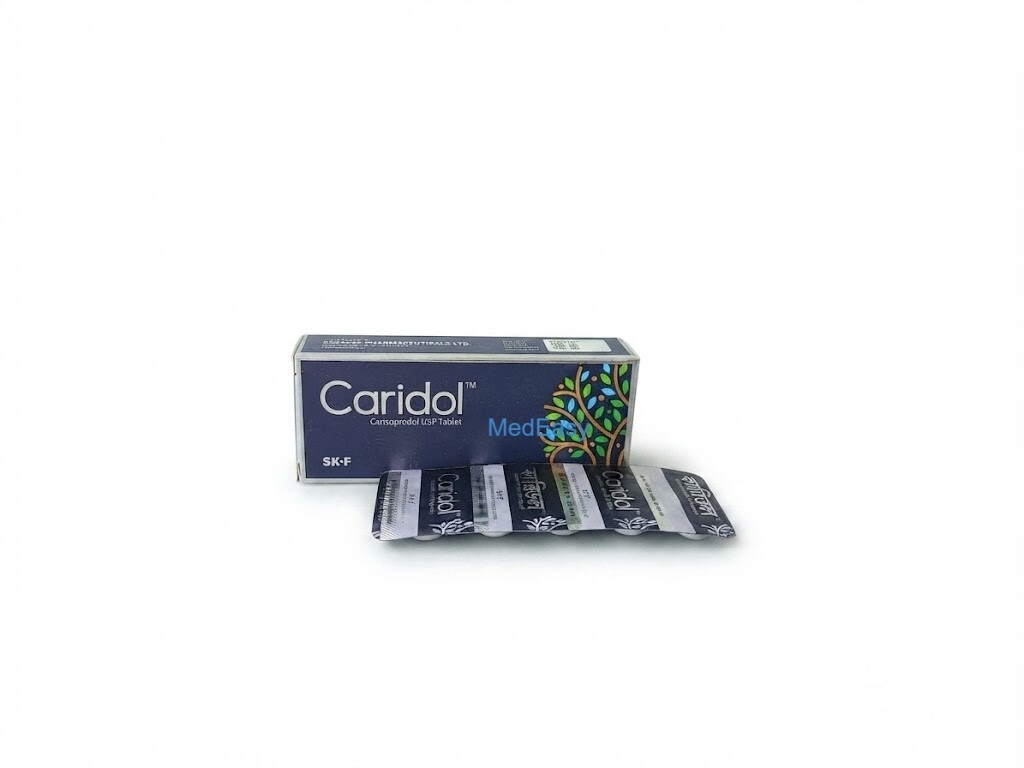
Caridol250 mg
Eskayef Bangladesh Ltd.
৳63.00
Add to cart


Carilax is indicated for the following use:
Carilax is not indicated, and evidence does not support its use, for chronic pain conditions or musculoskeletal conditions lasting longer than 2 to 3 weeks, since most such conditions are self-limiting and long-term efficacy has not been demonstrated.
Each tablet of Carisoprodol generally contains Carisoprodol USP 250 mg or 350 mg as the sole active ingredient, together with pharmaceutically acceptable excipients. It is formulated as an immediate-release oral tablet.
Carilax is a carbamate-derivative, centrally-acting skeletal muscle relaxant used to relieve pain and stiffness caused by acute musculoskeletal injuries. It does not act directly on skeletal muscle; its effects are believed to arise mainly from its sedative properties within the central nervous system (CNS). Carilax is metabolized in the liver (principally via CYP2C19) to meprobamate, a Schedule IV controlled substance with anxiolytic and sedative activity that contributes to its overall pharmacologic and abuse-related effects.
Centrally-acting skeletal muscle relaxant (carbamate derivative).
The precise mechanism by which Carisoprodol relieves discomfort from acute musculoskeletal conditions has not been clearly identified; it does not directly relax skeletal muscle. In animal models, Carisoprodol has been shown to modify interneuronal activity within the spinal cord and the descending reticular formation of the brain, producing general CNS depression and sedation, which is thought to underlie its clinical effect.
Carisoprodol is rapidly absorbed after oral administration, with peak plasma concentrations typically reached within 1.5 to 2 hours. It is metabolized in the liver, principally via the CYP2C19 enzyme, to meprobamate, an active metabolite with sedative and anxiolytic properties that is itself a Schedule IV controlled substance in the United States. Both Carisoprodol and meprobamate are eliminated primarily via the kidneys.
| Indication | Population | Dose |
|---|---|---|
| Acute, painful musculoskeletal conditions | Adults | 250 mg to 350 mg orally three times a day and at bedtime, for a maximum of 2 to 3 weeks |
| Acute, painful musculoskeletal conditions | Pediatric patients under 16 years | Safety and efficacy not established; not recommended |
Treatment should be limited to short-term use (up to 2 to 3 weeks) since evidence of effectiveness for more prolonged use is lacking and the risk of dependence and misuse increases with longer use (see Precautions and Warnings). Carilax may be taken with or without food. Doses should not be abruptly discontinued after extended use; see Precautions and Warnings for withdrawal risk.
Carilax is administered orally, with or without food. Tablets should be swallowed whole with water. Doses are typically given three times a day and at bedtime. Consistent timing helps reduce breakthrough discomfort, including at night. Alcohol and other CNS depressants should be avoided while taking Carilax (see Interactions).
Carilax has the potential for clinically significant interactions with the following:
Carisoprodol is contraindicated in patients with:
The most commonly reported adverse effects with Carilax include:
Less common effects include tachycardia, postural hypotension, facial flushing, nausea, vomiting, hiccups, epigastric discomfort, tremor, ataxia, irritability, and insomnia.
Rare but serious effects include hypersensitivity/anaphylactoid reactions (which may occur after the first dose and can include facial flushing, swelling, weakness, and dyspnea), asthma-like reactions, eosinophilia, fever, and seizures; severe CNS and respiratory depression can occur with misuse or overdose (see Overdose Effects and Precautions and Warnings).
Pregnancy: Carilax should be used during pregnancy only if clearly needed and the potential benefit justifies the potential risk to the fetus; available human data have not shown a clear increase in major birth defects, but data are limited, and animal studies have shown reduced fetal weight at maternally toxic doses. Consult a physician before using Carilax in pregnancy.
Lactation: Carilax and its active metabolite meprobamate are excreted into breast milk, generally at higher concentrations than in maternal plasma, and may cause sedation in a breastfed infant. Use of Carilax during breastfeeding should occur only after consulting a physician, weighing benefits against risks, and with monitoring of the infant for excess sedation or poor feeding.
Abuse, misuse, and dependence: Carilax is metabolized to meprobamate, a Schedule IV controlled substance with sedative and anxiolytic properties. Carilax itself carries a risk of misuse, abuse, and physical dependence, particularly with prolonged use, in patients with a history of substance use disorder, or when combined with opioids, benzodiazepines, or alcohol. Combining Carilax with opioids or benzodiazepines increases the risk of profound sedation, respiratory depression, coma, and death.
Limit duration of use: Treatment with Carilax should not exceed 2 to 3 weeks, as evidence of effectiveness beyond this period is lacking and the risk of dependence/misuse rises with longer use (see Duration of Treatment).
Withdrawal: Abrupt discontinuation of Carilax after prolonged or high-dose use may cause withdrawal symptoms such as insomnia, vomiting, tremor, muscle twitching, anxiety, ataxia, hallucinations, and psychosis. A gradual dose taper is recommended when discontinuing after extended use.
CNS/psychomotor effects: Carilax commonly causes drowsiness and dizziness. Patients should be cautioned against driving, operating hazardous machinery, or performing other tasks requiring mental alertness until they know how Carilax affects them.
Elderly patients: Increased sensitivity to sedation and increased fall risk have been reported in older adults; Carilax is generally best avoided or used with caution and close monitoring in this population.
Seizures: Seizures have been reported rarely with Carilax, generally in the setting of overdose or use with multiple other CNS-active drugs.
Hypersensitivity/anaphylactoid reaction: A first-dose idiosyncratic reaction with symptoms such as weakness, dizziness, facial flushing, and dyspnea has been reported rarely with Carilax; if this occurs, discontinue Carilax and seek medical attention.
Overdose of Carilax, particularly in combination with alcohol or other CNS depressants, can cause severe CNS depression, respiratory depression, hypotension, shock, seizures, coma, and death. Symptoms may include profound drowsiness, stupor, blurred vision, and loss of coordination.
Suspected overdose of Carilax is a medical emergency. Seek immediate medical attention or contact emergency services/a poison control center right away. Do not attempt home treatment. Management is supportive and may include airway protection, respiratory support, and monitoring in a medical facility; there is no specific antidote.
Store at room temperature (below 30°C), away from light and moisture. Keep out of reach of children.
Pediatric patients: Safety, efficacy, and pharmacokinetics of Carilax in patients younger than 16 years have not been established; use in this age group is not recommended (see Pediatric Uses).
Elderly patients: Data on safety and efficacy of Carilax in patients over 65 years are limited; increased sensitivity to sedative effects and fall risk warrant caution and, where possible, avoidance (see Precautions and Warnings).
Hepatic/renal impairment: No formally established dose adjustment exists for Carilax; use with caution due to the potential for reduced clearance of the drug and its active metabolite.
Patients with a history of substance use disorder: Increased risk of misuse and dependence with Carilax; use only with careful risk assessment and monitoring.
Treatment with Carilax should generally be limited to a short course of up to 2 to 3 weeks, since acute musculoskeletal conditions are typically self-limiting and evidence supporting effectiveness of Carilax beyond this period is lacking. Longer use increases the risk of dependence and misuse. Continued need for therapy beyond this period should be reassessed by a physician.
Carbamate derivative; centrally-acting skeletal muscle relaxant.
The exact mode of action of Carisoprodol is not fully established. It does not act directly on skeletal muscle. Its clinical effects are believed to result from general CNS depression, mediated through modification of interneuronal activity in the spinal cord and the descending reticular formation of the brain, producing sedation that is perceived as muscular relaxation. Carisoprodol is metabolized to meprobamate, which contributes additional sedative/anxiolytic activity.
C
The safety, efficacy, and pharmacokinetics of Carilax in pediatric patients younger than 16 years of age have not been established. Therefore, use of Carilax in this age group is not recommended.
Q: What is Carilax 250 mg Tablet used for?
A: Carilax 250 mg Tablet is used for short-term (2 to 3 weeks) relief of discomfort from acute, painful musculoskeletal conditions, such as muscle strains or spasms, used together with rest and physical therapy.
Q: How long can I take Carilax 250 mg Tablet?
A: Carilax 250 mg Tablet should generally not be used for more than 2 to 3 weeks, since acute musculoskeletal pain typically resolves within this time and prolonged use increases the risk of dependence and misuse. Your physician will advise if a longer course of Carilax 250 mg Tablet is truly necessary.
Q: Is Carilax 250 mg Tablet addictive?
A: Yes. Carilax 250 mg Tablet is broken down in the body into meprobamate, a controlled substance with sedative properties, and Carilax 250 mg Tablet itself has a recognized potential for misuse, abuse, and physical dependence, especially with prolonged use or when combined with alcohol, opioids, or benzodiazepines. It should be used exactly as prescribed and not shared with others.
Q: Can I drink alcohol while taking Carilax 250 mg Tablet?
A: No. Alcohol should be avoided while taking Carilax 250 mg Tablet, as the combination can cause additive sedation and dangerous respiratory depression. The same caution applies to opioids, benzodiazepines, and other sedating medicines.
Q: Can Carilax 250 mg Tablet be used during pregnancy or breastfeeding?
A: Carilax 250 mg Tablet should be used in pregnancy only if clearly needed, as data are limited, and during breastfeeding only after consulting a physician, since it passes into breast milk and may sedate the infant. Always discuss use of Carilax 250 mg Tablet with your doctor if you are pregnant or breastfeeding.
Q: What should I do if I miss a dose or think I have taken too much Carilax 250 mg Tablet?
A: If you miss a dose of Carilax 250 mg Tablet, take it when you remember unless it is close to your next dose; do not double up. If you suspect an overdose of Carilax 250 mg Tablet, seek emergency medical care or contact a poison control center immediately, as overdose can be life-threatening, especially when combined with alcohol or other sedatives.
Disclaimer
The information provided is accurate to the best of our knowledge, but it does not replace professional medical advice. We cannot guarantee its completeness or accuracy, and the absence of specific information about a drug should not be taken as an endorsement. We are not responsible for any consequences arising from this information, so please consult a healthcare professional for any concerns or questions.
