
10% Off
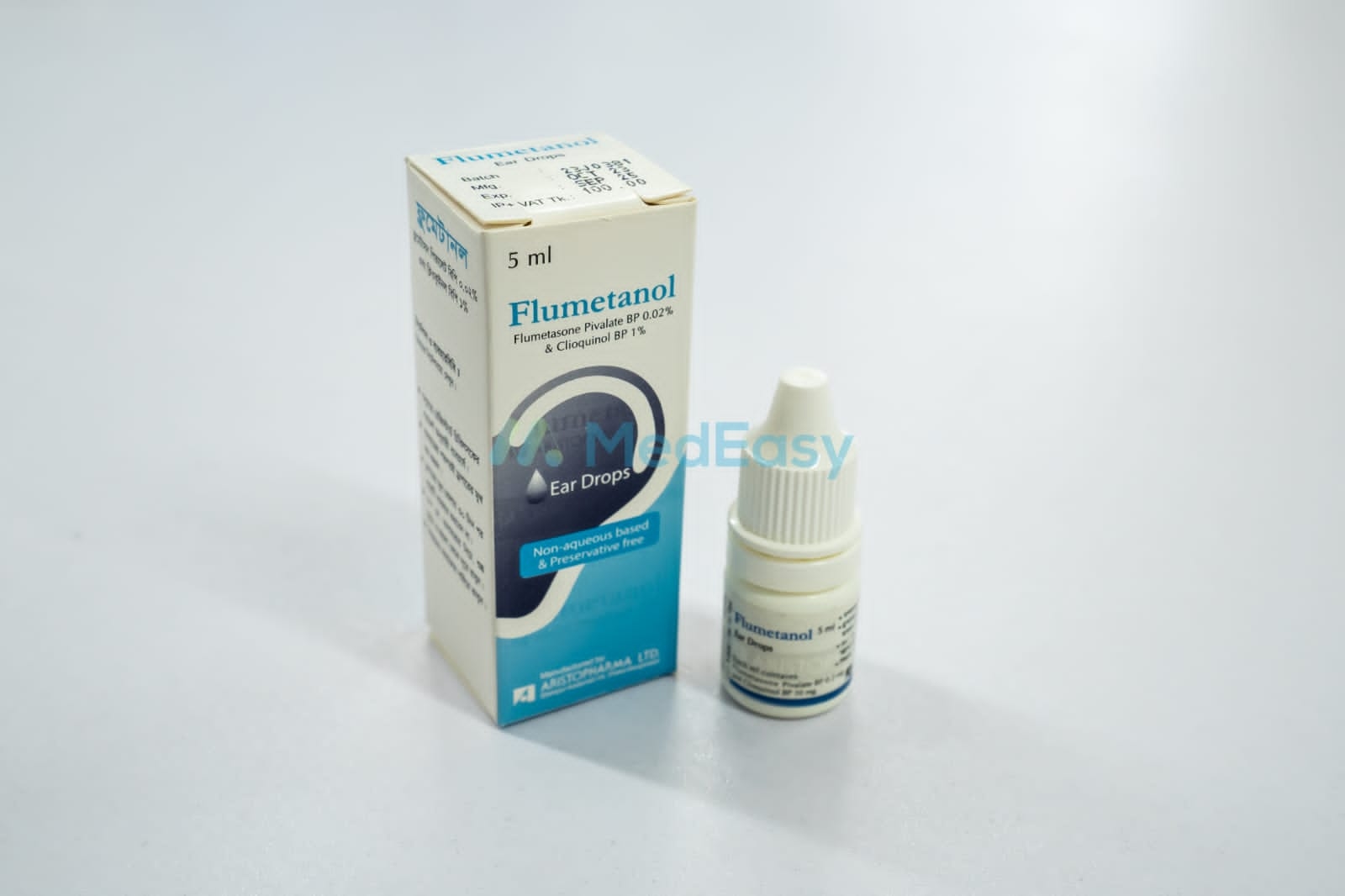
Flumetanol1%+0.02%
Aristopharma Ltd.
৳90.00
Add to cart

Cliomet 1%+0.02% Ear Drop is available on MedEasy for ৳90.00 per 5 ml drop, with home delivery anywhere in Bangladesh. It is manufactured by Incepta Pharmaceuticals Ltd. Its generic name is Clioquinol + Flumetasone Pivalate.

Cliomet is a topical/otic combination of an anti-infective (iodoquinoline) and a corticosteroid, used for short-term treatment of inflammatory skin and ear conditions that are infected or likely to be infected.
Cliomet is intended only for short courses in conditions where both an anti-infective and an anti-inflammatory effect are wanted at the same time; it is not intended as first-line therapy for infection or inflammation alone. It should not be used to treat primary fungal or viral infections without concurrent appropriate antimicrobial cover, and it is not a substitute for systemic therapy in severe or spreading infection.
Each mL/g of Clioquinol + Flumetasone Pivalate topical (ear/skin) drops typically contains:
Exact strengths and formulation (drops, cream, or lotion) may vary by brand; refer to the specific product label for the marketed strength.
Cliomet is a fixed-dose topical/otic combination product. Clioquinol is a halogenated 8-hydroxyquinoline derivative with antibacterial and antifungal activity, while flumetasone pivalate is a synthetic, fluorinated corticosteroid with anti-inflammatory, antipruritic, and vasoconstrictive properties.
The combination is formulated as ear drops and/or a topical skin preparation intended for short-term use in inflamed, infected or potentially infected skin and ear conditions, combining anti-infective cover with control of inflammation and itching.
Cliomet belongs to the class of topical corticosteroid and anti-infective combinations, used dermatologically and otologically.
Clioquinol is a halogenated hydroxyquinoline with broad-spectrum antibacterial and antifungal activity against common skin and ear pathogens, including Staphylococcus aureus, Candida species, and dermatophytes. Its exact mechanism is not completely defined but is thought to involve chelation of essential metal ions required by microorganisms.
Flumetasone pivalate is a synthetic corticosteroid that binds intracellular glucocorticoid receptors, inducing anti-inflammatory proteins and suppressing pro-inflammatory mediators. This reduces local oedema, erythema, itching, and inflammatory cell infiltration in the skin and ear canal.
When applied topically as directed, systemic absorption of both components is generally low; however, absorption increases with use on broken or extensively inflamed skin, under occlusion, on mucous membranes, or for prolonged periods, particularly in infants and young children.
| Population | Dose |
|---|---|
| Adults | 2-3 drops instilled into the affected ear, 2-3 times daily, or as directed by the physician |
| Children | As directed by a physician; short courses only, with careful assessment of the ear canal and eardrum before use |
| Population | Dose |
|---|---|
| Adults | Apply a thin layer / a few drops to the affected area 2-3 times daily |
| Children | As directed by a physician; use the smallest effective amount for the shortest necessary duration |
Cliomet is intended for short-term use only (see Duration of Treatment). If there is no improvement within 5-7 days, or symptoms worsen, treatment should be reviewed by a physician.
Because Cliomet is applied topically/locally and systemic absorption is normally low, clinically significant drug-drug interactions are uncommon with correct use.
Clioquinol + Flumetasone Pivalate is contraindicated in:
Most side effects of Cliomet are local and related to the site of application:
Patients should stop use and consult a physician if irritation, sensitisation, or worsening of the condition occurs.
Data on the use of Cliomet in pregnancy and lactation are limited. As with other topical corticosteroid/anti-infective combinations, Cliomet should be used in pregnancy only if clearly needed and if the potential benefit justifies the potential risk to the fetus, and treatment should be limited to the smallest effective amount for the shortest possible time, avoiding use over large areas.
It is not known whether topically applied clioquinol or flumetasone pivalate are excreted in human milk in clinically significant amounts. As a precaution, breastfeeding women should avoid applying Cliomet to the breast/nipple area and should consult a physician before use during breastfeeding.
Significant systemic toxicity from topical overdose of Cliomet is unlikely under normal use, but excessive or prolonged application over large areas, especially in children, may increase the risk of corticosteroid- and iodine-related systemic effects. If accidental ingestion occurs, or if signs of systemic toxicity (e.g., unusual drowsiness, thyroid disturbance symptoms) develop after extensive topical use, seek immediate medical attention or contact a poison control centre; do not attempt home treatment beyond removing residual product from the skin/ear and seeking prompt medical advice.
Store at room temperature (below 30°C), protected from light and moisture. Keep the container tightly closed and out of the reach of children.
Cliomet should be used with caution in infants and young children because their higher skin-surface-to-body-weight ratio increases the risk of systemic absorption of both the corticosteroid and clioquinol. Use the smallest effective amount for the shortest necessary duration, and avoid prolonged or extensive use, occlusive dressings, and use on broken skin in this age group. Safety and efficacy in neonates and very young infants have not been well established; use only under medical supervision.
Elderly patients often have thinner skin, which may increase local absorption and the risk of skin atrophy; use the lowest effective amount for the shortest duration.
No specific dose adjustment is established for topical/otic use, as systemic absorption is normally minimal; however, caution is advised with extensive or prolonged application in patients with significant hepatic or renal impairment.
Cliomet is intended for short-term use only. For ear conditions, treatment is generally limited to about 7-10 days; for skin conditions, courses are generally limited to about 2-4 weeks, and continuous use beyond this should be reassessed by a physician. If there is no improvement within the first week, or if the condition worsens, medical advice should be sought rather than continuing or increasing use.
Clioquinol + Flumetasone Pivalate combines two drug classes:
In Clioquinol + Flumetasone Pivalate, clioquinol provides local antibacterial and antifungal activity against common skin and ear pathogens, likely via chelation of metal ions essential to microbial metabolism, while flumetasone pivalate acts on glucocorticoid receptors in skin/mucosal cells to reduce inflammation, oedema, and itching. The combined effect is designed to control infection and inflammation together in short-term topical/otic therapy.
Cliomet may be used in children under medical supervision for short courses in otitis externa or infected inflammatory skin conditions, but should be used cautiously because of the larger skin-surface-to-body-weight ratio in children, which raises the risk of systemic absorption of the corticosteroid and iodine-containing components. Prolonged use, use under occlusion, and use on broken or extensively inflamed skin should be avoided in children. Safety and efficacy in neonates and infants have not been well established; use only as directed by a pediatrician.
Q: What is Cliomet 1%+0.02% Ear Drop used for?
A: Cliomet 1%+0.02% Ear Drop is a combination ear/skin preparation used for short-term treatment of infected or potentially infected inflammatory conditions such as otitis externa (inflammation of the outer ear canal) and infected eczema or dermatitis, combining an anti-infective with an anti-inflammatory corticosteroid.
Q: Can I use Cliomet 1%+0.02% Ear Drop if my eardrum is perforated?
A: No. Cliomet 1%+0.02% Ear Drop should not be used in the ear if the eardrum is perforated, because of the risk of ototoxicity (damage to hearing) if the drug reaches the middle or inner ear. Tell your doctor if you have ever had a perforated eardrum or ear surgery.
Q: Will Cliomet 1%+0.02% Ear Drop stain my skin?
A: Yes, Cliomet 1%+0.02% Ear Drop can cause a temporary yellow-brown staining of the skin, hair, nails, and clothing; this is a known characteristic of the clioquinol component and is not usually a sign of harm, but tell your physician if it concerns you.
Q: How long can I use Cliomet 1%+0.02% Ear Drop?
A: Cliomet 1%+0.02% Ear Drop is meant for short-term use only - typically about 7-10 days for ear conditions and up to about 2-4 weeks for skin conditions. Do not use it for longer than your physician recommends, as prolonged use increases the risk of skin thinning and absorption-related side effects.
Q: Is Cliomet 1%+0.02% Ear Drop safe during pregnancy or breastfeeding?
A: Data are limited. Cliomet 1%+0.02% Ear Drop should be used in pregnancy only if clearly needed, using the smallest effective amount for the shortest time, and breastfeeding women should avoid applying it to the breast/nipple area. Always consult your physician before use during pregnancy or breastfeeding.
Q: What should I do if I accidentally swallow Cliomet 1%+0.02% Ear Drop?
A: If Cliomet 1%+0.02% Ear Drop is accidentally swallowed, or if you notice unusual symptoms after extensive use, seek immediate medical attention or contact a poison control centre rather than trying to treat it at home.
Disclaimer
The information provided is accurate to the best of our knowledge, but it does not replace professional medical advice. We cannot guarantee its completeness or accuracy, and the absence of specific information about a drug should not be taken as an endorsement. We are not responsible for any consequences arising from this information, so please consult a healthcare professional for any concerns or questions.