
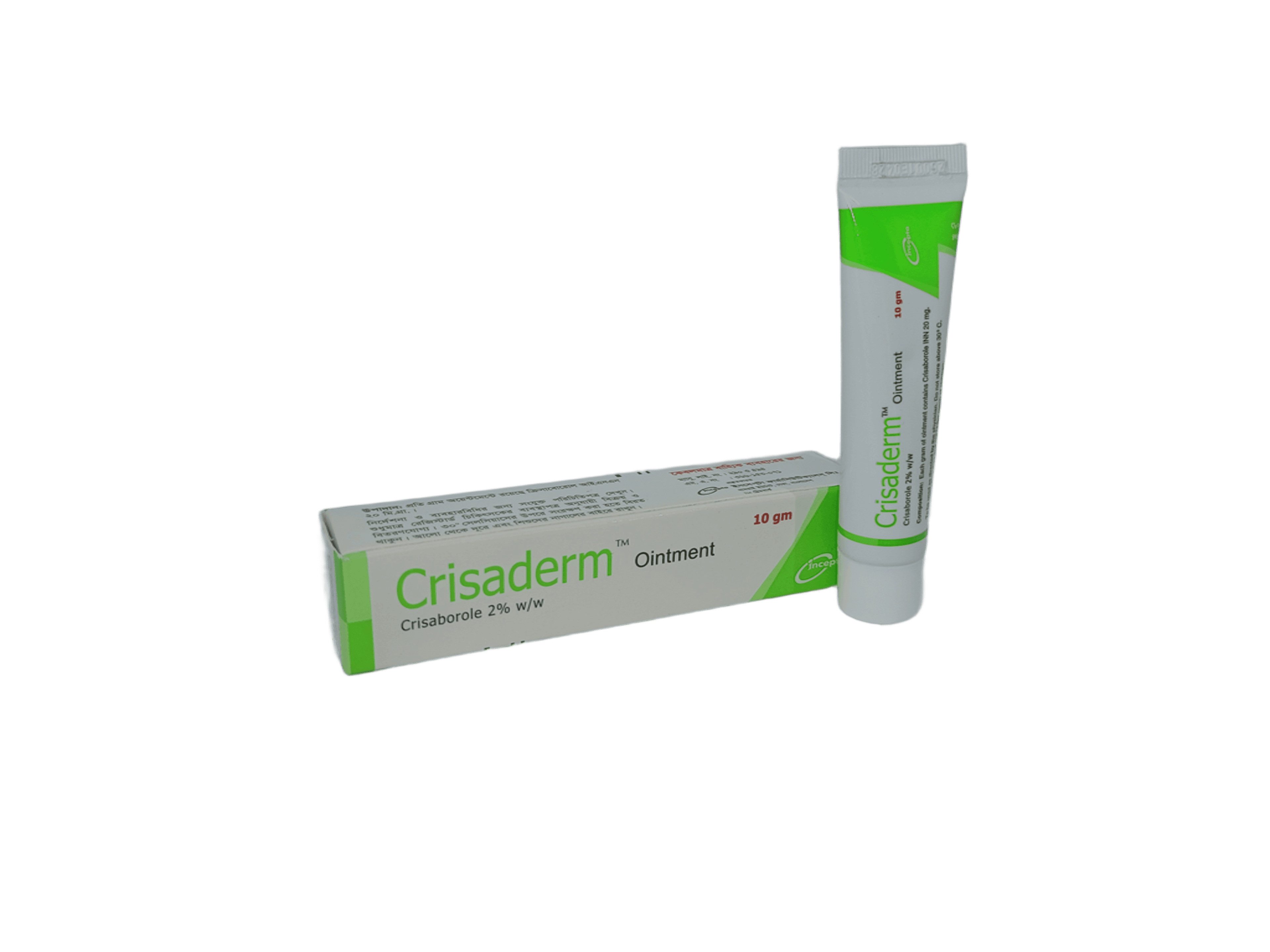

Medicine overview
Indications of Crisaderm
Crisaderm is a topical, non-steroidal phosphodiesterase-4 (PDE4) inhibitor approved for the following use:
- Established/FDA-approved use: Topical treatment of mild-to-moderate atopic dermatitis (eczema) in adult and pediatric patients 3 months of age and older.
Crisaderm is intended as a steroid-sparing option for eczema and does not replace basic eczema skin-care measures such as regular moisturizing and avoidance of known triggers (irritants, allergens, extreme temperature/humidity changes). There are currently no other guideline-endorsed or off-label indications with sufficient evidence to recommend routine use of Crisaderm outside atopic dermatitis; any such use should be individualized by a physician.
Composition
Each gram of Crisaborole ointment contains Crisaborole 20 mg (2% w/w) in a white-to-off-white, ointment base. It is formulated for topical (external skin) use only.
Description
Crisaderm is a topical, non-steroidal small-molecule phosphodiesterase-4 (PDE4) inhibitor developed for mild-to-moderate atopic dermatitis. Unlike topical corticosteroids, it does not carry the classic steroid-related risks (e.g., skin thinning), and is positioned as a steroid-sparing anti-inflammatory option, particularly useful for sensitive areas or for patients who need an alternative to long-term steroid use. It is a relatively newer therapy compared with well-established topical corticosteroids, so long-term safety experience is more limited, and current evidence should be interpreted with that context in mind.
Therapeutic Class
Topical anti-inflammatory agent — Phosphodiesterase-4 (PDE4) inhibitor, non-steroidal (for atopic dermatitis); Crisaderm.
Pharmacology
Mechanism of Action
Crisaborole works by inhibiting phosphodiesterase-4 (PDE4), an enzyme that breaks down cyclic adenosine monophosphate (cAMP) inside inflammatory cells. By blocking PDE4, Crisaborole raises intracellular cAMP levels, which in turn reduces the release of pro-inflammatory cytokines (such as TNF-alpha and various interleukins) implicated in atopic dermatitis. The precise contribution of this mechanism to the clinical benefit seen with Crisaborole has not been fully characterized.
Pharmacokinetics
- Absorption: Some systemic absorption occurs through the skin; average peak plasma concentration was low (around 127 ng/mL) even with substantial body-surface-area application over about a week.
- Distribution: Approximately 97% bound to plasma proteins.
- Metabolism: Extensively metabolized in the liver (hydrolysis and oxidation) to inactive metabolites.
- Elimination: Metabolites are eliminated mainly via the kidneys.
Dosage & Administration of Crisaderm
Adults and Pediatric Patients (3 months and older)
| Step | Instruction |
|---|---|
| Frequency | Apply a thin layer of Crisaderm to affected skin areas twice daily. |
| After improvement | Once visible clinical improvement occurs, the treating physician may reduce frequency to once daily. |
| Review | If there is no improvement after about 4 weeks of regular use, patients should follow up with their physician to reassess the diagnosis and treatment plan. |
Crisaderm is for topical (skin) use only; it is not intended for oral, ophthalmic, or intravaginal use. See Administration for application technique and Precautions and Warnings for site-restriction details.
Administration of Crisaderm
- Wash and dry hands before and after applying Crisaderm.
- Apply a thin, even layer of Crisaderm directly to the affected skin areas as directed by the physician.
- Crisaderm is for external use on the skin only — avoid contact with the eyes, mouth, lips, and vaginal/mucous membrane surfaces; if accidental contact occurs, rinse thoroughly with water.
- Do not apply Crisaderm to open wounds or broken skin unless directed by a physician.
- Crisaderm may be used together with a regular moisturizer as part of overall eczema skin care, applied at a different time if advised by the physician.
Interaction of Crisaderm
Because systemic absorption of Crisaderm after topical use is minimal, no clinically significant systemic drug-drug interactions have been well established for Crisaderm in humans. As a general precaution, patients should inform their physician about all other topical products (including other medicated creams/ointments) being used on the same skin areas, since combining multiple topical agents on the same site may affect local tolerability or absorption. There is no well-documented interaction requiring dose adjustment of concomitant systemic medications when Crisaderm is used as directed.
Contraindications
Crisaborole is contraindicated in patients with known hypersensitivity to Crisaborole or to any excipient in the Crisaborole ointment formulation.
Side Effects of Crisaderm
The most commonly reported side effect of Crisaderm is application-site pain, described as burning or stinging, which is usually mild-to-moderate in intensity and transient. Other reported effects include:
- Application-site burning/stinging or discomfort
- Contact urticaria (hives at the application site)
- Allergic contact dermatitis (reported post-marketing)
If signs of a hypersensitivity reaction occur (see Contraindications and Precautions and Warnings), stop using Crisaderm and contact a physician.
Pregnancy & Lactation
Pregnancy
Animal reproduction studies with Crisaderm did not show adverse effects on the fetus at systemic exposures several times the expected human exposure; however, adequate and well-controlled human studies are limited. Crisaderm should be used during pregnancy only if clearly needed and if the potential benefit justifies the potential risk to the fetus — consult a physician before use during pregnancy.
Lactation
It is not known whether Crisaderm or its metabolites pass into human breast milk following topical use. Because some systemic absorption of Crisaderm can occur, a nursing mother should consult her physician to weigh the benefits of breastfeeding against the limited safety data, and, if used, should avoid applying Crisaderm directly to the breast/nipple area.
Precautions & Warnings
- Hypersensitivity reactions: Discontinue Crisaderm immediately if signs of hypersensitivity (e.g., contact urticaria, worsening pruritus/swelling) occur, and seek prompt medical attention (see Contraindications).
- For topical/external use only: Avoid contact of Crisaderm with the eyes, mouth, lips, and mucous membranes; rinse with water if accidental contact occurs.
- Application-site reactions: Burning or stinging at the application site is common with Crisaderm, usually mild-to-moderate and transient (see Side Effects); persistent or severe discomfort should be reported to a physician.
- Limited long-term safety data: Crisaderm is a comparatively newer topical therapy relative to established topical corticosteroids; long-term safety experience with prolonged, repeated use of Crisaderm is more limited, so ongoing physician follow-up is advised, particularly with extended use.
- Not a substitute for basic eczema skin care: Crisaderm is intended as a steroid-sparing anti-inflammatory option and should be used alongside, not instead of, standard eczema measures such as regular moisturization and avoidance of known triggers.
Overdose Effects of Crisaderm
Topical overapplication of Crisaderm beyond the recommended amount is not expected to cause serious systemic toxicity given its low systemic absorption, but excessive or inappropriate use should still be avoided. If Crisaderm is accidentally ingested, or if excessive local irritation, an allergic reaction, or any unexpected symptoms occur after use, seek immediate medical attention or contact a poison control center/emergency services rather than attempting self-treatment at home.
Storage Conditions
Store at room temperature (20°C-25°C / 68°F-77°F); brief excursions between 15°C-30°C are permitted during travel. Keep the tube tightly closed, away from excess heat and moisture. Keep out of reach and sight of children.
Use In Special Populations
- Renal/hepatic impairment: No dedicated dose-adjustment studies are available for Crisaderm; because systemic absorption after topical application is minimal, specific adjustment is not generally expected to be necessary, but caution is reasonable in significant impairment.
- Geriatric use: Clinical data in elderly patients using Crisaderm are insufficient to determine whether they respond differently than younger adults; use with routine caution.
- Pediatric use: See Pediatric Uses.
- Pregnancy and lactation: See Pregnancy and Lactation.
Duration Of Treatment
Crisaderm is typically used twice daily and continued until the treated eczema lesions clear or as directed by the physician, with a possible reduction to once daily after improvement. If no improvement is seen after approximately 4 weeks of consistent use of Crisaderm, the patient should return to the physician to reassess the diagnosis and treatment approach. Given the more limited long-term safety experience with Crisaderm compared to established topical corticosteroids, continuous long-term use should be periodically reviewed with a physician rather than continued indefinitely without follow-up.
Drug Classes
Topical PDE4 (phosphodiesterase-4) inhibitors; non-steroidal topical anti-inflammatory agents for atopic dermatitis — Crisaborole is a member of this class.
Mode Of Action
Crisaborole inhibits phosphodiesterase-4 (PDE4), an enzyme responsible for degrading cyclic adenosine monophosphate (cAMP) within skin immune cells. Inhibition of PDE4 by Crisaborole leads to increased intracellular cAMP, which down-regulates the production of pro-inflammatory mediators (including certain cytokines) thought to drive the inflammation of atopic dermatitis. This non-steroidal mechanism differentiates Crisaborole from topical corticosteroids, though the full clinical significance of this pathway is not completely understood.
Pediatric Uses
Crisaderm is approved for use in pediatric patients 3 months of age and older with mild-to-moderate atopic dermatitis, applied twice daily (or once daily after improvement) as in adults, based on controlled clinical trials in this age group.
The safety and efficacy of Crisaderm in infants younger than 3 months have not been established, and Crisaderm is not recommended for this younger age group. As with any topical medication in children, caregivers should apply only to affected areas, avoid the eyes/mouth/mucous membranes, and consult a physician if application-site irritation or any signs of hypersensitivity develop.
Frequently Asked Questions
Q: What is Crisaderm 10 gm Ointment used for?
A: Crisaderm 10 gm Ointment is a topical, non-steroidal ointment used to treat mild-to-moderate atopic dermatitis (eczema) in adults and children 3 months of age and older.
Q: How should I apply Crisaderm 10 gm Ointment?
A: Apply a thin layer of Crisaderm 10 gm Ointment to the affected skin areas twice daily, or once daily after your skin improves, as directed by your physician. Avoid contact with the eyes, mouth, and mucous membranes.
Q: Is Crisaderm 10 gm Ointment a steroid?
A: No. Crisaderm 10 gm Ointment is a non-steroidal phosphodiesterase-4 (PDE4) inhibitor and does not carry the typical risks associated with long-term topical corticosteroid use, though it can still cause its own local side effects such as application-site burning or stinging.
Q: What are the most common side effects of Crisaderm 10 gm Ointment?
A: The most common side effect of Crisaderm 10 gm Ointment is application-site pain (burning or stinging), which is usually mild-to-moderate and temporary. Less commonly, contact urticaria or allergic contact dermatitis can occur; stop use and contact a physician if a hypersensitivity reaction develops.
Q: Can Crisaderm 10 gm Ointment be used during pregnancy or breastfeeding?
A: Data in pregnant and breastfeeding women are limited. Crisaderm 10 gm Ointment should be used during pregnancy only if clearly needed and the potential benefit justifies the potential risk, and nursing mothers should consult a physician before use, avoiding application to the breast/nipple area.
Q: What should I do if I miss a dose or use too much Crisaderm 10 gm Ointment?
A: If you miss an application of Crisaderm 10 gm Ointment, apply it as soon as you remember and continue your regular schedule. Do not apply more than directed. If Crisaderm 10 gm Ointment is accidentally swallowed or causes severe irritation or an allergic reaction, seek immediate medical attention or contact a poison control center.
Disclaimer
The information provided is accurate to the best of our knowledge, but it does not replace professional medical advice. We cannot guarantee its completeness or accuracy, and the absence of specific information about a drug should not be taken as an endorsement. We are not responsible for any consequences arising from this information, so please consult a healthcare professional for any concerns or questions.
