
8% Off
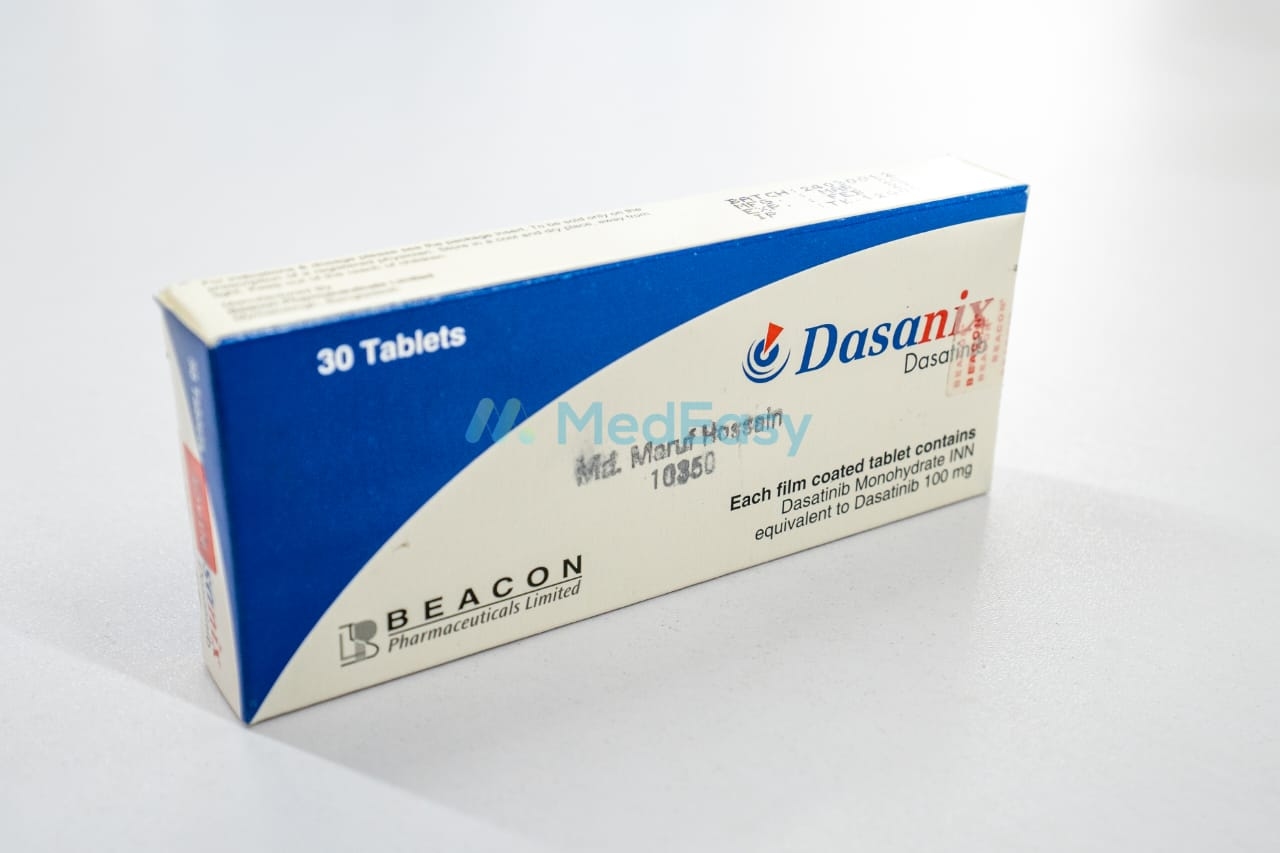
Dasanix100 mg
Beacon Pharmaceuticals PLC
৳11040.00
Add to cart

Danib 100 mg Tablet is available on MedEasy for ৳400.20 per piece, with home delivery anywhere in Bangladesh. It is manufactured by Healthcare Pharmaceuticals Ltd. Its generic name is Dasatinib.

Danib is a tyrosine kinase inhibitor (TKI) approved for the treatment of certain Philadelphia chromosome-positive (Ph+) leukemias. Its use is classified by strength of evidence as follows:
Danib is sometimes used off-label in other BCR-ABL-driven or SRC-kinase-driven conditions under specialist oncology guidance; such use is not FDA-approved and should only occur within a clinical trial or specialist protocol.
Each film-coated tablet contains Dasatinib (as the monohydrate) in strengths typically ranging from 20 mg to 140 mg, along with standard pharmaceutical excipients used in tablet coating and formulation.
Danib is an orally administered, second-generation small-molecule tyrosine kinase inhibitor used in the treatment of Philadelphia chromosome-positive leukemias. It is supplied as film-coated tablets and is taken once or twice daily depending on the indication.
Danib belongs to the therapeutic class of antineoplastic agents – tyrosine kinase inhibitors (BCR-ABL inhibitors), a category of targeted cancer therapy.
Dasatinib is a multi-targeted kinase inhibitor that binds to and inhibits the BCR-ABL fusion tyrosine kinase (the driver of Philadelphia chromosome-positive leukemias) in multiple conformations, including both active and inactive forms of the kinase domain. This broader binding profile allows it to remain active against many BCR-ABL mutations that confer resistance to first-generation TKIs such as imatinib. Dasatinib also inhibits SRC-family kinases, c-KIT, PDGFR-β, and ephrin (EPH) receptor kinases.
| Indication | Recommended dose |
|---|---|
| Chronic phase Ph+ CML (newly diagnosed or prior therapy) | 100 mg orally once daily |
| Accelerated, myeloid, or lymphoid blast phase Ph+ CML | 140 mg orally once daily |
| Ph+ acute lymphoblastic leukemia (ALL) | 140 mg orally once daily |
Dosing is weight-based for patients 1 year and older, using tablets or oral suspension as appropriate, generally ranging from about 40 mg to 100 mg once daily depending on body weight band; exact dose must be individualized by a pediatric oncologist per current weight-based dosing tables.
Dose interruption, reduction, or discontinuation is required for severe myelosuppression (neutropenia, thrombocytopenia), non-hematologic toxicity, QT prolongation, or fluid retention, as determined by the treating physician based on blood counts and clinical status.
No formal dose adjustment has been firmly established for renal impairment; use with caution and physician monitoring. In hepatic impairment, use with caution as hepatic metabolism may be altered; consult a physician for individualized dosing.
Danib tablets should be swallowed whole with a glass of water, with or without food, at approximately the same time each day. Do not crush, split, or chew the tablets.
Dasatinib is contraindicated in patients with known hypersensitivity to dasatinib or any component of the formulation.
Danib can cause fetal harm based on animal reproduction studies and its mechanism of action; it should be avoided during pregnancy. Danib should be used only if clearly needed and the potential benefit justifies the potential risk to the fetus, and only under close specialist supervision. Females of reproductive potential should use effective contraception during treatment with Danib and for at least 30 days after the final dose; male patients with partners of reproductive potential should also use effective contraception. Breastfeeding should be avoided during treatment with Danib and for at least 2 weeks after the last dose, due to the potential for serious adverse effects in a nursing infant. A physician must be consulted before use in pregnancy or lactation.
Danib carries boxed warnings for the following serious risks, which require regular monitoring:
Overdose with Danib may worsen myelosuppression, bleeding risk, fluid retention, and cardiac effects such as QT prolongation. There is no specific antidote. If overdose is suspected, seek immediate medical attention or contact emergency services/a poison control center; management is supportive, with close monitoring of blood counts and cardiac status in a medical facility. Do not attempt home treatment for a suspected overdose.
Store at room temperature (below 30°C), away from light and moisture. Keep out of reach of children.
Danib is approved for use in pediatric patients 1 year of age and older for the indications described under Indications; safety and efficacy in children younger than 1 year have not been established. Growth and bone development should be monitored during long-term therapy.
No overall differences in safety or effectiveness have been observed between elderly and younger adult patients, but greater sensitivity to adverse effects (particularly fluid retention) cannot be ruled out; monitor closely.
Data are limited; use with caution and physician-directed monitoring.
Use with caution, as hepatic metabolism of Danib may be affected; individualized dosing under specialist supervision is advised.
Treatment with Danib for chronic myeloid leukemia and Ph+ ALL is typically continued long-term (often indefinitely) until disease progression, unacceptable toxicity, or a physician-directed change in therapy occurs. In select patients with a sustained deep molecular response, a physician may consider a carefully monitored treatment-free remission attempt; this decision must only be made by the treating hematologist/oncologist.
Antineoplastic agent; tyrosine kinase inhibitor (TKI); BCR-ABL inhibitor; targeted (precision) cancer therapy.
Dasatinib works by binding to and inhibiting the abnormal BCR-ABL tyrosine kinase enzyme produced by the Philadelphia chromosome translocation, which drives uncontrolled proliferation of leukemic cells. By blocking this and related kinases (SRC-family kinases, c-KIT, PDGFR-β), Dasatinib suppresses the growth signal that sustains Philadelphia chromosome-positive leukemia cells, including many that have become resistant to earlier tyrosine kinase inhibitors.
D
Danib is approved for pediatric patients 1 year of age and older with Ph+ CML in chronic phase, and for newly diagnosed pediatric Ph+ ALL in combination with chemotherapy. Dosing is weight-based and must be individualized by a pediatric oncology specialist. Safety and efficacy have not been established in children under 1 year of age. Long-term monitoring of growth and bone development is recommended.
Q: What is Danib 100 mg Tablet used for?
A: Danib 100 mg Tablet is used to treat Philadelphia chromosome-positive chronic myeloid leukemia (CML) and Philadelphia chromosome-positive acute lymphoblastic leukemia (ALL), usually in patients who are newly diagnosed or who have not responded well to, or cannot tolerate, other similar medicines.
Q: How should I take Danib 100 mg Tablet?
A: Danib 100 mg Tablet tablets should be swallowed whole with water, with or without food, at the same time each day. Do not crush, split, or chew the tablets, and follow your physician's prescribed dose exactly.
Q: What are the most serious risks of Danib 100 mg Tablet?
A: Danib 100 mg Tablet carries boxed warnings for severe low blood counts (myelosuppression), fluid retention (including fluid around the lungs or heart), bleeding, heart rhythm changes (QT prolongation), and a serious lung blood-pressure condition called pulmonary arterial hypertension. Your physician will monitor you with regular blood tests and check-ups during treatment.
Q: Can Danib 100 mg Tablet be used during pregnancy or breastfeeding?
A: Danib 100 mg Tablet can harm an unborn baby and should be avoided during pregnancy; effective contraception is required during treatment and for a period after stopping. Breastfeeding should also be avoided during and shortly after treatment. Always consult your physician before use if you are pregnant, planning pregnancy, or breastfeeding.
Q: What should I avoid while taking Danib 100 mg Tablet?
A: Avoid proton pump inhibitor acid-reducing medicines, and separate any antacid or H2-blocker dosing from Danib 100 mg Tablet by several hours, since these can reduce its absorption. Also inform your physician of all other medicines you take, as several can interact with Danib 100 mg Tablet.
Q: What should I do if I miss a dose or suspect an overdose?
A: If you miss a dose of Danib 100 mg Tablet, take it as soon as you remember unless it is almost time for the next dose — do not double up. If an overdose is suspected, seek immediate medical attention or contact a poison control center right away.
Disclaimer
The information provided is accurate to the best of our knowledge, but it does not replace professional medical advice. We cannot guarantee its completeness or accuracy, and the absence of specific information about a drug should not be taken as an endorsement. We are not responsible for any consequences arising from this information, so please consult a healthcare professional for any concerns or questions.