10% Off
Q-Rash40%
Beximco Pharmaceuticals Ltd.
৳45.00
Add to cart
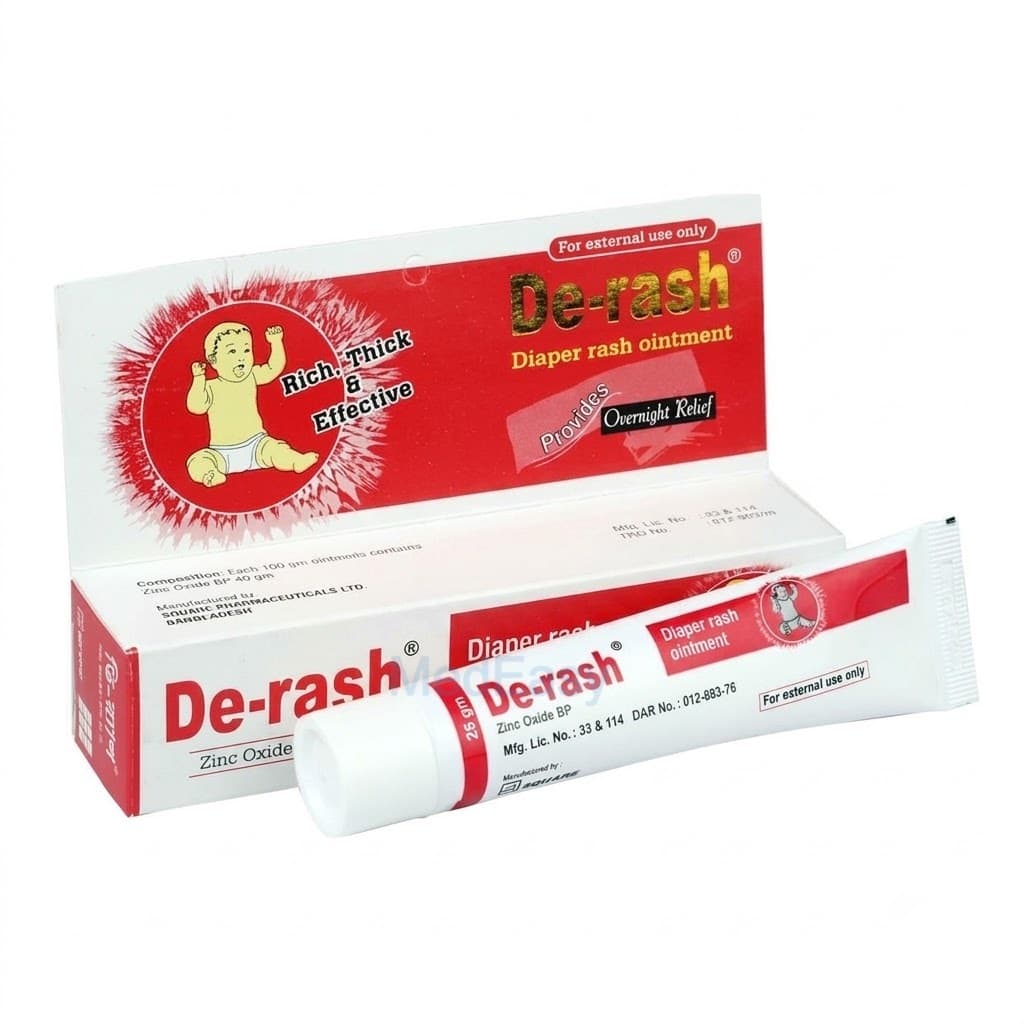

De-Rash is a topical skin protectant and mild astringent used for the following indications, classified by strength of evidence:
De-Rash is also used in some ophthalmic and dermatological preparations and topical pastes (e.g., calamine-type formulations) for its mild astringent and protective properties. These niche uses are formulation-specific and should follow product labeling.
Topical products containing Zinc Oxide are commonly available as:
Strength and base vary by brand and intended use (diaper rash care versus sunscreen versus general skin protectant); always check the specific product label.
De-Rash is an inorganic compound widely used in topical pharmaceutical and cosmetic preparations for its skin-protectant, mild astringent, and physical sun-blocking properties. It is a fine, white to off-white powder that is insoluble in water, which is incorporated into ointments, creams, and pastes.
When applied to the skin, De-Rash forms a physical, water-repellent barrier that shields the underlying skin from moisture, friction, and irritants such as urine and stool, making it a mainstay ingredient in diaper rash products. It also reflects and scatters ultraviolet light, which is why it is used as a broad-spectrum physical sunscreen agent. De-Rash has minimal systemic absorption when used topically as directed, and is considered one of the safest topical agents available, including for use in infants.
De-Rash belongs to the therapeutic class of topical skin protectants and astringents, and is also classified as a physical (inorganic/mineral) sunscreen agent when used in photoprotective formulations.
Mechanism of action: Zinc Oxide acts primarily through a physical (non-systemic) mechanism rather than a pharmacologic or receptor-mediated one.
Absorption/systemic exposure: When applied topically to intact skin as directed, systemic absorption of Zinc Oxide is minimal to negligible. It is not intended for systemic pharmacologic effect.
Clean and thoroughly dry the diaper area. Apply De-Rash ointment/cream liberally to the affected area with each diaper change, especially at bedtime or whenever exposure to a wet diaper may be prolonged.
Clean the affected area and apply De-Rash ointment/cream as a thin to liberal layer, as often as necessary, to the affected skin.
Apply De-Rash liberally to the affected area as needed to help dry oozing or weeping skin.
Apply the De-Rash-containing sunscreen product generously to exposed skin before sun exposure, and reapply as directed on the specific product label (typically every 2 hours, or after swimming/sweating/towel-drying).
| Indication | Typical strength | Frequency |
|---|---|---|
| Diaper rash | 10–40% | With every diaper change |
| Minor cuts/burns/irritation | 10–20% | As often as necessary |
| Poison ivy/oak/sumac | 10–20% | As needed for oozing/weeping |
| Sunscreen | Variable (combination product) | Before sun exposure; reapply per label |
For external use only. Do not apply to deep or puncture wounds, animal bites, or serious burns without medical advice (see Precautions).
Route: Topical (external use only). De-Rash is not intended for oral ingestion, ophthalmic use (unless in a specifically formulated ophthalmic product), or application to mucous membranes.
Wash hands before and after application unless the hands are the area being treated. Avoid contact with the eyes. If eye contact occurs, rinse thoroughly with water.
De-Rash has minimal systemic absorption when used topically as directed, so clinically significant systemic drug interactions are not expected.
Zinc Oxide is contraindicated in patients with known hypersensitivity to Zinc Oxide or to any component of the specific formulation.
De-Rash is generally very well tolerated when used topically as directed, with minimal systemic absorption.
Serious adverse effects are rare with topical use. Discontinue use and seek medical advice if a rash, worsening irritation, or signs of infection develop.
De-Rash used topically has minimal systemic absorption. However, as with any topical product, it should be used during pregnancy and breastfeeding only if clearly needed, applied to intact skin in the recommended amount, and with the potential benefit justifying any theoretical risk. Avoid applying to the nipple/areola area immediately before breastfeeding unless the product is specifically intended and labeled for that use. Consult a physician or pharmacist before use during pregnancy or lactation, particularly for use over large areas of skin or on broken skin.
De-Rash is for external use only.
Topical De-Rash has a wide margin of safety and systemic toxicity from correct topical use is extremely unlikely. If a large amount of De-Rash product is accidentally swallowed, or if signs of an allergic or unexpected systemic reaction occur, seek immediate medical attention or contact a poison control center right away. Do not attempt to manage a suspected ingestion or serious reaction at home without professional guidance.
Store at room temperature (below 30°C), away from light and moisture. Keep out of reach of children.
De-Rash is widely used and considered safe for diaper rash prevention and treatment in infants, including newborns, at standard over-the-counter concentrations when used as directed. It is one of the most established topical agents for this purpose.
Safe for use in children at standard concentrations for skin protection and diaper-area care; use under adult supervision and avoid ingestion.
No specific dose adjustment is required in elderly patients for topical use; general precautions regarding skin integrity and wound assessment apply.
Not applicable for topical use, as systemic absorption is minimal and De-Rash is not systemically metabolized or renally cleared in a clinically relevant way at recommended topical doses.
De-Rash may be used for as long as needed for skin protection (e.g., with every diaper change). For treatment of an irritation, rash, or minor wound, use should generally not continue beyond 7 days without medical evaluation if the condition has not improved, or sooner if it worsens.
Zinc Oxide is classified as a topical skin protectant, mild astringent, and physical/mineral sunscreen (UV filter) agent.
Zinc Oxide works by a physical rather than pharmacologic mechanism. On application, it forms an adherent, water-repellent film over the skin that mechanically shields the epidermis from moisture, friction, and chemical irritants, and provides mild astringent drying of oozing or weeping lesions. In sunscreen formulations, Zinc Oxide particles reflect, scatter, and absorb ultraviolet radiation, reducing the amount of UV-A and UV-B light reaching the skin.
De-Rash is well established and widely recommended for pediatric use, particularly for the prevention and treatment of diaper rash in infants and young children, at standard OTC concentrations applied topically. It is one of the preferred first-line topical agents in this age group due to its favorable safety profile and minimal systemic absorption. As with all age groups, it should be used only on intact or mildly irritated skin, not on deep wounds, and kept away from the eyes and out of reach of children to prevent accidental ingestion.
Q: What is De-Rash 40% Ointment used for?
A: De-Rash 40% Ointment is a topical skin protectant most commonly used to prevent and treat diaper rash in infants, protect and soothe minor skin irritations, cuts, and minor burns, help dry oozing skin from poison ivy/oak/sumac exposure, and act as a physical sunscreen ingredient in some products.
Q: Is De-Rash 40% Ointment safe for babies?
A: Yes. De-Rash 40% Ointment is one of the most established and widely used ingredients for diaper rash prevention and treatment in infants, including newborns, when used topically as directed at standard concentrations. Keep it away from the eyes and do not allow the infant to ingest it.
Q: Can De-Rash 40% Ointment be used during pregnancy or breastfeeding?
A: De-Rash 40% Ointment used topically has minimal systemic absorption, but it should still be used during pregnancy or breastfeeding only if clearly needed and applied as directed to intact skin, with the potential benefit justifying any theoretical risk to the fetus or infant. Avoid the nipple/areola area before nursing unless the product is specifically labeled for that use. Consult a physician or pharmacist if you have concerns.
Q: What are the side effects of De-Rash 40% Ointment?
A: De-Rash 40% Ointment is generally very well tolerated. Occasionally it may cause mild local skin irritation, dryness, or stinging at the application site. Allergic contact dermatitis is rare. Stop use and see a doctor if a rash, worsening irritation, or signs of infection develop.
Q: Who should not use De-Rash 40% Ointment?
A: Anyone with a known hypersensitivity (allergy) to De-Rash 40% Ointment or to any other component of the specific product should not use it. This is the only true absolute contraindication.
Q: What should I do if De-Rash 40% Ointment is accidentally swallowed?
A: If a significant amount of a De-Rash 40% Ointment product is swallowed, or if signs of an unexpected or allergic reaction occur, seek immediate medical attention or contact a poison control center right away rather than treating it at home.
Disclaimer
The information provided is accurate to the best of our knowledge, but it does not replace professional medical advice. We cannot guarantee its completeness or accuracy, and the absence of specific information about a drug should not be taken as an endorsement. We are not responsible for any consequences arising from this information, so please consult a healthcare professional for any concerns or questions.