
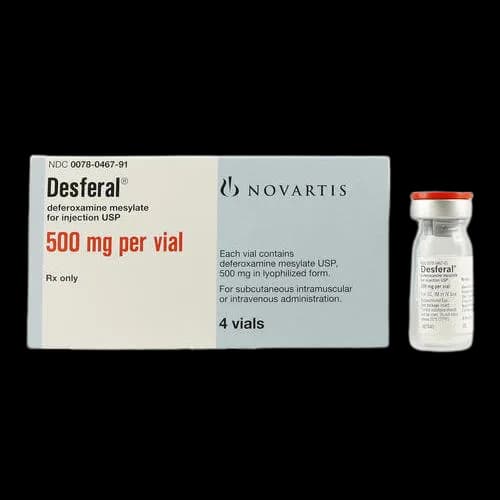

Medicine overview
Indications of Desferal
Desferal is an iron-chelating agent used to remove excess iron from the body. Indications are classified below by strength of evidence.
Established / FDA-approved uses
- Acute iron intoxication: Desferal is indicated as an adjunct to standard supportive treatment (e.g. gastric decontamination where appropriate) in acute iron poisoning/overdose, particularly when serum iron levels are markedly elevated or the patient is symptomatic.
- Chronic iron overload: Desferal is indicated for chronic iron overload due to transfusion-dependent anemias (for example, thalassemia major and other conditions requiring repeated blood transfusions) in patients where iron accumulates from ongoing transfusion therapy.
Important limitation
Desferal is not indicated for the treatment of primary hemochromatosis (a hereditary iron-overload disorder), for which therapeutic phlebotomy is generally the treatment of choice; it is reserved for situations where phlebotomy is not feasible or appropriate, under specialist direction.
Desferal therapy for chronic iron overload should be initiated and monitored by a physician experienced in the management of iron-overload disorders (e.g. hematologist).
Composition
Each vial contains Deferoxamine Mesylate (as a sterile, lyophilized powder) as the active ingredient, intended for reconstitution and administration by subcutaneous, intramuscular, or intravenous injection/infusion. Deferoxamine Mesylate is chemically a hexadentate iron-chelating agent derived from the actinomycete Streptomyces pilosus.
Description
Desferal is a parenteral iron-chelating agent used to bind and remove excess iron from the body in acute iron poisoning and in chronic transfusional iron overload. It is supplied as a sterile lyophilized powder that must be reconstituted before use, and is given by subcutaneous infusion (for chronic overload), intramuscular injection, or intravenous infusion (for acute poisoning or when subcutaneous/intramuscular routes are not suitable).
Desferal works by binding free (non-transferrin-bound) iron and iron from ferritin and hemosiderin to form a stable, water-soluble complex (ferrioxamine) that is then excreted, mainly in urine and to a lesser extent in feces via bile. It has a long history of use in transfusion-dependent conditions such as thalassemia, and remains an option for acute iron overdose, though newer oral iron chelators are now also used for chronic overload in some settings. Because of the need for prolonged parenteral administration and the potential for serious toxicity (ocular, auditory, pulmonary, and infection-related), Desferal therapy requires careful specialist supervision and monitoring.
Therapeutic Class
Desferal belongs to the class of iron-chelating agents (antidotes for iron toxicity / heavy-metal chelators).
Pharmacology
Mechanism: Deferoxamine Mesylate is a hexadentate chelating agent that binds ferric iron (Fe3+) with high affinity, forming a stable 1:1 complex called ferrioxamine. It chelates iron from ferritin and hemosiderin (storage iron) and from free plasma iron, but does not readily remove iron from transferrin or hemoglobin/cytochromes under normal conditions. Each gram of Deferoxamine Mesylate can bind approximately 100 mg of elemental iron.
Pharmacokinetics: Deferoxamine Mesylate is poorly absorbed orally and therefore must be given parenterally. After subcutaneous, intramuscular, or intravenous administration it is rapidly metabolized, mainly by plasma enzymes, to several metabolites including ferrioxamine (once bound to iron). It has a short plasma half-life (on the order of 20-30 minutes for the parent drug), and the iron-bound complex (ferrioxamine) is eliminated predominantly by the kidneys (giving urine a characteristic reddish/orange color), with a smaller fraction excreted in bile/feces. Because of its short half-life, prolonged or repeated administration (e.g. continuous subcutaneous or intravenous infusion) is required to maximize iron removal in chronic overload.
Dosage & Administration of Desferal
Acute iron intoxication (adults and children)
| Route | Typical regimen |
|---|---|
| Intramuscular (preferred when not in shock) | Initial dose of 1 g, followed by 0.5 g every 4 hours for two doses; further doses of 0.5 g may be given every 4-12 hours depending on clinical response, up to a usual maximum of 6 g in 24 hours |
| Intravenous (only if patient is in cardiovascular shock) | Infusion rate must not exceed 15 mg/kg/hour for the first 1 g infused; subsequent infusions given more slowly, not exceeding a total of 6 g in 24 hours |
Chronic iron overload (e.g. transfusional iron overload in thalassemia)
| Population/Route | Typical regimen |
|---|---|
| Adults - subcutaneous | 1-2 g/day (approximately 20-60 mg/kg/day) infused over 8-24 hours using a portable infusion pump, typically 5-7 nights per week |
| Children - subcutaneous/intravenous | Approximately 20-40 mg/kg/day, individualized to iron burden and growth; doses generally kept lower relative to adults, especially in young children, to reduce growth-related and ocular/auditory risks |
| Intravenous (chronic overload, e.g. via existing venous access) | Approximately 40-50 mg/kg/day (adults) infused slowly over 8-12 hours, on the days transfusions or chelation are scheduled, not exceeding about 60 mg/kg/day |
Administration
Desferal powder for injection must be reconstituted with an appropriate sterile diluent (see Reconstitution) immediately before use, and any unused reconstituted solution should be discarded. Intravenous infusions must be given slowly at the controlled rate specified above (never as a rapid IV push, except under specialist-directed emergency overdose protocols), as rapid administration can cause hypotension, flushing, and shock-like reactions. Subcutaneous infusion via a small portable pump is the standard method for long-term chronic overload therapy. All doses and duration must be individualized and supervised by a physician experienced in iron-chelation therapy.
Renal impairment
Desferal is contraindicated in severe renal disease or anuria because the iron-chelate complex is cleared renally (see Contraindications); in milder renal impairment, use with caution and closer monitoring.
Hepatic impairment
No formal validated dose-adjustment guidelines exist for hepatic impairment; use with caution and clinical monitoring.
Administration of Desferal
Desferal is given only by injection - subcutaneously (portable pump infusion, standard for chronic overload), intramuscularly, or by slow, controlled-rate intravenous infusion (used in acute poisoning with shock or when other routes are unsuitable). It must never be given as a rapid intravenous push outside specialist emergency protocols, as this can cause hypotension and shock-like reactions. The lyophilized powder must be reconstituted with the appropriate sterile diluent immediately before use (see Reconstitution), and administration should follow the treating physician's specific instructions on route, rate, and duration.
Interaction of Desferal
Only well-established, clinically significant interactions are listed below.
- Vitamin C (ascorbic acid): concurrent vitamin C can increase the amount of iron available for chelation but has also been associated with reversible cardiac dysfunction when combined with Desferal, particularly at higher vitamin C doses; if used, vitamin C should generally be limited to low doses (e.g. up to about 200 mg/day in adults, lower in children), started only after at least one month of established Desferal therapy, and taken shortly after a dose of Desferal.
- Prochlorperazine: concurrent use with Desferal has been associated with temporary impairment of consciousness; concurrent use should be monitored closely.
- Gallium-67 imaging: Desferal can interfere with the interpretation of gallium-67 scintigraphy scans by altering the biodistribution of gallium; Desferal should generally be discontinued for at least 48 hours before such imaging.
- Other nephrotoxic or ototoxic drugs: concurrent use with other agents that impair renal function or affect hearing/vision may increase the risk of Desferal-related renal, auditory, or ocular toxicity; use with caution and monitor accordingly (see Precautions and Warnings).
Contraindications
Deferoxamine Mesylate is contraindicated in the following situations:
- Known hypersensitivity to Deferoxamine Mesylate or any component of the formulation.
- Severe renal disease or anuria, because the iron-chelate complex formed by Deferoxamine Mesylate is eliminated primarily by the kidneys and cannot be adequately cleared.
Side Effects of Desferal
The most common and clinically significant adverse effects of Desferal include:
- Injection-site reactions: pain, swelling, induration, or itching at subcutaneous/intramuscular injection sites; common with prolonged subcutaneous infusion.
- Infusion-related reactions with rapid IV administration: flushing, urticaria (hives), hypotension, and, rarely, shock-like reactions (see Precautions).
- Gastrointestinal: nausea, vomiting, diarrhea, and abdominal pain/discomfort.
- Ocular: visual disturbances including blurred vision, reduced visual acuity, night blindness, cataracts, and retinal changes, generally with prolonged or high-dose use (see Precautions).
- Auditory: tinnitus and high-frequency sensorineural hearing loss, generally with prolonged or high-dose use (see Precautions).
- Musculoskeletal (children): growth retardation with long-term high-dose therapy relative to iron burden (see Precautions and Pediatric Uses).
- Respiratory: rare acute respiratory distress syndrome (ARDS)-like pulmonary reactions, particularly with high-dose intravenous use (see Precautions).
- Hematologic/other rare effects: leg cramps, dizziness, tachycardia, fever, and rare blood dyscrasias.
- Serious hypersensitivity: anaphylaxis has been reported rarely.
Pregnancy & Lactation
Desferal should be used during pregnancy only if the potential benefit justifies the potential risk to the fetus; it is not to be used routinely or without a clear clinical indication. Animal reproduction studies have shown some evidence of fetal skeletal effects at high multiples of the human dose. A physician should be consulted before use in pregnancy, and treatment decisions individualized, particularly weighing the risk of untreated severe iron overload/toxicity against chelation therapy.
It is not well established whether Desferal is excreted into human breast milk. Because of the potential for adverse effects in a nursing infant, Desferal should be used during breastfeeding only if clearly needed, with the mother advised to consult her physician; caution is warranted.
Precautions & Warnings
Key precautions and warnings for Desferal:
- Ocular and auditory toxicity: visual disturbances (including retinal changes and reduced acuity) and hearing loss/tinnitus have been reported, particularly with high doses, prolonged therapy, or low ferritin levels relative to the dose given. Baseline and periodic (e.g. annual) ophthalmologic and audiologic examinations are recommended for patients on long-term therapy, and doses should be adjusted to the patient's iron burden.
- Rapid intravenous infusion reactions: giving Desferal by rapid intravenous injection can cause flushing, urticaria, hypotension, and shock-like symptoms; intravenous Desferal must always be given at the recommended slow, controlled infusion rate, never as a rapid push, outside of specific specialist-directed emergency overdose protocols.
- Pulmonary toxicity: an acute respiratory distress syndrome (ARDS)-like presentation has been reported rarely, particularly with high-dose or prolonged high-dose intravenous use; doses above those recommended for chronic therapy should be avoided outside of short-term acute overdose management.
- Increased susceptibility to certain infections: Desferal therapy has been associated with an increased risk of infections with Yersinia species and, rarely, certain fungal infections (e.g. mucormycosis); patients should be evaluated promptly for unexplained fever, abdominal pain, or diarrhea during treatment, and Desferal should generally be withheld during active serious infection until the infection is treated.
- Growth retardation in children: reported in children on long-term high-dose therapy relative to their iron burden; dosing in children should be carefully individualized and monitored by a specialist familiar with chronic iron-overload management, with periodic assessment of growth (see Pediatric Uses).
- Renal and hepatic function: monitor renal function periodically; use with caution in hepatic impairment (see Dosage and Administration and Use in Special Populations).
- Local injection-site reactions: common with subcutaneous administration; rotate injection sites as advised.
Overdose Effects of Desferal
Overdose of Desferal (e.g. excessively rapid or high-dose administration) can cause pronounced hypotension, tachycardia, gastrointestinal symptoms, acute visual disturbances, and, in severe cases, shock, acute renal failure, or an ARDS-like pulmonary reaction. There is no specific antidote to Desferal itself. Anyone who has received or taken more Desferal than intended, or who develops signs of overdose, should seek immediate medical attention or contact emergency services/poison control; management is supportive and symptomatic, with discontinuation of the drug, close monitoring of vital signs, renal function, and respiratory status in a hospital setting, and Desferal is removable by dialysis if needed for other reasons.
Storage Conditions
Store at room temperature (below 30°C/86°F), protected from light and moisture. Do not use reconstituted solution that is discolored or contains particulate matter, and discard any unused reconstituted solution as directed, since it is intended for single use. Keep out of reach of children.
Use In Special Populations
Renal impairment
Desferal is contraindicated in severe renal disease or anuria (see Contraindications). Use with caution and closer monitoring of renal function in milder renal impairment.
Hepatic impairment
No formal validated dose-adjustment guidelines exist; use with caution and clinical monitoring of liver function.
Elderly
Clinical experience in elderly patients is limited since chronic transfusional iron overload chiefly affects younger patients with congenital anemias; when used in older adults (e.g. for myelodysplastic syndrome-related transfusional overload), start at the lower end of the dosing range and monitor closely for ocular, auditory, and renal effects.
Pediatric population
See Pediatric Uses for age-specific considerations, dosing caution, and growth monitoring requirements.
Duration Of Treatment
For acute iron intoxication, Desferal is typically continued only until serum iron levels normalize and clinical/laboratory evidence of iron toxicity resolves, usually a course of hours to a few days, as determined by the treating physician. For chronic transfusional iron overload, Desferal is generally used long-term (often for years), as regular therapy alongside ongoing transfusions, with the dose and duration individualized based on serial ferritin levels, body iron burden assessments (e.g. liver iron concentration where available), and tolerability. Treatment should never be started, stopped, or have its duration changed without the treating physician's explicit direction.
Reconstitution
Desferal is supplied as a sterile lyophilized powder that must be reconstituted before use. Each vial should be reconstituted with Sterile Water for Injection according to the product's specific instructions (the exact diluent volume depends on vial strength) to form the specified concentration for subcutaneous, intramuscular, or intravenous use. For intravenous infusion, the reconstituted solution is typically further diluted in a compatible intravenous fluid (e.g. 0.9% Sodium Chloride Injection, 5% Dextrose Injection, or Ringer's Injection) as directed. The reconstituted/diluted solution should be inspected visually for particulate matter and discoloration before use, is intended for single use, and any unused portion should be discarded. Reconstitution and preparation should be performed by a trained healthcare professional under aseptic conditions.
Drug Classes
Deferoxamine Mesylate: Iron-chelating agent (heavy-metal antidote).
Mode Of Action
Deferoxamine Mesylate is a hexadentate chelator that binds free and storage-form ferric iron (from ferritin and hemosiderin) to form a stable, water-soluble complex called ferrioxamine, which is then excreted mainly by the kidneys, thereby reducing total body iron burden.
Pregnancy
C
Pediatric Uses
In young children (generally under about 3 years of age), the safety and efficacy of routine long-term Desferal chelation have not been well established, and it is generally used in this age group only when significant, demonstrated iron mobilization justifies the risk, under specialist supervision. In older children with transfusion-dependent iron overload (e.g. thalassemia major), Desferal is used with weight-based dosing individualized to iron burden, generally kept toward the lower end of the dosing range relative to the degree of iron overload to minimize the risk of growth retardation, and ocular and auditory toxicity. Growth (height and weight) should be monitored periodically (e.g. every few months) during long-term therapy, along with baseline and periodic ophthalmologic and audiologic examinations. Any dose adjustment or interruption in a child must be directed by a pediatric specialist experienced in chronic iron-overload management.
Frequently Asked Questions
Q: What is Desferal 500 mg Injection used for?
A: Desferal 500 mg Injection is an injectable medicine used to remove excess iron from the body. It is used for acute iron poisoning/overdose and for chronic iron overload that builds up from repeated blood transfusions, such as in thalassemia.
Q: How is Desferal 500 mg Injection given?
A: Desferal 500 mg Injection is given only by injection - as a slow intravenous infusion, an intramuscular injection, or (most commonly for long-term therapy) as a subcutaneous infusion using a small portable pump, exactly as directed by your physician. It is never taken by mouth and must never be given as a rapid intravenous injection except in a specific emergency protocol directed by a specialist.
Q: What are the most important side effects of Desferal 500 mg Injection?
A: The most important effects of Desferal 500 mg Injection include eye problems (blurred vision, night blindness, retinal changes) and hearing problems (tinnitus, hearing loss), especially with high doses or long-term use, which is why regular eye and hearing checks are recommended. Rapid intravenous infusion can cause flushing, low blood pressure, and shock-like reactions, so it must always be given slowly. Other effects include injection-site reactions, nausea, and, rarely, serious infections or breathing problems.
Q: Can Desferal 500 mg Injection be used during pregnancy or breastfeeding?
A: Desferal 500 mg Injection should be used in pregnancy only if your physician decides the benefit clearly outweighs the potential risk to the baby, since some animal studies have shown effects at high doses. It is not fully known whether Desferal 500 mg Injection passes into breast milk, so it should be used while breastfeeding only if clearly needed and under your physician's advice.
Q: Why do I need eye and hearing tests while on Desferal 500 mg Injection?
A: Long-term or high-dose Desferal 500 mg Injection therapy has been linked to eye problems (including retinal changes and reduced vision) and hearing loss/tinnitus. Because these effects are more common at higher doses or when iron levels are already low, your specialist will check your eyes and hearing at the start of treatment and periodically afterward, and may adjust your dose based on the results.
Q: What should I do if too much Desferal 500 mg Injection is given or an overdose is suspected?
A: An overdose of Desferal 500 mg Injection is a medical emergency that can cause low blood pressure, fast heart rate, vision problems, or more serious effects such as shock or kidney problems. If an overdose is suspected, seek immediate medical attention or contact emergency services/poison control right away; treatment in a hospital is supportive, since there is no specific antidote.
Disclaimer
The information provided is accurate to the best of our knowledge, but it does not replace professional medical advice. We cannot guarantee its completeness or accuracy, and the absence of specific information about a drug should not be taken as an endorsement. We are not responsible for any consequences arising from this information, so please consult a healthcare professional for any concerns or questions.
