
Key facts
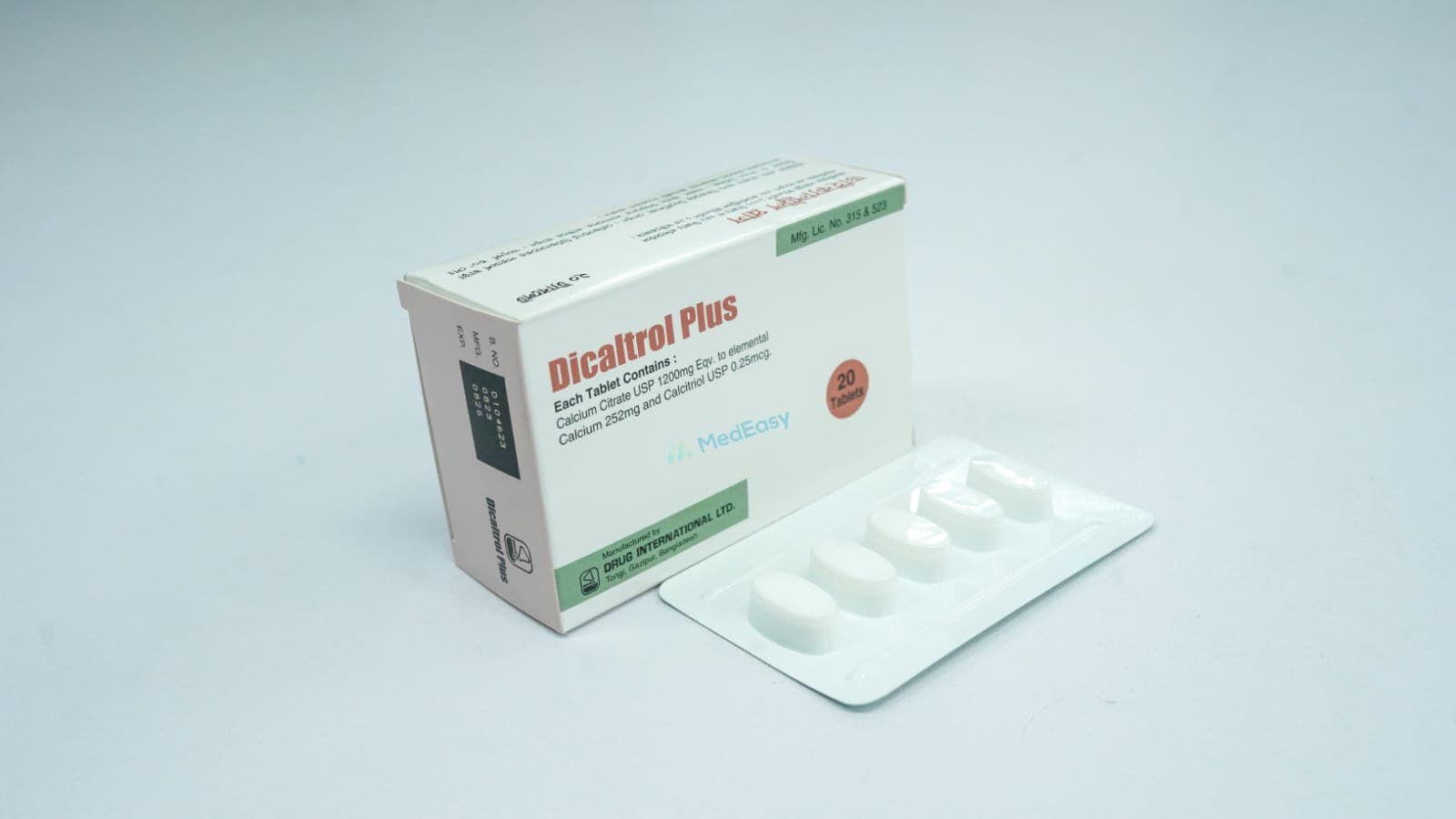
Dicaltrol Plus Tablet is available on MedEasy for ৳58.50 per 5's Strip, with home delivery anywhere in Bangladesh. It is manufactured by Drug International Ltd. Its generic name is Calcitriol + Calcium Citrate.
- Pack sizes
- 5's Strip, 20's Pack
- Prescription
- Not required (over-the-counter).
- Delivery
- Home delivery across Bangladesh. Same-day delivery in Dhaka, Chattogram, Sylhet and Bogura city areas; 2-3 days elsewhere.
- Payment
- Cash on delivery, bKash, cards and mobile banking.
- Brand
- Dicaltrol Plus
- Generic name
- Calcitriol + Calcium Citrate
- Manufacturer
- Drug International Ltd.
- Form & strength
- Tablet
- Availability
- In stock
- Authenticity
- Sourced from licensed suppliers and the manufacturer's authorised distributors in Bangladesh.

Medicine overview
Indications of Dicaltrol Plus
Dicaltrol Plus is a fixed-dose combination of calcitriol (the active, hormonally-functional form of vitamin D) and calcium citrate (an elemental calcium salt). It is used when both a rapidly-acting form of vitamin D and a well-absorbed calcium supplement are needed together.
Established / guideline-supported uses
- Management of hypocalcemia in patients with chronic kidney disease (predialysis and dialysis-dependent), where impaired renal activation of vitamin D limits calcium absorption.
- Management of hypocalcemia associated with hypoparathyroidism (surgical or idiopathic) and pseudohypoparathyroidism.
- Adjunctive management of osteoporosis, as part of a treatment plan that includes adequate calcium and vitamin D status.
Uses requiring combination/adjunct therapy
Dicaltrol Plus is typically used as an adjunct alongside other osteoporosis therapies (e.g., bisphosphonates) rather than as monotherapy for fracture prevention, and alongside phosphate binders and dietary phosphate control in chronic kidney disease.
Off-label use
Dicaltrol Plus is sometimes used off-label in vitamin D-dependent rickets and in postmenopausal women with vitamin D receptor resistance or malabsorption states, under specialist supervision; such use should be guided by a physician.
Composition
Each unit of Calcitriol + Calcium Citrate contains calcitriol (1,25-dihydroxyvitamin D3) as the active vitamin D component, combined with calcium citrate providing elemental calcium. Strengths of calcitriol and calcium citrate vary by brand and formulation; always check the product label for the exact strength dispensed.
Description
Dicaltrol Plus combines two agents that work together to correct and maintain normal calcium balance. Calcitriol is the biologically active metabolite of vitamin D3; unlike native vitamin D or vitamin D2/D3 supplements, it does not require further hydroxylation by the liver or kidney to become active, so it acts more rapidly and is especially useful in patients whose kidneys cannot activate vitamin D normally.
Calcium citrate is a highly bioavailable calcium salt that, unlike calcium carbonate, does not depend on stomach acid for absorption, making it suitable for patients with reduced gastric acidity or those on acid-suppressing therapy. Combining the two in Dicaltrol Plus ensures adequate substrate (calcium) is available for the enhanced intestinal absorption that calcitriol produces.
Therapeutic Class
Dicaltrol Plus belongs to the therapeutic class of vitamin D analogues (active form) combined with calcium supplements, used in calcium and bone metabolism disorders.
Pharmacology
Calcitriol is the active hormonal form of vitamin D (1,25-dihydroxycholecalciferol). It binds to vitamin D receptors in the intestine, bone, kidney and parathyroid gland to: increase intestinal absorption of calcium and phosphate; promote calcium mobilization from bone in conjunction with parathyroid hormone; increase renal tubular reabsorption of calcium; and suppress parathyroid hormone secretion. Because it does not require renal 1-alpha-hydroxylation, it remains effective even in advanced renal impairment, where endogenous activation of vitamin D is impaired.
Calcium citrate supplies elemental calcium that is absorbed in the small intestine (a process enhanced by calcitriol) and used for bone mineralization, neuromuscular function, cardiac conduction, and enzymatic processes. Calcium citrate is absorbed well independent of gastric pH.
Pharmacokinetics: Calcitriol is well absorbed orally, with peak plasma levels within 3-6 hours, a biologic half-life of approximately 5-8 hours, and is metabolized in the liver and kidney with excretion mainly in bile/feces. Calcium is absorbed in the proximal small intestine and excreted mainly via the kidney and gut.
Dosage & Administration of Dicaltrol Plus
General principle
Dosing of Dicaltrol Plus must be individualized based on serum calcium, phosphate, and parathyroid hormone levels, and titrated slowly under medical supervision.
| Indication | Typical adult dosing (calcitriol component) | Notes |
|---|---|---|
| Hypocalcemia in chronic kidney disease (dialysis) | 0.25 mcg once daily or every other day, adjusted by 0.25 mcg/day increments | Calcium citrate dose adjusted to maintain normal serum calcium |
| Hypoparathyroidism | 0.25 mcg once daily, titrated according to response | Some patients require higher doses under close monitoring |
| Osteoporosis (adjunct) | 0.25 mcg twice daily with elemental calcium as directed | Used with other anti-osteoporotic therapy |
Doses are increased only after checking serum calcium, generally not more often than every 2-4 weeks, since hypercalcemia can develop rapidly with calcitriol.
Administration of Dicaltrol Plus
Dicaltrol Plus is taken by mouth, generally with food to reduce gastrointestinal upset, unless the prescriber advises otherwise. Swallow tablets/capsules whole with a glass of water; do not crush chewable forms unless labeled for chewing. Take at the same time(s) each day and do not take with other calcium or vitamin D supplements unless directed by a physician.
Interaction of Dicaltrol Plus
- Thiazide diuretics: increase the risk of hypercalcemia when combined with Dicaltrol Plus; serum calcium should be monitored more closely.
- Digoxin and other cardiac glycosides: hypercalcemia from Dicaltrol Plus can potentiate digoxin toxicity and precipitate cardiac arrhythmias; concurrent use requires ECG and calcium monitoring.
- Other vitamin D analogues or supplements: concomitant use with Dicaltrol Plus increases the risk of hypervitaminosis D and hypercalcemia; avoid unless specifically directed.
- Magnesium-containing antacids: in patients with chronic kidney disease, concurrent use with Dicaltrol Plus may cause hypermagnesemia.
- Aluminum-containing antacids: chronic co-administration with Dicaltrol Plus may increase aluminum absorption and risk of aluminum toxicity, particularly in renal impairment.
- Cholestyramine, colestipol, or mineral oil: may reduce intestinal absorption of the calcitriol component of Dicaltrol Plus; separate dosing times.
- Oral bisphosphonates, tetracyclines, fluoroquinolones, and levothyroxine: the calcium citrate component of Dicaltrol Plus can reduce absorption of these drugs; separate administration by at least 2-4 hours.
- Corticosteroids: may antagonize the calcium-absorption-enhancing effect of Dicaltrol Plus.
Contraindications
- Known hypersensitivity to calcitriol, calcium citrate, or any component of Calcitriol + Calcium Citrate.
- Hypercalcemia.
- Evidence of vitamin D toxicity or hypervitaminosis D.
Calcitriol + Calcium Citrate should not be used in these settings; other cautions related to renal impairment, concurrent thiazide use, or hyperphosphatemia are addressed under Precautions and Warnings rather than being absolute contraindications.
Side Effects of Dicaltrol Plus
Most adverse effects of Dicaltrol Plus relate to excess calcium/vitamin D activity (hypercalcemia) or to the calcium citrate component itself.
Common
- Constipation, bloating, or gas (calcium citrate component)
- Mild nausea, dry mouth, or metallic taste
- Headache
Less common but clinically important (usually related to hypercalcemia)
- Weakness, fatigue, somnolence
- Anorexia, vomiting, abdominal pain
- Polyuria, polydipsia
- Hypercalciuria and, with prolonged hypercalcemia/hyperphosphatemia, soft tissue or vascular calcification and nephrocalcinosis
Patients should report symptoms suggestive of hypercalcemia promptly (see Precautions and Warnings).
Pregnancy & Lactation
Dicaltrol Plus should be used in pregnancy only if clearly needed and if the potential benefit justifies the potential risk to the fetus; a physician should individualize therapy and monitor maternal serum calcium, as both hypocalcemia and hypercalcemia during pregnancy can affect maternal and fetal outcomes.
Calcitriol and calcium are excreted into breast milk to some degree. Dicaltrol Plus should be used during breastfeeding only under medical supervision, with monitoring of the infant for signs of hypercalcemia if maternal doses are high. Consult a physician before using Dicaltrol Plus during pregnancy or lactation.
Precautions & Warnings
Hypercalcemia
Unlike standard vitamin D, the calcitriol component of Dicaltrol Plus acts rapidly, so hypercalcemia can develop faster and progress more acutely than with native vitamin D. Serum calcium should be monitored frequently (e.g., twice weekly during dose titration, then periodically thereafter) and the dose reduced or therapy interrupted promptly if hypercalcemia occurs.
Renal impairment
Dicaltrol Plus is frequently used specifically because renal activation of vitamin D is impaired; nonetheless, doses must be individualized carefully in renal impairment, with regular monitoring of serum calcium, phosphate, and renal function, because clearance of calcium and the risk of metastatic calcification are altered.
Concurrent thiazide diuretics
Co-administration of Dicaltrol Plus with thiazide diuretics increases the risk of hypercalcemia; closer monitoring is warranted (see Interactions).
Hyperphosphatemia
Because calcitriol also increases phosphate absorption, serum phosphate should be monitored during Dicaltrol Plus therapy; concurrent hyperphosphatemia and hypercalcemia raise the risk of extraskeletal (soft tissue, vascular) calcification.
Monitoring
Periodic monitoring of serum calcium, phosphate, and renal function is required throughout treatment with Dicaltrol Plus, particularly during dose adjustment.
Overdose Effects of Dicaltrol Plus
Overdose of Dicaltrol Plus presents primarily as acute or chronic hypercalcemia, with symptoms such as weakness, headache, nausea, vomiting, constipation, confusion, drowsiness, and, in severe cases, cardiac arrhythmias or renal impairment.
If overdose is suspected, discontinue Dicaltrol Plus and seek immediate medical attention or contact emergency services / a poison control center. Do not attempt specific home treatment; management (which may include intravenous fluids, monitoring of cardiac rhythm and serum calcium, and other supportive measures) should only be carried out by medical professionals.
Storage Conditions
Store at room temperature (below 30°C), away from light and moisture. Keep out of reach of children.
Use In Special Populations
Renal impairment
Dicaltrol Plus is commonly used in chronic kidney disease-associated hypocalcemia, but dosing must be individualized and monitored closely (see Precautions and Warnings).
Hepatic impairment
Because calcitriol does not require hepatic activation, mild-to-moderate hepatic impairment has limited effect on its action; however, caution and monitoring are still advised.
Elderly
Elderly patients, who more often have reduced renal function, should be monitored closely for hypercalcemia and renal effects during Dicaltrol Plus therapy.
Pediatric patients
See Pediatric Uses below.
Duration Of Treatment
Duration of Dicaltrol Plus therapy is determined by the underlying condition and is typically long-term/chronic (e.g., in hypoparathyroidism or chronic kidney disease), with periodic reassessment of serum calcium, phosphate, and parathyroid hormone levels to guide continuation or dose adjustment. Treatment should not be stopped or extended without medical advice.
Drug Classes
Active vitamin D analogue (calcitriol) plus calcium supplement (calcium citrate) fixed-dose combination.
Mode Of Action
Calcitriol + Calcium Citrate acts through two complementary mechanisms. Calcitriol binds intracellular vitamin D receptors, upregulating calcium-transport proteins in intestinal cells to directly increase intestinal calcium (and phosphate) absorption without needing further renal or hepatic activation; it also acts on bone and kidney to help maintain serum calcium and modulates parathyroid hormone secretion. Calcium citrate supplies readily absorbable elemental calcium as the substrate for this enhanced absorption, supporting bone mineralization and normal neuromuscular and cardiac function.
Pregnancy
C
Pediatric Uses
Dicaltrol Plus may be used in pediatric patients with conditions such as hypocalcemia of chronic kidney disease (including dialysis-dependent children) or hypoparathyroidism, with dosing individualized by age, weight, and serum calcium/phosphate response under specialist supervision. For many fixed-dose combination products of Dicaltrol Plus, safety and efficacy in children have not been separately established, so pediatric use should rely on the individual components' pediatric data and be directed by a pediatric specialist. Close monitoring for hypercalcemia is essential in children, as growth and bone development can be affected by both under- and over-treatment.
Frequently Asked Questions
Q: What is Dicaltrol Plus Tablet used for?
A: Dicaltrol Plus Tablet is used to treat and prevent hypocalcemia (low blood calcium) in conditions such as chronic kidney disease and hypoparathyroidism, and as part of osteoporosis management, by supplying both the active form of vitamin D and a well-absorbed calcium supplement.
Q: How should I take Dicaltrol Plus Tablet?
A: Dicaltrol Plus Tablet is usually taken by mouth, often with food, exactly as prescribed. Do not change the dose or stop treatment without consulting your physician, since the calcitriol component works quickly and dose changes affect blood calcium levels rapidly.
Q: What are the main side effects of Dicaltrol Plus Tablet?
A: The most common effects are constipation, bloating, mild nausea, or headache. More important is the risk of hypercalcemia (high blood calcium), which can cause weakness, confusion, vomiting, or irregular heartbeat; report such symptoms to your doctor promptly while taking Dicaltrol Plus Tablet.
Q: Can Dicaltrol Plus Tablet be taken during pregnancy or breastfeeding?
A: Dicaltrol Plus Tablet should be used in pregnancy or while breastfeeding only if a physician determines it is clearly needed, since safety data are limited; your doctor will weigh the benefits against potential risks and monitor your calcium levels closely.
Q: Who should not take Dicaltrol Plus Tablet?
A: Dicaltrol Plus Tablet should not be used by anyone with hypercalcemia, evidence of vitamin D toxicity, or a known hypersensitivity to calcitriol, calcium citrate, or related components. Other situations, such as kidney disease or use with thiazide diuretics, require caution and closer monitoring rather than being outright prohibited.
Q: What should I do if I miss a dose or take too much Dicaltrol Plus Tablet?
A: If you miss a dose of Dicaltrol Plus Tablet, take it as soon as you remember unless it is close to the next dose; do not double up. If you suspect an overdose (symptoms like severe nausea, confusion, or irregular heartbeat), stop the medicine and seek immediate medical attention or contact a poison control center.
Disclaimer
The information provided is accurate to the best of our knowledge, but it does not replace professional medical advice. We cannot guarantee its completeness or accuracy, and the absence of specific information about a drug should not be taken as an endorsement. We are not responsible for any consequences arising from this information, so please consult a healthcare professional for any concerns or questions.