
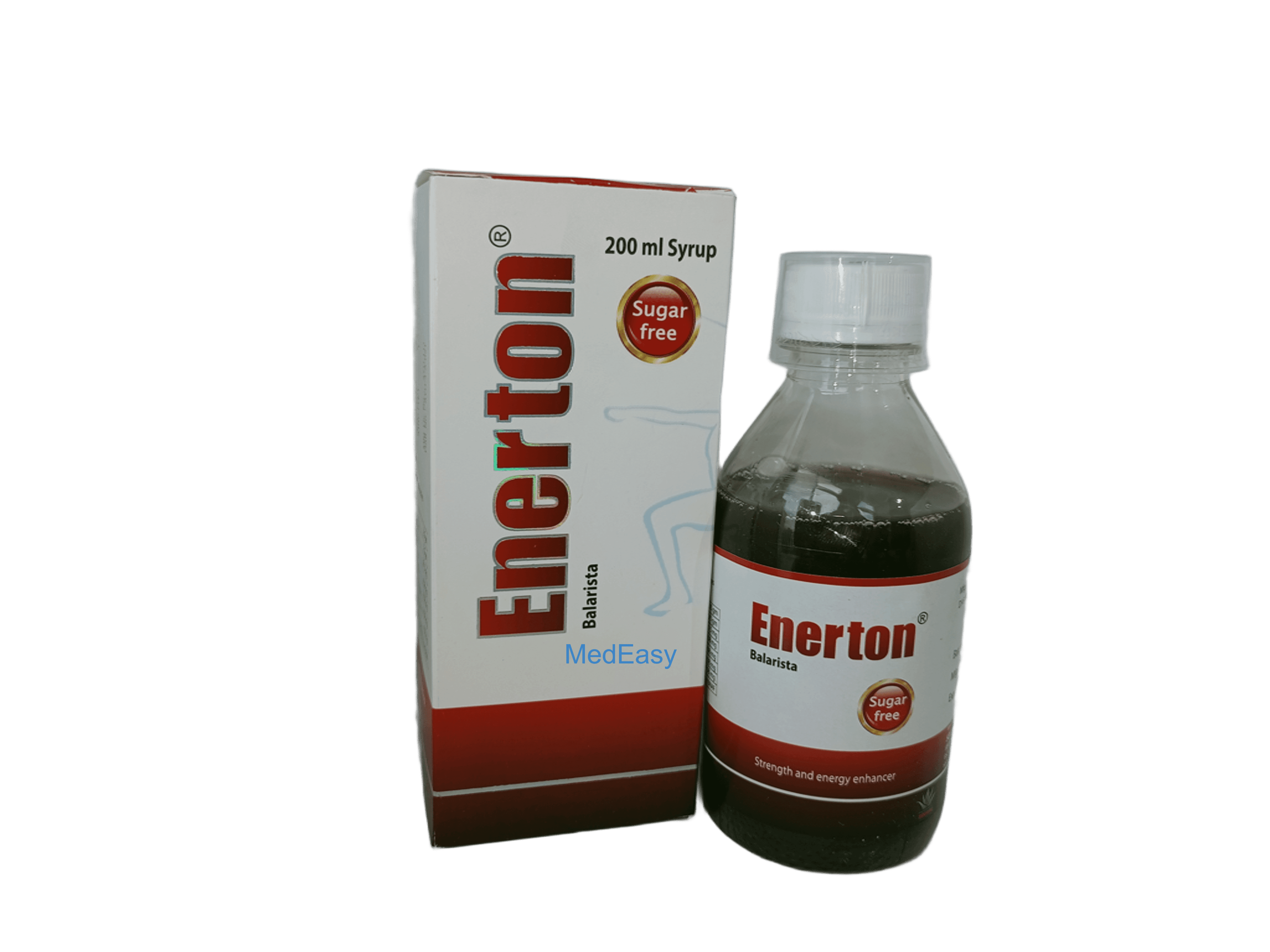

Medicine overview
Indications of Enerton
Enerton is a traditional Ayurvedic polyherbal fermented liquid preparation (an "Arishta")built around Bala (Sida cordifolia) root. Evidence for arishta-type formulations comes mainly fromtraditional Ayurvedic texts and long-standing clinical use rather than controlled modern clinical trials, soindications below are presented conservatively.
Traditionally used for (evidence-limited, traditional/experience-based use):
- General restorative tonic for debility and weakness (as a Rasayana/rejuvenative preparation)
- Supportive care during the postpartum recovery period, traditionally administered under practitioner guidance after delivery
- Supportive management of general nervous system and musculoskeletal weakness in traditional (Vata-predominant) conditions
- Adjunct supportive use alongside standard medical care for chronic fatigue or convalescence, as advised by a qualified practitioner
Enerton is not FDA-approved and does not have standardized clinical-trial-based indications like a conventional pharmaceutical;it should be used as an adjunct under professional guidance and not as a substitute for evidence-based medical treatment of any underlying condition.
Composition
Balarista is a polyherbal fermented liquid (Arishta) formulated primarily around Bala(Sida cordifolia) root, traditionally combined with other supportive herbs. Like classical arishtapreparations, it is fermented using a jaggery/Dhataki (Woodfordia fruticosa) flower base, whichgenerates a small amount of self-produced alcohol (typically in the range seen in arishta-type products, commonlyaround 5-10% v/v, though this varies by manufacturer).
Exact standardized composition, excipients, and alcohol content can vary between manufacturers and could not beindependently verified for every marketed product; patients should check the label of the specific product dispensedor ask their pharmacist/physician for the precise ingredient list.
Description
Enerton belongs to a class of classical Ayurvedic self-fermented liquid preparations known as"Arishta," used in traditional medicine for generations, chiefly as a general tonic and postpartum supportiveremedy. (Note: the spelling "Enerton" is preserved exactly as provided; it is commonly known in Ayurvedic literatureunder the similar name "Balarishta.")
Because standardized composition and dosing have not been independently verified across all marketed products,and rigorous modern clinical trial evidence for arishta-type formulations is generally limited, this content ispresented conservatively and is not a substitute for professional medical or Ayurvedic advice.
Therapeutic Class
Ayurvedic/herbal tonic (Rasayana) - polyherbal fermented liquid preparation (Arishta); Enerton is classified as a traditional medicine, not a conventional allopathic pharmaceutical.
Pharmacology
Balarista has not been subjected to the type of rigorous modern pharmacological and clinical trialevaluation used for conventional pharmaceuticals, so its pharmacology cannot be stated with the same certainty.
In traditional Ayurvedic understanding, the primary herb, Bala (Sida cordifolia), is regarded as havingmild anti-inflammatory, analgesic, and Vata-balancing (nervous system and musculoskeletal supportive) properties,and the overall fermented preparation is traditionally considered a general restorative (Rasayana) tonic. Thesetraditional attributions are based on classical texts and longstanding use rather than validated modernpharmacodynamic/pharmacokinetic studies, and should be understood as evidence-limited.
Dosage & Administration of Enerton
| Use | Adult dose | Notes |
|---|---|---|
| General debility / restorative tonic use | 15-30 mL, twice daily after meals | Mix with an equal quantity of water; take exactly as directed on the product label or by a qualified practitioner |
| Postpartum recovery support | 15-30 mL, twice daily after meals, as advised by an Ayurvedic practitioner/physician | Traditionally started after delivery under professional supervision; duration individualized |
Pediatric dosing is not established (see Use in Special Populations). There is no well-established renal orhepatic dose adjustment for Enerton; however, caution is advised in hepatic impairment given its self-generatedalcohol content (see Precautions and Warnings).
Do not exceed the recommended dose. Do not use for longer than advised without reassessment by a qualifiedpractitioner.
Administration of Enerton
Take Enerton orally after meals, diluted with an equal quantity of water, exactly as directed on the product label or by a qualified Ayurvedic practitioner/physician. Do not take on an empty stomach unless advised.
Interaction of Enerton
Enerton has not been formally studied for drug interactions in controlled clinical trials, so the list belowreflects well-recognized, mechanism-based cautions rather than an exhaustive evidence base.
- Alcohol and other CNS depressants (e.g., sedatives, sleep aids): Enerton contains self-generatedalcohol from fermentation; combining it with alcohol or other central nervous system depressants may increasedrowsiness and sedation.
- Disulfiram, metronidazole, and other alcohol-interacting medicines: the alcohol content ofEnerton may provoke a disulfiram-like reaction (flushing, nausea, palpitations) in patients taking these medicines;avoid concurrent use.
- Other prescription or herbal medicines: because formal interaction studies are lacking,patients taking other prescription medicines (especially for liver disease, seizure disorders, or psychiatricconditions) should inform their physician before starting Enerton.
Contraindications
- Known hypersensitivity to Balarista or any of its herbal ingredients.
- Pregnancy: Balarista is contraindicated during pregnancy because of its self-generated alcohol content andinsufficient safety data for use during gestation (see Pregnancy and Lactation for detail on postpartum use, which is distinct).
- Known alcohol-use disorder, or patients who must strictly avoid alcohol (e.g., taking disulfiram ormetronidazole), because of the self-generated alcohol content inherent to arishta-type preparations such as Balarista.
Side Effects of Enerton
Because Enerton has limited formal adverse-event surveillance compared with conventional pharmaceuticals, thefollowing reflects reported/expected effects based on its composition rather than large-scale trial data:
- Mild gastrointestinal upset (nausea, indigestion) in sensitive individuals
- Hypersensitivity reactions such as rash or itching (uncommon)
- Mild drowsiness or lightheadedness related to its self-generated alcohol content, particularly if taken withother sedating substances
Discontinue Enerton and seek medical advice if any concerning or persistent adverse effect occurs.
Pregnancy & Lactation
Pregnancy: Enerton is contraindicated for use during pregnancy because of its self-generatedalcohol content and insufficient safety data on fetal risk. It is traditionally administered only after delivery,during the postpartum recovery period, and even then only under the guidance of a qualified Ayurvedic practitioneror physician; it should not be used during pregnancy itself.
Lactation: Safety data on Enerton during breastfeeding are limited. Because of its alcoholcontent, it should be used during breastfeeding only if clearly needed and only under the guidance of a qualifiedpractitioner or physician who can weigh potential benefit against potential risk to the infant.
Precautions & Warnings
- Use Enerton only under the guidance of a qualified Ayurvedic practitioner or physician; it is not intended forunsupervised self-medication of significant medical conditions.
- Discontinue use and seek medical advice if any adverse effect occurs.
- Enerton is not a substitute for evidence-based medical care for significant weakness, pain, postpartumcomplications, or other symptoms; seek standard medical evaluation for such symptoms.
- Contains self-generated alcohol from fermentation; use caution when driving or operating machinery, and avoidin individuals who must abstain from alcohol (see Contraindications).
- Use with caution in patients with liver disease, given the alcohol content.
- Keep out of reach of children.
- Indications and benefits of Enerton are presented conservatively, as standardized composition and rigorousclinical trial evidence for arishta-type formulations are generally limited.
Overdose Effects of Enerton
Specific overdose data for Enerton are not well documented. Taking substantially more than the recommended dosemay worsen gastrointestinal upset or produce alcohol-related effects such as drowsiness, dizziness, or nausea dueto its self-generated alcohol content.
If an overdose is suspected, seek immediate medical attention or contact a poison control center/emergencyservices right away. Do not attempt specific home treatment.
Storage Conditions
Store at room temperature (below 30°C), away from light and moisture. Keep out of reach of children.
Use In Special Populations
- Children: Safety and efficacy of Enerton have not been established in children, largely becauseof its self-generated alcohol content and lack of pediatric safety data; use in children is not recommended unlessspecifically directed by a qualified Ayurvedic physician.
- Elderly: Limited specific data are available; use cautiously under practitioner guidance,particularly in those with hepatic impairment or on other sedating medicines.
- Hepatic impairment: Use with caution given the self-generated alcohol content; consult aphysician before use.
- Renal impairment: No well-established dose adjustment; use under practitioner guidance.
Duration Of Treatment
Enerton is typically used as a course lasting several weeks to a few months for general restorative or postpartumsupportive purposes, as advised by a qualified Ayurvedic practitioner or physician. It is not intended forindefinite, unsupervised self-directed use; treatment duration and continued need should be reassessed periodicallywith a practitioner.
Drug Classes
Ayurvedic polyherbal fermented liquid tonic (Arishta); traditional Rasayana (rejuvenative) preparation; Balarista is not classified within conventional allopathic drug classes.
Mode Of Action
Balarista does not have a modern, clinically validated mechanism of action in the way conventional pharmaceuticalsdo. In traditional Ayurvedic understanding, its principal herb, Bala (Sida cordifolia), is considered tohelp balance Vata dosha and provide general restorative (Rasayana) support to the nervous and musculoskeletalsystems. These explanations come from classical Ayurvedic theory and traditional use rather than controlledpharmacological studies, and should be regarded as evidence-limited.
Pediatric Uses
Safety and efficacy of Enerton have not been established in children. Because of its self-generated alcoholcontent and the absence of pediatric safety data, use of Enerton in children is not recommended unless specificallydirected and supervised by a qualified Ayurvedic physician.
Frequently Asked Questions
Q: What is Enerton 200 ml Syrup used for?
A: Enerton 200 ml Syrup is a traditional Ayurvedic polyherbal tonic (an "Arishta" built around Bala/Sida cordifolia root) traditionally used as a general restorative tonic for debility and weakness, and as postpartum recovery support under practitioner guidance. Evidence for these traditional uses is based mainly on classical Ayurvedic experience rather than rigorous modern clinical trials.
Q: Can I take Enerton 200 ml Syrup during pregnancy?
A: No. Enerton 200 ml Syrup is contraindicated during pregnancy because it contains self-generated alcohol from fermentation and there is insufficient safety data for use during gestation. It is traditionally used only after delivery, during postpartum recovery, and even then only under professional guidance.
Q: Is Enerton 200 ml Syrup safe while breastfeeding?
A: Safety data during breastfeeding are limited, and because Enerton 200 ml Syrup contains alcohol from fermentation, it should be used while breastfeeding only if clearly needed and only under the guidance of a qualified practitioner or physician.
Q: Can children take Enerton 200 ml Syrup?
A: No, Enerton 200 ml Syrup is not recommended for children because safety and efficacy have not been established in this age group, largely due to its self-generated alcohol content and lack of pediatric safety data, unless a qualified Ayurvedic physician specifically directs otherwise.
Q: What is the usual dose of Enerton 200 ml Syrup?
A: The usual adult dose is 15-30 mL twice daily after meals, mixed with an equal quantity of water, or as directed by a qualified Ayurvedic practitioner or physician. Do not exceed the recommended dose.
Q: Who should avoid Enerton 200 ml Syrup?
A: Enerton 200 ml Syrup should be avoided by anyone with known hypersensitivity to it or its ingredients, pregnant women, and people with a known alcohol-use disorder or who must strictly avoid alcohol (for example, those taking disulfiram or metronidazole), because Enerton 200 ml Syrup contains self-generated alcohol from fermentation.
Disclaimer
The information provided is accurate to the best of our knowledge, but it does not replace professional medical advice. We cannot guarantee its completeness or accuracy, and the absence of specific information about a drug should not be taken as an endorsement. We are not responsible for any consequences arising from this information, so please consult a healthcare professional for any concerns or questions.
