
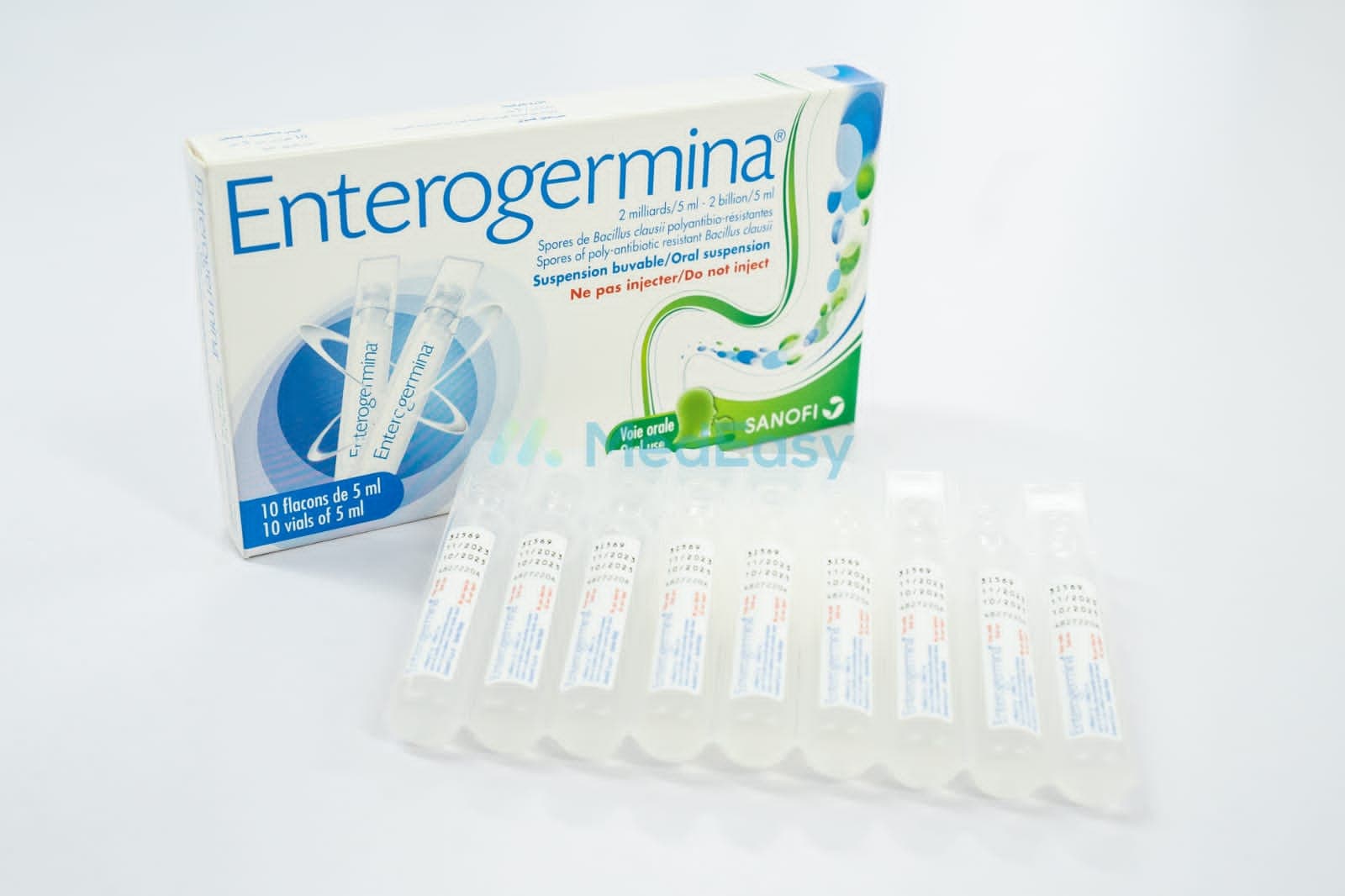

Medicine overview
Indications of Enterogermina
Enterogermina is a spore-forming probiotic supplement used to help restore and maintain a healthy balance of gut bacteria.
Evidence-supported use
- Prevention and management of antibiotic-associated diarrhea: Enterogermina has reasonable clinical evidence supporting its use, taken concurrently with or after a course of antibiotics, because its resistant spore form survives gastric acid and can be given alongside antibiotic therapy.
Adjunct / general digestive health use
- General support of digestive health and gut microbiota balance during diarrhea from other causes (e.g., acute infectious or dietary diarrhea) as an adjunct to standard treatment, not a replacement for it.
- Supportive use in mild dysbiosis-related digestive discomfort; evidence for these broader digestive claims is more limited than for antibiotic-associated diarrhea and should be presented with appropriately modest expectations.
Enterogermina is not a treatment for the underlying cause of diarrhea or infection and does not replace medical evaluation for significant or persistent gastrointestinal illness.
Composition
Each dose (capsule/sachet/oral suspension, depending on product presentation) of Bacillus Clausii spores contains live, resistant spores of the bacterium Bacillus clausii, typically standardized to provide a stated number of colony-forming units (CFU), commonly around 2 billion CFU per dose. Excipients vary by manufacturer and formulation.
Description
Enterogermina is a probiotic dietary/medicinal supplement containing live spores of Bacillus clausii, a gram-positive, spore-forming bacterium. Unlike many probiotic organisms, its spore form is naturally resistant to gastric acid and bile, allowing it to survive passage through the stomach and germinate in the intestine, and it is relatively resistant to co-administration with many antibiotics.
Enterogermina is widely used to help re-establish normal intestinal microbial balance, most notably during and after antibiotic therapy, and as general supportive care for digestive wellbeing.
Therapeutic Class
Pharmacology
Mechanism
Bacillus Clausii spores works through several complementary mechanisms attributed to its live bacterial spores:
- The spores are resistant to gastric acid, bile salts, and digestive enzymes, allowing viable organisms to reach and germinate in the small intestine.
- Germinated bacteria produce antimicrobial substances (including bacteriocin-like compounds) that inhibit the growth of certain pathogenic and gram-positive organisms.
- They contribute to restoration of normal intestinal flora balance disturbed by antibiotic therapy or gastrointestinal illness.
- They support intestinal barrier function and may modulate local immune responses within the gut.
Because of the spore form's relative resistance, Bacillus Clausii spores can generally be administered during a course of antibiotics, distinguishing it from many non-spore-forming probiotic strains.
Dosage & Administration of Enterogermina
General dosing principles
Dosing of Enterogermina varies by product strength and presentation (capsule, sachet, or oral suspension); always follow the product label or physician's instructions.
| Indication | Population | Typical Dose |
|---|---|---|
| Prevention/management of antibiotic-associated diarrhea | Adults | 1 sachet/capsule (~2 billion CFU) 1–3 times daily, for the duration of antibiotic therapy and typically continued for a few days after |
| Prevention/management of antibiotic-associated diarrhea | Children (per product labeling, generally above infancy) | 1 sachet/capsule once or twice daily, or as directed by a pediatrician; see Pediatric Use |
| General digestive support | Adults and children per label | 1 sachet/capsule once daily, or as directed |
Administration
Sachet/powder forms may be taken directly or mixed with a small amount of water, milk, or juice (avoid very hot liquids, which may reduce spore viability). Capsules are swallowed whole with water. When taken with antibiotics, allow a short interval (e.g., 2–3 hours) between the antibiotic dose and Enterogermina where practical, consistent with product labeling.
Administration of Enterogermina
Enterogermina sachets can be opened and the contents taken directly on the tongue, or dissolved in a small amount of cool or lukewarm water, milk, or fruit juice immediately before use; avoid mixing with hot beverages. Capsules should be swallowed whole with a glass of water. Enterogermina may be taken with or without food. If used alongside antibiotics, spacing the dose a couple of hours apart from the antibiotic dose is a reasonable precaution, following the specific product's label guidance.
Interaction of Enterogermina
Antibiotics: Enterogermina's spore form is relatively resistant to most antibiotics, so it can generally be taken during antibiotic therapy; however, following product-specific spacing guidance (e.g., separating doses by a couple of hours) is a reasonable precaution to maximize spore survival.
Immunosuppressive therapy: Use in patients on significant immunosuppressive treatment should be guided by a physician, given a small reported risk of bacteremia with live bacterial probiotics in vulnerable hosts (see Contraindications).
No other well-established, clinically significant drug interactions have been identified for Enterogermina.
Contraindications
- Known hypersensitivity to Bacillus Clausii spores or any component of the formulation.
- Severely immunocompromised patients (e.g., significant congenital or acquired immunodeficiency, active malignancy on chemotherapy).
- Critically ill patients.
- Patients with a central venous catheter in place.
- Patients with short-gut syndrome.
These contraindications reflect case reports of probiotic-associated bacteremia with Bacillus species in such vulnerable populations; Bacillus Clausii spores should be used only under direct medical guidance, if at all, in these groups.
Side Effects of Enterogermina
Enterogermina is generally well tolerated. Mild, transient gastrointestinal symptoms (such as bloating, gas, or mild abdominal discomfort) may occasionally occur, particularly when starting treatment, and typically resolve on their own.
Rare cases of bacteremia or systemic infection with Bacillus species have been reported in immunocompromised or critically ill patients (see Contraindications). Hypersensitivity reactions are rare but possible.
Pregnancy & Lactation
Data on the use of Enterogermina in pregnancy and lactation are limited. As with any supplement, Enterogermina should be used during pregnancy or breastfeeding only if clearly needed and if the potential benefit justifies the potential risk; a physician should be consulted before use in these situations.
Precautions & Warnings
- Enterogermina is not a substitute for medical treatment of significant or persistent gastrointestinal illness.
- Seek prompt medical evaluation for red-flag symptoms such as blood in the stool, high fever, or signs of severe dehydration, rather than relying on Enterogermina alone.
- Use only under medical guidance in immunocompromised, critically ill, or catheterized patients, or those with short-gut syndrome (see Contraindications).
- Evidence supporting Enterogermina varies by indication: it is best supported for antibiotic-associated diarrhea, with more limited evidence for other general digestive health claims; expectations should be set accordingly.
Overdose Effects of Enterogermina
Enterogermina has a wide margin of safety, and significant toxicity from excess intake is not expected given its nature as a live bacterial spore supplement. Taking more than the recommended dose may increase the likelihood of mild gastrointestinal upset. If a large accidental overdose occurs or the person develops concerning symptoms, seek immediate medical attention or contact a poison control center/emergency services rather than attempting home treatment.
Storage Conditions
Store at room temperature (below 30°C), away from light and moisture. Keep out of reach of children.
Use In Special Populations
- Elderly: No specific dose adjustment is generally required for Enterogermina; use as per standard adult dosing, considering overall health status.
- Renal/hepatic impairment: No well-established dose adjustment is required for Enterogermina, as systemic absorption of the organism is not expected in patients with intact gut integrity.
- Immunocompromised patients, those with central venous catheters, critical illness, or short-gut syndrome: See Contraindications — Enterogermina should be avoided or used only under direct medical supervision.
- Pediatric patients: See Pediatric Use.
- Pregnancy and lactation: See Pregnancy and Lactation.
Duration Of Treatment
For prevention or management of antibiotic-associated diarrhea, Enterogermina is typically continued for the full duration of the antibiotic course and, in some regimens, for a few additional days afterward. For general digestive support, it is commonly used for short courses of one to two weeks or as directed by a physician or the product label. Enterogermina is not intended for indefinite, unsupervised long-term use without medical review.
Drug Classes
Mode Of Action
Bacillus Clausii spores exerts its effect through acid- and bile-resistant bacterial spores that survive transit through the stomach, germinate in the intestine, and help restore normal gut flora by producing antimicrobial substances, competing with pathogenic organisms, and supporting intestinal barrier integrity.
Pediatric Uses
Enterogermina is commonly used in children, including for prevention/management of antibiotic-associated diarrhea, following product-specific age and dose recommendations; however, formal safety and efficacy data in very young infants (e.g., neonates and infants under a few months of age) are limited, and safety and efficacy in these youngest age groups have not been firmly established. Use in infants and young children should be guided by a pediatrician, with particular caution in premature infants or those with underlying immune or gastrointestinal conditions, given rare reports of bacteremia with Bacillus species in vulnerable infants.
Frequently Asked Questions
Q: What is Enterogermina 5 ml . used for?
A: Enterogermina 5 ml . is a probiotic supplement mainly used to help prevent or manage diarrhea associated with antibiotic use, and more generally to support a healthy balance of gut bacteria.
Q: Can I take Enterogermina 5 ml . together with antibiotics?
A: Yes. The spore form of Enterogermina 5 ml . is relatively resistant to most antibiotics, so it can usually be taken during a course of antibiotics. It is still reasonable to separate the doses by a couple of hours, following the specific product's label guidance, to help maximize spore survival.
Q: Are there people who should not take Enterogermina 5 ml .?
A: Yes. Enterogermina 5 ml . should be avoided, or used only under direct medical supervision, in people who are severely immunocompromised, critically ill, have a central venous catheter in place, or have short-gut syndrome, because of rare reports of bacteremia (bloodstream infection) with Bacillus species in these vulnerable groups. Anyone with a known hypersensitivity to Enterogermina 5 ml . should not use it.
Q: Is Enterogermina 5 ml . safe during pregnancy or breastfeeding?
A: Data are limited. Enterogermina 5 ml . should be used during pregnancy or breastfeeding only if clearly needed, after consulting a physician about the potential benefits and risks.
Q: What side effects can Enterogermina 5 ml . cause?
A: Enterogermina 5 ml . is usually well tolerated. Some people notice mild, temporary bloating, gas, or stomach discomfort, especially when first starting. Serious side effects are rare and occur mainly in vulnerable, immunocompromised individuals.
Q: What should I do if diarrhea does not improve while taking Enterogermina 5 ml .?
A: Enterogermina 5 ml . is not a substitute for medical treatment. If diarrhea is severe, persistent, or accompanied by blood in the stool, high fever, or signs of dehydration, stop relying on Enterogermina 5 ml . alone and seek medical evaluation promptly.
Disclaimer
The information provided is accurate to the best of our knowledge, but it does not replace professional medical advice. We cannot guarantee its completeness or accuracy, and the absence of specific information about a drug should not be taken as an endorsement. We are not responsible for any consequences arising from this information, so please consult a healthcare professional for any concerns or questions.
