
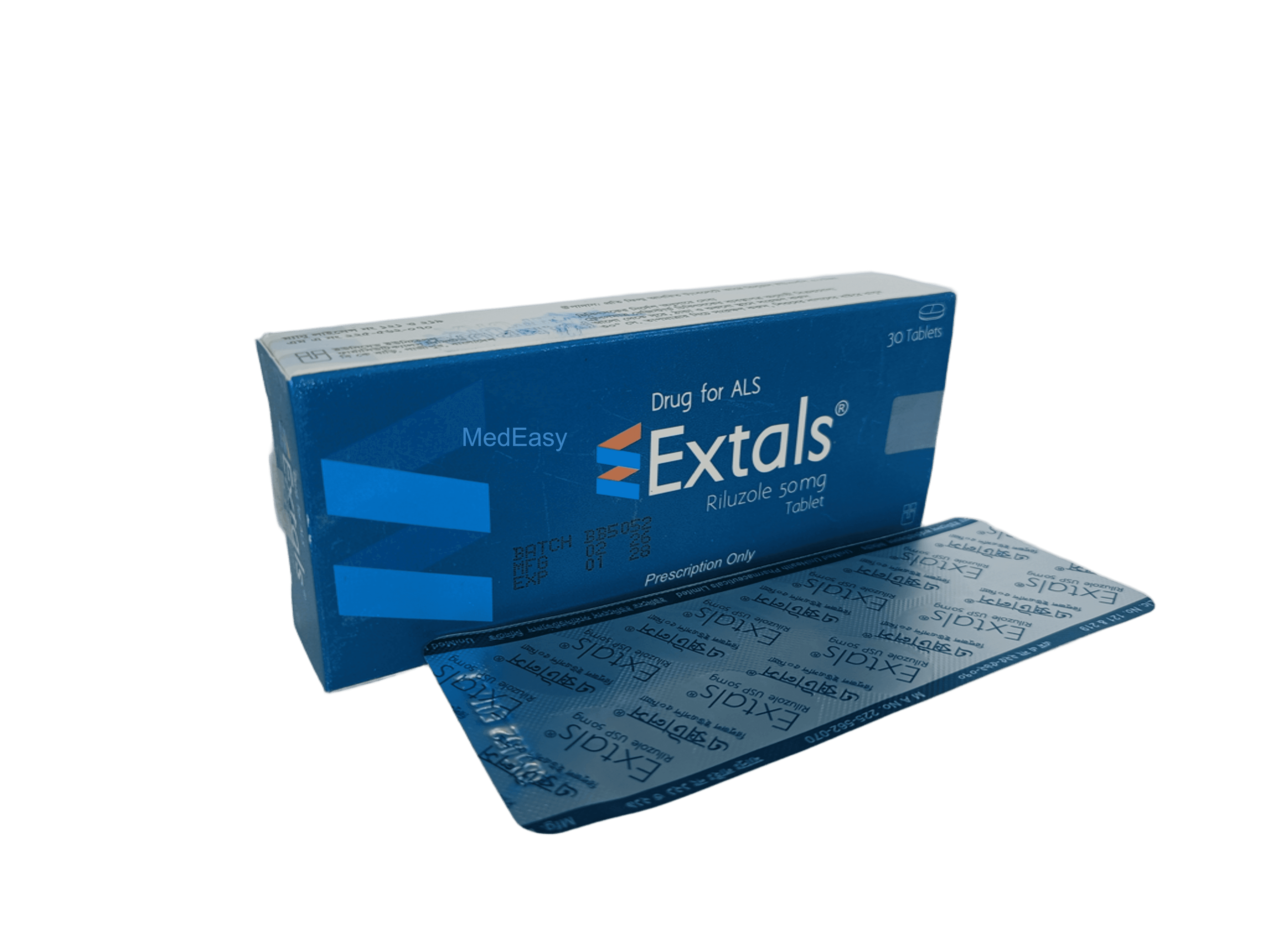

Medicine overview
Indications of Extals
Extals is indicated for the treatment of amyotrophic lateral sclerosis (ALS), also known as motor neuron disease. It is an FDA-approved, guideline-supported disease-modifying therapy shown to modestly prolong survival and/or extend the time to tracheostomy or mechanical ventilation in patients with ALS.
- Established/FDA-approved use: Treatment of ALS in adults, across clinical subtypes (bulbar-onset and limb-onset), typically initiated as soon as the diagnosis is confirmed.
Extals does not reverse motor neuron damage that has already occurred, does not improve muscle strength or function, and is not a cure for ALS; its benefit is a modest extension of survival time. Extals is not approved or indicated for other forms of motor neuron disease, general neuroprotection, or any condition outside ALS.
Composition
Each tablet of Riluzole contains Riluzole 50 mg as the active ingredient, along with pharmaceutically approved excipients. Riluzole is also available in some markets as an oral suspension (50 mg/10 mL) and as an orally disintegrating tablet, each formulated to deliver an equivalent 50 mg dose of Riluzole per unit.
Description
Extals is a benzothiazole-class, glutamate-modulating agent used specifically in the management of amyotrophic lateral sclerosis (ALS). It was one of the first agents shown in randomized controlled trials to extend survival in ALS patients and remains a standard-of-care disease-modifying option alongside supportive and symptomatic care.
Extals is administered orally, generally on an empty stomach, and is available as conventional tablets, an oral suspension, and an orally disintegrating tablet, allowing flexibility for patients with swallowing difficulties (dysphagia), which are common in ALS.
Therapeutic Class
Extals belongs to the therapeutic class of glutamate-modulating / neuroprotective agents used in motor neuron disease. Chemically, Extals is a benzothiazole derivative and is the prototype agent in this narrow drug class, which is specifically developed for ALS rather than general neurological or psychiatric use.
Pharmacology
The precise mechanism by which Riluzole exerts its therapeutic effect in ALS is not completely established, but several complementary actions have been described:
- Inhibition of presynaptic glutamate release, reducing excitotoxic stimulation of motor neurons.
- Inactivation of voltage-dependent sodium channels, which may reduce excessive neuronal excitability.
- Interference with intracellular events that follow glutamate binding at excitatory amino acid receptors.
Through these actions, Riluzole is thought to reduce glutamate-mediated excitotoxic damage to motor neurons, which is believed to contribute to the progression of ALS. Riluzole is well absorbed orally (absorption is reduced by food), is extensively metabolized in the liver primarily via CYP1A2, and has an elimination half-life of approximately 9-15 hours.
Dosage & Administration of Extals
| Indication | Population | Recommended Dose |
|---|---|---|
| Amyotrophic lateral sclerosis (ALS) | Adults | 50 mg orally twice daily (total 100 mg/day), taken at least 1 hour before or 2 hours after a meal |
| Amyotrophic lateral sclerosis (ALS) | Pediatric patients | Safety and efficacy not established; not recommended |
| Hepatic impairment (mild-moderate) | Adults | Use with caution and close liver function monitoring; not recommended if baseline transaminases are markedly elevated (see Contraindications) |
| Renal impairment | Adults | No well-established dose adjustment; limited data, use with caution |
Doses higher than 100 mg/day do not provide additional benefit and increase the risk of adverse effects. Extals is intended for long-term use as tolerated; do not stop or change the dose without consulting a physician.
Administration of Extals
Extals should be taken consistently at the same times each day, at least 1 hour before or 2 hours after a meal, because food reduces its absorption. Tablets should be swallowed whole with water. If an oral suspension formulation of Extals is used, shake well and measure the dose with the provided oral syringe. If an orally disintegrating tablet formulation is used, it should be placed on the tongue and allowed to disintegrate without water, which may benefit patients with swallowing difficulty. Do not crush conventional tablets unless directed by a physician or pharmacist.
Interaction of Extals
- CYP1A2 inhibitors (e.g., ciprofloxacin, fluvoxamine): may increase plasma concentrations of Extals, increasing the risk of adverse effects; use with caution.
- CYP1A2 inducers (e.g., rifampin, omeprazole, cigarette smoking): may decrease plasma concentrations of Extals and reduce its effectiveness.
- Other hepatotoxic drugs or alcohol: concurrent use may increase the risk of liver injury; monitor liver function closely (see Precautions and Warnings for full detail).
Contraindications
- Known hypersensitivity to Riluzole or any component of the formulation.
- Hepatic impairment with baseline liver transaminases (ALT) markedly elevated above the upper limit of normal, per product labeling thresholds.
Side Effects of Extals
Common side effects of Extals include:
- Nausea and vomiting
- Asthenia (weakness/fatigue)
- Dizziness
- Abdominal pain and diarrhea
- Elevated liver enzymes (usually asymptomatic)
- Decreased lung function (spirometry changes)
- Oral paresthesia (with orally disintegrating tablet)
Less common but serious effects include severe hepatotoxicity, neutropenia, and interstitial lung disease (see Precautions and Warnings). Seek prompt medical attention for signs of liver injury (jaundice, dark urine, persistent nausea), unusual bleeding/infection, or new breathing difficulty.
Pregnancy & Lactation
Pregnancy: There are limited human data on the use of Extals in pregnancy. Extals should be used during pregnancy only if clearly needed and if the potential benefit justifies the potential risk to the fetus; consult a physician before use.
Lactation: It is not known whether Extals passes into human breast milk. Because of the potential for serious adverse reactions in a breastfeeding infant, a decision should be made whether to discontinue breastfeeding or discontinue Extals, taking into account the importance of treatment to the mother, in consultation with a physician.
Precautions & Warnings
- Hepatotoxicity: Extals can cause drug-induced liver injury, including rare severe hepatitis. Liver function tests (ALT/AST, bilirubin) should be checked before starting treatment, monthly for the first 3 months, periodically thereafter, and if symptoms of liver dysfunction occur. Discontinue if transaminases rise markedly above the upper limit of normal or if jaundice develops.
- Neutropenia: Rare cases of severe neutropenia have been reported; advise patients to report fever or signs of infection promptly.
- Interstitial lung disease: Rare reports of interstitial lung disease, some severe; evaluate new respiratory symptoms promptly.
- Timing with food: Take consistently relative to meals (empty stomach) as food reduces absorption and may reduce effectiveness if timing is inconsistent.
- Driving/operating machinery: Extals may cause dizziness; use caution with activities requiring alertness.
- Smoking: Cigarette smoking may reduce plasma levels of Extals via CYP1A2 induction.
Overdose Effects of Extals
Limited data are available on Extals overdose. Reported features have included neurological and psychiatric symptoms, and toxic encephalopathy has been described with very large ingestions. There is no specific antidote for Extals overdose. If overdose is suspected, seek immediate medical attention or contact emergency services or a poison control center; treatment is supportive and symptomatic under medical supervision.
Storage Conditions
Store at room temperature (below 30°C), away from light and moisture. Keep out of reach of children.
Use In Special Populations
- Hepatic impairment: Use with caution and close monitoring in mild-to-moderate hepatic impairment; contraindicated with markedly elevated baseline transaminases (see Contraindications).
- Renal impairment: Limited data; no well-established dose adjustment, use with caution.
- Elderly: No specific dose adjustment established; monitor as for general adult population, considering age-related organ function decline.
- Smokers: Plasma levels of Extals may be reduced due to CYP1A2 induction from smoking.
- Pediatric patients: Safety and efficacy not established (see Pediatric Uses).
Duration Of Treatment
Extals is intended for long-term, continuous use in ALS, generally for as long as the patient tolerates therapy and derives potential benefit, under ongoing physician supervision with periodic liver function monitoring. Treatment should not be stopped abruptly without medical advice; the decision to continue or discontinue is individualized based on tolerability, disease progression, and patient/caregiver goals of care.
Drug Classes
Riluzole is classified as a benzothiazole derivative and glutamate-modulating (antiglutamatergic) neuroprotective agent, used specifically for amyotrophic lateral sclerosis.
Mode Of Action
Riluzole is believed to act by inhibiting presynaptic glutamate release, inactivating voltage-dependent sodium channels, and interfering with intracellular signaling triggered by glutamate binding at excitatory amino acid receptors. These combined actions reduce glutamate-mediated excitotoxicity, which is implicated in the progressive motor neuron degeneration seen in ALS.
Pregnancy
C
Pediatric Uses
The safety and efficacy of Extals have not been established in pediatric patients. Amyotrophic lateral sclerosis is extremely rare in children, and Extals is not indicated for pediatric use outside of specialist clinical judgment in rare confirmed pediatric ALS cases.
Frequently Asked Questions
Q: What is Extals 50 mg Tablet used for?
A: Extals 50 mg Tablet is used to treat amyotrophic lateral sclerosis (ALS), a progressive motor neuron disease. It can modestly extend survival and delay the need for mechanical ventilation, though it does not reverse existing nerve damage or cure ALS.
Q: How should I take Extals 50 mg Tablet?
A: Extals 50 mg Tablet is usually taken as 50 mg by mouth twice daily, at least 1 hour before or 2 hours after meals, since food reduces its absorption. Take it at the same times each day and do not change the dose without consulting your physician.
Q: What are the main side effects of Extals 50 mg Tablet?
A: Common side effects of Extals 50 mg Tablet include nausea, weakness, dizziness, abdominal pain, and elevated liver enzymes. Rare but serious effects include severe liver injury, low white blood cell counts (neutropenia), and interstitial lung disease. Contact your doctor promptly if you notice yellowing of the skin/eyes, persistent nausea, fever, or new breathing problems.
Q: Can Extals 50 mg Tablet be used during pregnancy or breastfeeding?
A: Extals 50 mg Tablet should be used in pregnancy only if clearly needed and if potential benefit outweighs potential risk to the fetus, since human data are limited. It is not known whether Extals 50 mg Tablet passes into breast milk, so a decision about breastfeeding versus continuing Extals 50 mg Tablet should be made with a physician.
Q: Does Extals 50 mg Tablet require any monitoring?
A: Yes. Because Extals 50 mg Tablet can affect the liver, doctors typically check liver function tests before starting treatment, monthly for the first 3 months, and periodically thereafter. Report any signs of liver problems, infection, or breathing difficulty to your doctor promptly.
Q: What should I do if I miss a dose or take too much Extals 50 mg Tablet?
A: If you miss a dose of Extals 50 mg Tablet, take it as soon as you remember, but skip it if it is almost time for the next dose - do not double up. If an overdose is suspected, seek immediate medical attention or contact emergency services or a poison control center right away.
Disclaimer
The information provided is accurate to the best of our knowledge, but it does not replace professional medical advice. We cannot guarantee its completeness or accuracy, and the absence of specific information about a drug should not be taken as an endorsement. We are not responsible for any consequences arising from this information, so please consult a healthcare professional for any concerns or questions.
