
10% Off
Uliroid5 mg
Ziska Pharmaceuticals Ltd.
৳495.00
Add to cart
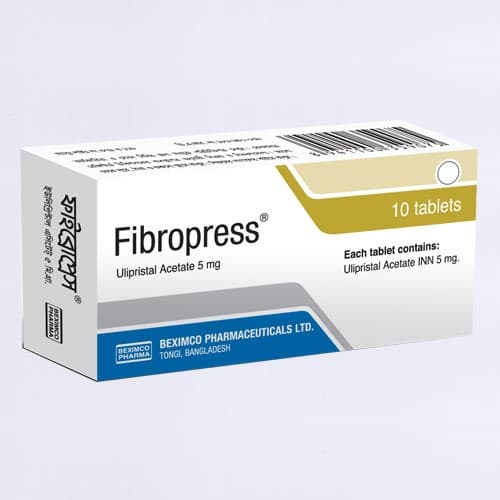

Fibropress is a selective progesterone receptor modulator (SPRM) indicated in premenopausal women for the intermittent or pre-operative treatment of moderate-to-severe signs and symptoms of uterine fibroids (leiomyomas), such as heavy or prolonged menstrual bleeding, pelvic pain/pressure, and fibroid-related anemia.
Note: This bracketed indication of Fibropress is distinct from the separate emergency-contraception use and dosing of ulipristal acetate, which is not covered by this entry.
Each film-coated tablet contains ulipristal acetate 5 mg as the active ingredient, formulated specifically under the Ulipristal Acetate [For uterine fibroids] indication and dosing regimen, along with standard pharmaceutical excipients (e.g., lactose, povidone, magnesium stearate, talc).
Fibropress is an oral selective progesterone receptor modulator (SPRM) used to manage moderate-to-severe symptoms caused by uterine fibroids in premenopausal women. It works by binding to progesterone receptors in fibroid tissue and the endometrium, producing a mixed agonist-antagonist effect that reduces fibroid size, decreases uterine bleeding, and helps correct fibroid-related anemia, typically given as pre-operative therapy or as intermittent courses under close medical supervision.
Fibropress belongs to the therapeutic class of Selective Progesterone Receptor Modulators (SPRMs), a group of hormonal agents used in reproductive endocrinology and gynecology for fibroid-related indications.
Ulipristal Acetate [For uterine fibroids] is a synthetic selective progesterone receptor modulator (SPRM) that exerts tissue-specific partial agonist/antagonist effects on the progesterone receptor.
Treatment with Fibropress should be initiated and supervised by a physician experienced in the diagnosis and treatment of uterine fibroids, with pregnancy excluded before starting.
| Indication | Dose | Duration |
|---|---|---|
| Pre-operative treatment | One 5 mg tablet by mouth once daily, started within the first week of the menstrual cycle | Up to 3 months, single course |
| Intermittent treatment (surgery not appropriate/failed) | One 5 mg tablet once daily, started within the first week of each menstrual cycle | Repeated courses of up to 3 months each, separated by a treatment-free interval (allowing a menstrual bleed) between courses, with mandatory liver monitoring between courses |
Tablets may be taken with or without food. If a dose is missed, it should be taken as soon as possible; if more than 12 hours late, the missed dose should be skipped and the next tablet taken at the usual time. Fibropress is not intended for continuous, uninterrupted long-term use outside a defined treatment-and-monitoring plan (see Precautions and Warnings).
Fibropress tablets are taken by mouth, once daily at approximately the same time each day, with or without food. Tablets should be swallowed whole with water and not chewed or crushed unless otherwise advised.
Clinically significant interactions with Fibropress include:
Ulipristal Acetate [For uterine fibroids] is contraindicated in patients with:
Reported adverse effects with Fibropress include:
Fibropress is contraindicated during known or suspected pregnancy; pregnancy must be excluded before starting treatment. Effective non-hormonal (barrier) contraception is recommended during treatment and for a defined period after stopping, since hormonal contraceptive efficacy may be reduced and the drug's effect on early pregnancy is not established. Use during breastfeeding is not recommended, as ulipristal acetate is excreted into breast milk and effects on the nursing infant are unknown; a decision to discontinue breastfeeding or to withhold Fibropress should be made in consultation with a physician, weighing the benefit of therapy against potential infant risk.
Liver injury (important safety concern): Rare cases of serious liver injury, including cases requiring liver transplantation, have been reported with Fibropress. Liver function tests should be performed before starting each treatment course, periodically during treatment, and again after completing each course. Treatment should be discontinued and the patient promptly evaluated if signs or symptoms suggestive of liver injury occur (e.g., yellowing of the skin or eyes, dark urine, unusual fatigue, nausea, vomiting, or right upper abdominal pain). This drug should not be used in patients with significant hepatic impairment (see Contraindications).
Treatment duration and monitoring: Fibropress is intended for defined treatment courses (typically up to 3 months) with medical supervision and liver monitoring — it is not intended for continuous, uninterrupted long-term use without such monitoring, per current regulatory guidance. It should only be used for pre-operative therapy or, in select patients for whom surgery is not appropriate or has failed, as intermittent courses separated by treatment-free intervals.
Contraception during treatment: Because Fibropress can affect the endometrium and its safety in early pregnancy is not established for this fibroid-treatment context, effective non-hormonal (barrier) contraception is advised during treatment and for a defined period after stopping, as hormonal contraceptives may be less reliable when used concurrently.
Other precautions: Use with caution in patients with severe, uncontrolled asthma inadequately controlled by oral glucocorticoids, due to weak anti-glucocorticoid activity. Amenorrhea is common during treatment; persistent or unusually heavy bleeding beyond the expected pattern should be evaluated. Endometrial thickening may be observed and generally resolves after stopping treatment; persistent thickening warrants further gynecologic assessment.
Limited data are available on overdose with Fibropress; reported cases involving doses higher than the recommended dose have not been associated with severe or serious adverse reactions. There is no specific antidote. In case of a suspected overdose, seek immediate medical attention or contact a poison control center; treatment should be symptomatic and supportive, with monitoring as advised by the treating physician.
Store below 25°C, protected from light and moisture, in the original package. Keep out of reach of children.
Pediatric use: Fibropress is not indicated for use in children or adolescents (premenarchal patients); safety and efficacy have not been established in this population.
Postmenopausal women: Not indicated, as uterine fibroids are a condition of the premenopausal reproductive years and efficacy has not been established after menopause.
Hepatic impairment: Contraindicated in patients with significant hepatic impairment (see Contraindications); liver function monitoring is required in all patients as described in Precautions and Warnings.
Renal impairment: Data are limited; use with caution, as no formal dose adjustment has been established.
Elderly: Not applicable, since the indication is limited to premenopausal women.
Each treatment course of Fibropress is typically limited to a maximum of 3 months. For pre-operative use, a single course is usually sufficient before proceeding to surgery. For intermittent use in patients for whom surgery is not currently appropriate or has failed, repeated courses may be given, each separated by a treatment-free interval (allowing a natural menstrual bleed to occur) and preceded by liver function testing, under continued specialist supervision. Fibropress should not be used continuously without such planned breaks and monitoring.
Ulipristal Acetate [For uterine fibroids] belongs to the drug class of Selective Progesterone Receptor Modulators (SPRMs), used in gynecologic and reproductive endocrine therapy.
Ulipristal Acetate [For uterine fibroids] acts as a selective progesterone receptor modulator (SPRM), binding with high affinity to the progesterone receptor and exerting tissue-specific partial agonist and antagonist activity. In uterine fibroid tissue, this leads to inhibition of cell proliferation and induction of apoptosis, resulting in a reduction of fibroid size. In the endometrium, it produces reversible histological changes and typically induces amenorrhea, which helps correct fibroid-related heavy bleeding and anemia.
Fibropress is not indicated for use in pediatric or premenarchal patients. Safety and efficacy of Fibropress have not been established in children and adolescents, and it should not be used in this population.
Q: What is Fibropress 5 mg Tablet used for?
A: Fibropress 5 mg Tablet is used in premenopausal women to treat moderate-to-severe symptoms of uterine fibroids, such as heavy menstrual bleeding and pelvic pain, either before surgery or as intermittent therapy when surgery is not currently suitable.
Q: How is Fibropress 5 mg Tablet taken?
A: It is taken as one 5 mg tablet by mouth once daily, usually starting within the first week of your menstrual cycle, for a course of up to 3 months as directed by your physician.
Q: Can Fibropress 5 mg Tablet be used during pregnancy?
A: No. Fibropress 5 mg Tablet is contraindicated in known or suspected pregnancy. Pregnancy must be ruled out before starting treatment, and effective non-hormonal (barrier) contraception should be used during treatment and for a period after stopping, since hormonal contraceptives may be less reliable when used together with this medicine.
Q: Is Fibropress 5 mg Tablet safe for the liver?
A: Rare but serious cases of liver injury, including cases requiring liver transplantation, have been reported with Fibropress 5 mg Tablet. Your doctor will check your liver function before, during, and after each treatment course. Seek immediate medical attention if you notice yellowing of the skin or eyes, dark urine, unusual tiredness, nausea, or vomiting while taking this medicine.
Q: Will my periods stop while taking Fibropress 5 mg Tablet?
A: Yes, it is very common to have little or no menstrual bleeding (amenorrhea) while taking Fibropress 5 mg Tablet; this is expected and usually returns to normal after each treatment course ends. Unusually heavy or persistent bleeding should be reported to your doctor.
Q: Can Fibropress 5 mg Tablet be used long-term without breaks?
A: No. Fibropress 5 mg Tablet is intended for defined treatment courses, typically up to 3 months each, with liver monitoring and treatment-free intervals between courses. It should not be used continuously for long periods without medical supervision and monitoring.
Disclaimer
The information provided is accurate to the best of our knowledge, but it does not replace professional medical advice. We cannot guarantee its completeness or accuracy, and the absence of specific information about a drug should not be taken as an endorsement. We are not responsible for any consequences arising from this information, so please consult a healthcare professional for any concerns or questions.