
Key facts
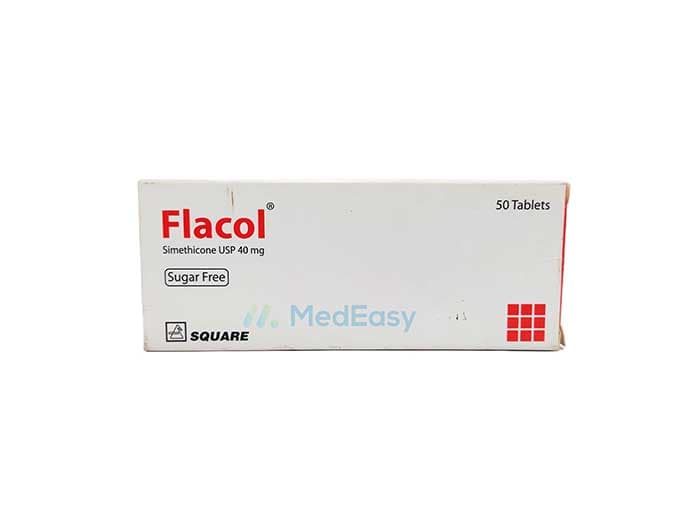
Flacol 40 mg Chewable Tablet is available on MedEasy for ৳27.60 per 10's Strip, with home delivery anywhere in Bangladesh. It is manufactured by Square Pharmaceuticals PLC. Its generic name is Simethicone.
- Pack sizes
- 10's Strip, 50's pack
- Prescription
- Required. Upload a valid doctor's prescription at checkout; a MedEasy pharmacist verifies it before dispatch.
- Delivery
- Home delivery across Bangladesh. Same-day delivery in Dhaka, Chattogram, Sylhet and Bogura city areas; 2-3 days elsewhere.
- Payment
- Cash on delivery, bKash, cards and mobile banking.
- Brand
- Flacol
- Generic name
- Simethicone
- Manufacturer
- Square Pharmaceuticals PLC.
- Form & strength
- Chewable Tablet 40 mg
- Availability
- In stock
- Authenticity
- Sourced from licensed suppliers and the manufacturer's authorised distributors in Bangladesh.

Medicine overview
Indications of Flacol
Established / Approved Uses
- Flacol is indicated for the symptomatic relief of excess gas (flatulence) associated with conditions such as functional dyspepsia, air swallowing (aerophagia), postoperative gas pain, and diverticular disease.
- Relief of pressure, bloating, and fullness commonly referred to as "gas" in adults and children.
Adjunct / Procedural Uses
- Used as an adjunct before abdominal ultrasound, endoscopy, or radiologic imaging to reduce interfering intestinal gas bubbles and improve visualization.
Commonly Used Off-Label
- Flacol drops are widely used for infant colic and excessive crying attributed to gas, although clinical trial evidence for efficacy in colic is limited and inconsistent. It remains popular for this use mainly because of its excellent safety profile rather than proven efficacy.
Flacol does not treat underlying digestive or bowel conditions; if gas symptoms are due to another disease process, that condition must be evaluated and managed separately by a physician.
Composition
Each dosage form contains Simethicone (a mixture of polydimethylsiloxane/dimethicone and silicon dioxide) as the sole active ingredient. It is available as chewable tablets (40 mg, 80 mg, 125 mg), softgel capsules (125 mg, 166 mg, 180 mg), and oral suspension/drops (typically 40 mg/0.6 mL or 40 mg/5 mL) for infant and pediatric use. Excipients vary by manufacturer and formulation.
Description
Flacol is an antiflatulent (anti-gas) agent used to relieve the discomfort of excess gas trapped in the stomach and intestines. Unlike most medicines, Flacol is not absorbed into the bloodstream and does not act on the body chemically; instead it works purely by a physical, mechanical action on gas bubbles within the gut.
Because of this local, non-absorbed mechanism, Flacol has a notably favorable safety profile with minimal risk of systemic side effects or drug interactions, and it is available over-the-counter for both adults and children, including specially formulated drops for infants.
Therapeutic Class
Flacol belongs to the therapeutic class of Antiflatulents (Anti-gas / Defoaming agents), a subgroup of gastrointestinal (GI) drugs.
Pharmacology
Mechanism of Action
Simethicone is a surface-active agent (surfactant) that lowers the surface tension of gas bubbles trapped within the gastrointestinal mucus and contents. By altering surface tension, it causes small, dispersed gas bubbles to coalesce into larger bubbles, which can then be passed more easily by belching or flatus, or absorbed through the intestinal wall in the normal course of digestion.
Pharmacokinetics
Simethicone is chemically and physiologically inert. It is not absorbed from the gastrointestinal tract, is not metabolized, and is excreted essentially unchanged in the feces. This lack of systemic absorption underlies its excellent tolerability and minimal interaction potential.
Dosage & Administration of Flacol
Adults and Children 12 years and older
| Indication | Dose | Frequency |
|---|---|---|
| Gas, bloating, postprandial fullness | 40–125 mg (up to 250 mg with some products) | After meals and at bedtime as needed; do not exceed 500 mg in 24 hours unless directed by a physician |
Children 2 to under 12 years
| Age | Dose | Frequency |
|---|---|---|
| 2–12 years | 40 mg | Four times daily as needed after meals and at bedtime; do not exceed 240 mg in 24 hours unless directed by a physician |
Infants under 2 years
| Age | Dose | Frequency |
|---|---|---|
| Under 2 years | 20 mg (0.3 mL of infant drops) | Four times daily as needed; do not exceed 240 mg in 24 hours; use only under medical/caregiver guidance |
Procedural / Diagnostic Use
When used as an adjunct before abdominal imaging, dosing and timing are determined by the ordering physician or facility protocol.
Administration
- Chewable tablets must be chewed thoroughly before swallowing, not swallowed whole.
- Softgel capsules should be swallowed whole with liquid.
- Infant drops may be given directly or mixed with 1 ounce (30 mL) of cool water, infant formula, or other liquid to ease administration; shake the suspension well before use.
- Best taken after meals and at bedtime, when gas symptoms are most likely to occur.
Administration of Flacol
Chew chewable tablets of Flacol completely before swallowing; swallow softgel capsules whole with water. Infant drops can be given directly into the infant's mouth or mixed with formula, milk, or water; shake well before each use. Take after meals and at bedtime for best relief of gas symptoms.
Interaction of Flacol
Flacol has an excellent safety profile with regard to drug interactions because it is not absorbed systemically and acts only by local physical action in the gut. No clinically significant pharmacokinetic or pharmacodynamic drug interactions have been well established for Flacol.
As a general precaution, if Flacol is being taken together with other oral medicines, it may be reasonable to space administration apart where practical, and patients on multiple medications should inform their physician or pharmacist of all products used, including over-the-counter antiflatulents.
Contraindications
Simethicone is contraindicated only in patients with known hypersensitivity to Simethicone or to any component of the specific product formulation.
Side Effects of Flacol
Flacol is very well tolerated overall, consistent with its non-absorbed, purely physical mechanism of action. Reported adverse effects are uncommon and generally mild.
- Mild gastrointestinal effects: nausea, belching, or diarrhea have been reported infrequently.
- Rare hypersensitivity reactions: skin rash or itching (see Contraindications for hypersensitivity).
No serious systemic adverse effects have been reported, reflecting the fact that Flacol is not absorbed into the bloodstream.
Pregnancy & Lactation
Flacol is not absorbed from the gastrointestinal tract, so systemic fetal or infant exposure is not expected. It is generally regarded as compatible with use in pregnancy and breastfeeding based on this mechanism; however, as with any medicine, Flacol should be used during pregnancy and lactation only if clearly needed, and a physician should be consulted before use, particularly for regular or prolonged use.
Precautions & Warnings
- Flacol is intended only for symptomatic relief of gas-related discomfort; it does not treat the underlying cause of gastrointestinal symptoms.
- If gas, bloating, or abdominal discomfort is severe, persistent beyond 2 weeks, or accompanied by alarm features such as unexplained weight loss, vomiting, blood in stool, fever, or severe abdominal pain, discontinue self-treatment and seek medical evaluation, as these may indicate an underlying condition requiring diagnosis and specific treatment.
- Discontinue use and consult a physician if signs of an allergic reaction (rash, itching, swelling) occur (see Contraindications).
- Keep out of reach of children; accidental ingestion of large amounts of any product, especially combination products, should prompt medical advice.
Overdose Effects of Flacol
Flacol has very low toxicity because it is not absorbed systemically; significant harm from an overdose of Flacol alone is unlikely. However, if a very large amount has been ingested, particularly of a combination product containing other active ingredients, or if any unusual symptoms occur, seek immediate medical attention or contact a poison control center/emergency services. Do not attempt specific home treatment for a suspected overdose without professional guidance.
Storage Conditions
Store at room temperature (below 30°C), away from light and moisture. Keep out of reach of children.
Use In Special Populations
Elderly
No dose adjustment is required for elderly patients; Flacol is well tolerated in this population due to its non-absorbed mechanism.
Renal or Hepatic Impairment
No dose adjustment is necessary in patients with renal or hepatic impairment, as Flacol is not absorbed or metabolized.
Infants and Young Children
Specially formulated Flacol drops are used in infants for gas-related fussiness under caregiver or physician guidance; efficacy specifically for infant colic is not firmly established, though the safety profile is favorable (see Pediatric Uses).
Duration Of Treatment
Flacol is intended for short-term, as-needed symptomatic use. If symptoms of gas or bloating persist for more than 2 weeks despite regular use, or recur frequently, a physician should be consulted to evaluate for an underlying cause rather than continuing indefinite self-treatment.
Drug Classes
Antiflatulents; Defoaming/Surface-active (surfactant) agents; Gastrointestinal (GI) agents
Mode Of Action
Simethicone acts as a surfactant that reduces the surface tension of gas bubbles in the gastrointestinal tract, causing small bubbles to coalesce into larger ones that are more easily expelled by belching or passing flatus. It exerts this effect purely by local physical action and is not absorbed or chemically active in the body (see Pharmacology).
Pediatric Uses
Flacol drops are marketed and commonly used for infants and young children for gas-related discomfort, with weight/age-based dosing as described in Dosage and Administration. Because Flacol is not absorbed, it has an excellent pediatric safety profile.
Its use for infant colic specifically is widespread in practice, but formal evidence of efficacy for colic (as opposed to simple gas relief) is limited and inconsistent; caregivers should consult a pediatrician if colic or crying is severe, persistent, or associated with poor feeding, vomiting, or weight concerns, since Flacol does not address other causes of infant crying.
Frequently Asked Questions
Q: What is Flacol 40 mg Chewable Tablet used for?
A: Flacol 40 mg Chewable Tablet is used to relieve the discomfort of excess gas, bloating, and fullness in the stomach and intestines. It is also sometimes used before abdominal ultrasound or endoscopy to reduce gas interference, and is commonly used off-label for infant gas-related fussiness.
Q: Is Flacol 40 mg Chewable Tablet safe to take every day?
A: Flacol 40 mg Chewable Tablet is generally very well tolerated because it is not absorbed into the bloodstream and works only by physical action in the gut. It can be used as needed after meals and at bedtime, but if you need it daily for more than 2 weeks, consult a physician to check for an underlying cause of your gas symptoms.
Q: Can Flacol 40 mg Chewable Tablet be given to infants and young children?
A: Yes, specially formulated Flacol 40 mg Chewable Tablet drops are made for infants and children, with dosing based on age. However, Flacol 40 mg Chewable Tablet is not absorbed systemically and its efficacy for infant colic specifically is not firmly proven; use under caregiver or physician guidance and seek medical advice if crying is severe or persistent.
Q: Is Flacol 40 mg Chewable Tablet safe during pregnancy or breastfeeding?
A: Flacol 40 mg Chewable Tablet is not absorbed from the gut, so it is generally considered compatible with pregnancy and breastfeeding. Even so, it should be used only if clearly needed, and a physician should be consulted before regular use during pregnancy or while breastfeeding.
Q: Does Flacol 40 mg Chewable Tablet interact with other medicines?
A: Flacol 40 mg Chewable Tablet has minimal interaction potential because it is not absorbed into the bloodstream and acts only locally in the gastrointestinal tract. No clinically significant drug interactions are well established, though you should still tell your doctor or pharmacist about all medicines you take.
Q: What should I do if I take too much Flacol 40 mg Chewable Tablet?
A: Flacol 40 mg Chewable Tablet has very low toxicity due to its lack of systemic absorption, so a simple overdose of Flacol 40 mg Chewable Tablet alone is unlikely to cause serious harm. Still, if a large amount was taken, especially of a combination product, or if unusual symptoms occur, seek immediate medical attention or contact a poison control center.
Disclaimer
The information provided is accurate to the best of our knowledge, but it does not replace professional medical advice. We cannot guarantee its completeness or accuracy, and the absence of specific information about a drug should not be taken as an endorsement. We are not responsible for any consequences arising from this information, so please consult a healthcare professional for any concerns or questions.