10% Off
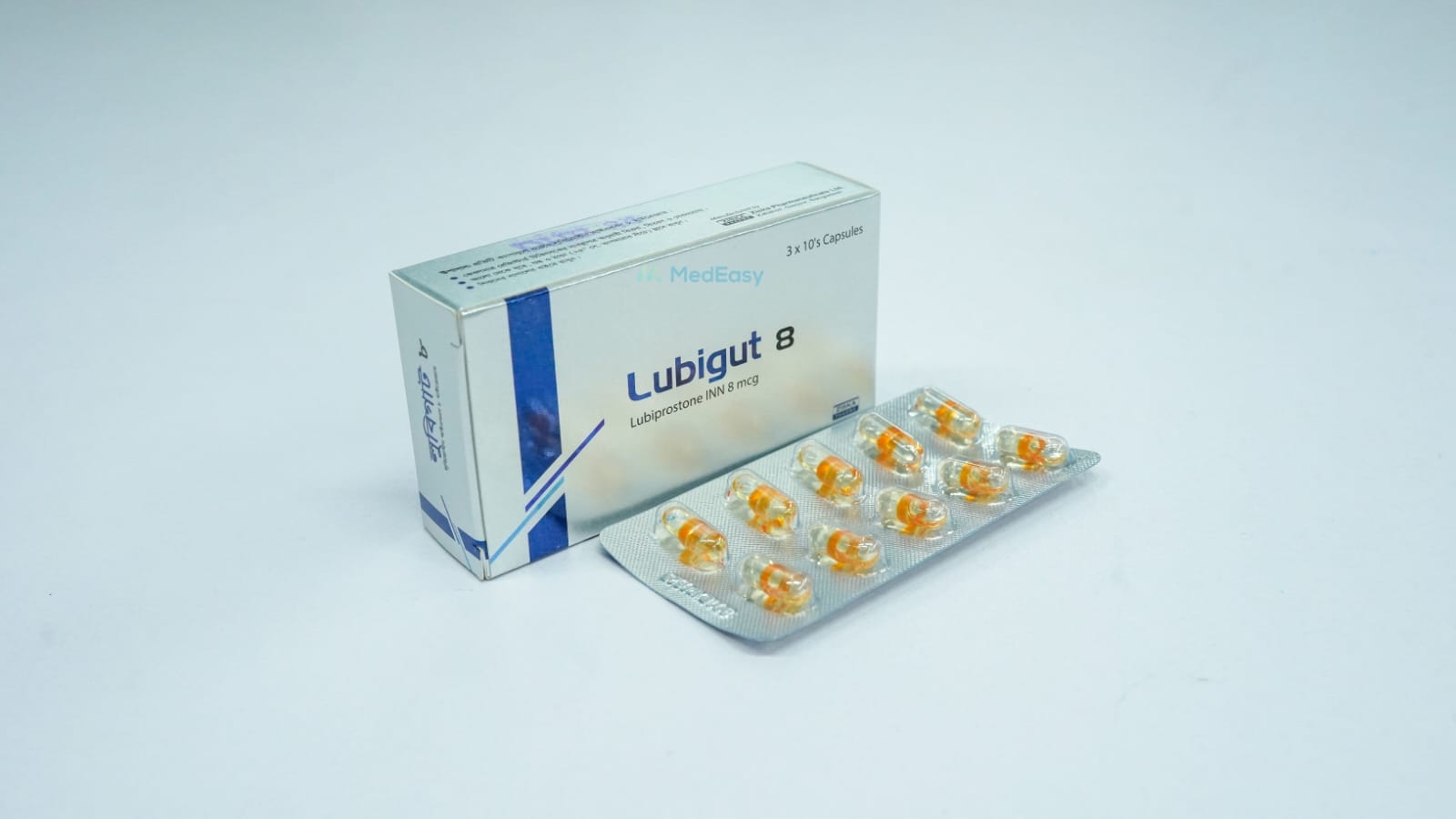
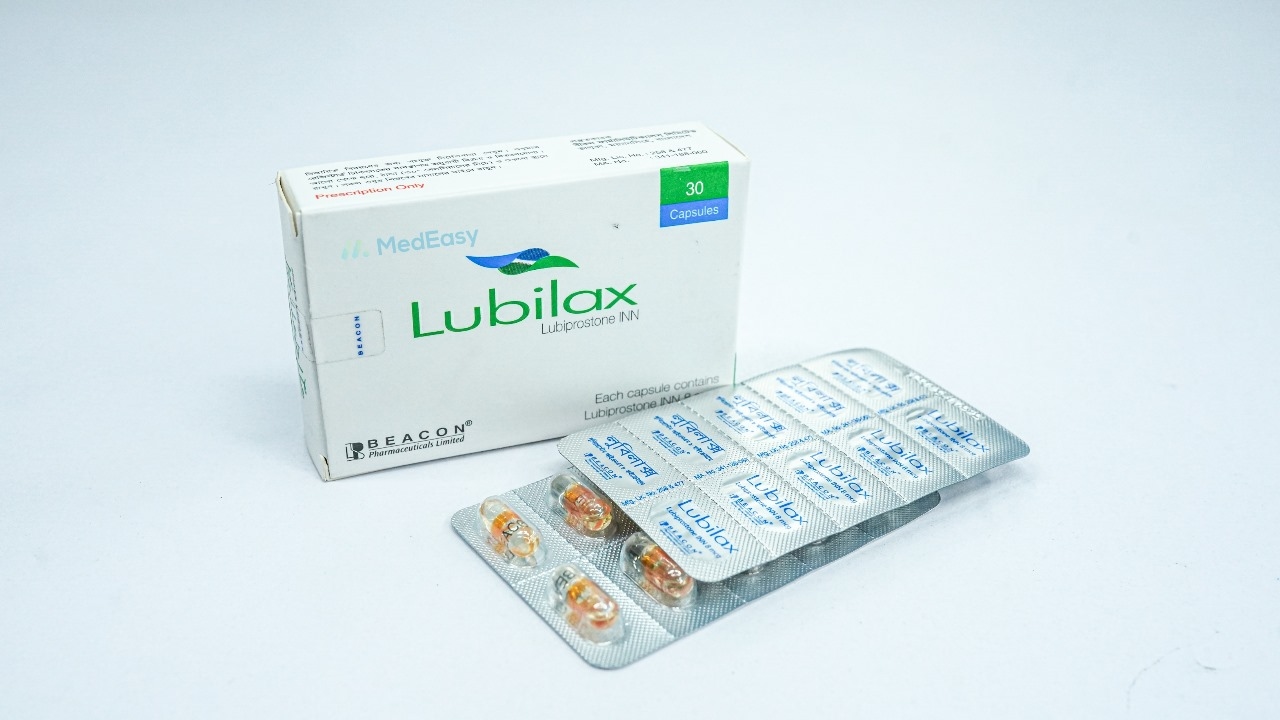
Lubilax8 mcg
Beacon Pharmaceuticals PLC
৳135.45
Add to cart


Gutfix is a locally-acting chloride channel activator indicated for:
Gutfix is not indicated for constipation caused by mechanical gastrointestinal obstruction, and it is not a first-line agent — it is generally used after lifestyle measures (fluid, fiber, exercise) and/or other laxatives have proven inadequate.
Each capsule contains Lubiprostone as the active pharmaceutical ingredient, available in strengths of 8 mcg and 24 mcg. Inactive ingredients typically include gelatin, sorbitol, glycerin, and other capsule-shell excipients; formulations may vary by manufacturer.
Gutfix is a bicyclic fatty acid derived from prostaglandin E1 that acts locally as a selective chloride channel (ClC-2) activator on the apical membrane of gastrointestinal epithelial cells. It increases intestinal fluid secretion, softening stool and enhancing motility without altering serum electrolyte (sodium/potassium) concentrations.
It is supplied as an oral gelatin capsule and is taken with food and water to minimize gastrointestinal side effects.
Gutfix belongs to the class of chloride channel activators (intestinal secretagogues), a category of laxative agents distinct from stimulant, osmotic, or bulk-forming laxatives.
Lubiprostone selectively activates type-2 chloride channels (ClC-2) located on the apical membrane of gastrointestinal epithelial cells. This activation increases secretion of a chloride-rich intestinal fluid, which softens stool, increases motility, and promotes spontaneous bowel movements — without altering serum sodium or potassium concentrations.
Lubiprostone is converted rapidly and extensively in the stomach and jejunum to an active metabolite (M3), with very low systemic absorption; plasma concentrations of the parent compound are generally below the level of quantification. Metabolism occurs largely locally within the gastrointestinal tract via reduction, independent of the cytochrome P450 (CYP450) enzyme system, which accounts for its minimal drug-interaction profile.
Gutfix should be taken orally, twice daily, with food and water, to reduce the likelihood of nausea. Capsules should be swallowed whole and not chewed.
| Indication | Adult Dose | Frequency |
|---|---|---|
| Chronic Idiopathic Constipation (CIC) | 24 mcg | Twice daily, with food |
| IBS-C (women ≥ 18 years) | 8 mcg | Twice daily, with food |
| Opioid-Induced Constipation (OIC) | 24 mcg | Twice daily, with food |
A reduced starting dose (e.g., 16 mcg twice daily for CIC or OIC, and 8 mcg once daily for IBS-C, adjusted per severity) may be considered in patients with moderate to severe hepatic impairment, based on prescribing information; individualize per clinical judgment.
No dedicated dose adjustment has been established; use with routine clinical monitoring.
Take the next dose at the regular scheduled time; do not double the dose to make up for a missed one.
Gutfix capsules should be taken orally, twice daily, with food and a full glass of water. Swallow the capsule whole; do not crush, chew, or open it. Taking the dose with food helps reduce the chance of nausea, the most commonly reported side effect.
Gutfix is metabolized locally within the gastrointestinal tract independent of the cytochrome P450 system, and systemic absorption is minimal. As a result, it has a low potential for clinically significant drug-drug interactions, and no specific interactions are well-established in labeling.
Always inform your physician or pharmacist of all medicines, supplements, and herbal products being used before starting Gutfix.
Lubiprostone is contraindicated in:
The most commonly reported adverse effects of Gutfix include:
Seek prompt medical attention for severe or persistent diarrhea, signs of an allergic reaction, or chest tightness/breathing difficulty.
Pregnancy: Data on Gutfix use in pregnant women are limited. Gutfix should be used during pregnancy only if the potential benefit justifies the potential risk to the fetus — consult a physician before use. Women of childbearing potential should be counseled about pregnancy status and effective contraception before starting therapy, per prescribing recommendations.
Lactation: It is not known whether Gutfix or its metabolites are excreted in human breast milk. Because many drugs are excreted in breast milk, a decision should be made whether to discontinue nursing or discontinue the drug, taking into account the importance of the drug to the mother — consult a physician before use while breastfeeding.
Severe diarrhea: Gutfix may cause diarrhea, which can occasionally be severe. Discontinue use if severe diarrhea occurs and consult a physician.
Mechanical obstruction: Patients should be evaluated to rule out mechanical gastrointestinal obstruction before starting Gutfix (see Contraindications).
Dyspnea: Some patients report chest tightness and shortness of breath, usually within an hour of the first dose and resolving within a few hours; it may recur with subsequent doses. Discuss with a physician if this occurs.
Nausea: Take with food and water to reduce the likelihood of nausea.
Pregnancy: See Pregnancy and Lactation.
Use only under medical supervision, and inform your physician of any history of gastrointestinal surgery, bowel obstruction, or other significant gastrointestinal disease before starting therapy.
Reported overdose experience with Gutfix is limited. Doses higher than recommended have been associated with increased nausea, diarrhea, and vomiting. In case of suspected overdose, seek immediate medical attention or contact a poison control center / emergency services. Treatment should be symptomatic and supportive, with attention to fluid and electrolyte status, particularly if significant diarrhea occurs; there is no specific antidote.
Store at room temperature (below 30°C), away from light and moisture. Keep out of reach of children.
Safety and effectiveness of Gutfix in pediatric patients have not been established. It is not recommended for use in children.
No overall differences in safety or effectiveness have been observed between elderly and younger adult patients in clinical trials; no dose adjustment is required based on age alone, though elderly patients should be monitored per usual clinical practice, particularly for diarrhea and dehydration risk.
A reduced starting dose is recommended in patients with moderate to severe hepatic impairment (see Dosage and Administration).
No specific dose adjustment has been established; use with routine monitoring.
Duration of treatment with Gutfix should be individualized based on indication and response, as determined by the prescribing physician. Response is usually assessed within the first month of therapy; if no meaningful improvement in bowel symptoms occurs, the physician may reassess the diagnosis and treatment plan. Long-term use is common for chronic conditions such as CIC, IBS-C, and OIC, with periodic physician follow-up to confirm ongoing benefit and tolerability.
Lubiprostone is classified as a chloride channel activator / intestinal secretagogue laxative.
Lubiprostone acts locally on the luminal surface of intestinal epithelial cells to selectively activate type-2 chloride channels (ClC-2), independent of dietary intake or gastrointestinal neural stimulation. This activation increases secretion of a chloride-rich intestinal fluid, which increases intestinal fluid volume and motility, softening stool and facilitating spontaneous bowel movements, without significantly altering serum electrolyte concentrations.
C
The safety and effectiveness of Gutfix in pediatric patients have not been established through adequate and well-controlled studies. Gutfix is therefore not recommended for use in infants, children, or adolescents outside of a physician's specific direction. Isolated cases of accidental ingestion in children have been reported to resolve without lasting harm, but this does not establish a safe pediatric dosing regimen. Any suspected pediatric ingestion should prompt immediate medical evaluation.
Q: What is Gutfix 8 mcg Capsule used for?
A: Gutfix 8 mcg Capsule is used to treat chronic idiopathic constipation in adults, irritable bowel syndrome with constipation (IBS-C) in adult women, and opioid-induced constipation in adults with chronic non-cancer pain. It works by increasing fluid secretion in the intestine to soften stool and promote bowel movements.
Q: How should I take Gutfix 8 mcg Capsule?
A: Take Gutfix 8 mcg Capsule exactly as prescribed, usually twice daily, with food and a full glass of water. Swallow the capsule whole — do not crush or chew it. Taking it with food helps reduce nausea, the most common side effect.
Q: What are the most common side effects of Gutfix 8 mcg Capsule?
A: The most common side effects of Gutfix 8 mcg Capsule are nausea, diarrhea, abdominal pain or distension, and headache. Nausea is more likely if the medicine is taken on an empty stomach. Some people also experience temporary shortness of breath or chest tightness shortly after the first dose, which usually resolves within a few hours.
Q: Who should not take Gutfix 8 mcg Capsule?
A: Gutfix 8 mcg Capsule should not be used by anyone with a known allergy to it, or by anyone with known or suspected mechanical bowel obstruction, since it can worsen that condition. Tell your physician about any history of bowel obstruction or major gastrointestinal surgery before starting Gutfix 8 mcg Capsule.
Q: Can Gutfix 8 mcg Capsule be used during pregnancy or breastfeeding?
A: Gutfix 8 mcg Capsule should be used during pregnancy only if the potential benefit justifies the potential risk to the baby, and only under a physician's guidance. It is not known whether Gutfix 8 mcg Capsule passes into breast milk, so a physician should be consulted to weigh the benefits of treatment against the risks before use while breastfeeding.
Q: What should I do if I miss a dose or take too much Gutfix 8 mcg Capsule?
A: If you miss a dose, simply take your next dose at the regular scheduled time — do not double up. If you or someone else has taken more Gutfix 8 mcg Capsule than prescribed, seek immediate medical attention or contact a poison control center, as overdose can cause increased nausea, diarrhea, and vomiting.
Disclaimer
The information provided is accurate to the best of our knowledge, but it does not replace professional medical advice. We cannot guarantee its completeness or accuracy, and the absence of specific information about a drug should not be taken as an endorsement. We are not responsible for any consequences arising from this information, so please consult a healthcare professional for any concerns or questions.