
10% Off
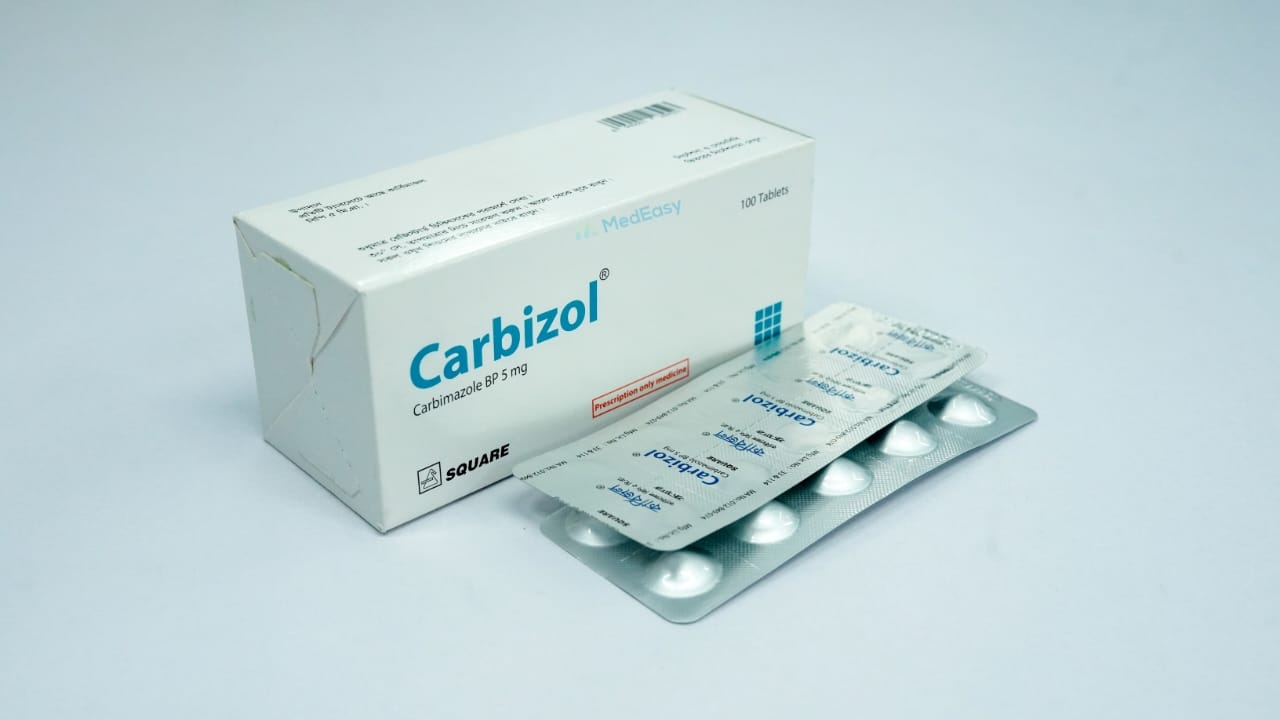
Carbizol5 mg
Square Pharmaceuticals PLC.
৳36.00
Add to cart


Mercazole is an antithyroid medicine used to reduce excessive thyroid hormone production. Its indications can be classified by strength of evidence as follows:
Mercazole is not used to treat hypothyroidism, simple (non-toxic) goitre, or thyroid cancer.
Each tablet contains Carbimazole INN (International Nonproprietary Name) as the active ingredient. Carbimazole is commonly available as oral tablets in strengths such as 5 mg and 20 mg; exact strength, tablet markings, and inactive ingredients (excipients) vary by manufacturer and brand available in the local market.
Mercazole is a synthetic antithyroid medicine belonging to the thionamide (thioimidazole) group of drugs. It is a prodrug that is rapidly and almost completely converted in the body to its pharmacologically active metabolite, methimazole (also called thiamazole), which is responsible for the therapeutic effect. Mercazole is used to reduce excessive production of thyroid hormones in conditions such as Graves' disease and toxic nodular goitre, and to prepare patients for thyroid surgery or radioactive iodine therapy. It is marketed and used in many countries, including Bangladesh, as an oral tablet for long-term outpatient management of hyperthyroidism under physician supervision.
Antithyroid agent (Thionamide / thioimidazole derivative). Mercazole is a prodrug within this class.
Carbimazole itself is largely inactive and is converted rapidly in the body to its active metabolite, methimazole. Methimazole inhibits the enzyme thyroid peroxidase, which is required for the iodination of tyrosine residues on thyroglobulin and for coupling of iodotyrosines to form triiodothyronine (T3) and thyroxine (T4). By blocking new hormone synthesis, Carbimazole gradually lowers circulating thyroid hormone levels.
Because Carbimazole does not inactivate hormone that is already synthesised and stored in the thyroid gland or already released into the circulation, a clinically meaningful fall in thyroid hormone levels typically takes about two to four weeks to become apparent, and full clinical response may take several weeks longer. Carbimazole may also have a mild immunomodulatory effect that reduces circulating levels of thyroid-stimulating immunoglobulins in Graves' disease, which may contribute to disease remission with prolonged treatment.
The dose of Mercazole and the length of treatment depend on the indication, the severity of thyrotoxicosis, and the individual's response, and must be guided by regular clinical assessment and monitoring of thyroid function tests.
| Indication / Population | Typical dosing |
|---|---|
| Adults - initial treatment of hyperthyroidism (Graves' disease, toxic nodular goitre) | Usually 20-40 mg once daily or in divided doses (up to 60 mg/day in severe thyrotoxicosis), continued until euthyroid, generally over 4-8 weeks |
| Adults - maintenance (titration regimen) | Gradually reduced to the lowest effective maintenance dose, typically 5-15 mg once daily, once thyroid function has normalised |
| Adults - "block-and-replace" regimen | A fixed higher dose (e.g. around 40 mg/day) is continued together with added levothyroxine to keep the patient euthyroid |
| Pre-operative preparation for thyroidectomy | Dosed as above until euthyroid; iodine is often added shortly before surgery per specialist protocol |
| Pre-treatment before radioactive iodine therapy | Dosed as above to achieve a euthyroid state; typically stopped for a short period before radioactive iodine administration on specialist advice, as it may reduce treatment efficacy |
| Children and adolescents | Individualised, weight-based dosing under specialist (paediatric endocrinology) supervision; treatment is initiated at a lower dose and carefully titrated |
| Elderly | Usual adult doses are generally used, with close monitoring given a higher likelihood of comorbidities |
Mercazole tablets are taken by mouth, with or without food, and should be swallowed whole with water. Doses are best taken at the same time(s) each day. Patients should not stop, increase, or reduce the dose of Mercazole without medical advice, and must attend all scheduled blood tests (thyroid function tests and complete blood counts) throughout treatment. The total duration of a course of Mercazole for Graves' disease is typically 12-18 months, after which a trial withdrawal may be considered under specialist supervision (see Duration of Treatment).
Take Mercazole tablets by mouth, with or without food, preferably at the same time(s) each day to maintain a consistent effect. Swallow the tablet whole with a glass of water; do not crush or chew unless your pharmacist advises otherwise. If your physician has prescribed a divided-dose schedule, try to space doses evenly through the day. Do not stop, increase, or decrease your dose of Mercazole without first consulting your physician, and keep all appointments for blood tests used to monitor your thyroid function and blood counts.
The following are well-recognised, clinically significant interactions with Mercazole:
Carbimazole is contraindicated in the following situations:
Most patients tolerate Mercazole well, but side effects can occur.
Pregnancy: Mercazole should be used in pregnancy only if clearly needed and if the potential benefit justifies the potential risk to the fetus, under specialist (endocrinology/obstetric) supervision. Antithyroid thionamide drugs cross the placenta, and use of Mercazole (or its active metabolite methimazole), particularly during the first trimester, has been associated with a rare pattern of congenital malformations (sometimes called "Mercazole/methimazole embryopathy"), including aplasia cutis and choanal or oesophageal atresia. Because of this, many specialist guidelines prefer propylthiouracil over Mercazole during the first trimester, with a switch back to Mercazole in the second and third trimesters when appropriate. Untreated or poorly controlled maternal hyperthyroidism also carries significant risks to both mother and fetus, so treatment should never be stopped without specialist advice. The lowest effective dose is used, with close monitoring of maternal and fetal thyroid status.
Lactation: Mercazole (as methimazole) passes into breast milk in small amounts. It is generally considered compatible with breastfeeding at low-to-moderate doses under medical supervision, with periodic monitoring of the infant's thyroid function and growth. A physician should be consulted before use while breastfeeding.
Agranulocytosis and hepatotoxicity are the most important safety concerns with Mercazole and other thionamide antithyroid drugs, and represent a boxed-warning-level concern for this drug class. Patients should be counselled before starting treatment to seek immediate medical attention and a complete blood count if they develop fever, sore throat, mouth ulcers, or other signs of infection, and to seek prompt medical review for symptoms suggestive of liver dysfunction (jaundice, dark urine, pale stools, persistent nausea, right upper abdominal pain). Baseline and periodic monitoring of complete blood count and liver function is advised (see Contraindications for pre-existing severe blood dyscrasias and severe hepatic impairment, which preclude use).
Overdose or excessive dosing with Mercazole can lead to symptoms of hypothyroidism over time (e.g. fatigue, cold intolerance, weight gain, goitre), which usually resolve with dose reduction or temporary discontinuation under medical guidance. Acute large overdose may cause gastrointestinal upset, headache, fever, joint pain, and, rarely, bone marrow suppression (with an increased risk of infection or bleeding).
If an overdose of Mercazole is suspected, seek immediate medical attention or contact a poison control centre/emergency services right away. Do not attempt specific home treatment; supportive care and monitoring (including blood counts and thyroid function) should be provided by a healthcare facility.
Store at room temperature (below 30°C), away from light and moisture. Keep out of reach of children.
For Graves' disease, Mercazole is typically continued for about 12 to 18 months using a gradually reduced (titration) dose, or for a similar duration using the block-and-replace regimen, after which a specialist may consider a supervised trial withdrawal to assess for remission. Relapse after stopping is common, and some patients require a further course of Mercazole, long-term antithyroid treatment, or definitive therapy with radioactive iodine or surgery. When used as pre-treatment before surgery or radioactive iodine, Mercazole is generally given for a shorter period, only until the patient is euthyroid or as directed by the specialist. Duration should always be individualised and guided by a physician based on clinical response and thyroid function tests.
Antithyroid agents; Thionamides (thioimidazole derivatives) - the class to which Carbimazole belongs
Carbimazole is a prodrug converted in the body to methimazole, which inhibits thyroid peroxidase and blocks the iodination and coupling steps needed to synthesise thyroid hormones (T3 and T4), thereby reducing new thyroid hormone production over several weeks.
D (legacy category associated with antithyroid thionamide drugs, based on data for the active metabolite methimazole; associated with a rare pattern of fetal malformations with first-trimester exposure). Mercazole itself is not separately rated by the US FDA as it is not marketed in the United States.
Mercazole may be used in children and adolescents with hyperthyroidism (e.g. Graves' disease), but only under the supervision of a paediatric endocrinologist or specialist. Dosing is individualised based on body weight, age, and clinical/biochemical response, starting at a lower dose and titrating carefully to the lowest effective maintenance dose. Children may be more susceptible to adverse effects such as agranulocytosis and hepatotoxicity, so regular monitoring of complete blood counts, liver function, and thyroid function is essential throughout treatment. Safety and efficacy of Mercazole in neonates and very young infants have not been well established, and use in this age group is reserved for rare, specific circumstances (such as neonatal Graves' disease) under close specialist care.
Q: What is Mercazole 5 mg Tablet used for?
A: Mercazole 5 mg Tablet is an antithyroid medicine used to treat hyperthyroidism (an overactive thyroid gland), most commonly caused by Graves' disease or a toxic nodular goitre. It is also used to make patients euthyroid (normal thyroid levels) before thyroid surgery or radioactive iodine treatment.
Q: How long does it take for Mercazole 5 mg Tablet to work?
A: Mercazole 5 mg Tablet blocks new thyroid hormone production but does not remove hormone already stored in the thyroid gland, so it usually takes about two to four weeks before you notice symptom improvement, with fuller control over six to eight weeks. Regular blood tests are used to track your response and adjust the dose.
Q: What serious side effects should I watch for with Mercazole 5 mg Tablet?
A: The most important serious side effect is agranulocytosis, a rare drop in white blood cells that can increase infection risk. Stop Mercazole 5 mg Tablet and seek immediate medical attention and a blood test if you develop fever, sore throat, mouth ulcers, or other signs of infection. Also seek prompt medical advice for signs of liver problems, such as yellowing of the skin or eyes, dark urine, pale stools, or persistent abdominal pain, as rare but serious liver injury has been reported.
Q: Can I take Mercazole 5 mg Tablet during pregnancy or while breastfeeding?
A: Mercazole 5 mg Tablet should only be used in pregnancy if clearly necessary, under specialist supervision, because antithyroid drugs cross the placenta and use in the first trimester has been linked to a rare pattern of birth defects; many specialists prefer a different antithyroid drug (propylthiouracil) in early pregnancy and may switch to Mercazole 5 mg Tablet later in pregnancy if appropriate. Untreated hyperthyroidism itself is also risky in pregnancy, so you should never stop Mercazole 5 mg Tablet on your own - always consult your physician. In breastfeeding, Mercazole 5 mg Tablet passes into breast milk in small amounts and is generally considered usable at low-to-moderate doses with medical supervision and monitoring of the baby's thyroid function; discuss this with your doctor.
Q: What happens if I stop taking Mercazole 5 mg Tablet suddenly?
A: Stopping Mercazole 5 mg Tablet abruptly without medical advice can allow thyroid hormone levels to rise again, causing a return or worsening of hyperthyroid symptoms and, in some cases, a dangerous flare-up of thyroid overactivity. Both under-treatment and over-treatment of the thyroid carry risks, so any change in your Mercazole 5 mg Tablet dose or treatment duration should always be directed by your physician, based on regular thyroid function testing.
Q: Can I take Mercazole 5 mg Tablet together with other medicines like warfarin or digoxin?
A: Mercazole 5 mg Tablet can interact with certain medicines. As your thyroid levels normalise with Mercazole 5 mg Tablet treatment, the effects of warfarin (increased bleeding risk), digoxin (risk of toxicity as clearance falls), theophylline, and beta-blockers used for symptom control may all change, so doses of these medicines often need adjustment. Always tell your physician about all medicines you take so your treatment can be monitored and adjusted safely.
Disclaimer
The information provided is accurate to the best of our knowledge, but it does not replace professional medical advice. We cannot guarantee its completeness or accuracy, and the absence of specific information about a drug should not be taken as an endorsement. We are not responsible for any consequences arising from this information, so please consult a healthcare professional for any concerns or questions.

