
8% Off
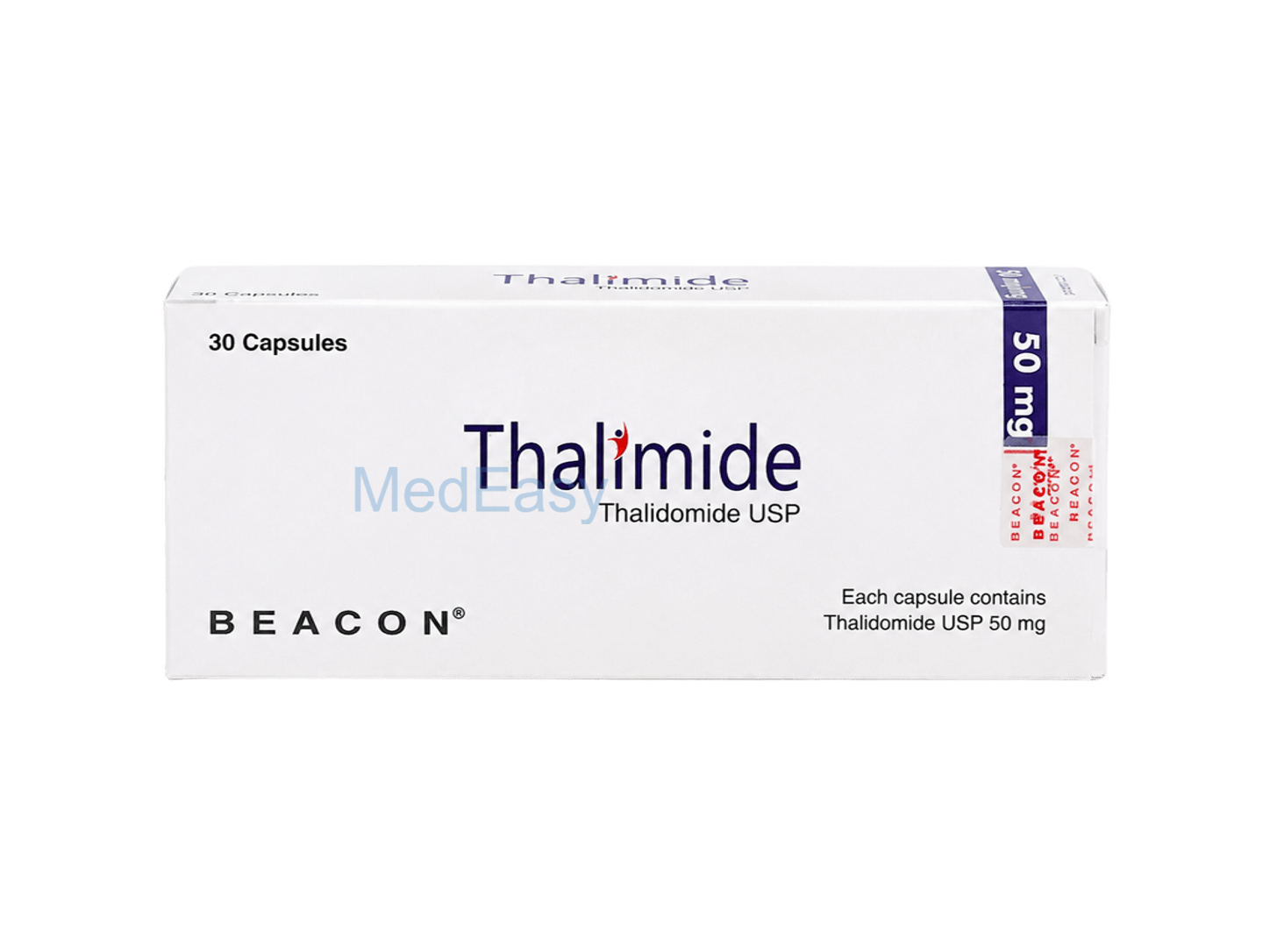
Thalimide50 mg
Beacon Pharmaceuticals PLC
৳460.00
Add to cart


Midothal is indicated for the following conditions:
Midothal should not be used as monotherapy in patients with moderate-to-severe ENL neuritis, and it does not replace standard multidrug anti-leprosy (mycobacterial) therapy, which must be continued concurrently.
Other uses of Midothal (for example in certain refractory graft-versus-host disease, Behçet's disease-related ulcers, or other inflammatory or oncologic conditions) are off-label and should only be considered by a specialist when standard treatments have failed, given the drug's serious risk profile.
Each capsule contains Thalidomide INN as the active ingredient, commonly available in strengths of 50 mg and 100 mg for oral administration.
Inactive ingredients typically include pregelatinized starch, croscarmellose sodium, magnesium stearate, and a hard gelatin capsule shell; exact excipients vary by manufacturer.
Midothal is an immunomodulatory, anti-angiogenic, and anti-inflammatory agent originally developed in the 1950s. It was withdrawn from general use after it was found to cause severe, life-threatening birth defects when taken during pregnancy, but it was later re-introduced under strict regulatory controls after its efficacy was established in erythema nodosum leprosum and, subsequently, multiple myeloma.
Today, Midothal is available only through tightly controlled distribution programs that require mandatory pregnancy testing, contraception counseling, and prescriber/pharmacy/patient registration, because of its extreme teratogenic potential.
Immunomodulatory imide drug (IMiD); antineoplastic and anti-inflammatory/anti-leprosy agent.
The precise mechanism of action of Thalidomide is not completely understood, but it involves multiple immunomodulatory, anti-angiogenic, and anti-inflammatory pathways:
Absorption after oral dosing is slow; peak plasma concentrations occur several hours after a dose, and food does not significantly affect the extent of absorption.
Dosing of Midothal is individualized by indication and must be initiated and monitored by a physician experienced in its use, within an appropriate risk-management program.
| Indication | Typical adult dose | Notes |
|---|---|---|
| Multiple myeloma (newly diagnosed) | 200 mg orally once daily, in combination with dexamethasone, given in 28-day treatment cycles | Continued as tolerated per treatment protocol; thromboprophylaxis usually required (see Precautions) |
| Erythema nodosum leprosum, acute | 100-300 mg orally once daily; up to 400 mg/day may be used for severe reactions | Continue for at least 2 weeks and until active skin lesions have resolved, then taper |
| Erythema nodosum leprosum, maintenance | Taper in decrements of about 50 mg every 2-4 weeks to the lowest effective dose | Used to prevent/suppress recurrence; discontinue as soon as possible |
Patients weighing less than 50 kg are generally started at the lower end of the dosing range. Midothal capsules should be taken whole with water at bedtime, at least one hour after the evening meal, to minimize sedation during waking hours.
Midothal is for oral use only. Capsules should be swallowed whole with a glass of water; they should not be opened, broken, or chewed, and should be handled with care (avoid direct skin contact with capsule contents) because of teratogenic risk.
Take the dose at approximately the same time each day, at bedtime and at least one hour after the evening meal, to reduce daytime drowsiness.
Midothal must never be shared with another person, even someone with the same symptoms. Any unused capsules must be returned to a pharmacy or disposed of according to local restricted-drug disposal instructions rather than discarded in household waste, because of the catastrophic risk if the drug reaches a pregnant woman.
Midothal has the following well-established clinically significant interactions:
Patients should inform their physician of all medicines they are taking before starting Midothal.
Thalidomide is contraindicated in:
Common and important adverse effects of Midothal include:
Patients should seek prompt medical attention for signs of neuropathy (numbness, tingling, pain in hands/feet), blood clots (leg swelling/pain, chest pain, shortness of breath), or severe rash.
Pregnancy: Midothal is absolutely contraindicated in pregnancy. It is a potent human teratogen — a single dose taken by a pregnant woman can cause severe, life-threatening birth defects (including limb malformations, and defects of the ear, eye, heart, and gastrointestinal and genitourinary systems) or fetal death. Females of reproductive potential must have a confirmed negative pregnancy test before starting therapy and must use two reliable forms of contraception during treatment and for a defined period afterward, in compliance with the mandatory risk-management program. Male patients must also use condoms during sexual contact with women of reproductive potential, as Midothal is present in semen.
Lactation: It is not known whether Midothal passes into breast milk; because of the potential for serious adverse effects in a nursing infant, breastfeeding is not recommended during treatment with Midothal.
Embryo-fetal toxicity: see Pregnancy and Lactation and Contraindications — Midothal must only be dispensed through a certified restricted distribution program.
Venous thromboembolism: deep vein thrombosis and pulmonary embolism occur at significantly increased rates, especially when Midothal is combined with dexamethasone or other antimyeloma agents. Prophylactic anticoagulation or antiplatelet therapy is often required, particularly in the first several months of treatment; patients should be monitored for and educated on symptoms of DVT/PE.
There is no specific antidote for Midothal overdose. Reported overdoses have generally not resulted in serious sequelae, but excessive doses may worsen sedation, dizziness, and other known adverse effects.
In case of suspected overdose, seek immediate medical attention or contact a poison control center/emergency services. Management is supportive, with monitoring of vital signs (including heart rate) and symptomatic treatment as needed; there is no established role for unsupervised home treatment.
Store at room temperature (20°C-25°C, below 30°C), away from light and moisture, in the original packaging. Keep out of reach of children and anyone other than the prescribed patient. Return unused or expired capsules to a pharmacy for proper disposal rather than discarding them in household trash.
Renal impairment: data are limited; use with caution and monitor closely, as Midothal and its metabolites may accumulate in significant renal impairment.
Hepatic impairment: specific dose-adjustment data are limited; use with caution and clinical monitoring in patients with hepatic dysfunction.
Elderly patients: may be more susceptible to sedation, dizziness, constipation, and bradycardia; use with caution and consider closer monitoring.
Pediatric patients: see Pediatric Uses.
For multiple myeloma, Midothal is generally continued in 28-day cycles for as long as the disease responds and the drug is tolerated, as determined by the treating oncologist.
For erythema nodosum leprosum, treatment is continued for a minimum of 2 weeks and until active cutaneous lesions have resolved, after which the dose is tapered gradually (in steps of about 50 mg every 2-4 weeks) to the lowest dose that controls symptoms, and discontinued as soon as clinically feasible.
Immunomodulatory imide drugs (IMiDs); antineoplastic agents; anti-leprosy/anti-inflammatory agents.
Thalidomide binds cereblon, a substrate receptor of the CRL4 E3 ubiquitin ligase complex, redirecting it to ubiquitinate and degrade specific transcription factors (such as Ikaros and Aiolos) that are important for myeloma cell survival, producing direct antineoplastic and immunomodulatory effects.
It also inhibits angiogenesis (blood vessel formation induced by growth factors such as VEGF and bFGF), reduces production of the pro-inflammatory cytokine TNF-alpha, and modulates T-cell co-stimulation and other cytokine pathways, which underlies its anti-inflammatory activity in erythema nodosum leprosum.
X
The safety and efficacy of Midothal in pediatric patients have not been established. It is not approved for routine use in children or adolescents.
Use in pediatric patients, where undertaken at all (for example in specialist-directed treatment of severe pediatric ENL), should occur only under close specialist supervision given the drug's severe teratogenic potential, risk of peripheral neuropathy, and other serious adverse effects, and only when no safer alternative exists.
Q: What is Midothal 50 mg Capsule used for?
A: Midothal 50 mg Capsule is used, in combination with dexamethasone, for newly diagnosed multiple myeloma, and separately for treating and preventing recurrence of erythema nodosum leprosum (ENL), a painful skin complication of leprosy.
Q: Can Midothal 50 mg Capsule be taken during pregnancy?
A: No. Midothal 50 mg Capsule is absolutely contraindicated in pregnancy — even one dose can cause severe, life-threatening birth defects or fetal death. Women who can become pregnant must have a negative pregnancy test and use two reliable forms of contraception before, during, and after treatment, as required by the mandatory risk-management program.
Q: What are the most serious risks of Midothal 50 mg Capsule?
A: The most serious risks of Midothal 50 mg Capsule, highlighted in boxed warnings, are severe birth defects if taken during pregnancy, and an increased risk of blood clots (deep vein thrombosis and pulmonary embolism), especially when combined with dexamethasone. Patients may need blood-thinning medicine to reduce this clot risk.
Q: Why does Midothal 50 mg Capsule sometimes cause numbness or tingling?
A: Midothal 50 mg Capsule commonly causes peripheral neuropathy — numbness, tingling, or pain, usually in the hands and feet — which can be dose-limiting and sometimes permanent. Tell your doctor immediately if you notice these symptoms so the dose can be adjusted.
Q: Can I share my Midothal 50 mg Capsule capsules with someone else?
A: No, never. Midothal 50 mg Capsule must not be shared with anyone, even a person with similar symptoms, because of the catastrophic risk of birth defects if it reaches a pregnant woman. Unused capsules should be returned to a pharmacy for safe disposal, not thrown in household trash.
Q: How should Midothal 50 mg Capsule be taken?
A: Midothal 50 mg Capsule capsules are usually taken once daily by mouth at bedtime, at least one hour after the evening meal, swallowed whole with water. Follow your physician's exact instructions on dose and duration for your specific condition.
Disclaimer
The information provided is accurate to the best of our knowledge, but it does not replace professional medical advice. We cannot guarantee its completeness or accuracy, and the absence of specific information about a drug should not be taken as an endorsement. We are not responsible for any consequences arising from this information, so please consult a healthcare professional for any concerns or questions.
