
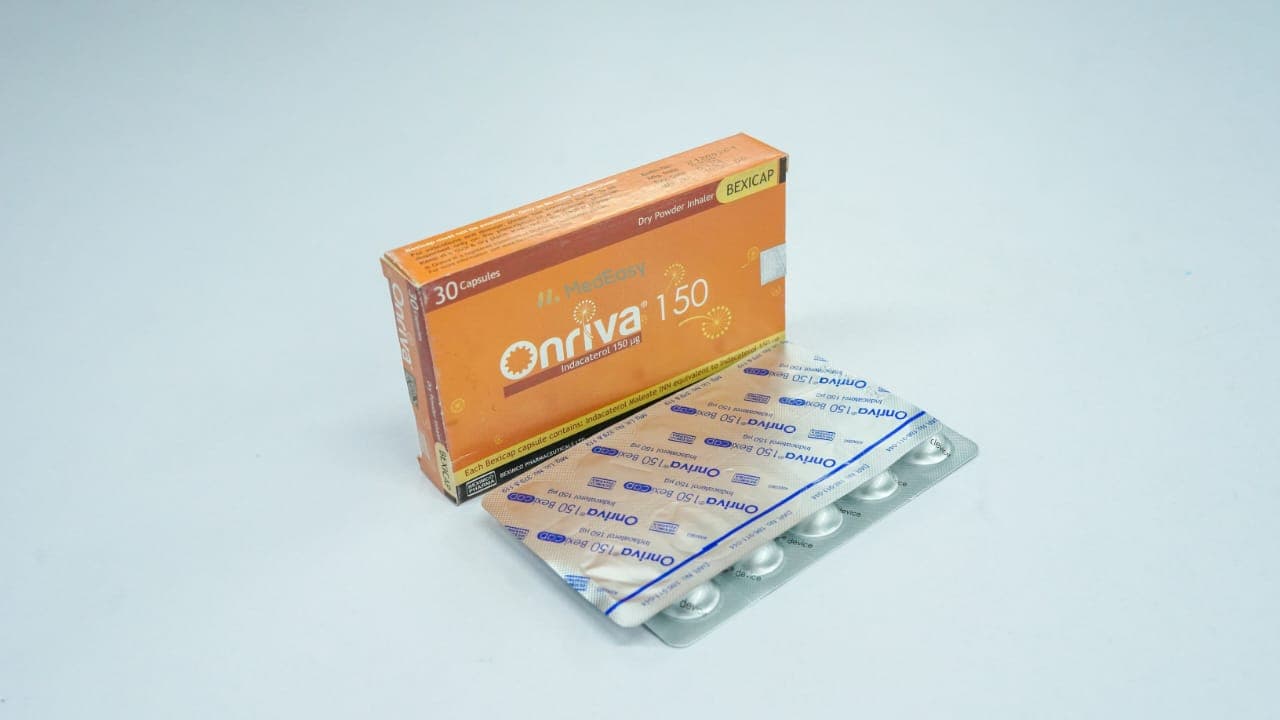
Key facts
Onriva 150 mcg Inhalation Capsule is available on MedEasy for ৳315.00 per 10's Strip, with home delivery anywhere in Bangladesh. It is manufactured by Beximco Pharmaceuticals Ltd. Its generic name is Indacaterol Maleate.
- Pack sizes
- 10's Strip, 30's pack
- Prescription
- Required. Upload a valid doctor's prescription at checkout; a MedEasy pharmacist verifies it before dispatch.
- Delivery
- Home delivery across Bangladesh. Same-day delivery in Dhaka, Chattogram, Sylhet and Bogura city areas; 2-3 days elsewhere.
- Payment
- Cash on delivery, bKash, cards and mobile banking.
- Brand
- Onriva
- Generic name
- Indacaterol Maleate
- Manufacturer
- Beximco Pharmaceuticals Ltd.
- Form & strength
- Inhalation Capsule 150 mcg
- Availability
- In stock
- Authenticity
- Sourced from licensed suppliers and the manufacturer's authorised distributors in Bangladesh.

Medicine overview
Indications of Onriva
Onriva is an inhaled, long-acting beta2-adrenergic agonist (LABA) indicated for the following use:
Established / FDA-Approved Indication
- Chronic Obstructive Pulmonary Disease (COPD): Onriva is indicated for the long-term, once-daily maintenance bronchodilator treatment of airflow obstruction in patients with COPD, including chronic bronchitis and/or emphysema.
Important Labeling Distinctions
- Onriva is NOT indicated for the treatment of asthma. Safety and efficacy of Onriva in asthma have not been established, and LABA monotherapy is associated with an increased risk of asthma-related death (see Precautions and Warnings).
- Onriva is NOT a rescue medication and must not be used to treat acute deteriorations of COPD or acute episodes of bronchospasm.
Composition
Each hard capsule for oral inhalation contains Indacaterol Maleate equivalent to a labeled dose of indacaterol base (commonly available internationally as 150 mcg or 300 mcg strengths), along with lactose monohydrate as a carrier/excipient. The capsule is intended for use only with its accompanying single-dose dry powder inhaler device and must not be swallowed.
Description
Onriva is the maleate salt of indacaterol, an ultra-long-acting beta2-adrenergic receptor agonist (LABA) developed for the maintenance treatment of chronic obstructive pulmonary disease (COPD). It is formulated as a dry powder inside hard capsules that are inserted into a dedicated single-dose inhaler device immediately before use; the powder is inhaled directly into the lungs.
Onriva provides sustained bronchodilation for a full 24 hours, allowing convenient once-daily dosing, unlike older short-acting bronchodilators that require multiple daily doses.
Therapeutic Class
Onriva belongs to the therapeutic class of long-acting beta2-adrenergic agonists (LABA), used as inhaled bronchodilators in the maintenance management of chronic obstructive pulmonary disease.
Pharmacology
Indacaterol Maleate acts as a selective agonist at beta2-adrenergic receptors present on airway smooth muscle. Binding of Indacaterol Maleate to these receptors activates adenylate cyclase, increasing intracellular cyclic AMP (cAMP). Elevated cAMP activates protein kinase A, which lowers intracellular calcium and relaxes bronchial smooth muscle, producing bronchodilation.
Onset of bronchodilation with Indacaterol Maleate occurs within about 5 minutes of inhalation, and the effect is sustained for 24 hours, supporting once-daily dosing. Indacaterol Maleate shows high intrinsic efficacy at the beta2-receptor, with relatively lower activity at beta1-receptors, though cardiovascular beta1-mediated effects (e.g., increased heart rate) can still occur, particularly at higher doses.
Dosage & Administration of Onriva
Dosing by Indication
| Indication | Population | Recommended Dose |
|---|---|---|
| COPD maintenance bronchodilator therapy | Adults | The contents of one inhalation capsule (strength as prescribed) are inhaled orally once daily, using the dedicated inhaler device, at the same time each day. |
| COPD | Pediatric patients | Not indicated; safety and efficacy have not been established in patients under 18 years of age (see Use in Special Populations). |
Renal and Hepatic Impairment
- Renal impairment: No dose adjustment is generally required in mild-to-severe renal impairment; clinical experience in severe renal impairment and end-stage renal disease is limited, and Onriva should be used with caution in these patients.
- Hepatic impairment: No dose adjustment is required in mild-to-moderate hepatic impairment. Onriva has not been studied in severe hepatic impairment and should be used with caution in this population.
Maximum Dose
Do not exceed the once-daily recommended dose of Onriva. More frequent dosing or additional doses do not provide added benefit and increase the risk of adverse cardiovascular effects.
Administration of Onriva
Onriva capsules are for oral inhalation only and must never be swallowed. To administer:
- Remove one capsule from the blister immediately before use; do not store capsules outside the blister.
- Open the inhaler device, place the capsule in the chamber, and close the device until it clicks.
- Press both side buttons once, fully, at the same time, then release, to pierce the capsule.
- Breathe out fully (away from the device), then place the mouthpiece in the mouth, tilt the head slightly back, and inhale rapidly and deeply through the device; hold the breath for as long as comfortable (up to 10 seconds).
- Check the capsule for remaining powder; if powder remains, repeat the inhalation step.
- Discard the empty capsule after use; do not use the device to inhale any other medication.
Interaction of Onriva
Onriva has the following clinically significant drug interactions:
- Other long-acting beta2-agonists (LABAs): Concomitant use with other LABA-containing medicines should be avoided because of the risk of additive sympathomimetic and cardiovascular effects; Onriva should not be combined with other LABA-containing products.
- Beta-adrenergic blockers: Beta-blockers (especially non-selective agents) may block the pulmonary and cardiovascular effects of Onriva and should generally be avoided in patients using Onriva; if required for compelling medical reasons, a cardioselective beta-blocker may be considered with caution.
- Monoamine oxidase (MAO) inhibitors and tricyclic antidepressants: These agents (and drugs known to prolong the QT interval) may potentiate the effect of Onriva on the cardiovascular system and should be used with caution.
- Non-potassium-sparing diuretics (e.g., loop or thiazide diuretics): Concurrent use may enhance ECG changes and/or hypokalemia associated with beta2-agonist therapy; use with caution and monitor potassium and ECG where clinically indicated.
- Other sympathomimetic agents: Concomitant use of other sympathomimetic medicines may potentiate adverse cardiovascular effects of Onriva.
Contraindications
Indacaterol Maleate is contraindicated in patients with a known hypersensitivity to indacaterol or to any excipient in the formulation, including patients with severe milk protein allergy (due to the lactose monohydrate content of the capsules), in whom serious hypersensitivity or bronchospasm may occur.
Side Effects of Onriva
The most commonly reported adverse effects with Onriva include:
- Nasopharyngitis (common cold-like symptoms)
- Cough
- Headache
- Nausea
- Musculoskeletal pain (including back pain)
- Hypertension
- Sinusitis and upper respiratory tract infection
Less common but clinically important cardiovascular effects, consistent with the beta2-agonist class, include tachycardia, palpitations, and tremor. Rarely, paradoxical bronchospasm can occur (see Precautions and Warnings).
Pregnancy & Lactation
There are limited data on the use of Onriva in pregnant women. As with other beta2-agonists, Onriva may inhibit uterine contractions (tocolytic effect) if used during labor. Onriva should be used during pregnancy only if the potential benefit to the mother justifies the potential risk to the fetus, and only under medical supervision.
It is not known whether Onriva is excreted in human breast milk. Because many drugs are excreted in breast milk, caution should be exercised, and Onriva should be used during breastfeeding only if clearly needed, after consulting a physician, weighing the benefits of treatment against any potential risk to the infant.
Precautions & Warnings
Boxed Warning: Asthma-Related Death (LABA Class Warning)
Long-acting beta2-adrenergic agonists (LABAs), the class of medicine that includes Onriva, increase the risk of asthma-related death. Onriva is not indicated for the treatment of asthma. Data are not available to determine whether the risk of asthma-related death is increased in patients with COPD who use Onriva.
Not for Acute Symptoms
Onriva is not a rescue medicine and must not be used to treat acute symptoms of COPD or acute bronchospasm; a short-acting bronchodilator should be used for acute relief, and patients should be instructed to seek medical attention if rescue treatment becomes less effective or is needed more often than usual.
Cardiovascular Effects
Beta2-agonists such as Onriva can produce clinically significant cardiovascular effects, including increases in heart rate, blood pressure, and ECG changes; Onriva should be used with caution in patients with cardiovascular disorders, especially coronary insufficiency, cardiac arrhythmias, and hypertension.
Other Precautions
- Paradoxical bronchospasm: Discontinue Onriva immediately if paradoxical bronchospasm occurs and institute alternative therapy.
- Convulsive disorders: Use with caution, as with other sympathomimetic agents.
- Thyrotoxicosis: Use with caution due to potential for increased sympathomimetic effects.
- Diabetes mellitus: Beta2-agonists may transiently raise blood glucose; monitor as clinically indicated.
- Hypokalemia: Beta2-agonist therapy may produce significant hypokalemia in some patients, potentiated by concomitant use with diuretics (see Interactions).
Overdose Effects of Onriva
Overdose of Onriva is likely to produce exaggerated beta2-agonist effects, such as tachycardia, palpitations, tremor, headache, nausea, hypokalemia, hyperglycemia, and increased blood pressure or, rarely, hypotension. Cardiac arrhythmias may occur.
There is no specific antidote for Onriva overdose. If overdose is suspected, discontinue Onriva immediately and seek immediate medical attention or contact a poison control center. Supportive treatment and monitoring of cardiac status (ECG) and serum potassium should be instituted by a physician as clinically indicated; cardioselective beta-blockers may be considered by a physician with caution, given the risk of inducing bronchospasm.
Storage Conditions
Store at room temperature (below 30°C), away from light and moisture. Keep capsules in the blister until immediately before use, and keep out of reach of children. Do not refrigerate or freeze.
Use In Special Populations
- Elderly: No overall differences in safety or efficacy have been observed between elderly and younger adult patients; no dose adjustment is required based on age alone.
- Renal impairment: No dose adjustment needed in mild-to-severe renal impairment; use with caution in severe renal impairment or end-stage renal disease due to limited data (see Dosage and Administration).
- Hepatic impairment: No dose adjustment needed in mild-to-moderate hepatic impairment; use with caution in severe hepatic impairment, which has not been studied (see Dosage and Administration).
- Pediatric patients: Safety and efficacy of Onriva have not been established in patients under 18 years of age; it is not indicated for use in children or adolescents.
- Pregnancy and lactation: See Pregnancy and Lactation section.
Duration Of Treatment
Onriva is intended for long-term, continuous, once-daily maintenance treatment of COPD and should be taken regularly every day as prescribed, even when the patient feels well, to maintain control of airflow obstruction. It is not intended for short-term or as-needed use. Patients should not stop Onriva without consulting their physician, and any perceived reduction in effectiveness or worsening of symptoms should be reported to a physician promptly rather than increasing the dose or frequency on their own.
Drug Classes
Bronchodilator; Long-acting beta2-adrenergic agonist (LABA); Anti-COPD inhaled therapy
Mode Of Action
Indacaterol Maleate selectively stimulates beta2-adrenergic receptors in bronchial smooth muscle, activating adenylate cyclase to raise intracellular cAMP, which relaxes airway smooth muscle and produces sustained bronchodilation lasting 24 hours (see Pharmacology for full mechanism).
Pregnancy
C
Pediatric Uses
The safety and efficacy of Onriva in pediatric patients (below 18 years of age) have not been established. Onriva is not indicated for use in children or adolescents, and it must not be used as a substitute for appropriate pediatric asthma or COPD-directed therapy. Use in this population should only occur under specialist medical guidance if ever considered off-label, which is not generally recommended.
Frequently Asked Questions
Q: What is Onriva 150 mcg Inhalation Capsule used for?
A: Onriva 150 mcg Inhalation Capsule is a long-acting inhaled bronchodilator used once daily for the long-term maintenance treatment of chronic obstructive pulmonary disease (COPD). It is not used to treat asthma and is not a rescue inhaler for sudden breathing difficulty.
Q: Can Onriva 150 mcg Inhalation Capsule be used for an asthma attack or sudden shortness of breath?
A: No. Onriva 150 mcg Inhalation Capsule is not a rescue medication and must not be used for acute symptoms or asthma attacks. A fast-acting rescue inhaler prescribed by your physician should be used for sudden symptoms, and you should seek medical attention if you need your rescue inhaler more often than usual.
Q: Is Onriva 150 mcg Inhalation Capsule safe to use during pregnancy?
A: Data on Onriva 150 mcg Inhalation Capsule use in pregnancy are limited. It may affect uterine contractions if used near labor. Onriva 150 mcg Inhalation Capsule should be used during pregnancy only if clearly needed and if the potential benefit justifies the potential risk to the fetus, and only under a physician's supervision.
Q: What are the most common side effects of Onriva 150 mcg Inhalation Capsule?
A: The most common side effects include nasopharyngitis (cold-like symptoms), cough, headache, nausea, muscle or back pain, and mild increases in blood pressure. Less commonly, it can cause a fast heartbeat, palpitations, or tremor. Contact your physician if these are severe or persistent.
Q: Why does Onriva 150 mcg Inhalation Capsule carry a warning about asthma-related death if it is used for COPD?
A: Onriva 150 mcg Inhalation Capsule belongs to a class of medicines called long-acting beta2-agonists (LABAs), which as a class carry a boxed warning because LABA monotherapy has been associated with an increased risk of asthma-related death. Onriva 150 mcg Inhalation Capsule itself is approved only for COPD, not asthma, and should never be used to treat asthma.
Q: What should I do if I miss a dose or think I have taken too much Onriva 150 mcg Inhalation Capsule?
A: If you miss a dose, take it as soon as you remember, but do not take a double dose to make up for a missed one, and never take more than one dose in 24 hours. If you suspect an overdose, or experience symptoms such as chest pain, rapid or irregular heartbeat, or severe tremor, seek immediate medical attention or contact a poison control center right away.
Disclaimer
The information provided is accurate to the best of our knowledge, but it does not replace professional medical advice. We cannot guarantee its completeness or accuracy, and the absence of specific information about a drug should not be taken as an endorsement. We are not responsible for any consequences arising from this information, so please consult a healthcare professional for any concerns or questions.