5% Off
Ontaxel6 mg/ml
Drug International Ltd.
৳1425.00
Add to cart


Paxel is a taxane-class chemotherapy agent used in the treatment of several solid-organ malignancies. Its indications are classified below by strength of evidence.
Paxel is used together with other agents (most commonly a platinum compound such as cisplatin or carboplatin) for ovarian cancer and NSCLC; it is not intended as monotherapy in these settings.
Guideline-supported off-label use of Paxel also occurs in some other solid tumours (e.g. certain gastric, cervical, endometrial, and head-and-neck cancers) as part of multidisciplinary oncology protocols; such use should be guided by an oncologist based on current treatment guidelines.
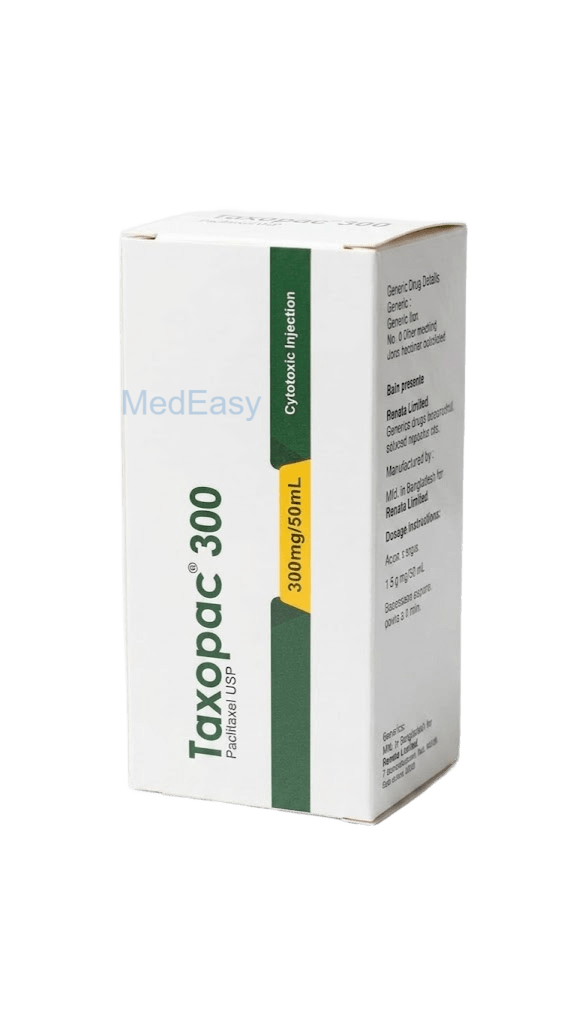
Each mL of Paclitaxel injection concentrate typically contains 6 mg of Paclitaxel, formulated in a vehicle of polyoxyethylated castor oil (Cremophor EL) and dehydrated alcohol (approximately 1:1, v/v). It is supplied as a sterile, non-aqueous concentrate in single-use vials of various strengths (e.g., 30 mg/5 mL, 100 mg/16.7 mL, 150 mg/25 mL, 300 mg/50 mL), intended for dilution before intravenous infusion.
Paxel is a semi-synthetic antineoplastic agent belonging to the taxane class, originally derived from the bark of the Pacific yew tree (Taxus brevifolia) and now produced by semi-synthesis. It is administered as an intravenous chemotherapy infusion under the supervision of an oncologist for the treatment of ovarian cancer, breast cancer, non-small cell lung cancer, and AIDS-related Kaposi's sarcoma.
Paxel works by binding to microtubules and preventing their normal breakdown, which blocks cell division and leads to death of rapidly dividing cancer cells.
Antineoplastic agent — Taxane (microtubule-stabilizing agent / mitotic inhibitor)
Paclitaxel promotes the assembly of microtubules from tubulin dimers and stabilizes the resulting microtubules by preventing their depolymerisation. This abnormal stability disrupts the normal dynamic reorganisation of the microtubule network that is required for vital interphase and mitotic cell functions, leading to inhibition of cell division (arrest at the G2/M phase of the cell cycle) and, ultimately, apoptosis of rapidly dividing cells, including malignant cells.
Following intravenous infusion, Paclitaxel exhibits a biphasic decline in plasma concentrations and is extensively (>88%) bound to plasma proteins. It is metabolised mainly in the liver via cytochrome P450 enzymes CYP2C8 and, to a lesser extent, CYP3A4, and is eliminated predominantly through biliary/faecal excretion, with a smaller fraction excreted renally. Its pharmacokinetics can be schedule- and dose-dependent (e.g., differing between 3-hour and 24-hour infusions).
Paxel dosing is individualised by indication, treatment protocol, and patient tolerance, and must only be prescribed and supervised by a physician experienced in the use of cancer chemotherapeutic agents. Standard premedication and administration precautions (see Administration and Precautions and Warnings) are required before every infusion.
| Indication | Typical Paxel Dose | Schedule |
|---|---|---|
| Ovarian carcinoma (first-line, with cisplatin) | 135 mg/m² over 24 hours, or 175 mg/m² over 3 hours | Every 3 weeks, for a physician-determined number of cycles (commonly 6) |
| Ovarian carcinoma (subsequent therapy) | 135–175 mg/m² over 3 hours | Every 3 weeks |
| Breast cancer (adjuvant, after anthracycline-based chemotherapy) | 175 mg/m² over 3 hours | Every 3 weeks, for 4 cycles |
| Breast cancer (metastatic) | 175 mg/m² over 3 hours | Every 3 weeks |
| Non-small cell lung cancer (with cisplatin) | 135 mg/m² over 24 hours | Every 3 weeks (Paxel given before cisplatin) |
| AIDS-related Kaposi's sarcoma | 135 mg/m² over 3 hours every 3 weeks, or 100 mg/m² over 3 hours every 2 weeks | Per protocol and tolerance |
Doses are given as an intravenous infusion, diluted as described under Reconstitution, and administered through an in-line filter. Treatment is generally not repeated until the neutrophil count recovers to at least 1,500 cells/mm³ (1,000 cells/mm³ for Kaposi's sarcoma) and platelets to at least 100,000 cells/mm³.
Pediatric use: safety and efficacy of Paxel have not been established in children (see Use in Special Populations).
Paxel is for intravenous infusion only and must be administered in a healthcare facility equipped to manage severe hypersensitivity reactions, under the supervision of a physician experienced in cancer chemotherapy.
Paxel is metabolised by cytochrome P450 enzymes CYP2C8 and CYP3A4, making it susceptible to clinically significant drug interactions.
Paclitaxel is contraindicated in:
Adverse effects of Paxel are common and dose/schedule-dependent. Serious reactions (hypersensitivity, bone marrow suppression, peripheral neuropathy) are discussed fully under Precautions and Warnings; only a brief mention is given here.
Paxel is a cytotoxic chemotherapy agent that can cause fetal harm and is contraindicated during pregnancy. Women of reproductive potential should use effective contraception during, and for a period after, treatment with Paxel; male patients with female partners of reproductive potential should also use effective contraception. If Paxel is used inadvertently during pregnancy, or if a patient becomes pregnant while on it, she should be informed of the potential risk to the fetus and referred for genetic counselling.
Paxel is contraindicated during breastfeeding because of the potential for serious adverse effects in the nursing infant; breastfeeding should be discontinued during treatment and is not recommended for a period after the last dose, on the advice of the treating physician.
Paxel must be administered only under the supervision of a physician experienced in the use of cancer chemotherapeutic agents, in a facility equipped to manage life-threatening complications.
Severe hypersensitivity reactions, including dyspnoea, hypotension requiring treatment, angioedema, and generalised urticaria, have occurred with Paxel, occasionally despite premedication. All patients must be premedicated with a corticosteroid, an H1-antihistamine, and an H2-antagonist prior to every infusion of Paxel (see Administration). Patients with a history of severe hypersensitivity to Paxel should not be re-challenged (see Contraindications). Fatal reactions have occurred rarely in patients despite premedication.
Paxel commonly causes dose-dependent bone marrow suppression, primarily neutropenia, which can be severe. Frequent monitoring of peripheral blood counts is required during treatment. Paxel should not be re-administered until neutrophils recover to at least 1,500 cells/mm³ (1,000 cells/mm³ for Kaposi's sarcoma) and platelets recover adequately; dose reduction may be needed for subsequent cycles.
Peripheral neuropathy is frequent and dose-related. Patients should be monitored for numbness, tingling, burning, or weakness in the hands and feet; dose reduction or discontinuation may be required for severe or worsening neuropathy.
There is no known antidote for Paxel overdosage. Anticipated complications of overdose include exaggerated forms of the drug's known toxicities: severe bone marrow suppression, peripheral neurotoxicity, and mucositis. In case of suspected overdose of Paxel, the patient should be monitored closely in a hospital setting and managed with supportive care; seek immediate medical attention or contact emergency services/poison control without delay. Do not attempt to manage a suspected overdose at home.
Store unopened Paxel vials at controlled room temperature, below 30°C (ideally 20–25°C), in the original carton to protect from light. Do not freeze. Diluted infusion solutions of Paxel should be used within the time and conditions specified by institutional protocol/manufacturer instructions. Keep out of reach of children. Paxel should be prepared, handled, and disposed of by trained personnel using appropriate hazardous-drug precautions.
Patients with hepatic impairment have a higher risk of toxicity with Paxel; dose adjustment based on bilirubin/transaminase levels and infusion schedule is recommended, per institutional protocol.
Data are limited; Paxel should be used with caution in patients with significant renal impairment, with close monitoring.
Elderly patients may be more likely to experience peripheral neuropathy, arthralgia, and cardiovascular events with Paxel; use with appropriate monitoring.
Safety and efficacy of Paxel have not been established in pediatric patients; its use is generally not recommended in this population outside of clinical trials.
See Pregnancy and Lactation for full detail — Paxel is contraindicated in both settings.
Paxel is administered in cycles (commonly every 2–3 weeks) for a number of cycles determined by the indication, treatment protocol, and the patient's response and tolerance — for example, a defined number of adjuvant cycles for breast cancer, or repeated cycles for metastatic/advanced disease until disease progression, unacceptable toxicity, or completion of the planned course. The exact duration of Paxel treatment must be individualised by the treating oncologist and should not be shortened or extended without medical advice.
Paxel injection concentrate is supplied ready-to-dilute and must be diluted prior to intravenous infusion — it is not a powder requiring reconstitution. It should be diluted in 0.9% Sodium Chloride Injection, 5% Dextrose Injection, 5% Dextrose and 0.9% Sodium Chloride Injection, or 5% Dextrose in Ringer's Injection, to a final concentration of 0.3–1.2 mg/mL. Once diluted, Paxel solutions may develop slight haziness, which is attributable to the formulation vehicle and does not indicate reduced potency. The diluted solution must be administered through tubing containing an in-line microporous filter (pore size ≤0.22 micron) and used within the time limits specified by institutional protocol, as it does not contain a preservative.
Antineoplastic agents; Taxanes; Mitotic inhibitors / Microtubule-stabilizing agents
Paclitaxel binds to the beta-subunit of tubulin within microtubules and promotes their assembly while inhibiting depolymerisation. This results in abnormally stable microtubule bundles and disrupts the normal dynamic reorganisation of the microtubule network that cells require for interphase functions and mitosis. The disrupted mitotic spindle formation arrests affected cells at the G2/M phase of the cell cycle, ultimately triggering programmed cell death (apoptosis), which underlies the antitumour activity of Paclitaxel against rapidly dividing malignant cells.
D
The safety and efficacy of Paxel in pediatric patients have not been established. Paxel is not routinely recommended for use in children outside of a clinical trial setting, and any such use should be directed by a pediatric oncologist experienced with cytotoxic chemotherapy.
Q: What is Paxel 6 mg/ml IV Infusion used for?
A: Paxel 6 mg/ml IV Infusion is a chemotherapy medicine used to treat certain cancers, including ovarian cancer, breast cancer, non-small cell lung cancer, and AIDS-related Kaposi's sarcoma. It is given as an intravenous infusion by a cancer specialist, usually in combination with other anticancer medicines.
Q: Why do I need pre-medications before receiving Paxel 6 mg/ml IV Infusion?
A: Before every infusion, patients receive a corticosteroid, an antihistamine, and an H2-blocker to reduce the risk of severe hypersensitivity (allergic) reactions, which can occur with Paxel 6 mg/ml IV Infusion, especially during the first two infusions. Skipping premedication increases the risk of a serious reaction.
Q: Will Paxel 6 mg/ml IV Infusion cause hair loss?
A: Yes, alopecia (hair loss), including body hair, occurs in nearly all patients receiving Paxel 6 mg/ml IV Infusion. Hair typically begins to regrow after treatment ends.
Q: What is peripheral neuropathy and why does Paxel 6 mg/ml IV Infusion cause it?
A: Paxel 6 mg/ml IV Infusion commonly causes numbness, tingling, or burning in the hands and feet, called peripheral neuropathy, because it affects nerve function as well as cancer cells. This is dose-related and usually improves after treatment, though it can persist in some patients; report new or worsening symptoms to your doctor.
Q: Can Paxel 6 mg/ml IV Infusion be used during pregnancy or breastfeeding?
A: No. Paxel 6 mg/ml IV Infusion is a cytotoxic drug that can harm a developing fetus and is contraindicated in pregnancy; breastfeeding should also be stopped during treatment with Paxel 6 mg/ml IV Infusion. Effective contraception is recommended during and after treatment — discuss this with your oncologist.
Q: What should I do if I think I received too much Paxel 6 mg/ml IV Infusion or experience a severe reaction?
A: Because Paxel 6 mg/ml IV Infusion is given in a hospital or clinic setting under close monitoring, overdose is uncommon, but if you notice symptoms of a severe reaction (difficulty breathing, swelling, severe rash, fainting) during or after an infusion, tell the medical staff immediately or seek emergency medical attention right away.
Disclaimer
The information provided is accurate to the best of our knowledge, but it does not replace professional medical advice. We cannot guarantee its completeness or accuracy, and the absence of specific information about a drug should not be taken as an endorsement. We are not responsible for any consequences arising from this information, so please consult a healthcare professional for any concerns or questions.