
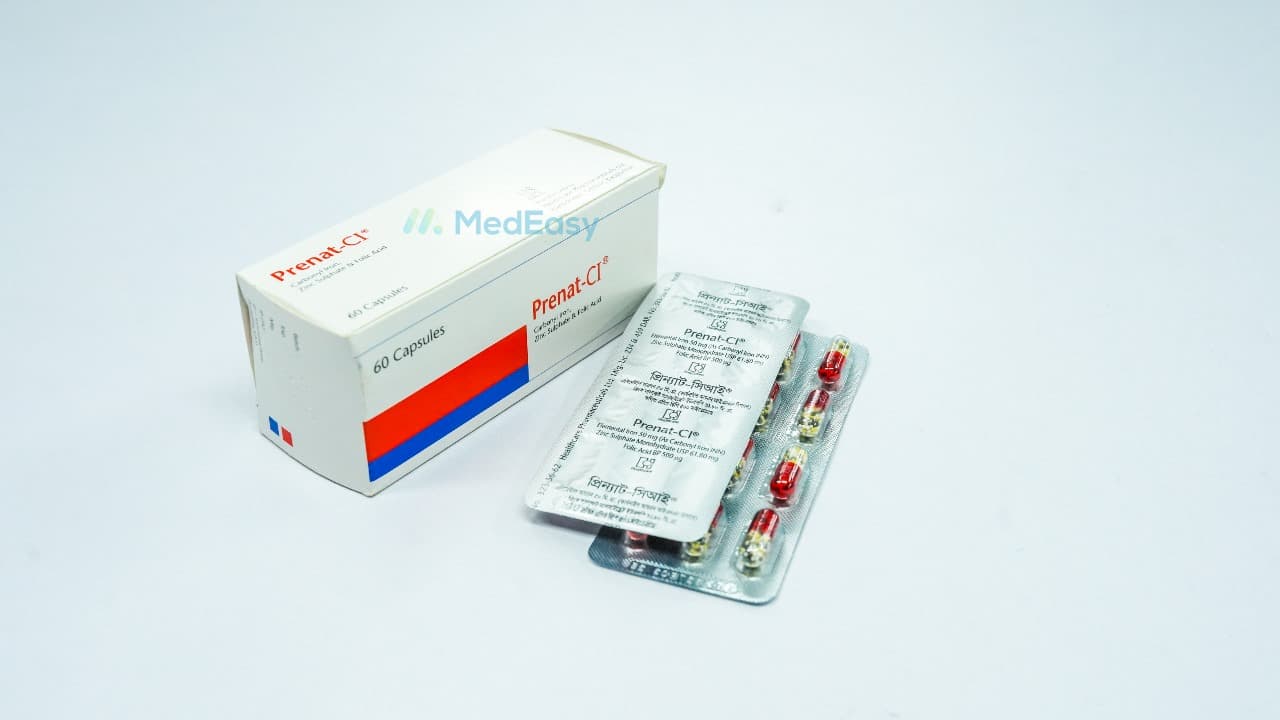
Prenat-CI50 mg+0.5 mg+61.8 mg

Medicine overview
Indications of Prenat-CI
Prenat-CI is a combination hematinic and micronutrient supplement used for the prevention and treatment of iron-deficiency anemia and associated folate and zinc deficiency.
Established/Well-Supported Uses
- Treatment of iron-deficiency anemia, including anemia due to inadequate dietary iron intake, chronic blood loss, or increased physiological demand.
- Prevention and treatment of iron, folate, and zinc deficiency during pregnancy and lactation, consistent with WHO antenatal micronutrient supplementation guidance.
- Nutritional supplementation during periods of rapid growth (infancy, childhood, adolescence) when dietary intake is inadequate, under medical supervision.
Adjunct/Supportive Uses
- As an adjunct to correct micronutrient deficiency during convalescence, malabsorption states, or restrictive diets, alongside treatment of the underlying cause.
Prenat-CI does not treat anemia caused by conditions other than iron, folate, or zinc deficiency (e.g., vitamin B12 deficiency, thalassemia, chronic disease anemia); a physician should confirm the underlying cause before starting therapy.
Composition
Each unit of Carbonyl Iron + Folic Acid + Zinc Sulfate Monohydrate typically contains carbonyl iron (an elemental, purified iron powder) equivalent to a specified amount of elemental iron, together with folic acid and zinc sulfate monohydrate (providing elemental zinc). Exact strengths vary by manufacturer and formulation (tablet, capsule, or syrup); refer to the product label for the precise composition of Carbonyl Iron + Folic Acid + Zinc Sulfate Monohydrate being dispensed.
Description
Prenat-CI is an oral combination product formulated to correct iron-deficiency anemia along with concurrent folic acid and zinc deficiency. Carbonyl iron is a highly purified, elemental form of iron that is absorbed more slowly and in a more controlled manner than ionic iron salts (such as ferrous sulfate or ferrous fumarate), which is associated with a comparatively favorable gastrointestinal tolerability profile and a wider safety margin in accidental overdose. Folic acid supports red blood cell production and is essential during pregnancy for fetal neural tube development. Zinc sulfate monohydrate supplies elemental zinc, a trace mineral required for immune function, growth, and wound healing. Together, the components of Prenat-CI are used to prevent and treat combined iron, folate, and zinc deficiency, particularly in pregnancy, childhood growth, and recovery from illness.
Therapeutic Class
Prenat-CI belongs to the therapeutic class of hematinics (anti-anemia preparations) and nutritional/micronutrient supplements, combining an elemental iron source, a B-vitamin (folic acid), and a trace mineral (zinc).
Pharmacology
Carbonyl iron (in Carbonyl Iron + Folic Acid + Zinc Sulfate Monohydrate) is elemental iron that must first be oxidized and dissolved in gastric acid before absorption in the duodenum and proximal jejunum, the same general route used by dietary iron. Its slower dissolution compared with ionic iron salts leads to more gradual, controlled absorption, replenishing hemoglobin synthesis in erythroid precursor cells while reducing peak free-iron exposure in the gut.
Folic acid (in Carbonyl Iron + Folic Acid + Zinc Sulfate Monohydrate) is a synthetic form of vitamin B9 that is reduced to tetrahydrofolate, a cofactor required for one-carbon transfer reactions in DNA synthesis and red blood cell maturation; it corrects megaloblastic changes and supports the increased erythropoiesis needed during iron repletion.
Zinc sulfate monohydrate (in Carbonyl Iron + Folic Acid + Zinc Sulfate Monohydrate) provides elemental zinc, absorbed mainly in the small intestine, which functions as a cofactor for numerous metalloenzymes involved in immune function, protein synthesis, cell division, and wound healing.
Dosage & Administration of Prenat-CI
Dosage of Prenat-CI should be individualized by a physician based on the severity of deficiency, age, and clinical response. The following is general guidance; always follow the product label and physician's prescription for the specific strength dispensed.
| Indication/Population | Typical Adult Dosing | Notes |
|---|---|---|
| Treatment of iron-deficiency anemia | One tablet/capsule of Prenat-CI once or twice daily, as directed | Continue for the duration advised by the physician; response is monitored with follow-up blood counts |
| Prevention during pregnancy/lactation | One tablet/capsule of Prenat-CI once daily | Usually started after the first trimester unless otherwise directed |
| Pediatric supplementation | As prescribed by a pediatrician; weight-based dosing | See Use in Special Populations / Pediatric Uses |
See Administration for instructions on how to take Prenat-CI, and see Duration of Treatment for how long therapy is typically continued.
Administration of Prenat-CI
Prenat-CI is taken by mouth, preferably with water. It may be taken on an empty stomach for optimal absorption, but may be taken with food if it causes stomach upset, since carbonyl iron is generally better tolerated than ionic iron salts. Swallow tablets/capsules whole; do not crush or chew unless the product is specifically designed to be chewed. Avoid taking with tea, coffee, or calcium-rich dairy products, which can reduce iron absorption; separate dosing from these by at least 1-2 hours where possible.
Interaction of Prenat-CI
Prenat-CI can interact with certain medications through reduced absorption or altered efficacy:
- Tetracyclines and fluoroquinolone antibiotics: Iron chelates with these antibiotics, reducing absorption of both. Separate administration by at least 2-3 hours.
- Levothyroxine: Iron can reduce levothyroxine absorption; separate dosing by at least 4 hours.
- Calcium-containing products and antacids: May reduce iron and zinc absorption; avoid co-administration.
- Penicillamine: Zinc may reduce absorption of penicillamine; separate dosing.
- Additional iron or zinc supplements: Concomitant use of separate iron or zinc supplements beyond Prenat-CI should be avoided without medical guidance, as excessive intake of one mineral can impair absorption of the other and increase toxicity risk.
Contraindications
Carbonyl Iron + Folic Acid + Zinc Sulfate Monohydrate is contraindicated in:
- Known hypersensitivity to carbonyl iron, folic acid, zinc sulfate monohydrate, or any excipient of the product.
- Hemochromatosis or other iron-overload states (e.g., hemosiderosis, transfusional iron overload).
- Hemolytic anemia not caused by iron deficiency.
Side Effects of Prenat-CI
The most common side effects associated with Prenat-CI relate to the gastrointestinal tract and include nausea, stomach cramps, constipation or diarrhea, and dark or black-colored stools (a harmless effect of iron). Carbonyl iron's controlled-release absorption is generally associated with better gastrointestinal tolerability than ionic iron salts. Zinc, especially on an empty stomach, may occasionally cause additional nausea or a metallic taste. Rarely, allergic reactions (rash, itching, swelling) may occur.
Pregnancy & Lactation
Prenat-CI is commonly used during pregnancy and lactation to correct iron, folate, and zinc deficiency, and folic acid supplementation is specifically recommended to reduce the risk of neural tube defects. However, as with any supplement, Prenat-CI should be used during pregnancy and breastfeeding only if clearly needed and at doses recommended by a physician; the potential benefit should justify any potential risk. Consult a physician before use, particularly to confirm dosing and avoid inadvertent excess iron or zinc intake.
Precautions & Warnings
Use Prenat-CI with caution in individuals with a history of gastrointestinal disorders (e.g., peptic ulcer disease, inflammatory bowel disease), as iron and zinc can aggravate GI symptoms. Excess supplemental zinc beyond what is provided in Prenat-CI should be avoided, as it can interfere with iron and copper absorption and, with prolonged high intake, cause copper deficiency. Iron overdose remains a serious and potentially fatal risk in young children even with carbonyl iron's improved safety margin; keep Prenat-CI in a childproof container out of the reach of children at all times. Prenat-CI should not replace medical evaluation of the underlying cause of anemia; if there is no improvement despite adherence, or symptoms worsen, consult a physician. See Contraindications and Interaction for additional safety information.
Overdose Effects of Prenat-CI
Although carbonyl iron carries a wider margin of safety than ionic iron salts in accidental overdose, taking substantially more than the prescribed dose of Prenat-CI can still cause toxicity, particularly in children, with symptoms such as nausea, vomiting, abdominal pain, diarrhea, or lethargy. Excess zinc can cause additional gastrointestinal symptoms. In case of suspected overdose, seek immediate medical attention or contact a poison control center/emergency services right away; do not attempt home treatment.
Storage Conditions
Store at room temperature (below 30°C), away from light and moisture. Keep out of reach of children.
Use In Special Populations
Renal impairment: No specific dose adjustment is generally required for Prenat-CI, but iron and zinc supplementation should be guided by a physician, especially in patients on dialysis with altered iron metabolism.
Hepatic impairment: Use Prenat-CI with caution; iron overload can worsen certain liver conditions (e.g., hemochromatosis-related liver disease); see Contraindications.
Elderly: No specific dose adjustment is generally required; monitor for gastrointestinal tolerability.
See Pediatric Uses for information on use of Prenat-CI in children.
Duration Of Treatment
Treatment with Prenat-CI for iron-deficiency anemia is typically continued for 3 to 6 months, or for about 3 months after hemoglobin normalizes, to replenish iron stores, as advised by a physician. For prophylactic use during pregnancy, Prenat-CI is generally continued throughout pregnancy and, if advised, during lactation. Duration should be individualized based on follow-up blood test results.
Drug Classes
Carbonyl Iron + Folic Acid + Zinc Sulfate Monohydrate is classified as a hematinic (antianemic preparation) and multi-micronutrient nutritional supplement, combining an elemental iron source, a folate (vitamin B9) source, and a zinc source.
Mode Of Action
The components of Carbonyl Iron + Folic Acid + Zinc Sulfate Monohydrate act together to correct iron-deficiency anemia and associated micronutrient deficiency: carbonyl iron is oxidized in the stomach and absorbed as ferrous iron in the small intestine to replenish hemoglobin and iron stores; folic acid is converted to its active tetrahydrofolate form to support DNA synthesis and red cell maturation; and zinc, absorbed in the small intestine, serves as an essential cofactor for enzymes involved in cellular metabolism, immune function, and growth.
Pediatric Uses
Use of Prenat-CI in children should be guided by a pediatrician, with weight-based or age-appropriate dosing to correct diagnosed iron, folate, or zinc deficiency or to support growth when dietary intake is inadequate. Safety and efficacy of this specific fixed-dose combination have not been formally established across all pediatric age groups; formal pediatric dosing recommendations exist for the individual components (iron, folic acid, and zinc) rather than for this combination product specifically. Prenat-CI must be stored safely out of children's reach, since accidental ingestion of iron-containing products is a recognized cause of serious pediatric poisoning.
Frequently Asked Questions
Q: What is Prenat-CI 50 mg+0.5 mg+61.8 mg Capsule used for?
A: Prenat-CI 50 mg+0.5 mg+61.8 mg Capsule is used to prevent and treat iron-deficiency anemia along with folic acid and zinc deficiency, particularly during pregnancy, growth periods, or when dietary intake is insufficient.
Q: Can I take Prenat-CI 50 mg+0.5 mg+61.8 mg Capsule during pregnancy?
A: Prenat-CI 50 mg+0.5 mg+61.8 mg Capsule is commonly used in pregnancy to support iron, folate, and zinc needs, but it should be used only if clearly needed and as directed by a physician, since the potential benefit should justify any potential risk; always consult your doctor before starting.
Q: Is Prenat-CI 50 mg+0.5 mg+61.8 mg Capsule safer than regular iron tablets?
A: Carbonyl iron, the iron source in Prenat-CI 50 mg+0.5 mg+61.8 mg Capsule, is absorbed more slowly than ionic iron salts like ferrous sulfate, which is associated with better gastrointestinal tolerability and a wider margin of safety in accidental overdose. However, it can still be harmful in overdose, especially in children, so it must be stored safely out of their reach.
Q: What are the common side effects of Prenat-CI 50 mg+0.5 mg+61.8 mg Capsule?
A: The most common side effects are gastrointestinal: nausea, constipation, stomach cramps, and dark-colored stools. These are usually mild, and carbonyl iron tends to be better tolerated than other iron salts.
Q: Can I take Prenat-CI 50 mg+0.5 mg+61.8 mg Capsule with other supplements or medicines?
A: Prenat-CI 50 mg+0.5 mg+61.8 mg Capsule should be separated by at least 2 hours from antibiotics like tetracyclines or fluoroquinolones, and from levothyroxine and calcium-containing products, as these can reduce absorption. Avoid taking additional iron or zinc supplements alongside Prenat-CI 50 mg+0.5 mg+61.8 mg Capsule unless advised by a physician.
Q: What should I do if a child accidentally swallows Prenat-CI 50 mg+0.5 mg+61.8 mg Capsule?
A: Iron-containing products, including Prenat-CI 50 mg+0.5 mg+61.8 mg Capsule, can be dangerous if a child takes more than the prescribed amount. Seek immediate medical attention or contact a poison control center/emergency services right away; do not wait for symptoms to appear.
Disclaimer
The information provided is accurate to the best of our knowledge, but it does not replace professional medical advice. We cannot guarantee its completeness or accuracy, and the absence of specific information about a drug should not be taken as an endorsement. We are not responsible for any consequences arising from this information, so please consult a healthcare professional for any concerns or questions.
