
10% Off
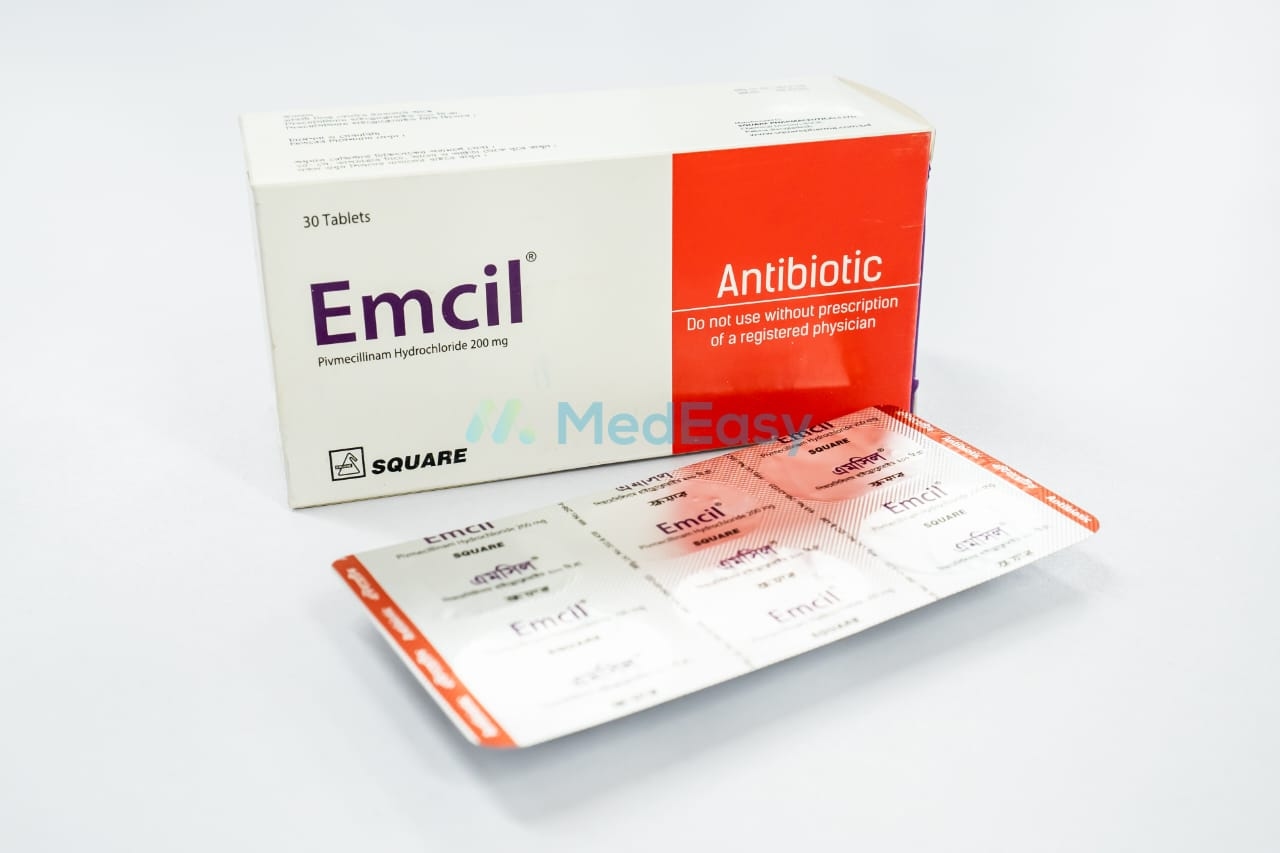
Emcil200 mg
Square Pharmaceuticals PLC.
৳13.55
Add to cart


Relexid is a beta-lactam antibiotic (amidinopenicillin class) indicated for the treatment of specific bacterial infections. Its indications, classified by strength of evidence, are as follows:
Relexid should only be used for infections proven or strongly suspected to be caused by susceptible bacteria, as prescribed by a physician.
Each tablet contains Pivmecillinam (as pivmecillinam hydrochloride) as the active pharmaceutical ingredient. Pivmecillinam is a prodrug ester of mecillinam (amdinocillin), a semi-synthetic amidinopenicillin. Strength and excipients vary by manufacturer and formulation; refer to the specific product label for exact composition.
Relexid is an orally-administered prodrug of mecillinam, a beta-lactam antibiotic belonging to the amidinopenicillin subclass of penicillins. After oral absorption, Relexid is rapidly hydrolyzed by esterases in the intestinal wall and blood to release active mecillinam, along with formaldehyde and pivalic acid as inactive byproducts. Unlike most penicillins, mecillinam has predominant activity against gram-negative bacteria and a distinct mechanism of bacterial cell wall inhibition, making Relexid particularly useful for uncomplicated urinary tract infections caused by susceptible gram-negative uropathogens such as E. coli.
Relexid belongs to the beta-lactam antibiotic class, specifically the amidinopenicillin (mecillinam ester/prodrug) subclass of penicillins.
Pivmecillinam is an inactive ester prodrug that is hydrolyzed after absorption to its active form, mecillinam. Mecillinam exerts bactericidal activity by binding with high affinity and selectivity to penicillin-binding protein 2 (PBP2) in the bacterial cell wall of susceptible gram-negative organisms. This differs from most other beta-lactams (including aminopenicillins and cephalosporins), which primarily target PBP1 and PBP3. Inhibition of PBP2 disrupts the rod shape of the bacterial cell, causing the organism to become a large, osmotically fragile spheroplast that eventually lyses and dies. This distinct target site accounts for the drug's characteristic activity against many gram-negative uropathogens, including some strains resistant to other beta-lactams, and for a low propensity to select for resistance during short-course cystitis therapy.
Pharmacokinetics: After oral administration, Pivmecillinam is well absorbed and rapidly and almost completely hydrolyzed to mecillinam in the intestinal mucosa and plasma. Mecillinam is widely distributed, achieves high concentrations in urine, is minimally protein bound, and is eliminated primarily unchanged by renal excretion (glomerular filtration and tubular secretion). The elimination half-life is approximately 1 to 2 hours in patients with normal renal function.
| Indication | Dose | Duration |
|---|---|---|
| Acute uncomplicated cystitis in adult women | 185 mg (one tablet) orally three times a day | 3 to 7 days, as clinically indicated |
Relexid tablets may be taken with or without food. Tablets should be swallowed whole with a full glass of water.
Safety and efficacy of Relexid have not been established in patients under 18 years of age; a pediatric dosing regimen is not established for this formulation in this market. See Use in Special Populations.
Relexid (as mecillinam) is eliminated mainly by the kidneys. No formal dose-adjustment schedule has been established; use with caution in patients with significant renal impairment, and consider an extended dosing interval in patients with severe renal impairment (creatinine clearance below 30 mL/min), at the physician's discretion.
Use with caution in patients with severe hepatic impairment (see Contraindications and Precautions regarding carnitine-related hepatic effects); no specific dose adjustment has been established.
Take Relexid exactly as prescribed by your physician; do not stop, extend, skip doses, or share this medicine with others without medical advice. Completing the full prescribed course, even if symptoms improve early, helps prevent recurrence and the development of antibiotic-resistant bacteria.
Relexid tablets are for oral use only. Swallow the tablet whole with a glass of water; do not crush or chew unless directed by a physician. It may be taken with or without food. Doses should be spaced evenly through the day (approximately every 8 hours) to maintain effective drug levels, and the full course should be completed even if symptoms resolve before the course ends.
The following clinically significant drug interactions have been identified with Relexid (mecillinam):
Inform your physician or pharmacist of all medicines, supplements, and herbal products you are taking before starting Relexid.
Pivmecillinam is contraindicated in patients with:
Most patients tolerate Relexid well. Reported adverse effects include:
Contact your physician if you experience severe or persistent side effects while taking Relexid.
Pregnancy: Data on the use of Relexid in pregnant women are limited. As a beta-lactam/penicillin-related antibiotic, it is generally considered among the lower-risk antibiotic options, and some international guidelines include it as an option for uncomplicated UTI in pregnancy; however, this is not an approved use in all markets. Relexid should be used during pregnancy only if clearly needed and if the potential benefit justifies the potential risk to the fetus, and only as prescribed by a physician.
Lactation: Mecillinam is excreted in small amounts in human breast milk. Caution is advised; consult a physician to weigh the benefits of treatment against the theoretical risk of effects on the breastfed infant (such as diarrhea or allergic sensitization) before use during breastfeeding.
The following precautions apply to the use of Relexid:
Limited data are available on overdose with Relexid. Expected effects of overdose are largely extensions of known side effects, such as nausea, vomiting, and diarrhea, and theoretically increased risk of carnitine-related effects with very high or repeated overdoses. In case of a suspected overdose of Relexid, seek immediate medical attention or contact a poison control center/emergency services. Do not attempt specific home treatment; management is supportive and symptomatic, guided by a physician.
Store at room temperature (below 30°C), away from light and moisture. Keep out of reach of children.
Safety and efficacy of Relexid have not been established in patients under 18 years of age. Relexid is not recommended for use in children pending further clinical data.
Clinical experience in elderly patients is limited. Elderly patients, particularly those with reduced renal function, should be monitored, and dose/interval adjustment considered by the physician (see Dosage and Administration - Renal Impairment).
Use with caution; consider extended dosing intervals in severe renal impairment (see Dosage and Administration).
Relexid is contraindicated in patients with primary or secondary carnitine deficiency and should be used with caution in severe hepatic impairment given the rare risk of hepatic/carnitine-related effects with prolonged use.
Safety and efficacy have not been established in men; Relexid is indicated for use in adult women only for the approved uncomplicated cystitis indication.
The typical duration of treatment with Relexid for uncomplicated acute cystitis is 3 to 7 days, as determined by the prescribing physician based on clinical response and severity. The full prescribed course should always be completed, even if symptoms improve earlier, to reduce the risk of relapse and antibiotic resistance. Prolonged or repeated courses beyond what is prescribed should be avoided due to the risk of carnitine depletion (see Precautions and Warnings).
Pivmecillinam is classified as a beta-lactam antibiotic, in the amidinopenicillin subclass of penicillins (a mecillinam ester prodrug).
Pivmecillinam is hydrolyzed after absorption to active mecillinam, which selectively binds to penicillin-binding protein 2 (PBP2) on susceptible gram-negative bacteria. This inhibits normal cell wall elongation, causing the bacteria to lose their characteristic rod shape and become fragile, rounded spheroplasts that lyse and die. This mechanism differs from that of typical penicillins, which mainly act on PBP1 and PBP3, giving Pivmecillinam a distinct spectrum concentrated against gram-negative uropathogens.
The safety and efficacy of Relexid have not been established in pediatric patients (under 18 years of age). Relexid should not be used in children outside of specific physician direction based on individualized clinical judgment, given the lack of established pediatric dosing and safety data.
Q: What is Relexid 200 mg Tablet used for?
A: Relexid 200 mg Tablet is an antibiotic used to treat uncomplicated urinary tract infections (acute cystitis) in adult women caused by susceptible bacteria such as E. coli. It should only be used for infections confirmed or strongly suspected to be caused by susceptible bacteria, as prescribed by your physician.
Q: How should I take Relexid 200 mg Tablet?
A: Relexid 200 mg Tablet is usually taken as one 185 mg tablet by mouth three times a day for 3 to 7 days, with or without food, exactly as prescribed by your physician. Complete the full course even if you feel better before finishing it, and do not skip, stop, extend, or share doses with others without medical advice.
Q: Can I take Relexid 200 mg Tablet if I am pregnant or breastfeeding?
A: Relexid 200 mg Tablet should be used during pregnancy only if clearly needed and if your physician determines the potential benefit outweighs the potential risk to the baby. Small amounts pass into breast milk, so breastfeeding mothers should consult their physician before use. Do not start or stop Relexid 200 mg Tablet during pregnancy or breastfeeding without medical advice.
Q: What are the most common side effects of Relexid 200 mg Tablet?
A: The most commonly reported side effects of Relexid 200 mg Tablet are nausea, diarrhea, headache, and vaginal yeast infection. Most side effects are mild, but you should contact your physician if you experience a severe rash, difficulty breathing, facial swelling, severe diarrhea, or any symptom that concerns you.
Q: Who should not take Relexid 200 mg Tablet?
A: Relexid 200 mg Tablet should not be taken by patients with a known allergy to Relexid 200 mg Tablet, mecillinam, or other penicillin/beta-lactam antibiotics, patients with primary or secondary carnitine deficiency, or patients with acute porphyria. Tell your physician about all your medical conditions and allergies before starting Relexid 200 mg Tablet.
Q: What should I do if I miss a dose or take too much Relexid 200 mg Tablet?
A: If you miss a dose of Relexid 200 mg Tablet, take it as soon as you remember unless it is almost time for your next dose; do not double the dose. If you or someone else has taken too much Relexid 200 mg Tablet, seek immediate medical attention or contact a poison control center or emergency services right away.
Disclaimer
The information provided is accurate to the best of our knowledge, but it does not replace professional medical advice. We cannot guarantee its completeness or accuracy, and the absence of specific information about a drug should not be taken as an endorsement. We are not responsible for any consequences arising from this information, so please consult a healthcare professional for any concerns or questions.

