
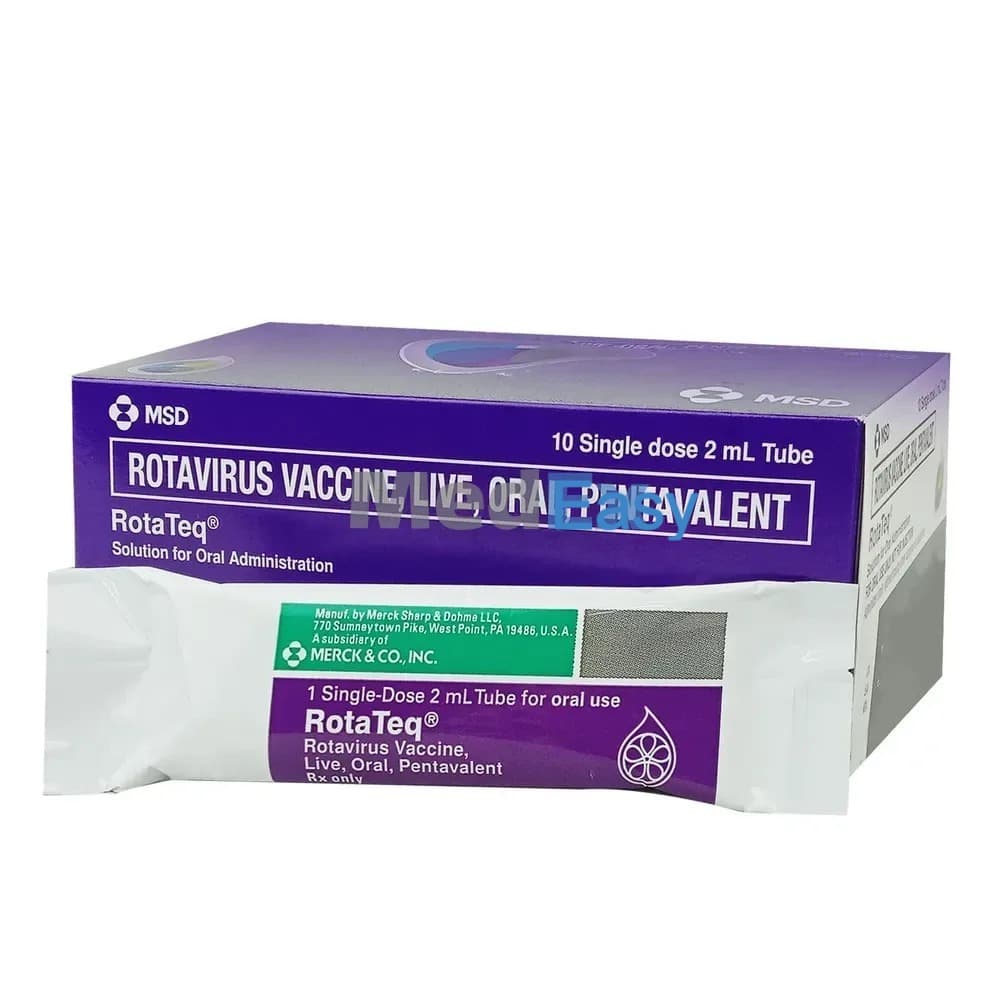

Medicine overview
Indications of RotaTeq
RotaTeq is a live, orally administered vaccine indicated for the active immunization of infants for the prevention of gastroenteritis caused by rotavirus. This is an established, guideline-supported preventive (prophylactic) use and is part of the routine childhood immunization schedule recommended by the WHO, national Expanded Programme on Immunization (EPI) schedules (including Bangladesh's EPI), and pediatric bodies such as the American Academy of Pediatrics (AAP).
- Established/approved use: Prevention of rotavirus gastroenteritis (a common cause of severe, dehydrating diarrhea in infants and young children) when given as a complete series within the recommended age windows.
RotaTeq is a preventive vaccine only — it is not used to treat an infant who already has rotavirus gastroenteritis, and it does not protect against diarrhea caused by other organisms.
Composition
Each dose of Rotavirus Vaccine contains live, attenuated (weakened) rotavirus strain(s) presented as an oral liquid suspension (or a lyophilized powder for reconstitution, depending on the product), together with stabilizing excipients such as sucrose and buffering agents. The exact strain composition (a single attenuated human strain, or multiple human-bovine reassortant strains) and the number of doses in the series depend on the specific licensed product.
Description
RotaTeq is a live attenuated viral vaccine given by mouth (not by injection) to infants to prevent severe diarrheal illness caused by rotavirus, the leading cause of severe gastroenteritis in young children worldwide. It is administered as a 2- or 3-dose oral series, depending on the specific product, within strict age windows established to maximize benefit and minimize risk.
Therapeutic Class
Vaccines – Live Attenuated Viral Vaccine (Rotavirus). RotaTeq belongs to the class of oral, live, attenuated enteric viral vaccines used for active immunization in infancy.
Pharmacology
Rotavirus Vaccine contains live, attenuated rotavirus strain(s) that replicate to a limited extent in the infant's small intestine after oral administration. This controlled, mild replication stimulates the infant's immune system to mount both a systemic (serum antibody) and a local mucosal (intestinal secretory IgA) immune response, closely mimicking the immunity produced by natural rotavirus infection but without causing significant disease. This immune response substantially reduces the risk of subsequent severe rotavirus gastroenteritis.
Dosage & Administration of RotaTeq
| Product type | Number of doses | Typical schedule |
|---|---|---|
| 2-dose oral series | 2 doses | First dose at 2 months of age, second dose at 4 months of age (minimum 4 weeks apart) |
| 3-dose oral series | 3 doses | Doses at 2, 4, and 6 months of age (minimum 4 weeks apart) |
Age windows (apply to all products of RotaTeq):
- Minimum age for the first dose: 6 weeks.
- Maximum age for the first dose: 14 weeks 6 days — the first dose should not be given at or after 15 weeks of age.
- Maximum age for any dose (series completion): 8 months 0 days — doses should not be given after this age.
- Doses must be separated by an interval of at least 4 weeks.
Doses of RotaTeq given outside these labeled age windows are not recommended and catch-up dosing beyond the maximum age should not be attempted, due to data suggesting a higher risk of intussusception with later administration. RotaTeq can generally be co-administered with other routine childhood vaccines (e.g. DTaP, inactivated poliovirus vaccine, Hib, hepatitis B, pneumococcal conjugate vaccine) at the same visit.
Administration of RotaTeq
RotaTeq is administered orally only — it must never be injected. The liquid is given directly into the infant's mouth (from the manufacturer-supplied applicator or dropper) allowing the infant to swallow it; it should not be mixed with any other vaccine, food, or liquid. If the infant spits out or regurgitates most of the dose, current guidance is not to repeat that dose within the same visit; the vaccination series is simply continued on schedule.
Interaction of RotaTeq
RotaTeq has the following well-documented, clinically significant interactions:
- Other childhood vaccines: RotaTeq can be co-administered with other age-appropriate inactivated or live childhood vaccines given at the same visit without reducing efficacy or safety.
- Immunosuppressive therapy / immunodeficiency: Concomitant immunosuppressive treatment or underlying immunodeficiency may reduce the immune response to RotaTeq and, because it is a live vaccine, may increase the risk of vaccine-strain viral illness (see Contraindications and Use in Special Populations).
- Blood products / immunoglobulins: Recent administration of antibody-containing blood products (e.g. immunoglobulin, blood transfusion) may blunt the immune response to RotaTeq; timing relative to such products should be discussed with the physician.
Contraindications
Rotavirus Vaccine is contraindicated in infants with any of the following:
- A history of a severe allergic reaction (e.g. anaphylaxis) after a previous dose of Rotavirus Vaccine or to any component of the vaccine.
- A history of intussusception (a type of bowel obstruction).
- Severe Combined Immunodeficiency (SCID) — as a live vaccine, Rotavirus Vaccine poses a specific risk of prolonged vaccine-virus shedding and gastroenteritis in infants with this immunodeficiency.
- Uncorrected congenital malformation of the gastrointestinal tract (e.g. Meckel diverticulum) that would predispose the infant to intussusception.
Side Effects of RotaTeq
Most infants tolerate RotaTeq well. Reported side effects include:
- Common: Irritability/fussiness, mild transient diarrhea, vomiting, and low-grade fever.
- Uncommon: Abdominal discomfort, decreased appetite.
- Rare but serious: Intussusception — a small increased risk has been observed with RotaTeqs, occurring primarily within about one week after the first or second dose (see Precautions and Warnings for warning signs).
Pregnancy & Lactation
RotaTeq is intended exclusively for oral administration to infants within specific early-life age windows and is not used in pregnant or breastfeeding women; there is no indication or established dosing for administration during pregnancy or lactation. A breastfeeding mother may continue to breastfeed her infant around the time of vaccination — breastfeeding does not reduce the effectiveness of RotaTeq and vaccination should not be delayed for this reason. Any question about vaccination in the context of maternal health should be directed to a physician.
Precautions & Warnings
The following precautions apply to the use of RotaTeq:
- Strict age windows: RotaTeq must be given within the labeled minimum/maximum age limits for the first dose and for series completion (see Dosage and Administration). Doses outside these windows are not recommended due to intussusception risk data, and catch-up dosing beyond the maximum age should not be attempted.
- Intussusception risk: A small increased risk of intussusception has been observed with RotaTeqs, mainly in the week following the first or second dose. Caregivers should be counseled to seek urgent medical care if the infant develops severe abdominal pain/crying, persistent vomiting, blood in the stool, or lethargy after vaccination.
- Viral shedding: As a live oral vaccine, vaccinated infants shed vaccine virus in the stool for a period after each dose. Caregivers and household members, especially those in close contact with immunocompromised individuals, should practice careful hand hygiene (e.g. thorough handwashing after diaper changes).
- Acute illness: Vaccination should generally be postponed in infants with moderate-to-severe acute gastroenteritis or other significant acute illness until the condition improves; mild illness without fever is usually not a reason to delay.
- Altered immunocompetence (other than SCID): Infants with other forms of immunocompromise (e.g. HIV infection, malignancy, chronic immunosuppressive therapy) should be evaluated individually, weighing potential benefits against the theoretical risk of vaccine-virus-associated illness.
Overdose Effects of RotaTeq
There is no established scenario of vaccine "overdose" in the way that applies to medications, as RotaTeq is given as fixed, single oral doses at scheduled visits. If an infant is inadvertently given a dose that is not within the recommended volume or timing, or develops any concerning symptoms after receiving RotaTeq, caregivers should contact a physician or seek immediate medical attention; in an emergency, contact local emergency services or a poison control center for guidance rather than attempting home treatment.
Storage Conditions
Store RotaTeq refrigerated at 2°C to 8°C. Do not freeze; discard if the product has been frozen. Protect from light, and use/reconstitute strictly according to the manufacturer's instructions and expiry date. Keep out of reach of children and administer only under the supervision of a qualified healthcare provider.
Use In Special Populations
Preterm infants: May receive RotaTeq according to their chronological (not gestational) age, provided they are clinically stable and meet the standard age criteria; consult a physician for very premature or hospitalized infants.
Infants with altered immunocompetence (other than SCID): See Precautions and Warnings — individualized assessment is required.
Infants with chronic gastrointestinal disease or a history of intussusception: See Contraindications; a prior history of intussusception is an absolute contraindication.
Infants exposed to household contacts who are immunocompromised: Vaccination is generally still recommended, with attention to hand hygiene given post-vaccination viral shedding (see Precautions and Warnings).
Duration Of Treatment
RotaTeq is given as a complete oral series of 2 or 3 doses (depending on the product), each separated by at least 4 weeks, with the entire series completed by 8 months 0 days of age. No further doses, boosters, or ongoing treatment with RotaTeq are given after the primary series is completed.
Reconstitution
Some presentations of RotaTeq are supplied as a lyophilized (freeze-dried) powder that must be reconstituted with the manufacturer-supplied liquid diluent immediately before oral administration, following the specific instructions provided with that product. Ready-to-use liquid suspension presentations of RotaTeq do not require reconstitution and should be used directly from the prefilled oral applicator or tube.
Drug Classes
Live attenuated oral viral vaccine; enteric (gastrointestinal) viral vaccine used for active immunization against rotavirus gastroenteritis.
Mode Of Action
Rotavirus Vaccine works by introducing live, attenuated rotavirus strain(s) into the infant's gastrointestinal tract via oral administration. The attenuated virus undergoes limited replication in intestinal cells, which is sufficient to stimulate protective humoral and mucosal (secretory IgA) immune responses without causing significant clinical disease, thereby priming the infant's immune system to resist subsequent infection with wild-type rotavirus.
Pediatric Uses
RotaTeq is a vaccine intended exclusively for infants within a defined early-life age window: the first dose must be given between 6 weeks and 14 weeks 6 days of age, with all doses in the series completed by 8 months 0 days of age. Safety and efficacy of RotaTeq have not been established for use in infants outside this age window, in older children, or in adults, and it is not indicated for these groups.
Frequently Asked Questions
Q: What is RotaTeq 1.5 ml/dose Oral Suspension used for?
A: RotaTeq 1.5 ml/dose Oral Suspension is given to infants to help prevent severe diarrheal illness (gastroenteritis) caused by rotavirus, a common and sometimes serious infection in young children.
Q: When should my baby receive RotaTeq 1.5 ml/dose Oral Suspension?
A: The first dose of RotaTeq 1.5 ml/dose Oral Suspension should be given between 6 weeks and 14 weeks 6 days of age. Depending on the product, 2 or 3 doses are given, each at least 4 weeks apart, with the full series completed before the baby turns 8 months old. Doses should not be started or completed outside these age limits.
Q: Is RotaTeq 1.5 ml/dose Oral Suspension safe? What side effects can occur?
A: Most infants tolerate RotaTeq 1.5 ml/dose Oral Suspension well, with mild fussiness, transient diarrhea, vomiting, or low-grade fever being the most common effects. There is a small increased risk of intussusception (a bowel problem), mainly in the week after the first or second dose — seek urgent medical care if your baby develops severe abdominal pain/crying, repeated vomiting, blood in the stool, or unusual lethargy.
Q: What if we miss a dose of RotaTeq 1.5 ml/dose Oral Suspension or are running late?
A: Try to keep doses of RotaTeq 1.5 ml/dose Oral Suspension on schedule, spaced at least 4 weeks apart. However, no dose of RotaTeq 1.5 ml/dose Oral Suspension should be given after 8 months 0 days of age; if the schedule falls outside the labeled age windows, discuss with your physician — catch-up dosing beyond the maximum age is not recommended.
Q: Can RotaTeq 1.5 ml/dose Oral Suspension be given if my baby has a mild cold?
A: Mild illness without fever is generally not a reason to delay RotaTeq 1.5 ml/dose Oral Suspension. If your baby has a moderate-to-severe illness, especially significant vomiting or diarrhea, your physician may recommend postponing the dose until your baby recovers.
Q: Does my baby need to avoid other people after getting RotaTeq 1.5 ml/dose Oral Suspension?
A: Because RotaTeq 1.5 ml/dose Oral Suspension is a live oral vaccine, your baby may shed vaccine virus in the stool for some time afterward. Everyday precautions such as thorough handwashing after diaper changes are recommended, particularly around anyone with a weakened immune system.
Disclaimer
The information provided is accurate to the best of our knowledge, but it does not replace professional medical advice. We cannot guarantee its completeness or accuracy, and the absence of specific information about a drug should not be taken as an endorsement. We are not responsible for any consequences arising from this information, so please consult a healthcare professional for any concerns or questions.
