

10% Off
Oflacin200 mg
Drug International Ltd.
৳10.84
Add to cart
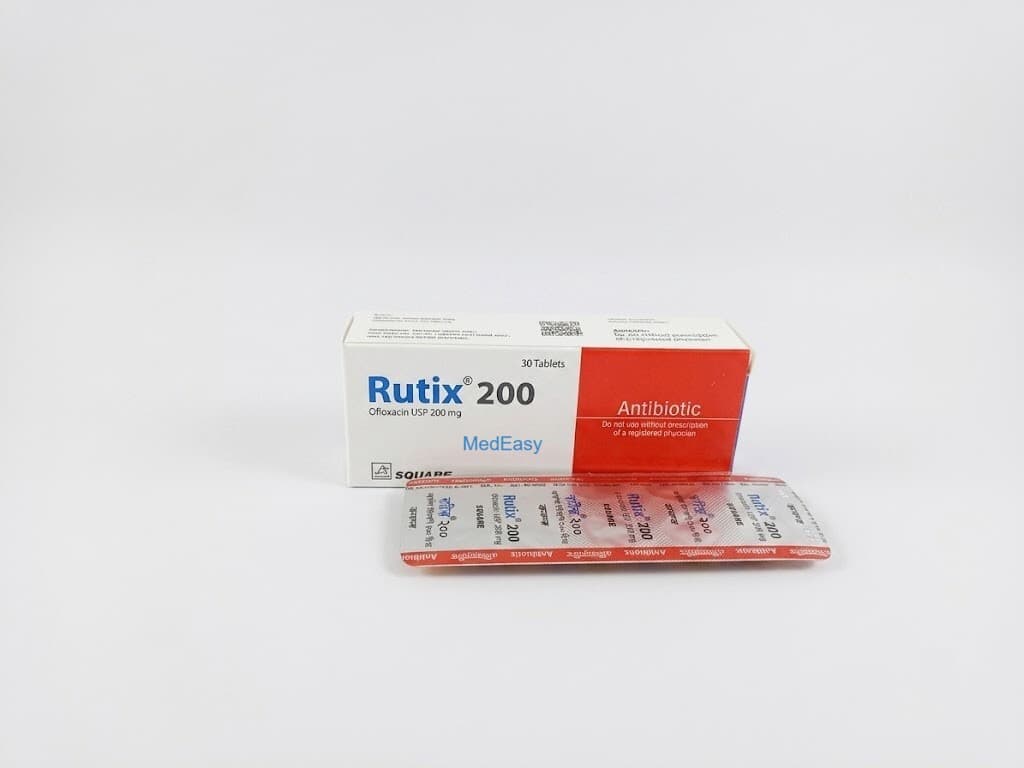

Rutix is a fluoroquinolone antibiotic used to treat infections caused by susceptible strains of bacteria. Because fluoroquinolones carry serious risks (see Precautions and Warnings), Rutix is generally reserved for infections without a suitable alternative treatment option.
Due to widespread resistance, fluoroquinolones including Rutix are no longer recommended by public health authorities (e.g. CDC) as first-line therapy for gonorrhea in most regions; use should be guided by local susceptibility testing and current treatment guidelines.
Each formulation of Ofloxacin contains Ofloxacin as the active pharmaceutical ingredient. Common presentations include:
Inactive ingredients vary by manufacturer and formulation; refer to the specific product label for excipient details.
Rutix is a synthetic broad-spectrum fluoroquinolone antibacterial agent. It is active against a range of Gram-negative and some Gram-positive organisms and is used to treat various bacterial infections of the respiratory tract, urinary tract, skin, reproductive tract, and, in topical formulations, the eye and ear.
Rutix works by interfering with bacterial DNA replication, leading to bacterial cell death (bactericidal activity).
Rutix belongs to the fluoroquinolone class of antibacterial agents.
Ofloxacin exerts its bactericidal effect by inhibiting two essential bacterial enzymes, DNA gyrase (topoisomerase II) and topoisomerase IV, which are required for bacterial DNA replication, transcription, repair, and recombination. Inhibition of these enzymes causes double-strand breaks in bacterial DNA, leading to rapid bacterial cell death.
Rutix dosing depends on the site and severity of infection and must be individualized by a physician. Below is general guidance; always follow the prescribing physician's instructions.
| Indication | Typical Adult Dose | Duration |
|---|---|---|
| Acute bacterial exacerbation of chronic bronchitis / Community-acquired pneumonia | 400 mg orally every 12 hours | 10 days |
| Uncomplicated UTI | 200 mg orally every 12 hours | 3 days |
| Complicated UTI | 200 mg orally every 12 hours | 10 days |
| Acute pyelonephritis | 200 mg orally every 12 hours | 10 days |
| Uncomplicated skin/skin structure infection | 400 mg orally every 12 hours | 10 days |
| Uncomplicated cervicitis/urethritis (chlamydial or gonococcal, per susceptibility) | 300 mg orally every 12 hours | 7 days |
| Chronic bacterial prostatitis | 300 mg orally every 12 hours | 6 weeks |
Bacterial conjunctivitis: 1-2 drops in the affected eye(s) every 2-4 hours while awake for the first 2 days, then 4 times daily for up to 5 more days (dosing may vary by product).
Acute otitis externa/otitis media: typically 5-10 drops in the affected ear once or twice daily for 7-14 days, as directed by the prescribing physician.
Dose or dosing interval adjustment is required in patients with reduced kidney function (creatinine clearance below 50 mL/min); consult a physician for individualized adjustment.
Take Rutix exactly as prescribed by your physician; do not stop, extend, skip doses, or share this medicine with others without medical advice. Complete the full course even if symptoms improve early, to reduce the risk of antibiotic resistance and treatment failure.
Rutix tablets should be swallowed whole with a full glass of water, with or without food, though consistent timing relative to meals is recommended. Tablets should not be crushed or split unless directed. Avoid taking Rutix with antacids, sucralfate, or multivitamins/mineral supplements containing iron or zinc at the same time (see Interactions) — separate dosing by at least 2 hours before or 6 hours after these products.
Ophthalmic solution: Tilt the head back, pull down the lower eyelid, and instill the prescribed number of drops into the pocket formed. Avoid touching the dropper tip to the eye or any surface. Do not wear contact lenses during treatment of an eye infection.
Otic solution: Warm the bottle in the hand before use. Lie down with the affected ear upward, instill the prescribed number of drops, and remain in that position for several minutes.
Rutix has several clinically significant drug interactions:
Ofloxacin is contraindicated in patients with:
Side effects of Rutix vary by route of administration.
Local irritation, burning, itching, or discomfort at the site of application; bitter taste (with otic use) is possible. Systemic absorption and systemic side effects are much less likely with these routes compared to oral or intravenous use.
Pregnancy: Rutix should be used during pregnancy only if clearly needed and the potential benefit justifies the potential risk to the fetus. Fluoroquinolones as a class have been associated with musculoskeletal effects (arthropathy) in juvenile animal studies, and safety data in human pregnancy are limited; a physician should be consulted before use, and alternative agents with a better-established safety profile should be considered when appropriate.
Lactation: Rutix is excreted into human breast milk. Because of the potential for adverse effects on the nursing infant (including joint/cartilage effects reported with the fluoroquinolone class), a decision should be made to discontinue nursing or discontinue the drug, taking into account the importance of the drug to the mother; consult a physician.
Ophthalmic and otic formulations result in much lower systemic exposure than oral or intravenous use, but caution and physician guidance are still advised during pregnancy and breastfeeding.
Rutix belongs to the fluoroquinolone class of antibiotics, which carries several serious safety warnings recognized by regulatory authorities:
Antibiotic stewardship: Take Rutix exactly as prescribed by your physician; do not stop, extend, skip doses, or share this medicine with others without medical advice.
In case of a suspected Rutix overdose, seek immediate medical attention or contact a poison control center/emergency services right away. Reported overdose symptoms may include nausea, dizziness, and, in severe cases, more pronounced central nervous system or cardiac effects. There is no specific antidote; management is supportive and symptomatic, and may include monitoring in a medical facility. Do not attempt to manage a suspected overdose at home.
Store at room temperature (below 30°C), away from light and moisture. Keep out of reach of children. Ophthalmic and otic solutions should be discarded per the product's stated in-use shelf life after opening.
Systemic Rutix is generally not recommended for use in patients under 18 years of age because of the risk of arthropathy (joint/cartilage damage) observed in immature animals, except in specific situations where a physician determines the benefit outweighs the risk. Certain otic formulations may be approved for specific pediatric age groups (e.g. otitis externa, otitis media with tympanostomy tubes) — refer to product labeling and consult a pediatrician.
Elderly patients are at increased risk of tendinitis and tendon rupture, especially when taking corticosteroids concurrently, and may also be at higher risk of QT prolongation. Use with caution and appropriate monitoring.
Dose or dosing interval adjustment is required in patients with creatinine clearance below 50 mL/min; consult a physician for individualized dosing.
Use with caution; dose adjustment may be required in patients with significant hepatic impairment. Consult a physician.
The duration of Rutix treatment depends on the indication, typically ranging from 3 days (uncomplicated UTI) to 10 days (respiratory tract, complicated UTI, skin infections) or up to 6 weeks (chronic bacterial prostatitis). The full prescribed course should always be completed, even if symptoms improve earlier, unless a physician advises otherwise.
Ofloxacin is classified as a fluoroquinolone antibacterial agent, part of the broader quinolone class of synthetic antibiotics.
Ofloxacin acts by inhibiting bacterial DNA gyrase and topoisomerase IV, enzymes essential for bacterial DNA supercoiling, replication, and repair. By blocking these enzymes, Ofloxacin prevents bacterial DNA from replicating properly, resulting in bactericidal (bacteria-killing) activity.
C
Rutix is generally not approved for systemic use in patients younger than 18 years due to the risk of arthropathy (cartilage/joint damage) demonstrated in juvenile animal studies; safety and efficacy of systemic Rutix in this population have not been established except in select situations where a physician determines benefits outweigh risks. Certain otic (ear) formulations of Rutix are approved for use in specific pediatric age groups (e.g. from 6 months to 12 years for select indications, depending on the product) — always follow the product labeling and pediatrician's guidance.
Q: What is Rutix 200 mg Tablet used for?
A: Rutix 200 mg Tablet is a fluoroquinolone antibiotic used to treat various bacterial infections, including urinary tract infections, respiratory tract infections, certain skin infections, and some sexually transmitted infections. Ophthalmic and otic forms of Rutix 200 mg Tablet are used for bacterial eye and ear infections respectively.
Q: Can I stop taking Rutix 200 mg Tablet once I feel better?
A: No. You should complete the full course of Rutix 200 mg Tablet exactly as prescribed by your physician, even if your symptoms improve. Stopping early can lead to treatment failure and contributes to antibiotic resistance. Do not stop, extend, skip doses, or share Rutix 200 mg Tablet with others without medical advice.
Q: What are the most serious risks of Rutix 200 mg Tablet?
A: Rutix 200 mg Tablet belongs to the fluoroquinolone class, which carries risks of tendinitis and tendon rupture (especially in the elderly or those on corticosteroids), peripheral neuropathy that may be irreversible, central nervous system effects including seizures, and QT prolongation affecting heart rhythm. Contact your doctor immediately if you experience tendon pain, numbness/tingling, or unusual heart symptoms while taking Rutix 200 mg Tablet.
Q: Can pregnant or breastfeeding women take Rutix 200 mg Tablet?
A: Rutix 200 mg Tablet should be used during pregnancy only if clearly needed and the potential benefit outweighs the potential risk to the baby, and it passes into breast milk. Always consult your physician before using Rutix 200 mg Tablet if you are pregnant, planning pregnancy, or breastfeeding.
Q: Can I take antacids with Rutix 200 mg Tablet?
A: Antacids, as well as products containing calcium, iron, zinc, or magnesium, significantly reduce the absorption of oral Rutix 200 mg Tablet. Take Rutix 200 mg Tablet at least 2 hours before or 6 hours after these products.
Q: Is Rutix 200 mg Tablet safe for children?
A: Systemic (oral/IV) Rutix 200 mg Tablet is generally not recommended for children and adolescents under 18 years due to a risk of joint/cartilage effects observed in animal studies, unless a physician determines the benefit outweighs this risk. Certain otic (ear drop) formulations of Rutix 200 mg Tablet may be approved for use in specific pediatric age groups — follow your pediatrician's guidance.
Disclaimer
The information provided is accurate to the best of our knowledge, but it does not replace professional medical advice. We cannot guarantee its completeness or accuracy, and the absence of specific information about a drug should not be taken as an endorsement. We are not responsible for any consequences arising from this information, so please consult a healthcare professional for any concerns or questions.
