
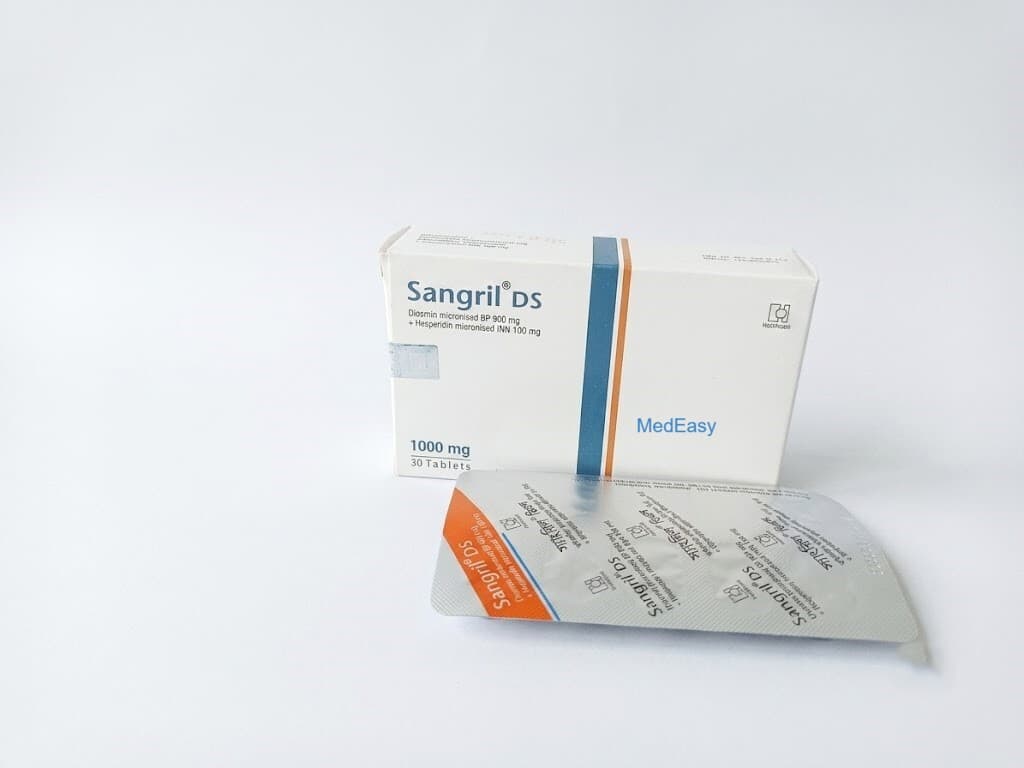

Medicine overview
Indications of Sangril DS
Sangril DS is a micronized purified flavonoid combination (a venotonic / vascular-protective agent) used for the following indications:
Established / commonly approved uses
- Chronic venous insufficiency (CVI): Symptomatic treatment of symptoms related to venous-lymphatic insufficiency such as leg heaviness, pain, nocturnal cramps, and edema (swelling) of the lower limbs.
- Hemorrhoidal disease: Symptomatic treatment of the functional signs of acute hemorrhoidal attacks (pain, bleeding, discomfort) and as an adjunct in the management of chronic hemorrhoidal symptoms.
Notes on evidence and scope
- Sangril DS treats the symptoms of venous insufficiency and hemorrhoids; it does not correct underlying structural venous disease (e.g., significant varicose veins), which may require compression therapy, sclerotherapy, or surgical management.
- It does not replace medical evaluation of hemorrhoidal symptoms if bleeding is significant, persistent, or accompanied by other concerning features (e.g., weight loss, change in bowel habit), which require assessment to exclude other causes.
- Some venous leg ulcer protocols use it as an adjunct to standard compression therapy, based on limited supportive evidence; it is not a substitute for standard ulcer care.
Composition
Each tablet typically contains a micronized purified flavonoid fraction consisting of Diosmin + Hesperidin in a fixed ratio (commonly diosmin 90% and hesperidin 10%, e.g. diosmin 450 mg + hesperidin 50 mg per 500 mg tablet). Exact strengths vary by brand and market; always check the specific product label.
Description
Sangril DS is a fixed-dose combination of two citrus-derived flavonoids belonging to the "venotonic" or vasoprotective drug class. It is formulated as a micronized preparation to improve gastrointestinal absorption. Sangril DS is widely used for the symptomatic relief of chronic venous insufficiency of the lower limbs and for acute and chronic hemorrhoidal disease.
Therapeutic Class
Venotonic / vasoprotective agent (flavonoid combination) — Sangril DS belongs to the class of drugs used for venous and capillary insufficiency and hemorrhoidal disease.
Pharmacology
Mechanism
Diosmin + Hesperidin acts on the venous system and microcirculation through several complementary effects:
- Increased venous tone: Prolongs the vasoconstrictive effect of noradrenaline on the venous wall, reducing venous distensibility and capacitance, and decreasing venous stasis.
- Improved lymphatic drainage: Increases lymphatic flow rate and lymphatic capillary resorption, reducing edema.
- Microcirculatory protection: Reduces capillary hyperpermeability and increases capillary resistance.
- Anti-inflammatory action: Reduces leukocyte adhesion and migration at the level of the venous wall and inhibits release of inflammatory mediators, which is thought to contribute to its effect in acute hemorrhoidal attacks.
Pharmacokinetics
The micronized formulation of Diosmin + Hesperidin improves oral bioavailability compared with non-micronized forms. Diosmin is largely metabolized to its aglycone diosmetin and other flavonoid metabolites in the gut before absorption; elimination occurs mainly via feces and, to a lesser extent, urine.
Dosage & Administration of Sangril DS
Chronic venous insufficiency
| Population | Dose |
|---|---|
| Adults | Equivalent of 1000 mg of the flavonoid fraction of Sangril DS per day, usually taken as two divided doses with meals. |
Acute hemorrhoidal attack
| Phase | Dose |
|---|---|
| Days 1–4 | Higher initial dose (equivalent of up to 3000 mg/day of the flavonoid fraction of Sangril DS, in divided doses) for rapid symptom control, as directed by the physician. |
| Days 5–7 | Reduced intermediate dose (equivalent of about 2000 mg/day), then taper to the standard maintenance dose. |
Exact tablet strength and dosing schedule depend on the specific brand/formulation of Sangril DS; always follow the physician's prescription and the product label. Take with food to minimize gastrointestinal upset.
Administration of Sangril DS
Sangril DS tablets should be taken orally, swallowed whole with a glass of water, preferably with meals to reduce the chance of gastrointestinal discomfort. Do not crush or chew unless the product label specifically allows it.
Interaction of Sangril DS
No major, well-established clinically significant drug-drug interactions have been documented for Sangril DS at recommended doses. As with other flavonoid-containing products, theoretical additive effects with other agents affecting the vasculature are possible but not clinically established. Patients should inform their physician of all other medicines, supplements, and herbal products they are taking before starting Sangril DS.
Contraindications
Diosmin + Hesperidin is contraindicated in patients with known hypersensitivity to diosmin, hesperidin, other flavonoids, or any excipient in the specific formulation.
Side Effects of Sangril DS
Sangril DS is generally well tolerated at recommended doses. Reported adverse effects include:
- Common: Mild gastrointestinal disturbances — diarrhea, dyspepsia, nausea, vomiting.
- Uncommon: Headache, dizziness, malaise.
- Rare: Skin rash, pruritus, urticaria, isolated reports of colitis.
Patients should seek medical attention if a hypersensitivity reaction (e.g., facial/lip/throat swelling, severe rash, difficulty breathing) occurs while taking Sangril DS.
Pregnancy & Lactation
Data on the use of Sangril DS in pregnancy are limited. As a general precaution, Sangril DS should be used during pregnancy only if clearly needed and if the potential benefit justifies the potential risk to the fetus; use should be under medical supervision. Similarly, because it is not established whether the components of Sangril DS pass into breast milk in clinically significant amounts, caution is advised during breastfeeding and a physician should be consulted before use. Do not self-medicate with Sangril DS during pregnancy or lactation without medical advice.
Precautions & Warnings
- Sangril DS is intended for symptomatic relief; if symptoms of hemorrhoidal disease do not improve within a few days, or if rectal bleeding is significant, persistent, or recurrent, stop self-treatment and seek prompt medical evaluation to exclude other causes.
- Sangril DS does not treat the underlying structural cause of chronic venous insufficiency (e.g., significant varicose veins); patients with significant venous disease should be evaluated for compression therapy or other definitive management alongside Sangril DS.
- See Contraindications for hypersensitivity information and Pregnancy and Lactation for use during pregnancy/breastfeeding.
- Use with caution in patients with a history of gastrointestinal sensitivity, as mild GI upset can occur (see Side Effects).
Overdose Effects of Sangril DS
Limited data exist on overdose with Sangril DS; it has a wide margin of safety at recommended doses. In case of suspected overdose, symptoms would most likely be an exaggeration of known gastrointestinal side effects. There is no specific antidote. If overdose is suspected, seek immediate medical attention or contact a poison control center; treatment is supportive.
Storage Conditions
Store at room temperature (below 30°C), away from light and moisture. Keep out of reach of children.
Use In Special Populations
Pediatric use
Safety and efficacy of Sangril DS in children have not been well established; it is generally not recommended for use in the pediatric population outside specific physician guidance.
Elderly
No specific dose adjustment is generally required in elderly patients, but Sangril DS should be used with the same precautions as in adults, with attention to any comorbid conditions.
Renal/hepatic impairment
Specific dose-adjustment data for Sangril DS in renal or hepatic impairment are not well established; use with caution and under medical supervision in these populations.
Duration Of Treatment
For chronic venous insufficiency, Sangril DS is typically used as a longer-term or intermittent course as advised by the physician, since symptoms may recur if treatment is stopped. For acute hemorrhoidal attacks, a short course of about 7 days (with an initial higher dose tapered to maintenance, as above) is typical. Duration should be individualized by the prescribing physician.
Drug Classes
Flavonoids; venotonics; vasoprotective agents — Diosmin + Hesperidin is classified within this drug class.
Mode Of Action
Diosmin + Hesperidin increases venous tone and lymphatic drainage, reduces capillary hyperpermeability, and exerts anti-inflammatory effects on the venous wall by reducing leukocyte-endothelial interaction — collectively improving symptoms of venous insufficiency and hemorrhoidal disease. See Pharmacology for details.
Pediatric Uses
Sangril DS is not well established for use in children; safety and efficacy data in the pediatric population are lacking. It should generally not be used in children unless specifically directed by a physician.
Frequently Asked Questions
Q: What is Sangril DS 900 mg+100 mg Tablet used for?
A: Sangril DS 900 mg+100 mg Tablet is used to relieve symptoms of chronic venous insufficiency (leg heaviness, pain, swelling) and to relieve symptoms of acute and chronic hemorrhoidal disease.
Q: How should I take Sangril DS 900 mg+100 mg Tablet?
A: Take Sangril DS 900 mg+100 mg Tablet tablets by mouth with a glass of water, preferably with meals, exactly as prescribed. For hemorrhoids, your doctor may prescribe a higher dose for the first few days followed by a lower maintenance dose.
Q: Can I take Sangril DS 900 mg+100 mg Tablet during pregnancy or while breastfeeding?
A: Data are limited. Sangril DS 900 mg+100 mg Tablet should be used during pregnancy or breastfeeding only if clearly needed and under medical supervision, since the potential benefit must be weighed against any potential risk to the baby.
Q: What are the common side effects of Sangril DS 900 mg+100 mg Tablet?
A: Sangril DS 900 mg+100 mg Tablet is generally well tolerated. The most common side effects are mild gastrointestinal symptoms such as diarrhea, dyspepsia, nausea, or vomiting. Headache, dizziness, and rash have also been reported.
Q: Who should not take Sangril DS 900 mg+100 mg Tablet?
A: Sangril DS 900 mg+100 mg Tablet should not be taken by anyone with a known hypersensitivity (allergy) to diosmin, hesperidin, other flavonoids, or any ingredient in the specific product.
Q: What should I do if my hemorrhoid symptoms do not improve with Sangril DS 900 mg+100 mg Tablet?
A: If symptoms do not improve within a few days, or if you notice significant, persistent, or recurrent rectal bleeding while taking Sangril DS 900 mg+100 mg Tablet, stop self-treatment and see a doctor promptly to rule out other causes.
Disclaimer
The information provided is accurate to the best of our knowledge, but it does not replace professional medical advice. We cannot guarantee its completeness or accuracy, and the absence of specific information about a drug should not be taken as an endorsement. We are not responsible for any consequences arising from this information, so please consult a healthcare professional for any concerns or questions.
