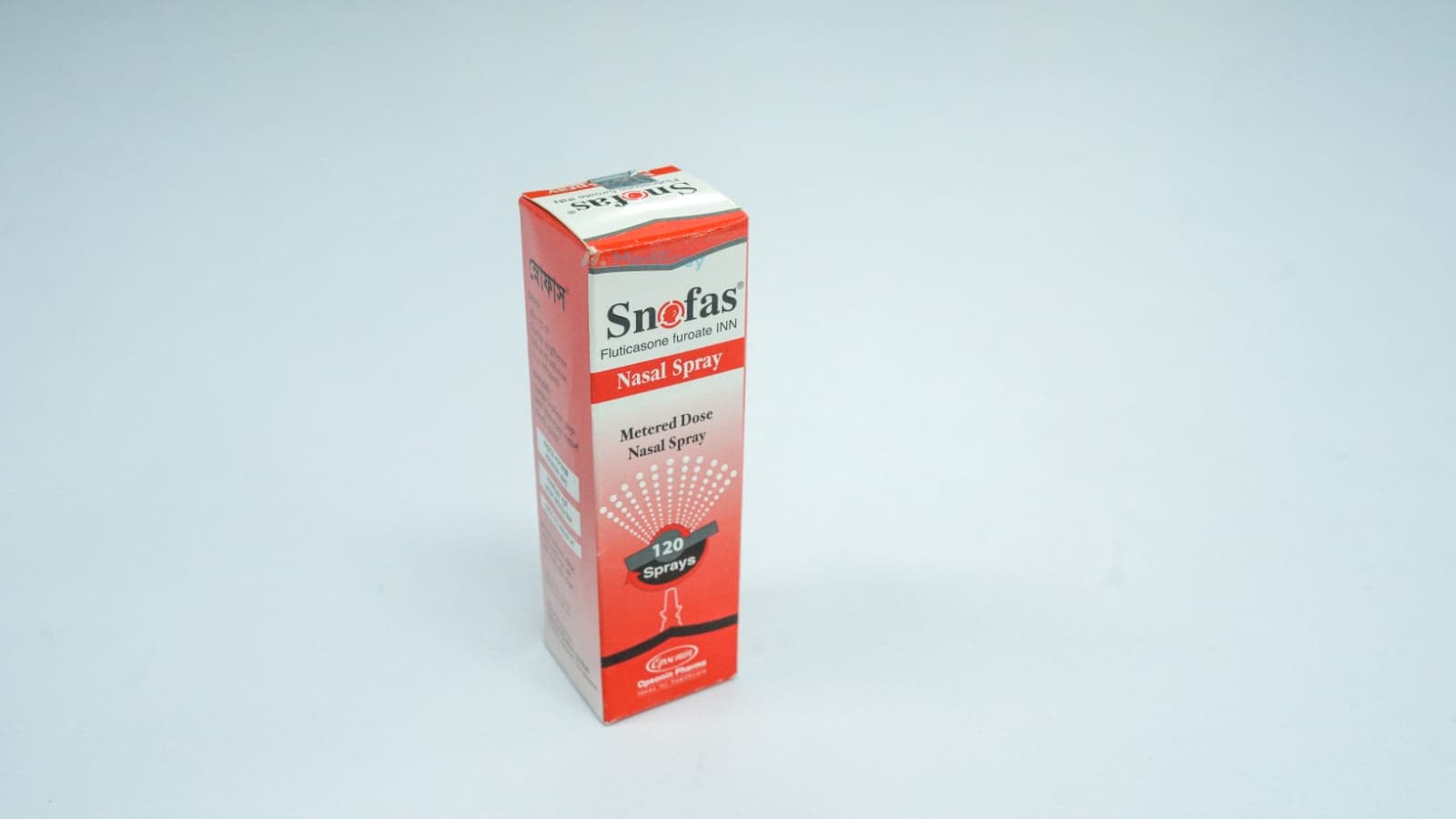
Snofas 27.5 mcg/spray Nasal Spray is indicated for the treatment of the symptoms of seasonal and perennial allergic rhinitis in patients aged 2 years and older.Snofas 27.5 mcg/spray inhalation powder is indicated for the once-daily maintenance treatment of asthma as prophylactic therapy in patients aged 5 years and older. This is not indicated for the relief of acute bronchospasm.
Theropeutic Class
Nasal Steroid Preparations
Pharmacology
Snofas 27.5 mcg/spray is a synthetic trifluorinated corticosteroid with potent anti-inflammatory activity. Like other corticosteroids Snofas 27.5 mcg/spray is found to have a wide range of actions on multiple cell types (e.g., mast cells, eosinophils, neutrophils, macrophages, lymphocytes) and mediators (e.g.- histamine, eicosanoids, leukotrienes, cytokines) involved in inflammation.
Dosage of Snofas 27.5 mcg/spray
Snofas 27.5 mcg/spray Nasal Spray:
Adults & Children over 12 years: 2 sprays in each nostril once a day. In some cases 2 sprays into each nostril twice daily, not exceeding 4 sprays.
Children under 12 years (2-11 Years): 1 spray in each nostril once a day. Patients should use Snofas 27.5 mcg/spray nasal spray at regular intervals as directed since its effectiveness depends on its regular use.
Children (under 2 years of age): There are no data to recommend use of Snofas 27.5 mcg/spray Nasal Spray for the treatment of seasonal or perennial allergic rhinitis in children under 2 years of age.
Snofas 27.5 mcg/spray Inhalation Capsule: should be administered as 1 inhalation once daily by the orally inhaled route. Snofas 27.5 mcg/spray should be used at the same time every day. Do not use Snofas 27.5 mcg/spray more than 1 time every 24 hours.
Adults and Adolescents Aged 12 Years and Older: The starting dosage for Snofas 27.5 mcg/spray should be based upon patients' asthma severity.
The usual recommended starting dose for adults and adolescents aged 12 years and older not on an inhaled corticosteroid (ICS) is 100 mcg.
For other adults and adolescents aged 12 years and older, the starting dose should be based on previous asthma drug therapy and disease severity.
For adults and adolescents aged 12 years and older who do not respond to Snofas 27.5 mcg/spray 100 mcg after 2 weeks of therapy, replacement with Snofas 27.5 mcg/spray 200 mcg may provide additional asthma control.
If a dosage regimen of Snofas 27.5 mcg/spray fails to provide adequate control of asthma, the therapeutic regimen should be re-evaluated and additional therapeutic options, e.g., replacing the current strength of Snofas 27.5 mcg/spray with a higher strength, initiating an ICS and long- acting beta 2 -agonist (LABA) combination product, or initiating oral corticosteroids, should be considered.The highest recommended daily dose in adults and adolescents aged 12 years and older is 200 mcg. After asthma stability has been achieved, it is desirable to titrate to the lowest effective dosage to help reduce the possibility of side effects.Pediatric Patients Aged 5 to 11 Years: The recommended dosage for children aged 5 to 11 years is 50 mcg administered once daily
Administration of Snofas 27.5 mcg/spray
How to use the Nasal Spray-
Shake the bottle gently and remove the dust cover.
Hold the spray with your forefinger and middle finger on either side of the nozzle and your thumb underneath the bottle. Press down until a fine spray appears. If using for the first time or if you have not used it for a week or more, press the nasal applicator several times until a fine moist comes out from the container.
Gently blow the nose to clear the nostrils.
Close one nostril and carefully insert the nasal applicator into the open nostril. Tilt your head forward slightly and keep the spray upright. Breathe in through your nose and while breathing in, press the white-collar of nasal applicator firmly down once to release a spray.
Breathe out through your mouth.
Repeat the above steps in the same/ other nostril for consecutive doses.
Cleaning: The nasal spray should be cleaned at least once a week. The procedures are as follows-
Remove the dust cover.
Gently pull off the nasal applicator.
Wash the applicator and dust cover in warm water.
Shake off the excess water and leave to dry in a normal place. Avoid to apply additional heat.
Gently push the applicator back on the top of the bottle and re-fix the dust cover.
Interaction of Snofas 27.5 mcg/spray
Potent inhibitors of cytochrome P450 3A4 (CYP3A4) may increase exposure to Snofas 27.5 mcg/spray. Coadministration of ritonavir is not recommended. Use caution with coadministration of other potent CYP3A4 inhibitors, such as ketoconazole.Special instruction: Patients should be instructed that the device must be primed: before first use, and if the cap is left off or if the device does not seem to be working or if the nasal spray has not been used for 30 days or more. In order to prime the device, the nasal spray needs to be shaken vigorously for about 10 seconds with the cap on. The patient must then press the button firmly all the way in, approximately 6 times until a fine mist is seen. Once primed, the patient must shake the nasal spray vigorously each time before use.
Contraindications
Snofas 27.5 mcg/spray nasal spray is contraindicated in patients with a hypersensitivity to any of its ingredients.
Side Effects of Snofas 27.5 mcg/spray
Snofas 27.5 mcg/spray nasal spray is absorbed less into the rest of the body, therefore fewer side effects are seen. With the nasal spray, drying of the nose and an increase in the incidence of nosebleeds may occur.Most common adverse reactions of Snofas 27.5 mcg/spray inhalation capsule reported in ≥5% of adult and adolescent subjects are nasopharyngitis, bronchitis, upper respiratory tract infection, and headache. Most common adverse reactions reported in ≥3% of pediatric subjects aged 5 to 11 years are pharyngitis, bronchitis, and viral infection.
Pregnancy & Lactation
Pregnancy: Plasma Snofas 27.5 mcg/spray concentrations were typically non-quantifiable and therefore potential for reproductive toxicity is expected to be very low.Lactation: The excretion of Snofas 27.5 mcg/spray into human breast milk has not been investigated.
Precautions & Warnings
Rarely, immediate hypersensitivity reactions or contact dermatitis may occur after the administration of Snofas 27.5 mcg/spray nasal spray. Rare instances of wheezing, nasal septum perforation, cataracts, glaucoma and increased intraocular pressure have been reported following the intranasal application of corticosteroids, including Snofas 27.5 mcg/spray. Although systemic effects have been minimal with recommended doses of Snofas 27.5 mcg/spray nasal spray, potential risk increases with larger doses. Therefore, larger than recommended doses of Snofas 27.5 mcg/spray nasal spray should be avoided.
Storage Conditions
Store at a temperature not exceeding 30°C. Do not refrigerate. Protect from light and moisture. Keep out of the reach of children.
Use In Special Populations
Pediatric use: The safety and effectiveness of Snofas 27.5 mcg/spray in children younger than 2 years have not been established. Geriatric use: In general, dose selection for the elderly patient should be cautious, keeping in mind the greater frequency of decreased hepatic, renal, or cardiac function, and of concomitant disease or other drug therapy. Use in hepatic impairment: Use Snofas 27.5 mcg/spray with caution in patients with severe hepatic impairment. Use in renal impairment: No dosage adjustment is required in patients with renal impairment.
Drug Classes
Nasal Steroid Preparations
Mode Of Action
Snofas 27.5 mcg/spray is a synthetic trifluorinated corticosteroid with potent anti inflammatory activity. Like other corticosteroids Snofas 27.5 mcg/spray is found to have a wide range of actions on multiple cell types (e.g., mast cells, eosinophils, neutrophils, macrophages, lymphocytes) and mediators (e.g.- histamine, eicosanoids, leukotrienes, cytokines) involved in inflammation.
Pregnancy
Use in pregnancy: Pregnancy category C. There are no adequate and well-controlled studies in pregnant women. Snofas 27.5 mcg/spray nasal spray should be used during pregnancy only if the potential benefit justifies the potential risk of the fetus.Use in lactation: It is not known whether Snofas 27.5 mcg/spray is excreted in human breast milk. However, since other corticosteroids have been detected in human milk, caution should be exercised when Snofas 27.5 mcg/spray is administered to a nursing woman.
Pediatric Uses
Geriatric use: In general, dose selection for the elderly patient should be cautious, keeping in mind the greater frequency of decreased hepatic, renal, or cardiac function, and of concomitant disease or other drug therapy.Use in hepatic impairment: Use Snofas 27.5 mcg/spray with caution in patients with severe hepatic impairment.Use in renal impairment: No dosage adjustment is required in patients with renal impairment.
Frequently Asked Questions
What is Snofas 27.5 mcg/spray used for?
Snofas 27.5 mcg/spray Nasal Spray is indicated for the treatment of the symptoms of seasonal and perennial allergic rhinitis in patients aged 2 years and older.Snofas 27.5 mcg/spray inhalation powder is indicated for the once-daily maintenance treatment of asthma as prophylactic therapy in patients aged 5 years and older. This is not indicated for the relief of acute bronchospasm.
What is the dosage of Snofas 27.5 mcg/spray?
Snofas 27.5 mcg/spray Nasal Spray: Adults & Children over 12 years: 2 sprays in each nostril once a day. In some cases 2 sprays into each nostril twice daily, not exceeding 4 sprays. Children under 12 years (2-11 Years): 1 spray in each nostril once a day. Patients should use Snofas 27.5 mcg/spray nasal spray at regular intervals as directed since its effectiveness depends on its regular use. Chil…
What are the side effects of Snofas 27.5 mcg/spray?
Snofas 27.5 mcg/spray nasal spray is absorbed less into the rest of the body, therefore fewer side effects are seen. With the nasal spray, drying of the nose and an increase in the incidence of nosebleeds may occur.Most common adverse reactions of Snofas 27.5 mcg/spray inhalation capsule reported in ≥5% of adult and adolescent subjects are nasopharyngitis, bronchitis, upper respiratory tract infec…
Who should not take Snofas 27.5 mcg/spray?
Snofas 27.5 mcg/spray nasal spray is contraindicated in patients with a hypersensitivity to any of its ingredients.
What precautions should be taken with Snofas 27.5 mcg/spray?
Rarely, immediate hypersensitivity reactions or contact dermatitis may occur after the administration of Snofas 27.5 mcg/spray nasal spray. Rare instances of wheezing, nasal septum perforation, cataracts, glaucoma and increased intraocular pressure have been reported following the intranasal application of corticosteroids, including Snofas 27.5 mcg/spray. Although systemic effects have been minima…
Is Snofas 27.5 mcg/spray safe during pregnancy and breastfeeding?
Pregnancy: Plasma Snofas 27.5 mcg/spray concentrations were typically non-quantifiable and therefore potential for reproductive toxicity is expected to be very low.Lactation: The excretion of Snofas 27.5 mcg/spray into human breast milk has not been investigated.
Disclaimer
The information provided is accurate to our best practices, but it does not replace professional medical advice. We cannot guarantee its completeness or accuracy. The absence of specific information about a drug should not be seen as an endorsement. We are not responsible for any consequences resulting from this information, so consult a healthcare professional for any concerns or questions.