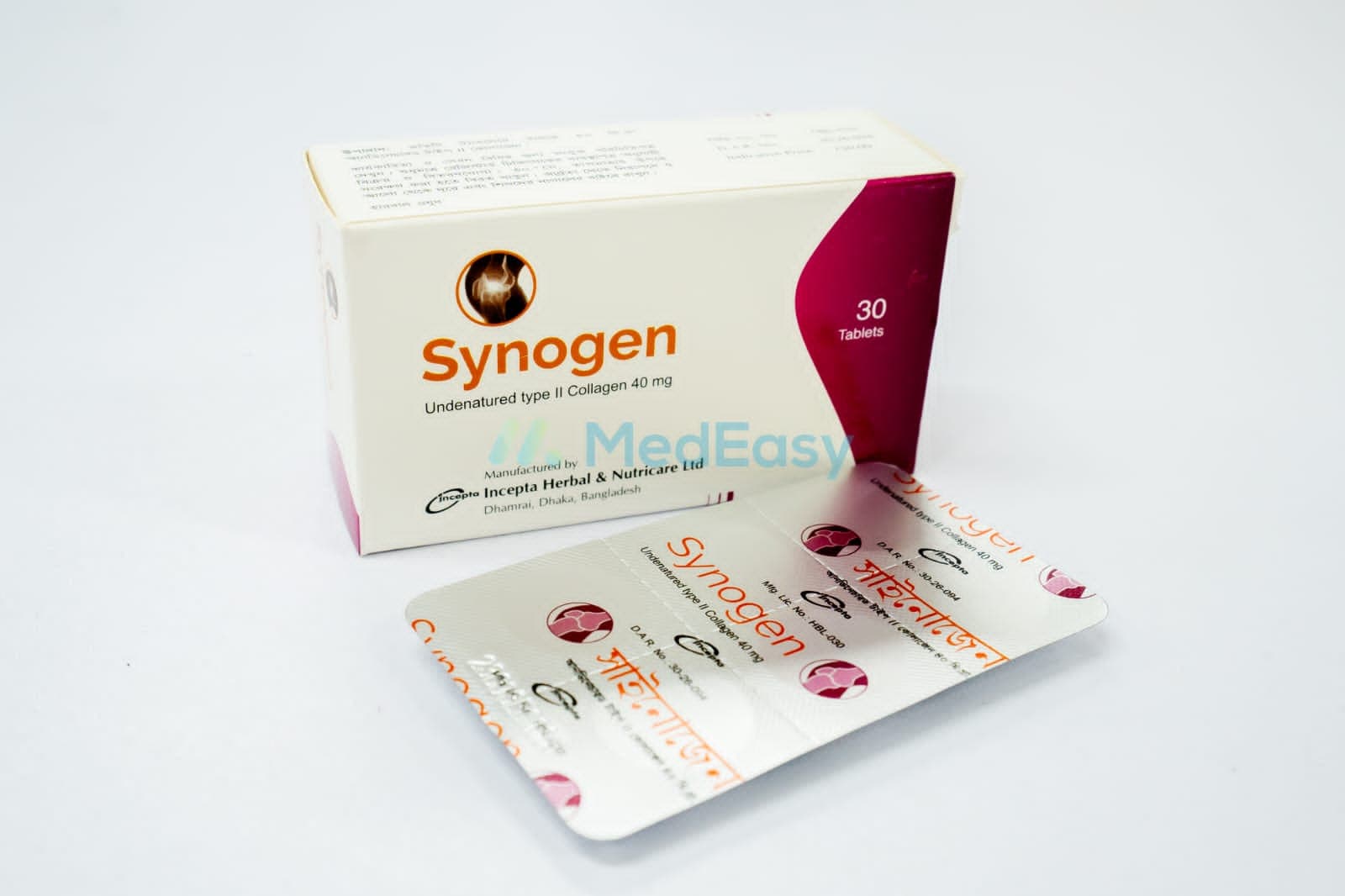
Medicine overview
Indications of Synogen
Synogen is a dietary/nutraceutical supplement used mainly for joint health support. It is not a conventional prescription drug and does not have FDA-approved therapeutic indications; rather, it is marketed and studied as a supplement with the following evidence-based uses:
- Osteoarthritis (adjunctive use): Guideline and clinical-trial evidence (small-to-moderate randomized trials) supports use of Synogen as an adjunct to standard care for reducing joint pain and stiffness and improving joint function in knee osteoarthritis, typically over 3 months or longer.
- Rheumatoid arthritis (adjunctive use): Limited clinical trial data suggest Synogen, taken together with standard disease-modifying anti-rheumatic drug (DMARD) therapy such as methotrexate, may modestly reduce joint swelling and tenderness. It is not a substitute for DMARD therapy.
- General joint/cartilage health (commonly used, off-label/wellness use): Widely used by athletes and older adults as a joint-support supplement, though rigorous evidence for this broad use is limited.
Important: Synogen should not be used as a replacement for physician-prescribed treatment of osteoarthritis, rheumatoid arthritis, or any other joint disease. It should be used as a complement to, not instead of, medical therapy and lifestyle measures (weight management, physiotherapy, exercise).
Composition
Each dose/capsule contains a standardized quantity of Undenatured Type II Collagen, an undenatured (native, non-hydrolyzed) form of type II collagen typically derived from chicken sternum cartilage. Unlike hydrolyzed collagen, the collagen in Undenatured Type II Collagen retains its natural triple-helix structure, which is considered relevant to its proposed immunomodulatory mechanism of action.
Common commercially available strength: 40 mg per capsule/tablet, taken once daily. Exact strength and excipients vary by brand/manufacturer; refer to the specific product label.
Description
Synogen is a cartilage-derived nutraceutical ingredient used as an oral joint-health supplement. "Undenatured" means the collagen's native triple-helix molecular structure has been preserved during manufacturing (using low-heat, non-hydrolyzing processes), as opposed to hydrolyzed or denatured collagen (gelatin, collagen peptides), where the structure is broken down.
Synogen is proposed to act differently from structural cartilage-building supplements such as glucosamine and chondroitin. Rather than being incorporated directly into cartilage, small doses of intact, undenatured type II collagen are thought to interact with gut-associated immune tissue to promote a state of oral tolerance, reducing immune-mediated inflammation directed against the body's own joint cartilage.
Synogen is available as an over-the-counter dietary supplement (capsules/tablets) and is not classified as a prescription medicine in most jurisdictions, including for general sale as a joint-health supplement.
Therapeutic Class
Nutraceutical / Dietary Supplement – Joint Health Supplement (Synogen)
Pharmacology
Mechanism of Action
Undenatured Type II Collagen is believed to act through oral tolerance and immunomodulation rather than through direct structural replacement of cartilage (unlike hydrolyzed collagen, glucosamine, or chondroitin, which are proposed to provide building blocks for cartilage matrix).
Small oral doses of intact (undenatured) type II collagen are taken up by gut-associated lymphoid tissue (GALT), particularly Peyer's patches in the small intestine. This is thought to induce regulatory T-cell mediated tolerance to native type II collagen — the major protein of articular cartilage. In osteoarthritis and rheumatoid arthritis, low-grade autoimmune reactivity to endogenous type II collagen is thought to contribute to joint inflammation and cartilage breakdown; by promoting tolerance, Undenatured Type II Collagen may reduce this autoimmune-driven inflammatory cascade, secondarily decreasing pain, swelling, and stiffness.
Pharmacokinetics
As a protein-based oral supplement, Undenatured Type II Collagen is not absorbed intact into the systemic circulation in a manner typical of small-molecule drugs; its proposed site of action is local, at the level of gut immune tissue, rather than requiring systemic bioavailability. Formal pharmacokinetic (absorption, distribution, metabolism, excretion) data of the type generated for conventional drugs are not established for Undenatured Type II Collagen.
Dosage & Administration of Synogen
| Indication | Typical Adult Dose | Notes |
|---|---|---|
| Osteoarthritis (adjunct) | 40 mg once daily | Studied duration typically 3–6 months; benefit, if any, usually apparent after 8–12 weeks of continuous use. |
| Rheumatoid arthritis (adjunct to DMARD therapy) | 40 mg once daily | Used alongside, not instead of, prescribed DMARD/methotrexate therapy. |
| General joint/cartilage health (wellness use) | 40 mg once daily | Evidence for this broad use is limited; use as directed on product labeling. |
Synogen is typically taken orally, once daily, preferably on an empty stomach (e.g., before breakfast), as co-administration with food/other proteins may theoretically reduce the intended immunomodulatory effect, although this has not been rigorously confirmed. No well-established renal or hepatic dose adjustment exists for Synogen, as it is a nutraceutical, not a systemically-acting drug requiring organ-based clearance adjustment.
Always follow the dose stated on the specific product label, as strength may vary by brand.
Administration of Synogen
Synogen is administered orally. It is generally recommended to take it on an empty stomach, such as before breakfast, with a full glass of water, to support intended uptake by gut-associated immune tissue. It should be swallowed whole and not chewed or crushed unless the product label specifically permits this. Consistent daily use for at least 2–3 months is usually needed before any clinical benefit becomes apparent.
Interaction of Synogen
Synogen has not been associated with well-established, clinically significant pharmacokinetic drug interactions, as it is not known to inhibit or induce major drug-metabolizing enzymes or transporters.
- Immunosuppressants/DMARDs (e.g., methotrexate, biologic agents): Synogen has been studied as an add-on to these therapies without evidence of harmful interaction; however, since Synogen works through immune modulation, its combined long-term effect with immunosuppressive therapy has not been extensively studied, and use should be under medical supervision.
- Other joint-health supplements (glucosamine, chondroitin, hydrolyzed collagen): No known harmful interaction; these are sometimes combined, though this is not required for Synogen to exert its proposed effect.
If you are taking any prescription medicines, especially for arthritis or immune conditions, inform your physician before starting Synogen.
Contraindications
Undenatured Type II Collagen is contraindicated in individuals with a known hypersensitivity/allergy to collagen or to the source material from which the product is derived (commonly chicken sternum cartilage). Patients with known chicken or egg-related allergy should exercise caution and check the specific source material of their product, as cross-reactivity is possible; if allergy is confirmed or strongly suspected, Undenatured Type II Collagen should be avoided.
There are no other well-established absolute contraindications to Undenatured Type II Collagen.
Side Effects of Synogen
Synogen is generally well tolerated in clinical studies. Reported side effects are usually mild and include:
- Mild gastrointestinal upset (nausea, bloating, flatulence, diarrhea, or constipation)
- Headache
- Mild joint discomfort during initial use (uncommon)
Allergic reactions (skin rash, itching, or, rarely, more severe hypersensitivity reactions) can occur, particularly in individuals sensitive to the collagen source material (see Contraindications). If any signs of allergic reaction occur, discontinue use and seek medical advice.
Pregnancy & Lactation
Data on the safety of Synogen in human pregnancy and lactation are limited, as is typical for dietary supplements that have not undergone the extensive controlled trials required of prescription drugs. As a conservative precaution, Synogen should be used during pregnancy and breastfeeding only if clearly needed and after consulting a physician, who can weigh the potential benefit against the largely unknown risk in this population. It is not recommended to start Synogen during pregnancy or lactation purely for general wellness purposes without medical advice.
Precautions & Warnings
Synogen is a supplement and is not intended to replace medically prescribed treatment for osteoarthritis, rheumatoid arthritis, or any other joint or autoimmune condition; patients should continue their prescribed therapy unless advised otherwise by their physician.
- Use with caution in individuals with known chicken/poultry or egg allergy, given the common source material (see Contraindications).
- Effects, if any, typically take 8–12 weeks of continuous use to become apparent; Synogen is not intended for rapid or acute pain relief.
- Quality and labeled strength of Synogen products can vary between manufacturers; choose products from reputable sources.
- Not a substitute for a balanced diet, weight management, physiotherapy, or prescribed medical/surgical treatment of joint disease.
- Patients on immunosuppressive therapy should use Synogen only under medical supervision, given its proposed immune-modulating mechanism.
Overdose Effects of Synogen
There is limited data on overdose with Synogen, as it is a low-dose (40 mg) nutraceutical with a wide margin of apparent safety in studies conducted to date. Taking substantially more than the labeled dose is not expected to provide additional benefit and may increase the likelihood of gastrointestinal side effects. If a large accidental overdose is taken, or if any concerning symptoms develop after excessive intake, seek immediate medical attention or contact a poison control center/emergency services; do not attempt unsupervised home treatment.
Storage Conditions
Store at room temperature (below 30°C), away from light and moisture. Keep out of reach of children.
Use In Special Populations
Elderly: Synogen has been studied in older adults with osteoarthritis and is generally well tolerated; no specific dose adjustment is established for this age group.
Renal/Hepatic impairment: No specific dose adjustment is established, as Synogen is not known to require renal or hepatic clearance in the manner of conventional systemic drugs; however, patients with significant organ impairment should consult a physician before use.
Autoimmune disease on immunosuppressive therapy: Use only under medical supervision (see Interactions and Precautions).
Vegetarians/Vegans: Synogen is animal-derived (commonly from chicken cartilage) and is not suitable for strict vegetarians or vegans.
Duration Of Treatment
Synogen is typically used for a minimum of 3 months continuously to assess response, as clinical benefit in trials generally emerged after 8–12 weeks. Many patients continue longer-term (e.g., 6 months or more) for ongoing joint-health support, under periodic reassessment by their physician of whether continued use is providing meaningful benefit.
Drug Classes
Nutraceutical; Joint-health dietary supplement; Immunomodulatory cartilage-derived protein (Undenatured Type II Collagen)
Mode Of Action
Undenatured Type II Collagen works primarily through a proposed oral tolerance/immunomodulatory mechanism rather than by directly supplying structural building blocks to cartilage. After oral ingestion, small intact fragments of undenatured type II collagen are sampled by gut-associated lymphoid tissue, which is thought to induce regulatory T-cell responses that reduce autoimmune-type reactivity against the body's own type II collagen in joint cartilage. This is believed to lower the low-grade inflammatory process that contributes to cartilage degradation and joint symptoms in osteoarthritis and rheumatoid arthritis. This mechanism is distinct from that of hydrolyzed collagen, glucosamine, or chondroitin, which are proposed to act as cartilage matrix precursors rather than through immune modulation.
Pediatric Uses
Safety and efficacy of Synogen in children and adolescents have not been established, as clinical studies have been conducted almost exclusively in adults with osteoarthritis or rheumatoid arthritis. Synogen is therefore not recommended for use in pediatric populations except under specific medical guidance, and is not commonly indicated for typical pediatric joint conditions.
Frequently Asked Questions
Q: What is Synogen 40 mg Tablet used for?
A: Synogen 40 mg Tablet is a dietary supplement mainly used to support joint health, and as an adjunct (add-on) treatment alongside standard care for osteoarthritis and, in some cases, rheumatoid arthritis. It is not a replacement for physician-prescribed treatment of these conditions.
Q: How is Synogen 40 mg Tablet different from regular (hydrolyzed) collagen?
A: Synogen 40 mg Tablet retains its natural, intact triple-helix protein structure and is thought to work by promoting immune tolerance to the body's own cartilage collagen (an immunomodulatory effect), whereas hydrolyzed collagen is broken down into smaller peptides that are proposed to act as building blocks for new cartilage. The two are not interchangeable, and Synogen 40 mg Tablet is used at a much lower daily dose (around 40 mg) than hydrolyzed collagen products.
Q: How long does it take for Synogen 40 mg Tablet to work?
A: Clinical studies of Synogen 40 mg Tablet generally show that noticeable improvement in joint pain and stiffness takes about 8 to 12 weeks of continuous daily use to emerge. It is not intended for rapid or immediate pain relief, and it should be taken consistently, typically for at least 3 months, before deciding whether it is helping.
Q: Is Synogen 40 mg Tablet safe to take during pregnancy or breastfeeding?
A: Safety data on Synogen 40 mg Tablet during pregnancy and breastfeeding are limited. As a precaution, it should be used during pregnancy or lactation only if clearly needed and after consulting a physician, who can weigh the potential benefit against the largely unknown risk in this situation, rather than being started on one's own for general wellness.
Q: Who should not take Synogen 40 mg Tablet?
A: Synogen 40 mg Tablet should be avoided by anyone with a known allergy or hypersensitivity to collagen or to its source material, which is commonly chicken sternum cartilage; people with chicken or egg allergy should check the product source and use caution. There are no other well-established absolute contraindications, but people on immunosuppressive therapy or with significant organ impairment should consult their physician first.
Q: Can Synogen 40 mg Tablet replace my arthritis medicine?
A: No. Synogen 40 mg Tablet is a supplement intended to be used alongside, not instead of, physician-prescribed treatment for osteoarthritis or rheumatoid arthritis (such as analgesics, anti-inflammatory drugs, or DMARDs like methotrexate). Patients should continue their prescribed medical therapy and use Synogen 40 mg Tablet only as an adjunct, under their physician's guidance.
Disclaimer
The information provided is accurate to the best of our knowledge, but it does not replace professional medical advice. We cannot guarantee its completeness or accuracy, and the absence of specific information about a drug should not be taken as an endorsement. We are not responsible for any consequences arising from this information, so please consult a healthcare professional for any concerns or questions.
