
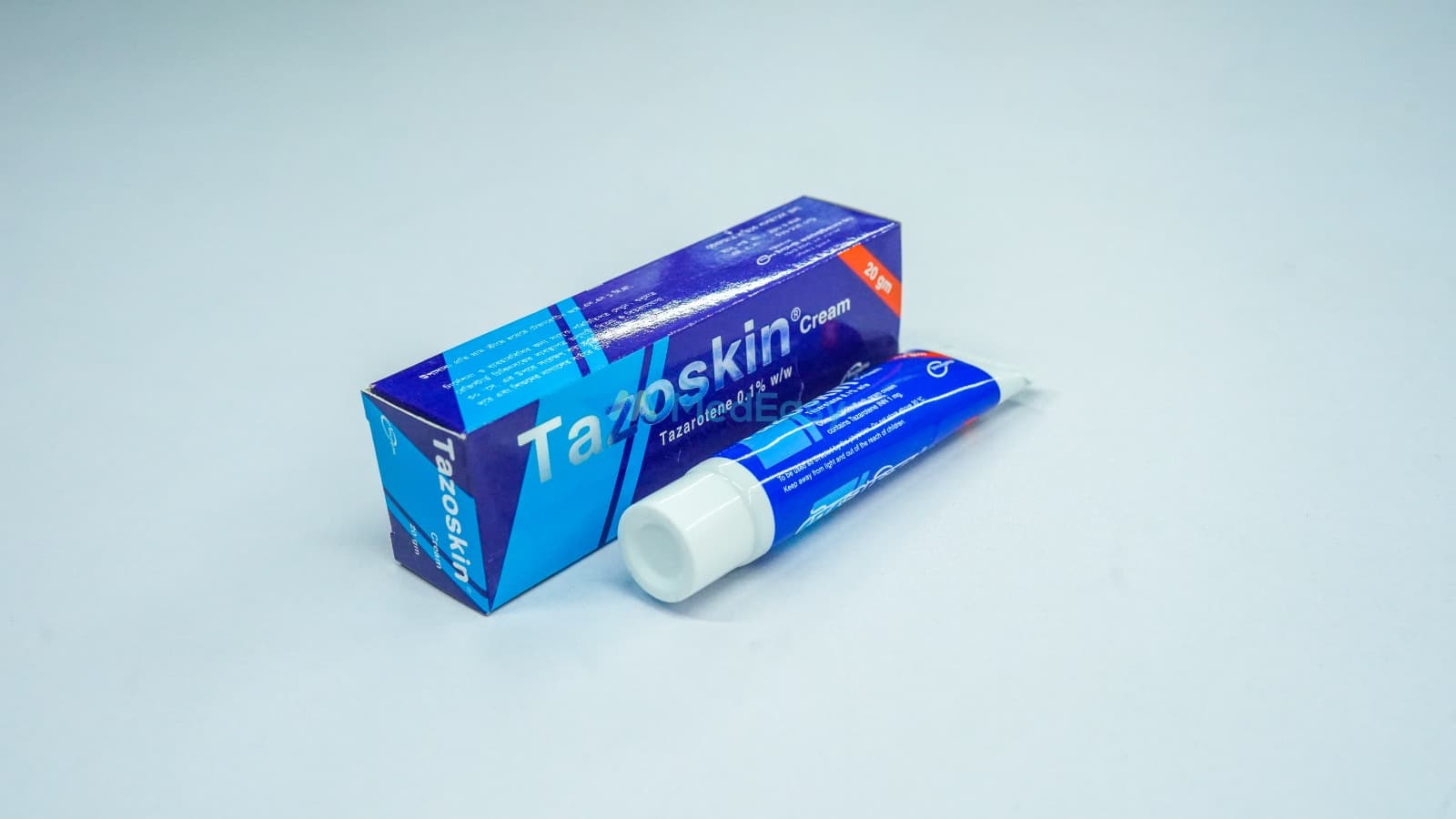

Medicine overview
Indications of Tazoskin
Tazoskin is a topical retinoid indicated for the following uses, classified by strength of evidence:
- FDA-approved – Plaque psoriasis: Tazoskin is indicated for the topical treatment of stable plaque psoriasis of limited body surface area in adults.
- FDA-approved – Acne vulgaris: Tazoskin is indicated for the topical treatment of acne vulgaris in appropriate patients, including adolescents per specific product labeling.
- FDA-approved (specific formulation) – Photodamage: Tazoskin 0.1% cream is indicated as part of a comprehensive skin care and sun protection programme for mitigation of facial fine wrinkling, mottled hyper-/hypopigmentation, and benign facial lentigines associated with photodamage, for use only as directed by a physician.
- Not indicated / off-label: Tazoskin is not established or approved for use in unstable, erythrodermic, exfoliative, or pustular psoriasis, and should not be used for these conditions unless specifically directed by a dermatologist.
Composition
Tazarotene is available in several topical dosage forms and strengths, including Tazarotene Cream 0.05% and 0.1%, Tazarotene Gel 0.05% and 0.1%, Tazarotene Foam 0.1%, and Tazarotene Lotion 0.045%. Each formulation contains Tazarotene as the sole active pharmaceutical ingredient in a topical vehicle base.
Description
Tazoskin is a synthetic, receptor-selective topical retinoid prodrug. After application to the skin, Tazoskin is converted to its active metabolite, tazarotenic acid, which binds to retinoic acid receptors (RARs) in the skin. Tazoskin is used topically for the treatment of stable plaque psoriasis of limited body surface area and for acne vulgaris. Certain Tazoskin formulations are also used as part of a comprehensive skin care and sun protection program to help mitigate facial fine wrinkling, mottled hyper-/hypopigmentation, and benign facial lentigines associated with photodamage.
Therapeutic Class
Topical Retinoid (Retinoic Acid Receptor Agonist) – Tazoskin belongs to the topical retinoid class used in dermatology.
Pharmacology
Tazarotene is a prodrug that is rapidly converted by esterases in the skin to its active metabolite, tazarotenic acid. Tazarotenic acid binds to all three retinoic acid receptor (RAR) subtypes but shows relative selectivity for RAR-β and RAR-γ, which are the predominant retinoid receptors found in the skin. This receptor binding modulates gene transcription involved in keratinocyte differentiation and proliferation.
- In psoriasis: Tazarotene normalizes the abnormal, hyperproliferative differentiation of keratinocytes and reduces epidermal inflammatory markers.
- In acne vulgaris: Tazarotene reduces follicular hyperkeratinization and decreases the cohesiveness of follicular epithelial cells, which helps normalize desquamation and reduce microcomedone formation; it also has anti-inflammatory activity.
- In photodamage: Tazarotene promotes more normal keratinocyte maturation and epidermal turnover, reducing the appearance of fine wrinkling and mottled pigmentation over time.
Systemic absorption of Tazarotene through the skin is minimal under labeled use conditions.
Dosage & Administration of Tazoskin
General Instructions
Tazoskin is for topical (external skin) use only. It should be applied as a thin film once daily, in the evening, to clean, dry skin, unless a physician directs otherwise. Avoid application to the eyes, eyelids, lips, angles of the nose, mucous membranes, and normal (non-affected) surrounding skin. Wash hands after application.
| Indication | Recommended Use |
|---|---|
| Plaque psoriasis | Apply a thin film of Tazoskin cream or gel (0.05% or 0.1%) once daily in the evening to the psoriatic lesions, covering no more than the body surface area specified by the prescriber. Adjacent healthy skin should be protected. |
| Acne vulgaris | Apply a thin film of Tazoskin cream, gel, foam, or lotion (0.045% or 0.1%, per product) once daily in the evening to the entire affected area of the face and/or trunk, after the skin is clean and dry. |
| Photodamage (facial fine wrinkling, mottled hyper-/hypopigmentation, benign lentigines) | Apply a pea-sized amount of Tazoskin 0.1% cream once daily in the evening to the face only, as part of a comprehensive skin care and sun-protection programme, under physician supervision. |
Therapy is usually started at a lower strength/frequency and adjusted based on tolerability. If significant irritation occurs, application may be reduced to alternate evenings or a lower-strength formulation may be substituted, as advised by the prescriber. Do not apply more Tazoskin than directed, and do not apply to a larger area than prescribed. See Precautions and Warnings for guidance on sun exposure and skin irritation.
Administration of Tazoskin
Apply Tazoskin to clean, dry skin only, at least 20–30 minutes after washing, since applying to damp skin can increase irritation. Use only a thin, even film – a small (pea-sized to fingertip-sized) amount is usually sufficient to cover the treatment area. Avoid the eyes, mouth, nostrils, and mucous membranes; if accidental contact occurs, rinse thoroughly with water. Do not apply Tazoskin to cuts, abrasions, sunburned, or eczematous skin. Wait for the skin to dry completely before applying other topical products, cosmetics, or sunscreen. Wash hands immediately after application unless the hands are a treated area.
Interaction of Tazoskin
Because systemic absorption of topical Tazoskin is minimal, clinically significant systemic drug interactions are uncommon. However, the following topical/local interactions are clinically relevant:
- Other potentially irritating topical products (other retinoids, benzoyl peroxide in high concentrations, strong soaps, astringents, exfoliants, or products with high alcohol content, or medicated/abrasive cosmetics): concurrent use with Tazoskin may cause additive skin irritation and should generally be avoided unless directed by a clinician.
- Photosensitizing drugs or products (e.g., thiazide diuretics, tetracyclines, fluoroquinolones, sulfonamides, phenothiazines, other photosensitizers): concurrent use with Tazoskin may increase the risk of photosensitivity reactions; sun protection is advised.
- Preparations with a known irritant or drying effect (e.g., medicated or abrasive soaps/cleansers, products with a strong drying effect, permanent wave solutions, hair depilatories/waxing): may increase local irritation when combined with Tazoskin.
Contraindications
Tazarotene is contraindicated in:
- Pregnancy. Tazarotene is a retinoid with demonstrated teratogenic potential in animal studies; it must not be used by women who are pregnant or who may become pregnant during treatment (see Pregnancy and Lactation).
- Known hypersensitivity to Tazarotene or to any component of the specific formulation being used.
Side Effects of Tazoskin
The most common adverse effects of Tazoskin are local skin reactions at the application site, which are often most pronounced during the first few weeks of treatment and tend to lessen with continued use:
- Burning, stinging, or a sensation of skin irritation
- Erythema (redness)
- Pruritus (itching)
- Dryness, peeling, or scaling (desquamation) of the skin
- Worsening of localized irritation with sun/wind/cold exposure
Less common effects include: localized skin pain, contact dermatitis, skin discoloration (hyper- or hypopigmentation), a transient worsening of psoriasis, and rash. Photosensitivity reactions can occur (see Precautions and Warnings). Severe irritation or allergic contact dermatitis is uncommon but should prompt discontinuation of Tazoskin and medical review.
Pregnancy & Lactation
Pregnancy: Tazoskin is contraindicated in pregnancy. As a retinoid, Tazoskin carries a teratogenic risk based on animal reproduction data, similar to other drugs in this class. Tazoskin should not be used by women who are pregnant. Women of reproductive potential should be counselled to use effective contraception during treatment, and a pregnancy test prior to starting Tazoskin is recommended by the label. If pregnancy occurs during treatment, Tazoskin should be discontinued immediately and a physician consulted.
Breastfeeding: It is not known whether topically applied Tazoskin is excreted in human breast milk in clinically significant amounts. Because systemic absorption is generally minimal but not zero, Tazoskin should be used with caution during breastfeeding, and only if the potential benefit justifies the potential risk to the infant; Tazoskin should not be applied to the chest area if breastfeeding. Consult a physician before use while breastfeeding.
Precautions & Warnings
Local skin irritation: Burning, stinging, redness, and peeling are common with Tazoskin, especially at the start of treatment. If irritation is significant, reduce the frequency of application, use a lower-strength formulation, or temporarily discontinue use, as advised by a physician.
Photosensitivity: Tazoskin may increase skin sensitivity to sunlight and ultraviolet (UV) light, including from tanning beds. Minimize sun exposure during treatment, use sunscreen and protective clothing, and avoid concurrent use of other photosensitizing medicines or cosmetic procedures (e.g., waxing, dermabrasion) unless approved by a physician.
Avoid irritated or broken skin: Do not apply Tazoskin to eczematous, sunburned, windburned, or broken/abraded skin, and avoid the eyes, lips, angles of the nose, and mucous membranes.
Concurrent topical products: Avoid using other potentially irritating topical products (other retinoids, high-concentration benzoyl peroxide, strong exfoliants/astringents) at the same time as Tazoskin unless directed by a clinician.
Women of reproductive potential: Use effective contraception during Tazoskin treatment; do not use if pregnant or planning pregnancy (see Contraindications and Pregnancy and Lactation).
Extent of use: Tazoskin has not been extensively studied for safety when applied to very large body surface areas or for prolonged, uninterrupted periods; use only as directed by a physician.
Overdose Effects of Tazoskin
Excessive or too-frequent topical application of Tazoskin does not lead to faster results and increases the risk of marked skin redness, peeling, burning, and discomfort; if this occurs, wash off the product, stop use, and contact a physician. Tazoskin is intended for external use only and is not meant to be swallowed. In case of accidental ingestion or a suspected overdose, seek immediate medical attention or contact a poison control center; do not attempt unsupervised home treatment.
Storage Conditions
Store at room temperature (below 30°C), away from light and moisture. Do not freeze. Keep the container tightly closed and out of the reach of children.
Use In Special Populations
- Pediatric use: See Pediatric Uses. In general, use of Tazoskin for acne is approved from around 9–12 years of age depending on the specific formulation, while safety and efficacy of Tazoskin for plaque psoriasis in pediatric patients have not been established.
- Elderly: Clinical studies of Tazoskin did not include sufficient numbers of patients aged 65 and over to determine whether they respond differently from younger adults; use with the same precautions regarding skin irritation and sun sensitivity.
- Renal/hepatic impairment: Because systemic absorption of topical Tazoskin is minimal, no specific dose adjustment is established for renal or hepatic impairment; however, caution is advised and no formal studies in these populations exist.
- Extensive/erythrodermic psoriasis or very large treatment areas: Use of Tazoskin in patients with widespread or unstable psoriasis has not been well studied; use only under close physician supervision.
Duration Of Treatment
Duration of Tazoskin therapy should be determined by a physician based on response and tolerability. For plaque psoriasis, improvement is generally assessed over several weeks, and treatment is continued as directed; if no improvement is seen after 12 weeks, the physician should reassess the treatment plan. For acne vulgaris, visible improvement with Tazoskin typically takes 8–12 weeks of consistent use, and longer-term maintenance therapy may be prescribed. For photodamage-related use, Tazoskin is typically continued for up to 24 weeks or longer as part of an ongoing skin care programme, per physician guidance. Do not stop or restart treatment without medical advice.
Drug Classes
Topical Retinoid / Retinoic Acid Receptor (RAR) Agonist – Antipsoriatic and Antiacne Agent
Mode Of Action
Tazarotene acts as a retinoid prodrug. Its active metabolite, tazarotenic acid, binds nuclear retinoic acid receptors (RAR-β and RAR-γ), altering gene expression that controls epidermal cell growth and differentiation, thereby correcting the abnormal keratinization seen in psoriasis and acne and improving the appearance of photodamaged skin.
Pregnancy
X
Pediatric Uses
Approved pediatric use of Tazoskin depends on the indication and specific formulation:
- Acne vulgaris: Tazoskin has been studied and is approved for use in adolescent patients (commonly from about 9–12 years of age and older, depending on the specific product's labeling) with a safety profile similar to that seen in adults.
- Plaque psoriasis: The safety and efficacy of Tazoskin have not been established in pediatric patients; use in children for this indication is not recommended outside of physician-directed, individualized care.
- Photodamage indication: Tazoskin for this use is intended for adults only and is not indicated in children.
- Caregivers should ensure Tazoskin is applied only to the areas directed, kept away from a child's eyes and mouth, and stored safely out of children's reach.
Frequently Asked Questions
Q: What is Tazoskin 20 gm Cream used for?
A: Tazoskin 20 gm Cream is a topical retinoid used mainly to treat plaque psoriasis and acne vulgaris. Certain formulations are also used, as part of a broader skin care and sun-protection programme, to help reduce the appearance of fine facial wrinkles, mottled pigmentation, and benign lentigines caused by sun damage.
Q: How should I apply Tazoskin 20 gm Cream?
A: Apply a thin film of Tazoskin 20 gm Cream once daily in the evening to clean, dry skin, avoiding the eyes, lips, nostrils, and mucous membranes. Use only the amount and frequency directed by your physician, and wash your hands after applying unless your hands are part of the treated area.
Q: Why does my skin burn, sting, or peel after using Tazoskin 20 gm Cream?
A: Local skin irritation – burning, stinging, redness, dryness, and peeling – is a common effect of Tazoskin 20 gm Cream, especially in the first few weeks of treatment, and usually lessens with continued use. If irritation is severe or persistent, tell your physician; they may recommend reducing how often you apply Tazoskin 20 gm Cream or switching to a lower-strength formulation.
Q: Can I use Tazoskin 20 gm Cream if I am pregnant or breastfeeding?
A: No. Tazoskin 20 gm Cream is contraindicated in pregnancy because, as a retinoid, it carries a risk of harm to the developing baby based on animal studies. Women who could become pregnant should use effective contraception while using Tazoskin 20 gm Cream, and a pregnancy test before starting is recommended. If you are breastfeeding, use Tazoskin 20 gm Cream only if your physician feels the benefit outweighs the potential risk, and avoid applying it to the chest area.
Q: Do I need to avoid sun exposure while using Tazoskin 20 gm Cream?
A: Yes. Tazoskin 20 gm Cream can make your skin more sensitive to sunlight and ultraviolet (UV) light, including tanning beds. Minimize sun exposure, use sunscreen and protective clothing, and avoid other photosensitizing products or medicines while using Tazoskin 20 gm Cream unless your physician approves.
Q: Can children use Tazoskin 20 gm Cream?
A: Tazoskin 20 gm Cream is approved for acne in adolescents from about 9 to 12 years of age and older, depending on the specific product. Its safety and efficacy for plaque psoriasis have not been established in children, so it should only be used in pediatric patients under a physician's direct guidance.
Disclaimer
The information provided is accurate to the best of our knowledge, but it does not replace professional medical advice. We cannot guarantee its completeness or accuracy, and the absence of specific information about a drug should not be taken as an endorsement. We are not responsible for any consequences arising from this information, so please consult a healthcare professional for any concerns or questions.
