
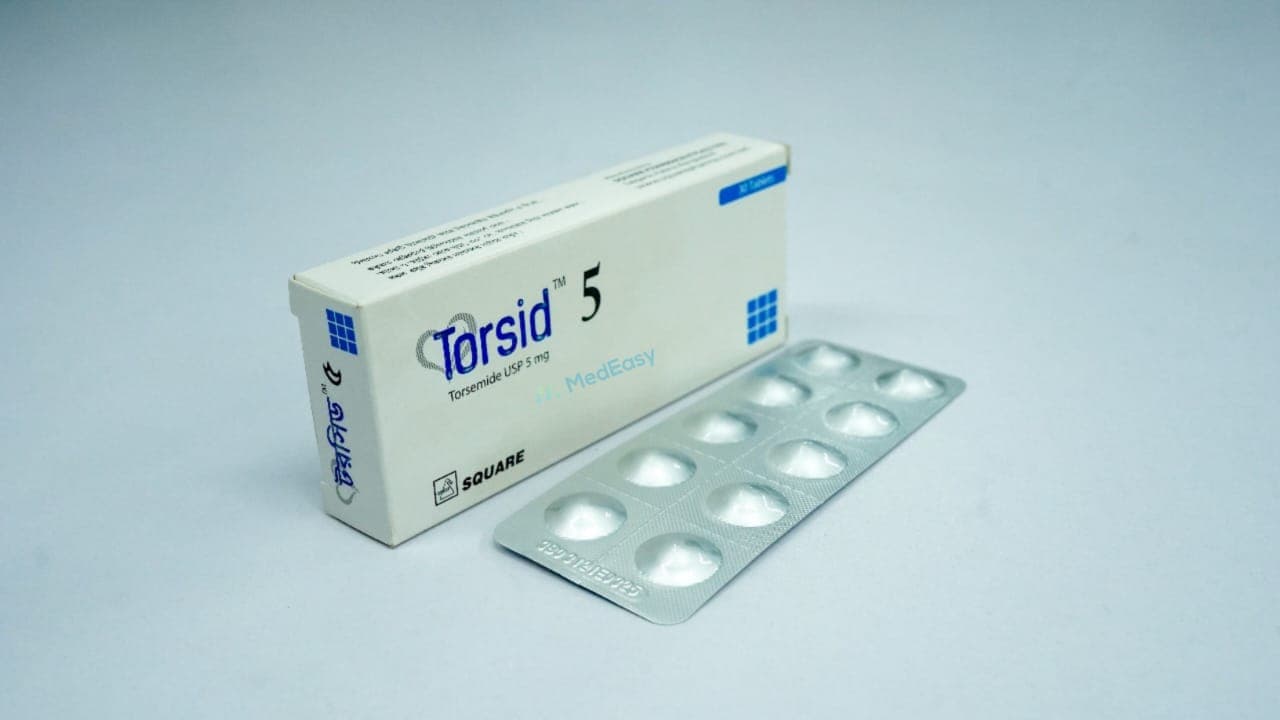

Medicine overview
Indications of Torsid
Torsid is a loop diuretic (water tablet) used in the following settings:
Established / FDA-approved uses
- Edema associated with congestive heart failure, chronic renal (kidney) disease, and hepatic (liver) cirrhosis.
- Hypertension - to lower blood pressure, alone or in combination with other antihypertensive agents, to reduce the risk of fatal and non-fatal cardiovascular events such as stroke and myocardial infarction.
Notes on use
- In hepatic cirrhosis, Torsid is generally used together with an aldosterone antagonist or a potassium-sparing diuretic, as monotherapy in this setting can precipitate serious electrolyte disturbances.
- Use for indications other than the above is not established and should not be undertaken without specialist guidance.
Composition
Each tablet contains Torsemide as the active ingredient, commonly available in strengths of 5 mg, 10 mg, 20 mg, and 100 mg. An intravenous injectable formulation is also available in some markets. Exact available strengths and dosage forms vary by manufacturer and market.
Description
Torsid is a pyridine-sulfonylurea-type loop diuretic that acts primarily on the ascending limb of the loop of Henle in the kidney. It is used to reduce fluid overload (edema) in patients with heart failure, chronic kidney disease, or liver cirrhosis, and to treat hypertension. Compared with some other loop diuretics, Torsid has a longer duration of action and higher, more consistent oral bioavailability. It is available as oral tablets and, in some markets, as an intravenous injection for use when oral therapy is not feasible.
Therapeutic Class
Loop diuretic (high-ceiling diuretic)
Pharmacology
Mechanism of action
Torsemide inhibits the Na+/K+/2Cl- co-transporter in the thick ascending limb of the loop of Henle, blocking reabsorption of sodium and chloride and promoting excretion of sodium, chloride, and water, along with increased excretion of potassium, magnesium, and calcium. This produces a dose-dependent diuretic and antihypertensive effect.
Pharmacokinetics
- Absorption: Rapidly and almost completely absorbed after oral administration (bioavailability greater than 80%), with peak plasma concentration reached within about 1 hour; food may slightly delay absorption without reducing overall extent.
- Distribution: Highly bound to plasma proteins (greater than 99%); relatively small volume of distribution.
- Metabolism: Extensively metabolized in the liver, mainly via the CYP2C9 enzyme, to metabolites with little or no diuretic activity.
- Excretion: Approximately 80% is eliminated via hepatic metabolism and biliary/fecal excretion of metabolites, with the remainder excreted unchanged in urine; elimination half-life is approximately 3.5 hours in healthy individuals.
- Onset/Duration: Diuresis begins within about 1 hour of an oral dose and lasts approximately 6-8 hours.
Dosage & Administration of Torsid
Edema (heart failure, renal disease, hepatic cirrhosis)
| Indication | Starting dose | Titration |
|---|---|---|
| Heart failure | 10-20 mg once daily | Double the dose as needed until desired diuretic response is achieved (doses above 200 mg have not been well studied) |
| Chronic renal disease | 20 mg once daily | Double the dose as needed (doses above 200 mg have not been well studied) |
| Hepatic cirrhosis | 5-10 mg once daily, given with an aldosterone antagonist or potassium-sparing diuretic | Double the dose as needed (doses above 40 mg have not been well studied) |
Hypertension
Initial dose: 5 mg once daily. If blood pressure is not adequately controlled after 4-6 weeks, the dose may be increased to 10 mg once daily. If 10 mg once daily is not sufficient, an additional antihypertensive agent should generally be added rather than further increasing the Torsid dose.
Renal/hepatic adjustment
No specific dose reduction is required for renal impairment, as total body clearance is not significantly altered, though higher doses may be needed to achieve adequate urine output; in severe hepatic impairment, initiate at the lowest recommended dose and titrate cautiously with close monitoring, preferably starting in a supervised/hospital setting (see Precautions).
Administration of Torsid
Torsid tablets are taken orally, once daily, with or without food, generally in the morning to avoid nocturnal diuresis disturbing sleep. Where an injectable form is used, it is administered intravenously by a healthcare professional, typically when oral administration is not practical.
Interaction of Torsid
| Interacting agent | Clinical effect |
|---|---|
| NSAIDs (e.g., indomethacin) | May blunt the diuretic and antihypertensive effect of Torsid and increase risk of renal impairment, especially with volume depletion. |
| Lithium | Reduced renal clearance of lithium, increasing risk of lithium toxicity; monitor lithium levels closely if co-administered. |
| ACE inhibitors / ARBs | Additive blood-pressure-lowering effect and increased risk of hypotension and renal impairment, particularly at initiation. |
| Aminoglycosides and other ototoxic drugs | Additive risk of ototoxicity (hearing loss, tinnitus), especially with impaired renal function. |
| CYP2C9 inhibitors (e.g., certain sulfonamides) | May increase Torsid plasma levels by reducing its metabolism. |
| Cholestyramine | Reduces absorption of Torsid; separate dosing by several hours if co-administered. |
| Corticosteroids / ACTH | Increased risk of hypokalemia (potassium depletion). |
| Digoxin | Diuretic-induced hypokalemia or hypomagnesemia can increase susceptibility to digoxin toxicity; monitor electrolytes. |
| Probenecid and other organic anion transport inhibitors | May reduce the diuretic effect of Torsid. |
| Radiocontrast agents | Additive risk of renal toxicity, particularly in dehydrated patients. |
Contraindications
Torsemide is contraindicated in:
- Known hypersensitivity to Torsemide or to sulfonylureas (structurally related, sulfonamide-derived compound; cross-reactivity caution per class labeling).
- Anuria (absence of urine production).
- Hepatic coma or precoma associated with electrolyte depletion, in whom further diuresis without correction of electrolytes can be dangerous.
Side Effects of Torsid
The most common adverse effect of Torsid is excessive or increased urination.
Common
- Increased urination, dizziness, headache
- Electrolyte disturbances (see Precautions and Warnings)
Less common / postmarketing
- Gastrointestinal: nausea, diarrhea, constipation, abdominal pain, rarely pancreatitis
- Nervous system: paresthesia, confusion, blurred vision
- Ototoxicity: tinnitus and hearing loss, usually reversible (see Precautions)
- Hematologic (rare): leukopenia, thrombocytopenia, anemia
- Dermatologic (rare): photosensitivity, and very rare serious skin reactions such as Stevens-Johnson syndrome/toxic epidermal necrolysis
- Urogenital: acute urinary retention (particularly in patients with bladder outlet obstruction)
Pregnancy & Lactation
Pregnancy: There are no adequate, well-controlled human studies of Torsid in pregnancy. Animal reproduction studies have not shown teratogenicity at therapeutic doses, though fetal toxicity was observed at higher doses. Torsid should be used during pregnancy only if the potential benefit justifies the potential risk to the fetus, and only under close medical supervision.
Lactation: It is not known whether Torsid is excreted in human breast milk. Diuretics in general may suppress lactation. A decision on breastfeeding while using Torsid should be made only after consulting a physician, weighing the benefits of breastfeeding against the mother's clinical need for the drug.
Precautions & Warnings
Fluid, electrolyte, and renal monitoring
Excessive diuresis with Torsid can cause dehydration, reduction in blood volume, hypotension, and worsening renal function, particularly in elderly patients or with aggressive dosing. Periodic monitoring of serum electrolytes (sodium, potassium, magnesium, chloride), renal function, and blood glucose/uric acid is recommended, especially at higher doses or with concurrent diuretic combinations.
Electrolyte disturbances
Risk of hypokalemia, hyponatremia, hypomagnesemia, and hypochloremic metabolic alkalosis. Hyperuricemia and, rarely, precipitation of acute gout may occur; hyperglycemia has also been reported.
Ototoxicity
Tinnitus and hearing loss (usually reversible) have been reported, especially with rapid intravenous administration, very high doses, severe renal impairment, or when given with other ototoxic drugs; caution is advised in these situations.
Hepatic cirrhosis
Sudden alterations in fluid and electrolyte balance in patients with cirrhosis and ascites may precipitate hepatic coma; diuresis should generally be initiated in a hospital setting under close monitoring, with concurrent use of an aldosterone antagonist or potassium-sparing diuretic.
Sulfonamide hypersensitivity
Torsid is chemically related to sulfonamide-derived drugs; patients with known sulfonamide allergy may have cross-sensitivity and should be monitored closely if the drug is used.
Lithium therapy
Concurrent lithium use increases the risk of lithium toxicity due to reduced renal lithium clearance; monitor lithium levels closely.
Overdose Effects of Torsid
Overdosage with Torsid may cause dehydration, hypovolemia, hypotension, hyponatremia, hypokalemia, and hypochloremic alkalosis. There is no specific antidote. If overdose is suspected, seek immediate medical attention or contact a poison control center; treatment is supportive, consisting of fluid and electrolyte replacement under medical supervision. Torsid is not significantly removed by dialysis.
Storage Conditions
Store at room temperature (below 30°C), away from light and moisture. Keep out of reach of children.
Use In Special Populations
Pediatric use
Safety and efficacy of Torsid in pediatric patients have not been established.
Geriatric use
No overall differences in effectiveness or safety have been observed between elderly and younger patients in clinical studies, but elderly patients may be more sensitive to excessive diuresis, dehydration, and electrolyte disturbances; use with caution and monitor closely.
Renal impairment
Total body clearance of Torsid is not markedly altered in renal impairment, though higher doses may be required to achieve an adequate diuretic response; monitor renal function and electrolytes.
Hepatic impairment
Use with caution; risk of precipitating hepatic coma from fluid/electrolyte shifts (see Precautions and Warnings). Initiate in hospital with concomitant aldosterone antagonist or potassium-sparing diuretic.
Duration Of Treatment
Duration of treatment with Torsid depends on the underlying condition: hypertension and chronic edematous states (heart failure, chronic kidney disease, cirrhosis) typically require long-term, often indefinite, therapy with periodic reassessment of dose and clinical/laboratory monitoring by a physician; the lowest effective dose should be used and treatment reviewed regularly.
Drug Classes
Loop diuretics; High-ceiling diuretics; Antihypertensive agents
Mode Of Action
Torsemide inhibits the Na+/K+/2Cl- co-transport system in the thick ascending limb of the loop of Henle, reducing reabsorption of sodium and chloride and increasing urinary excretion of sodium, chloride, water, potassium, magnesium, and calcium, producing diuresis and a reduction in blood pressure.
Pregnancy
B
Pediatric Uses
The safety and efficacy of Torsid in pediatric patients have not been established, and it is not generally recommended for use in children outside specialist supervision. Loop diuretics, including Torsid, used in premature infants have been associated with nephrocalcinosis/nephrolithiasis; renal ultrasound monitoring may be warranted if used in this population under specialist care.
Frequently Asked Questions
Q: What is Torsid 5 mg Tablet used for?
A: Torsid 5 mg Tablet is a loop diuretic ("water tablet") used to reduce fluid retention (edema) caused by heart failure, kidney disease, or liver cirrhosis, and to treat high blood pressure.
Q: How should I take Torsid 5 mg Tablet?
A: Torsid 5 mg Tablet is usually taken once daily by mouth, with or without food, preferably in the morning so that increased urination does not disturb sleep. Take it exactly as prescribed by your physician and do not stop or change the dose without medical advice.
Q: What are the common side effects of Torsid 5 mg Tablet?
A: The most common effect is increased urination. Other possible effects include dizziness, headache, electrolyte changes (low potassium, sodium, or magnesium), and, less commonly, hearing changes such as ringing in the ears (tinnitus) or hearing loss, which is usually reversible.
Q: Who should not take Torsid 5 mg Tablet?
A: Torsid 5 mg Tablet should not be used by people with a known allergy to Torsid 5 mg Tablet or to sulfonylurea medicines, people who produce no urine (anuria), or people in hepatic coma or precoma with depleted electrolytes. Discuss your full medical history with your physician before starting treatment.
Q: Can Torsid 5 mg Tablet be taken during pregnancy or breastfeeding?
A: There is limited human data on Torsid 5 mg Tablet use in pregnancy, so it should be used only if the potential benefit clearly outweighs the potential risk to the fetus, and only under a physician's supervision. It is not known if it passes into breast milk; consult your physician before breastfeeding while taking this medicine.
Q: What should I do if I miss a dose or take too much Torsid 5 mg Tablet?
A: If you miss a dose, take it as soon as you remember unless it is close to your next dose; do not double up. If an overdose is suspected (leading to symptoms such as severe dehydration, dizziness, or very low blood pressure), seek immediate medical attention or contact a poison control center right away.
Disclaimer
The information provided is accurate to the best of our knowledge, but it does not replace professional medical advice. We cannot guarantee its completeness or accuracy, and the absence of specific information about a drug should not be taken as an endorsement. We are not responsible for any consequences arising from this information, so please consult a healthcare professional for any concerns or questions.
