
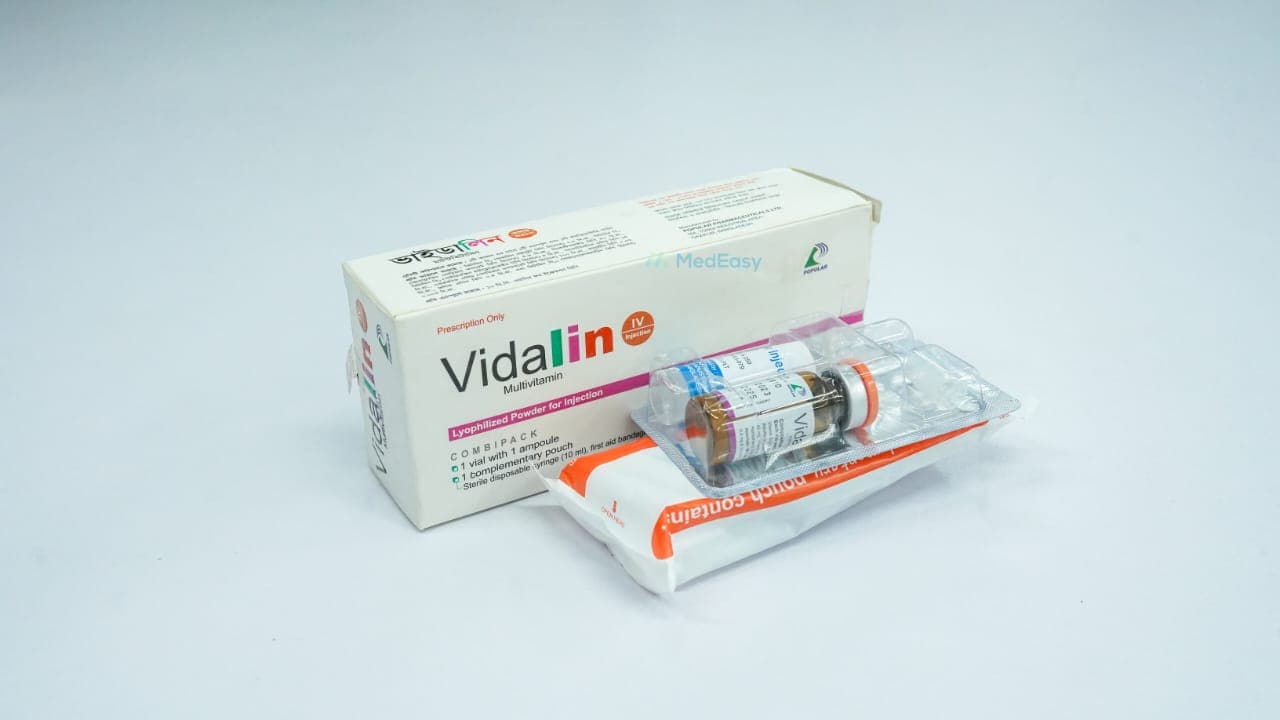

Medicine overview
Indications of Vidalin
Vidalin is a parenteral (injectable) multivitamin preparation combining several water-soluble and, in many formulations, fat-soluble vitamins. It is indicated for the following uses, classified by strength of evidence:
- Established/guideline-supported use: Prevention and treatment of vitamin deficiency in patients who are unable to take, or cannot adequately absorb, oral vitamin supplements - for example, hospitalized patients who are nil-by-mouth, patients with severe gastrointestinal disease or malabsorption, and patients receiving total or partial parenteral nutrition (TPN/PPN), where Vidalin is added to the nutrition admixture as a source of daily vitamin requirements.
- Adjunct use: Adjunctive nutritional support in critically ill, post-surgical, or severely malnourished patients as part of an overall parenteral nutrition or fluid-replacement plan, used together with appropriate caloric, protein, electrolyte, and trace-element repletion under medical supervision.
- Combination-therapy use: As a component of compounded parenteral nutrition solutions, where Vidalin is combined with amino acids, dextrose, lipids, electrolytes, and trace elements by a pharmacist or trained clinician; it is not intended to be given as the sole nutritional intervention.
Vidalin is intended for use by, or under the direct supervision of, a physician or other qualified healthcare professional in a hospital or clinical setting; it is not typically a self-administered outpatient product.
Composition
Vidalin formulations vary by manufacturer, but a typical adult vial provides a combination of water-soluble vitamins and, depending on the product, fat-soluble vitamins, such as:
- Thiamine (Vitamin B1)
- Riboflavin (Vitamin B2)
- Pyridoxine (Vitamin B6)
- Cyanocobalamin (Vitamin B12)
- Nicotinamide (Vitamin B3)
- Dexpanthenol/Pantothenic acid (Vitamin B5)
- Ascorbic acid (Vitamin C)
- Folic acid
- Biotin
- Vitamin A, Vitamin D, and Vitamin E (in formulations designed as a complete multivitamin additive for parenteral nutrition; some formulations exclude Vitamin K, which must then be supplied separately)
Exact vitamins, strengths, and whether the product is supplied as a ready-to-use solution or as a lyophilized powder for reconstitution vary by brand and formulation. Always refer to the specific product's label for its precise composition.
Description
Vidalin is a combination parenteral vitamin product designed to meet daily vitamin requirements in patients who cannot take or absorb oral vitamins adequately. It brings together B-complex vitamins, vitamin C, and (in many formulations) the fat-soluble vitamins A, D, and E into a single injectable preparation.
Vidalin is most commonly administered as an additive to intravenous fluids or total/partial parenteral nutrition (TPN/PPN) admixtures, though some multivitamin injection formulations intended for general nutritional supplementation are given by intramuscular (IM) injection. It works by directly replenishing the body's stores of essential vitamins that support energy metabolism, red blood cell formation, nervous system function, antioxidant defense, and bone and vision health, bypassing the gastrointestinal tract entirely.
Vidalin is used only under medical supervision and is not intended for self-diagnosis or self-treatment of specific disease states.
Theropeutic Class
Vidalin belongs to the therapeutic class of Vitamins and Nutritional Supplements - specifically, a multi-component parenteral (injectable) multivitamin preparation used for vitamin repletion and as an additive to parenteral nutrition.
Pharmacology
Vidalin supplies a combination of essential vitamins that act through their individual, well-established physiological roles rather than a single unified mechanism:
- B-complex vitamins (B1, B2, B3, B5, B6, B12, folic acid, biotin): Function as coenzymes or coenzyme precursors in carbohydrate, fat, and protein metabolism, DNA synthesis, red blood cell formation, and normal nervous system function.
- Vitamin C (ascorbic acid): An essential cofactor for collagen synthesis and a water-soluble antioxidant that also supports immune function and enhances non-heme iron absorption.
- Vitamin A (in applicable formulations): Required for normal vision (rhodopsin synthesis), epithelial cell integrity, and immune function.
- Vitamin D (in applicable formulations): Promotes intestinal calcium and phosphate absorption and supports bone mineralization.
- Vitamin E (in applicable formulations): A lipid-soluble antioxidant that protects cell membranes from oxidative damage.
When given intravenously as part of parenteral nutrition, these vitamins bypass intestinal absorption limitations entirely, allowing rapid repletion of vitamin stores in patients who cannot absorb or take oral vitamins.
Dosage & Administration of Vidalin
Dosage of Vidalin depends on the specific product formulation (adult vs. pediatric, IV additive vs. IM), the clinical indication, and institutional protocol. The figures below are general guidance; the specific product's labeling and the prescriber's instructions take precedence.
| Indication/Population | Typical Dose |
|---|---|
| Adults - daily additive to parenteral nutrition (IV) | One standard adult vial (per product labeling) added to the parenteral nutrition admixture or IV fluid once daily |
| Adults - general nutritional supplementation (IM, where a product is labeled for this route) | As directed by the physician, typically administered on a scheduled basis (e.g., a few times weekly) rather than daily; not for continuous self-administration |
| Pediatric patients | A pediatric-specific, lower-dose Vidalin formulation must be used if available; dosing is weight/age-based and must be individualized by the treating physician (see Pediatric Uses) |
| Renal/hepatic impairment | No specific validated dose adjustment is established for most components; use with caution and monitor for accumulation of fat-soluble vitamins (see Precautions and Use in Special Populations) |
Vidalin must be administered by, or under the direct supervision of, a trained healthcare professional. Do not exceed the recommended frequency of administration, given the risk of cumulative toxicity with fat-soluble vitamins on repeated dosing.
Dosage of Vidalin
The usual adult dose of Vidalin is one standard vial added to the daily parenteral nutrition admixture or IV fluid, or administered as directed by the physician for other indications. Dosing must not exceed the frequency and amount specified on the product label or prescribed by the treating physician.
Administration of Vidalin
Vidalin is administered by a healthcare professional in a clinical or hospital setting:
- Intravenous (IV) use: Added aseptically to a compatible parenteral nutrition admixture or IV fluid immediately before infusion, and infused at a rate consistent with the overall infusion protocol; do not infuse undiluted as a rapid IV push unless the specific product is labeled for that use.
- Intramuscular (IM) use (where the product is labeled for this route): Injected deep into a large muscle mass using aseptic technique, with injection sites rotated to reduce local irritation.
If the specific product is supplied as a lyophilized powder, it must be reconstituted with the recommended diluent before use (see Reconstitution). Protect the reconstituted/admixed solution from light where indicated on the product label, and inspect visually for particulate matter or discoloration before administration.
Interaction of Vidalin
Vidalin has the following clinically significant interactions:
- Warfarin and other vitamin K antagonists: If the specific Vidalin formulation contains vitamin K, it can reduce the anticoagulant effect of warfarin and destabilize INR control; conversely, formulations without vitamin K do not carry this risk. Confirm the vitamin K content of the specific product before use in patients on anticoagulants, and monitor INR closely if used.
- Levodopa (without carbidopa): The pyridoxine (vitamin B6) component can reduce the therapeutic effect of levodopa given alone by enhancing its peripheral breakdown; this interaction does not occur with carbidopa-levodopa combinations.
- Phenytoin: The folic acid component may lower plasma phenytoin levels, potentially reducing seizure control; monitor phenytoin levels and seizure control with concurrent use.
- Chloramphenicol: May blunt the hematologic response to the vitamin B12 component; monitor response in patients requiring both.
- Retinoid medications (e.g., isotretinoin, acitretin): Concurrent use with vitamin A-containing formulations can have additive toxicity and increase the risk of hypervitaminosis A; avoid concurrent use unless directed by a physician.
Contraindications
Vidalin is contraindicated in:
- Known hypersensitivity to any vitamin component of the specific formulation or to any excipient of the product.
- Pre-existing hypervitaminosis A or hypervitaminosis D (in formulations containing these vitamins).
Side Effects of Vidalin
Vidalin is generally well tolerated when administered as directed. Reported side effects include:
- Common: Pain, redness, or induration at the intramuscular injection site; mild flushing or a transient warm sensation during IV administration.
- Uncommon: Nausea, headache, and mild pruritus or rash.
- Rare but serious: Hypersensitivity or anaphylactoid reactions (including bronchospasm, hypotension, and angioedema), particularly with rapid IV administration; symptoms of hypervitaminosis with excessive or prolonged dosing (see Overdose).
Pregnancy & Lactation
Vidalin should be used in pregnancy and lactation only if clearly needed, when a patient cannot meet vitamin requirements orally, and after the potential benefit has been weighed against any potential risk by the treating physician. Vitamin requirements increase during pregnancy and lactation, and parenteral vitamin repletion is used when clinically indicated (for example, alongside parenteral nutrition), but doses must not exceed those recommended, particularly for fat-soluble vitamins A and D, which carry a risk of fetal harm at excessive doses. Use under close medical supervision.
Precautions & Warnings
The following precautions apply to Vidalin :
- Healthcare-professional administration: Vidalin is intended for administration by, or under the direct supervision of, a trained healthcare professional in a clinical setting; it is generally not a self-administered outpatient product.
- Rate of intravenous administration: Rapid IV administration has been associated with infusion/hypersensitivity-type reactions; follow the specific product's and the institution's protocol for infusion rate.
- Cumulative fat-soluble vitamin risk: Do not exceed the recommended dosing frequency, particularly with repeated or prolonged administration, because vitamins A, D, and E can accumulate in the body and lead to toxicity over time.
- Renal impairment: Patients with reduced renal function may have impaired clearance of certain vitamins and metabolites; use with caution and monitor for accumulation.
- Hepatic impairment: Vitamin A storage and activation occur in the liver; use with caution in significant hepatic disease, as clearance and toxicity risk may be altered.
- Admixture compatibility: When added to parenteral nutrition solutions, confirm compatibility and stability with all other additives (electrolytes, trace elements, lipids) per institutional pharmacy guidance, as some combinations can cause precipitation or vitamin degradation.
Overdose Effects of Vidalin
Excessive or excessively frequent administration of Vidalin , particularly of its fat-soluble vitamin components, may lead to hypervitaminosis with symptoms such as nausea, vomiting, headache, blurred vision, irritability, bone or joint pain (vitamin A toxicity), or symptoms of hypercalcemia such as weakness, confusion, excessive thirst, and frequent urination (vitamin D toxicity). In case of a suspected overdose or an acute adverse reaction during administration, stop the infusion/injection immediately and seek immediate medical attention or contact emergency services/a poison control center; do not attempt specific home treatment.
Storage Conditions
Store at room temperature (below 30°C), protected from light, unless the specific product's label specifies refrigeration. Do not freeze. Keep out of reach of children. Once reconstituted or added to an IV admixture, use within the time period specified on the product label and protect from light where indicated.
Use In Special Populations
Renal impairment: Use with caution due to potential reduced clearance of certain vitamins and their metabolites; see Precautions.
Hepatic impairment: Use with caution given the liver's role in vitamin A storage and activation; see Precautions.
Elderly: No specific dose adjustment is established, but age-related decline in renal/hepatic function should be considered; monitor clinically.
Pediatric population: See Pediatric Uses - a pediatric-specific formulation with age/weight-based dosing must be used, not the adult product.
Pregnancy and lactation: See Pregnancy and Lactation section.
Duration Of Treatment
Vidalin is typically continued for as long as the patient is unable to meet vitamin requirements orally or is receiving parenteral nutrition, as determined by the treating physician. Vitamin status should be periodically reassessed clinically, and where appropriate with laboratory testing, and Vidalin should be discontinued or transitioned to oral vitamin supplementation once the patient can tolerate and absorb oral intake.
Reconstitution
Some Vidalin products are supplied as a lyophilized (freeze-dried) powder that must be reconstituted with the diluent specified on the product label (typically Sterile Water for Injection or a compatible IV fluid) immediately before use, using aseptic technique, and the resulting solution should be inspected for complete dissolution and absence of particulate matter before being added to the IV fluid or parenteral nutrition admixture. Other Vidalin products are supplied as a ready-to-use liquid solution and do not require reconstitution. Always confirm which type of formulation is being used from the specific product's labeling before preparation.
Drug Classes
Parenteral Multivitamin (Vitamin B-complex + Vitamin C, with or without Vitamins A, D, E/K, depending on formulation); Nutritional Supplement for injectable/parenteral use
Mode Of Action
Vidalin acts by directly supplying essential water-soluble (B-complex, C) and, in many formulations, fat-soluble (A, D, E) vitamins into the systemic circulation, bypassing gastrointestinal absorption. Each vitamin acts through its own established physiological role - as coenzymes in metabolic pathways (B-complex), as an antioxidant and collagen synthesis cofactor (vitamin C), and, where present, in vision and epithelial integrity (vitamin A), calcium/phosphate homeostasis and bone mineralization (vitamin D), and membrane antioxidant protection (vitamin E) - allowing rapid correction of vitamin deficiency in patients who cannot absorb or take oral vitamins.
Pediatric Uses
Vidalin adult formulations are not appropriate for use in pediatric patients because they contain vitamin doses formulated for adult requirements. A pediatric-specific parenteral multivitamin formulation, with age- and weight-based dosing, should be used when parenteral vitamin supplementation is needed in infants and children, such as those receiving parenteral nutrition. Safety and efficacy of any specific Vidalin product in neonates, infants, or children have not been established unless that specific product is labeled for pediatric use; use in pediatric patients should be directed and monitored by a physician experienced in pediatric parenteral nutrition.
Frequently Asked Questions
Q: What is Vidalin used for?
A: Vidalin is used to prevent or treat vitamin deficiency in patients who cannot take or absorb oral vitamins adequately, such as hospitalized patients on parenteral nutrition, those who are nil-by-mouth, or patients with severe malabsorption. It is given by a healthcare professional as an additive to intravenous fluids/parenteral nutrition or, for some formulations, by intramuscular injection.
Q: Can I inject Vidalin myself at home?
A: No. Vidalin is intended to be administered by, or under the direct supervision of, a trained healthcare professional in a hospital or clinical setting. It is generally not a self-administered outpatient product, and the intravenous route in particular requires proper aseptic technique and controlled infusion rate.
Q: Is Vidalin safe during pregnancy or breastfeeding?
A: Vidalin should be used in pregnancy and breastfeeding only if clearly needed - for example, when a patient cannot meet vitamin needs orally - and after your physician weighs the potential benefit against any potential risk. Doses should not exceed those recommended, particularly for vitamins A and D, which can be harmful to the fetus in excess.
Q: What are the side effects of Vidalin ?
A: Most patients tolerate Vidalin well. Injection-site pain or redness (with intramuscular use) and mild flushing or nausea (with intravenous use) can occur. Rarely, hypersensitivity or anaphylactoid reactions can occur, especially with rapid intravenous administration - report any difficulty breathing, swelling, or rash to the healthcare team immediately.
Q: Can Vidalin be given with blood thinners like warfarin?
A: Some Vidalin formulations contain vitamin K, which can reduce the effect of warfarin and other vitamin K antagonists and destabilize INR control, while formulations without vitamin K do not carry this risk. Your healthcare team will check the specific product's composition and may monitor your INR more closely if needed.
Q: What happens if too much Vidalin is given?
A: Giving Vidalin too frequently or in excessive amounts, especially of its fat-soluble vitamin components, can cause hypervitaminosis, with symptoms such as nausea, vomiting, headache, or (with excess vitamin D) confusion and excessive thirst. If an overdose or a reaction during administration is suspected, the infusion/injection should be stopped immediately and emergency medical attention sought.
Disclaimer
The information provided is accurate to the best of our knowledge, but it does not replace professional medical advice. We cannot guarantee its completeness or accuracy, and the absence of specific information about a drug should not be taken as an endorsement. We are not responsible for any consequences arising from this information, so please consult a healthcare professional for any concerns or questions.
