

10% Off
Carbolin100 ml
Eskayef Bangladesh Ltd.
৳27.00
Add to cart
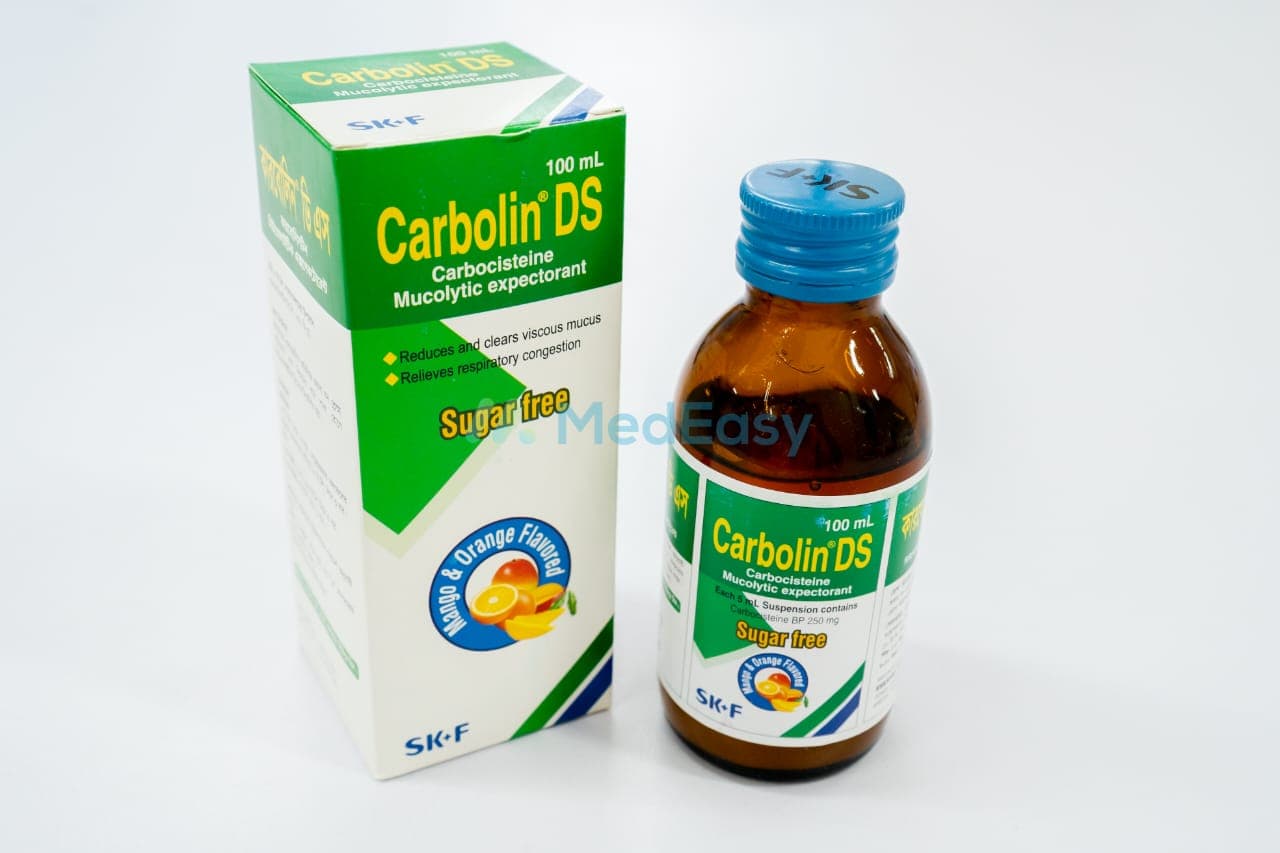

Carbolin DS is a mucolytic (mucoregulator) agent used to reduce the viscosity of thick, tenacious mucus in respiratory conditions where excessive or sticky sputum causes airway obstruction and impairs clearance.
Note: Carbolin DS is not a treatment for the underlying infection or disease process; it works on mucus consistency only and should be used alongside appropriate disease-specific treatment.
Each formulation contains Carbocisteine as the active ingredient, commonly available as capsules (375 mg) and oral syrup (125 mg/5 mL and 250 mg/5 mL). Excipients vary by manufacturer and formulation (e.g., sweeteners, preservatives, flavoring agents in syrups).
Carbolin DS is a carbocysteine-class mucoactive (mucolytic/mucoregulator) drug that alters the physical and chemical properties of respiratory mucus. It is widely used across Asia and Europe for productive respiratory conditions in which thick, sticky secretions are difficult to clear.
Unlike cough suppressants, Carbolin DS does not act on the cough reflex; instead, it makes mucus less viscous so that it can be cleared more easily by coughing or ciliary action.
Mucolytic / Expectorant (Mucoactive agent)
Carbocisteine acts on the sialomucin-producing goblet cells of the respiratory mucosa. It reduces the viscosity of respiratory secretions primarily through two mechanisms:
By making mucus thinner and less sticky, Carbocisteine facilitates its removal by cilia and coughing, helping to relieve airway obstruction caused by thick secretions.
| Indication | Dose |
|---|---|
| Initial dose | 750 mg three times daily (2,250 mg/day) |
| Maintenance (once response is satisfactory) | 375 mg four times daily (1,500 mg/day) |
| Age | Dose |
|---|---|
| 2–5 years | 62.5–125 mg four times daily |
| 6–12 years | 250 mg three times daily |
Alternative weight-based dosing sometimes used: approximately 20 mg/kg/day in divided doses. Carbolin DS is generally not recommended in infants under 2 years; see Use in Special Populations.
Carbolin DS may be taken with or after food to minimize gastrointestinal discomfort. Capsules should be swallowed whole with water; oral syrup should be measured using an appropriate measuring device. Adequate fluid intake supports the mucolytic effect. Do not exceed the dose or duration advised by your physician.
Take by mouth, preferably with or after food, with a full glass of water. Use the measuring cup/spoon provided for syrup formulations. Do not alter the dose without consulting a physician.
Carbolin DS has a relatively low potential for clinically significant drug interactions, but the following should be noted:
Always inform your physician or pharmacist of all medicines, supplements, and herbal products you are taking before starting Carbolin DS.
Carbocisteine is contraindicated in:
Most adverse effects associated with Carbolin DS are mild and gastrointestinal in nature:
Seek medical attention if severe abdominal pain, black/tarry stools, vomiting blood, or signs of an allergic reaction (rash, swelling, difficulty breathing) occur while taking Carbolin DS.
Pregnancy: Carbolin DS is not recommended during the first trimester of pregnancy as a precautionary measure, in line with conventional labeling guidance. For the remainder of pregnancy, Carbolin DS should be used only if clearly needed and if the potential benefit justifies the potential risk to the fetus; a physician should always be consulted before use in pregnancy.
Lactation: There is limited data on the excretion of Carbolin DS into breast milk. As a precaution, use during breastfeeding should occur only under medical advice, weighing benefit against unknown risk to the infant.
Use Carbolin DS with caution in patients with a history of peptic ulcer disease, as it may cause gastric mucosal irritation or erosion by disrupting the protective gastric mucus barrier; monitor for gastrointestinal bleeding symptoms in such patients.
Carbolin DS should not be used together with cough-suppressing (antitussive) medicines, as this can lead to dangerous retention of loosened mucus in the respiratory tract (see Interactions).
Use with caution in elderly or debilitated patients who have a weak cough reflex, since increased mucus mobilization without effective clearance could theoretically worsen airway obstruction.
Discontinue and seek medical advice if signs of gastrointestinal bleeding or hypersensitivity reactions occur (see Side Effects and Contraindications).
Reported overdose experience with Carbolin DS is limited; gastrointestinal symptoms such as nausea, vomiting, diarrhea, and abdominal pain may be expected to be more pronounced. There is no specific antidote. In case of suspected overdose, seek immediate medical attention or contact a poison control center; treatment is supportive and symptomatic, and should be managed by qualified medical personnel.
Store at room temperature (below 30°C), away from light and moisture. Keep out of reach of children.
Pediatric use: Carbolin DS may be used in children from 2 years of age at the doses described above, under medical supervision. Use in infants below 2 years is generally not established and not recommended; dosage in this age group has not been established.
Elderly: No specific dose adjustment is generally required, but caution is advised in elderly patients with reduced cough reflex or gastrointestinal fragility (see Precautions).
Renal/Hepatic impairment: There is limited specific data on dose adjustment of Carbolin DS in renal or hepatic impairment; use with caution and under medical supervision in such patients.
Peptic ulcer history: See Precautions and Warnings.
Duration of treatment with Carbolin DS depends on the underlying condition and clinical response, and is typically continued for as long as excess, thick mucus production persists, as directed by a physician. Long-term use in chronic conditions (e.g., chronic bronchitis, bronchiectasis) should be periodically reviewed by the prescribing physician.
Mucolytics; Mucoactive/Mucoregulatory agents; Respiratory secretion modifiers
Carbocisteine reduces mucus viscosity by breaking disulfide bonds in mucin glycoproteins and by normalizing the sialomucin/fucomucin balance produced by the bronchial mucosa, resulting in thinner, more easily cleared respiratory secretions.
Carbolin DS is used in children aged 2 years and above for thick-mucus respiratory conditions, at reduced weight/age-appropriate doses (see Dosage and Administration). Safety and efficacy in infants below 2 years have not been established, and use in this age group is generally not recommended. Pediatric use should always be initiated and monitored by a physician.
Q: What is Carbolin DS 100 ml Syrup used for?
A: Carbolin DS 100 ml Syrup is a mucolytic medicine used to thin and loosen thick, sticky mucus in conditions such as chronic bronchitis, COPD, bronchiectasis, sinusitis, and other respiratory conditions with excessive mucus production, making it easier to cough up and clear the airways.
Q: Can I take Carbolin DS 100 ml Syrup with a cough suppressant like codeine or dextromethorphan?
A: No. Carbolin DS 100 ml Syrup loosens mucus so it can be coughed up, while cough suppressants block the cough reflex. Taking them together can cause loosened mucus to build up dangerously in the airway, so this combination is generally discouraged unless specifically directed by a physician.
Q: Can Carbolin DS 100 ml Syrup be taken during pregnancy?
A: Carbolin DS 100 ml Syrup is not recommended in the first trimester of pregnancy. In later pregnancy, it should only be used if clearly needed, when the potential benefit outweighs the potential risk to the fetus, and always under medical advice. Do not take Carbolin DS 100 ml Syrup during pregnancy without consulting a physician.
Q: Is Carbolin DS 100 ml Syrup safe for someone with a history of stomach ulcers?
A: Carbolin DS 100 ml Syrup should be used with caution in people with a history of peptic ulcer disease, as it can irritate the gastric lining and potentially cause bleeding. It is completely contraindicated (must not be used) in people with an active peptic ulcer. Discuss your ulcer history with your physician before starting Carbolin DS 100 ml Syrup.
Q: What should I do if I miss a dose of Carbolin DS 100 ml Syrup?
A: Take the missed dose as soon as you remember, unless it is close to the time of your next dose, in which case skip the missed dose and continue your regular schedule. Do not double the dose of Carbolin DS 100 ml Syrup to make up for a missed one.
Q: What are the common side effects of Carbolin DS 100 ml Syrup?
A: The most common side effects of Carbolin DS 100 ml Syrup are mild gastrointestinal symptoms such as nausea, diarrhea, and stomach discomfort. Skin rash and, rarely, gastrointestinal bleeding can also occur. Seek medical attention if you notice black stools, vomiting blood, severe stomach pain, or signs of an allergic reaction.
Disclaimer
The information provided is accurate to the best of our knowledge, but it does not replace professional medical advice. We cannot guarantee its completeness or accuracy, and the absence of specific information about a drug should not be taken as an endorsement. We are not responsible for any consequences arising from this information, so please consult a healthcare professional for any concerns or questions.
