

10% Off
Briva50 mg
ACME Laboratories Ltd.
৳54.00
Add to cart
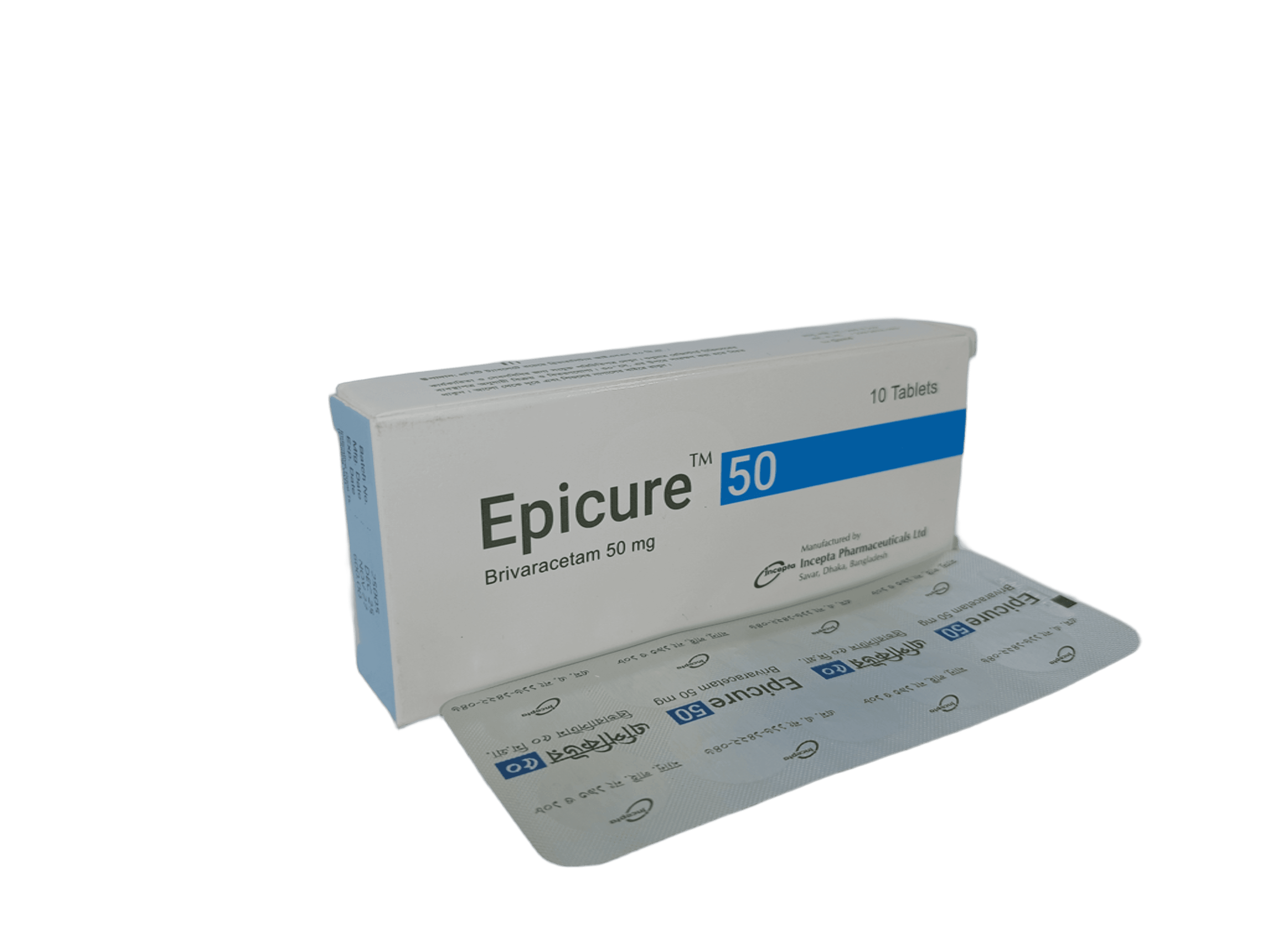

Epicure is a synaptic vesicle protein 2A (SV2A) ligand antiepileptic drug (AED). Its established and evidence-based uses are:
Each Brivaracetam tablet/oral solution/intravenous injection contains Brivaracetam as the active ingredient. It is available in multiple strengths (commonly 10 mg, 25 mg, 50 mg, 75 mg, and 100 mg tablets; 10 mg/mL oral solution; and 10 mg/mL solution for intravenous injection). Tablets also contain standard excipients such as lactose, microcrystalline cellulose, and film-coating agents; formulations may vary by manufacturer.
Epicure is a third-generation antiepileptic drug chemically related to levetiracetam. It works by selectively binding to synaptic vesicle protein 2A (SV2A) in the brain, which is thought to modulate neurotransmitter release and reduce abnormal neuronal excitability that leads to seizures. Epicure is used in the long-term management of partial-onset (focal) seizures, either alone or together with other antiepileptic medicines, and is available as oral tablets, oral solution, and an intravenous formulation for use when oral administration is not feasible.
Epicure belongs to the class of antiepileptic drugs (AEDs), specifically the synaptic vesicle protein 2A (SV2A) ligand class, structurally related to levetiracetam (racetam derivatives).
Brivaracetam exhibits high and selective binding affinity for synaptic vesicle protein 2A (SV2A), a transmembrane glycoprotein present in synaptic vesicles that is believed to participate in vesicle fusion and neurotransmitter release. By binding SV2A, Brivaracetam is thought to modulate synaptic neurotransmitter release and dampen the abnormal, hypersynchronous neuronal firing that underlies seizure activity. Its exact mechanism in the treatment of epilepsy has not been fully established.
Pharmacokinetics: Brivaracetam is rapidly and almost completely absorbed after oral administration (bioavailability ~100%), with peak plasma concentration reached within about 1 hour. It is extensively metabolized in the liver (mainly via hydrolysis and, to a lesser extent, CYP2C19-mediated hydroxylation), with an elimination half-life of approximately 9 hours. It is primarily excreted in the urine as metabolites.
| Indication | Starting dose | Maintenance dose | Maximum dose |
|---|---|---|---|
| Partial-onset seizures (adjunctive or monotherapy) | 50 mg twice daily (100 mg/day) | 25–100 mg twice daily, adjusted based on response and tolerability | 200 mg/day |
| Body weight | Starting dose | Maintenance range |
|---|---|---|
| Less than 11 kg | 0.75 mg/kg twice daily | 0.75–3 mg/kg twice daily |
| 11 kg to less than 20 kg | 0.5 mg/kg twice daily | 0.5–2.5 mg/kg twice daily |
| 20 kg to less than 50 kg | 0.5 mg/kg twice daily | 0.5–2 mg/kg twice daily |
| 50 kg or more | Same as adult dosing | Same as adult dosing |
Epicure tablets and oral solution can be taken with or without food, twice daily. The oral solution should be measured with an appropriate calibrated measuring device. The intravenous form of Epicure is administered by a healthcare professional as a slow injection or infusion over 2–15 minutes.
Epicure has relatively few clinically significant drug interactions compared with older antiepileptic drugs, but the following are well-documented:
Brivaracetam is contraindicated in patients with a known hypersensitivity to Brivaracetam or to any of its formulation excipients.
Common side effects of Epicure (occurring in clinical trials at meaningfully higher rates than placebo) include:
Serious but less common effects requiring prompt medical attention:
Pregnancy: Data on the use of Epicure in pregnant women are limited. As with other antiepileptic drugs, uncontrolled seizures during pregnancy pose risks to both mother and fetus, so Epicure should be used during pregnancy only if the potential benefit of seizure control justifies the potential risk to the fetus, and only under close physician supervision. Discontinuation should not be done without medical advice, as abrupt withdrawal can precipitate seizures. Enrollment in an antiepileptic drug pregnancy registry, where available, is encouraged to help monitor outcomes.
Lactation: Epicure passes into breast milk. A decision should be made whether to discontinue breastfeeding or discontinue the medicine, taking into account the benefit of breastfeeding and the mother's clinical need for Epicure; consult a physician before breastfeeding while using this medicine.
Psychiatric effects: Epicure may cause or worsen irritability, aggression, depression, and, rarely, suicidal thoughts or behavior. Patients and caregivers should be counseled to report any new or worsening mood or behavioral changes promptly (see Side Effects).
CNS depression: Epicure commonly causes somnolence and fatigue, especially at treatment initiation; patients should avoid driving or operating machinery until they know how the medicine affects them, and should use caution with alcohol or other CNS-depressant medicines.
Do not discontinue abruptly: Stopping Epicure suddenly can increase seizure frequency or precipitate status epilepticus; the dose should be tapered gradually under medical supervision unless a serious adverse reaction requires rapid discontinuation.
Hepatic and renal impairment: Dose adjustment of Epicure is recommended in patients with hepatic impairment (see Use in Special Populations); caution is advised in severe renal impairment.
Use exactly as prescribed; do not change the dose or stop Epicure without consulting your physician.
Reported symptoms of Epicure overdose include somnolence and sedation. There is no specific antidote for Epicure overdose. In case of a suspected overdose, seek immediate medical attention or contact a poison control center/emergency services right away. Treatment is supportive and may include general symptomatic and supportive measures; Epicure can be removed by hemodialysis if clinically necessary.
Store at room temperature (below 30°C), away from light and moisture. Keep out of reach of children. Do not freeze the oral solution. Discard any unused oral solution after the period specified on the label (commonly around 5 months after first opening, per the manufacturer's instructions).
Hepatic impairment: Dose reduction of Epicure is recommended in patients with mild, moderate, or severe hepatic impairment; the maximum recommended dose is lower than in patients with normal hepatic function. Consult a physician for individualized dosing.
Renal impairment: No dose adjustment is generally required in mild-to-severe renal impairment; Epicure is not recommended in patients with end-stage renal disease undergoing dialysis due to limited data, and the drug is removed by hemodialysis.
Elderly: No overall differences in safety or effectiveness have been observed between elderly and younger adult patients, but caution is advised given the greater frequency of hepatic, renal, or cardiac impairment and concomitant medication use in this age group.
Pediatric use: see Pediatric Uses.
Epicure is generally used as a long-term, chronic maintenance therapy for epilepsy, and duration of treatment should be determined by the treating physician based on seizure control, tolerability, and overall clinical course. It is not intended for short-term or as-needed use, and should not be discontinued without medical supervision (see Precautions and Warnings).
Antiepileptic drug (AED); synaptic vesicle protein 2A (SV2A) ligand.
Brivaracetam selectively binds to synaptic vesicle protein 2A (SV2A) in the brain, modulating neurotransmitter release from nerve terminals and thereby reducing the abnormal, excessive neuronal firing associated with seizures. The precise mechanism by which SV2A binding translates into an antiepileptic effect has not been fully elucidated.
Epicure is approved for the treatment of partial-onset seizures (as adjunctive therapy or monotherapy) in children 1 month of age and older, with weight-based dosing (see Dosage and Administration). Safety and effectiveness of Epicure in children younger than 1 month of age have not been established. As in adults, pediatric patients and caregivers should be monitored for psychiatric/behavioral changes and somnolence, and the medicine should not be stopped abruptly.
Q: What is Epicure 50 mg Tablet used for?
A: Epicure 50 mg Tablet is used to treat partial-onset (focal) seizures in adults and children 1 month of age and older, usually as an add-on to other antiepileptic medicines, though it can also be used alone.
Q: How should I take Epicure 50 mg Tablet?
A: Epicure 50 mg Tablet tablets or oral solution are usually taken twice daily, with or without food, at the dose prescribed by your physician. Do not change your dose or stop taking Epicure 50 mg Tablet without consulting your doctor, as stopping suddenly can increase the risk of seizures.
Q: What are the common side effects of Epicure 50 mg Tablet?
A: The most common side effects of Epicure 50 mg Tablet are sleepiness (somnolence), dizziness, fatigue, and nausea or vomiting. Some patients may also experience mood or behavior changes such as irritability or agitation, which should be reported to a physician promptly.
Q: Can Epicure 50 mg Tablet be used during pregnancy or breastfeeding?
A: Epicure 50 mg Tablet should be used during pregnancy only if clearly needed, since uncontrolled seizures can also harm mother and baby; discuss the benefits and risks with your physician. Epicure 50 mg Tablet passes into breast milk, so a doctor should be consulted before breastfeeding while taking this medicine.
Q: Who should not take Epicure 50 mg Tablet?
A: Patients with a known allergy (hypersensitivity) to Epicure 50 mg Tablet should not take it. Tell your doctor about all other medical conditions and medicines you take before starting Epicure 50 mg Tablet.
Q: What should I do if I miss a dose or take too much Epicure 50 mg Tablet?
A: If you miss a dose of Epicure 50 mg Tablet, take it as soon as you remember unless it is almost time for your next dose; do not double the dose. If you or someone else has taken too much Epicure 50 mg Tablet, seek immediate medical attention or contact a poison control center.
Disclaimer
The information provided is accurate to the best of our knowledge, but it does not replace professional medical advice. We cannot guarantee its completeness or accuracy, and the absence of specific information about a drug should not be taken as an endorsement. We are not responsible for any consequences arising from this information, so please consult a healthcare professional for any concerns or questions.
