
5% Off
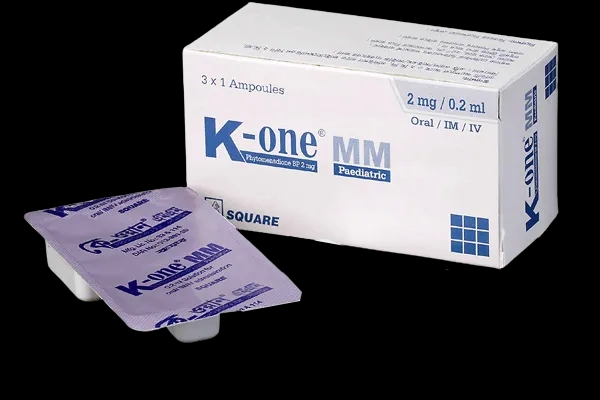
K-One MM2 mg/0.2 m
Square Pharmaceuticals PLC.
৳18.94
Add to cart


Inj. K MM is a fat-soluble vitamin (Vitamin K1) used to prevent and treat bleeding problems that result from low levels of vitamin K-dependent clotting factors.
Use of Inj. K MM should always be guided by a physician, particularly when it is being used to reverse anticoagulation, since this may affect ongoing anticoagulant therapy.
Each formulation of Phytomenadione contains phytomenadione (vitamin K1) as the active ingredient. Common presentations include:
Exact strength and available dosage forms may vary by manufacturer; refer to the specific product label.
Inj. K MM is the pharmaceutical name for phylloquinone, the naturally occurring form of vitamin K found in plants. It is a fat-soluble vitamin that the liver requires to synthesize several proteins essential for normal blood clotting.
Vitamin K deficiency can occur in newborns (whose vitamin K stores are naturally low at birth), in people with fat malabsorption disorders, in those on long-term antibiotics, and in patients who have taken an excessive dose of a vitamin K antagonist anticoagulant such as warfarin. Inj. K MM corrects this deficiency by restoring the vitamin K needed for normal coagulation factor production.
Inj. K MM belongs to the therapeutic class of Vitamin K preparations / antihemorrhagic agents (coagulation factor synthesis-promoting vitamins).
Phytomenadione (vitamin K1) is an essential cofactor for a hepatic carboxylase enzyme that converts specific glutamic acid residues on clotting factors II (prothrombin), VII, IX, and X, as well as the anticoagulant proteins C and S, into their biologically active gamma-carboxyglutamate (Gla) forms.
Without adequate vitamin K, the liver produces non-functional (undercarboxylated) clotting factors, resulting in a bleeding tendency and a prolonged prothrombin time (PT/INR). By supplying vitamin K, Phytomenadione allows the liver to resume synthesis of functional clotting factors, correcting the coagulation defect and, in the context of vitamin K antagonist (e.g., warfarin) therapy, reversing excessive anticoagulation. The onset of effect is not immediate, since it depends on synthesis of new clotting factors: some improvement in coagulation is typically seen within a few hours after oral or parenteral administration, with fuller correction over 12-24 hours.
Dosing of Inj. K MM must be individualized by a physician based on the indication, severity, patient age, and response (guided by PT/INR monitoring where relevant).
| Indication | Typical Adult Dose | Typical Pediatric/Neonatal Dose |
|---|---|---|
| Prevention of hemorrhagic disease of the newborn | Not applicable | Single dose of 0.5-1 mg by intramuscular injection shortly after birth (per pediatric guidance), or an oral regimen if IM injection is declined |
| Treatment of vitamin K deficiency bleeding / hypoprothrombinemia (e.g. malabsorption) | 5-10 mg orally, IM, or SC; repeated based on PT/INR response | Dose individualized by weight and severity, guided by a pediatrician |
| Reversal of excessive warfarin/vitamin K antagonist effect | Dose (typically 1-10 mg, oral or slow IV depending on INR level and presence/severity of bleeding) individualized according to current anticoagulation guidelines and INR | Individualized by a pediatric specialist |
No specific dose adjustment is well established for renal impairment. In significant hepatocellular disease, response to Inj. K MM may be reduced because the liver's capacity to synthesize clotting factors is itself impaired; response should be monitored clinically and with coagulation tests.
Inj. K MM may be given orally, or by intramuscular (IM), subcutaneous (SC), or intravenous (IV) injection, depending on the clinical situation.
Vitamin K antagonist anticoagulants (warfarin and other coumarin derivatives): Inj. K MM directly antagonizes and reverses the anticoagulant effect of these drugs. This is the intended mechanism when Inj. K MM is used to treat excessive anticoagulation or warfarin overdose, but in a patient who needs to remain therapeutically anticoagulated, administration of Inj. K MM will reduce or reverse that needed anticoagulant effect. For this reason, the dose and route of Inj. K MM used for reversal must be carefully individualized (often using the lowest effective dose) so that the patient can be safely re-anticoagulated later if ongoing anticoagulation is still required.
Mineral oil and orlistat (and other agents that reduce fat absorption): may reduce the intestinal absorption of oral Inj. K MM, potentially reducing its effectiveness.
Broad-spectrum antibiotics: prolonged use can reduce vitamin K-producing gut flora and may increase vitamin K requirements or potentiate anticoagulant effects, indirectly affecting the response to Inj. K MM.
Phytomenadione is contraindicated in patients with known hypersensitivity to phytomenadione or to any component of the formulation used.
Most side effects of Inj. K MM are mild and related to the injection site; serious reactions are rare but can occur, particularly with intravenous use.
Inj. K MM (vitamin K1) is generally considered safe for use during pregnancy when clinically indicated, and it is standard practice to give it to newborns immediately after birth to prevent hemorrhagic disease of the newborn. Nonetheless, as with any medicine in pregnancy, Inj. K MM should be used only if clearly needed and the potential benefit justifies any potential risk; use should be under the guidance of a physician.
Inj. K MM is compatible with breastfeeding at recommended doses; it is naturally present in breast milk in small amounts, and maternal or infant supplementation should still be guided by a physician's advice regarding dose and necessity.
Risk of severe reactions with intravenous administration: Rare but serious and occasionally fatal anaphylactoid reactions (resembling anaphylaxis, with flushing, dyspnea, chest pain, hypotension, and cardiovascular collapse) have been reported with intravenous Inj. K MM, particularly following rapid injection. Because of this, the intramuscular, subcutaneous, or oral route should be used whenever clinically appropriate; if the IV route is unavoidable, Inj. K MM must be diluted and given as a slow infusion, with the patient monitored during and after administration.
Hepatic impairment: in patients with significant liver disease, the coagulation defect may not be fully corrected by Inj. K MM because the liver's ability to synthesize clotting factors is itself impaired; response should be assessed with follow-up coagulation testing.
Ongoing anticoagulation needs: in patients who require continued therapeutic anticoagulation, use of Inj. K MM to correct an elevated INR should be dose-individualized to avoid unnecessarily reversing needed anticoagulant therapy (see Interactions).
Repeated high doses in neonates: caution is advised with repeated or excessive dosing in newborns, especially preterm infants, due to a historical association between high vitamin K doses and hyperbilirubinemia.
Overdose or excessive dosing with Inj. K MM is uncommon but may transiently interfere with the effectiveness of vitamin K antagonist anticoagulants (making a patient resistant to re-anticoagulation for some time) and, in neonates, has been associated with a risk of hyperbilirubinemia. Symptoms of a serious reaction (particularly after IV use) may include flushing, breathing difficulty, chest tightness, or a drop in blood pressure.
If an overdose or a serious reaction is suspected, seek immediate medical attention or contact a poison control center/emergency services right away. Do not attempt to manage a suspected overdose or severe reaction at home.
Store at room temperature (below 30°C), protected from light and moisture, as Inj. K MM is a light-sensitive compound. Keep out of reach of children.
Neonates/Infants: Inj. K MM is standard of care for prevention of hemorrhagic disease of the newborn, given as a single dose shortly after birth per pediatric guidelines; treatment doses for bleeding are individualized by weight.
Children: dosing is individualized based on age, weight, and severity of vitamin K deficiency or bleeding, under pediatric supervision.
Elderly: no specific dose adjustment is established based on age alone, but elderly patients on anticoagulant therapy should have their dose individualized carefully and their coagulation status monitored.
Hepatic impairment: response may be reduced; see Precautions and Warnings.
Renal impairment: no well-established dose adjustment is required.
For prevention of hemorrhagic disease of the newborn, Inj. K MM is typically given as a single dose at birth. For treatment of bleeding due to vitamin K deficiency or anticoagulant reversal, treatment duration and repeat dosing are guided by clinical response and coagulation test results (PT/INR), and may range from a single dose to several days of therapy. For chronic malabsorption-related deficiency, longer-term or repeated dosing may be required as directed by a physician.
Phytomenadione belongs to the drug class of Vitamin K1 (phylloquinone) preparations, also categorized under antihemorrhagic/hemostatic vitamins.
Phytomenadione acts as an essential cofactor for the hepatic enzyme gamma-glutamyl carboxylase, which converts inactive precursor clotting factors II, VII, IX, and X (and proteins C and S) into their active, gamma-carboxylated forms capable of binding calcium and participating in the coagulation cascade. By replenishing vitamin K, Phytomenadione restores the liver's ability to produce functional clotting factors, correcting bleeding tendencies caused by vitamin K deficiency or by vitamin K antagonist drugs.
C
Inj. K MM is well established and widely recommended for routine prophylaxis of hemorrhagic disease of the newborn, given as a single intramuscular dose (typically 0.5-1 mg) shortly after birth, per pediatric society guidance.
For treatment of vitamin K deficiency bleeding beyond the neonatal period, dosing of Inj. K MM is individualized by a pediatrician based on the child's weight, age, and severity of the bleeding tendency. Safety and efficacy of repeated high-dose use in preterm or very low birth weight infants require particular caution due to the historical association between high vitamin K doses and hyperbilirubinemia in this population.
Q: What is Inj. K MM 2 mg/0.2 ml Injection used for?
A: Inj. K MM 2 mg/0.2 ml Injection (vitamin K1) is used to prevent and treat bleeding problems caused by low vitamin K levels, including hemorrhagic disease of the newborn and bleeding due to vitamin K deficiency or an overdose of warfarin-type anticoagulants.
Q: Why do newborns receive Inj. K MM 2 mg/0.2 ml Injection at birth?
A: Newborns have naturally low vitamin K stores and are at risk of serious bleeding (hemorrhagic disease of the newborn). A single dose of Inj. K MM 2 mg/0.2 ml Injection, usually given by injection shortly after birth, is a well-established preventive measure recommended by pediatric guidelines.
Q: Is intravenous Inj. K MM 2 mg/0.2 ml Injection safe?
A: Intravenous Inj. K MM 2 mg/0.2 ml Injection carries a rare but serious risk of severe allergic-type (anaphylactoid) reactions, especially if injected quickly. For this reason, oral, intramuscular, or subcutaneous routes are preferred when possible, and any necessary IV dose must be given slowly by a healthcare professional, with monitoring.
Q: Can Inj. K MM 2 mg/0.2 ml Injection be used with warfarin?
A: Inj. K MM 2 mg/0.2 ml Injection is often used specifically to reverse excessive warfarin effect (high INR or bleeding). However, if a patient still needs to be anticoagulated, Inj. K MM 2 mg/0.2 ml Injection can reduce or reverse that needed effect, so the dose must be carefully individualized by a physician.
Q: Is Inj. K MM 2 mg/0.2 ml Injection safe in pregnancy and breastfeeding?
A: Inj. K MM 2 mg/0.2 ml Injection is generally considered safe in pregnancy and breastfeeding when used as directed, and is routinely given to newborns at birth. Even so, it should be used only under a physician's guidance regarding the right dose and necessity.
Q: What should I do if I suspect an overdose or a severe reaction to Inj. K MM 2 mg/0.2 ml Injection?
A: Seek immediate medical attention or contact emergency services/poison control right away. Do not try to manage a suspected overdose or a severe reaction (such as difficulty breathing or a sudden drop in blood pressure) at home.
Disclaimer
The information provided is accurate to the best of our knowledge, but it does not replace professional medical advice. We cannot guarantee its completeness or accuracy, and the absence of specific information about a drug should not be taken as an endorsement. We are not responsible for any consequences arising from this information, so please consult a healthcare professional for any concerns or questions.

