
10% Off
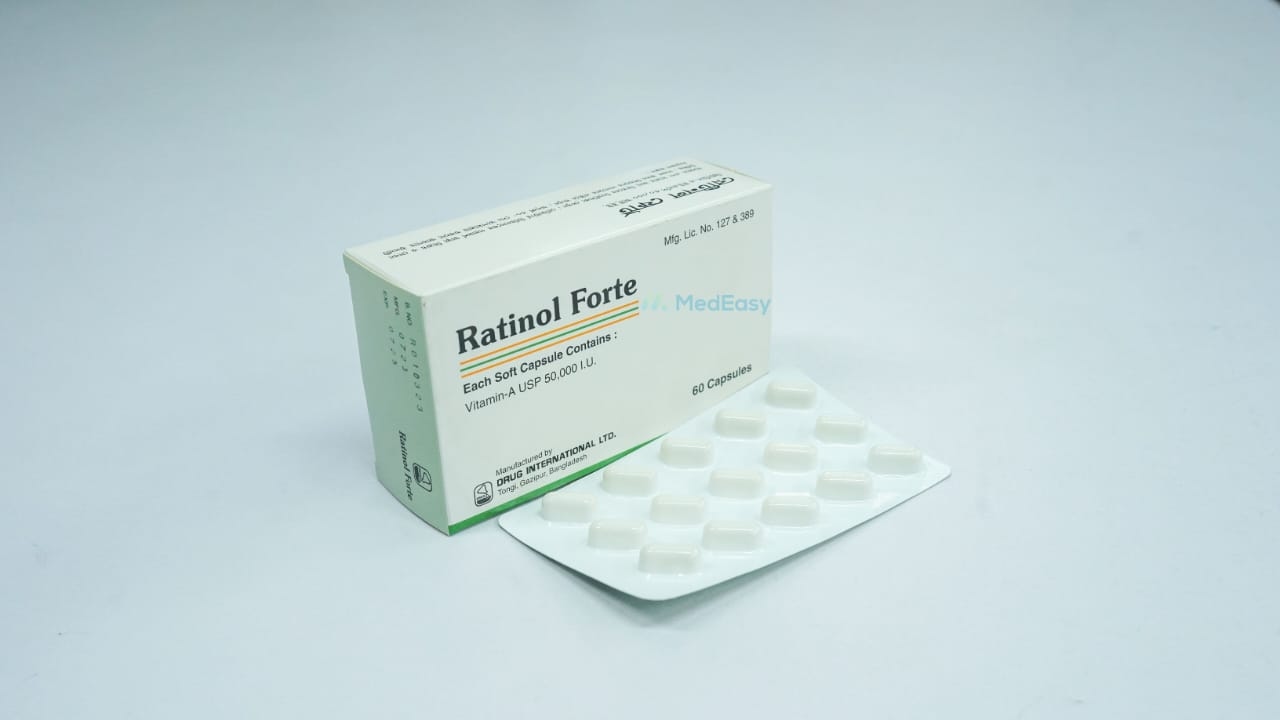
Ratinol Forte50000 IU
Drug International Ltd.
৳1.74
Add to cart


Ovit-A is a fat-soluble vitamin essential for normal vision, immune function, reproduction, and the health of epithelial (skin and mucous membrane) tissue. Its indications can be classified by strength of evidence as follows:
Ovit-A is not indicated for general health maintenance at doses above the Recommended Dietary Allowance (RDA) in people who are not deficient, as excess intake carries risk of toxicity (see Overdose and Precautions).
Each capsule/tablet of Vitamin A typically contains Vitamin A as retinyl (retinol) palmitate or retinyl acetate, labeled in International Units (IU) or micrograms of Retinol Activity Equivalents (RAE). Common oral strengths include 10,000 IU, 25,000 IU, 50,000 IU, and 200,000 IU capsules; oral solution and injectable forms are also available in some markets. Exact strength and excipients vary by manufacturer and formulation.
Ovit-A is a fat-soluble micronutrient belonging to the retinoid family, naturally occurring in preformed form (retinol, retinyl esters) in animal-derived foods and as provitamin A carotenoids (e.g., beta-carotene) in plant-derived foods. It is essential for the visual cycle (formation of rhodopsin in the retina), maintenance and differentiation of epithelial tissue, immune system function, and reproduction and fetal development. Ovit-A is used therapeutically to prevent and treat deficiency states and their complications, particularly in populations with limited dietary access to Ovit-A-rich foods.
Fat-soluble vitamin; Ovit-A and derivatives (retinoids) — nutritional supplement / anti-xerophthalmic vitamin.
Vitamin A is absorbed in the small intestine, esterified, and transported via chylomicrons to the liver, where it is stored primarily as retinyl esters. It is mobilized as needed and transported in circulation bound to retinol-binding protein (RBP) and transthyretin. Active metabolites include 11-cis-retinal, which combines with opsin to form rhodopsin in retinal rod cells and is essential for vision in low-light conditions, and all-trans-retinoic acid, which acts on nuclear retinoic acid receptors (RAR) and retinoid X receptors (RXR) to regulate gene transcription involved in epithelial cell growth, differentiation, and immune function. Deficiency impairs dark adaptation (night blindness), leads to keratinization and dryness of epithelial surfaces (xerophthalmia, corneal damage), and increases susceptibility to infection. Vitamin A is metabolized in the liver and excreted mainly via bile into feces, with a small amount excreted in urine; it accumulates in hepatic stores with chronic excessive intake.
Dosing of Ovit-A is individualized by indication, age, and severity of deficiency; high-dose deficiency-treatment regimens are far higher than routine dietary supplementation doses and should not be self-administered without medical or public-health program guidance.
| Indication | Population | Typical Dose |
|---|---|---|
| Ovit-A deficiency (dietary/malabsorptive) | Adults | 10,000–50,000 IU orally per day for 1–2 weeks, then a maintenance dose, guided by clinical and biochemical response |
| Xerophthalmia / severe deficiency | Adults and children ≥1 year | 200,000 IU orally on day 1, day 2, and again at 2–4 weeks (WHO treatment schedule), or as directed by a physician |
| Xerophthalmia / severe deficiency | Infants 6–12 months | 100,000 IU on day 1, day 2, and at 2–4 weeks |
| Periodic prophylactic supplementation (endemic deficiency areas) | Children 6–11 months | 100,000 IU orally as a single dose every 4–6 months (WHO/national program schedule) |
| Periodic prophylactic supplementation (endemic deficiency areas) | Children 12–59 months | 200,000 IU orally as a single dose every 4–6 months (WHO/national program schedule) |
| Measles, adjunct (deficient populations) | Children, age-based | 50,000–200,000 IU orally on day 1 and day 2, per age-based WHO schedule |
Doses should be taken orally, generally with a meal containing some fat to enhance absorption, unless a physician or specific product labeling directs otherwise. Renal or hepatic impairment: use with caution and reduce dose/frequency in significant hepatic impairment, as the liver stores and metabolizes Ovit-A; no well-established fixed renal dose adjustment exists, but caution is warranted as toxicity risk may be altered.
Ovit-A capsules/tablets are taken orally, preferably with a meal containing fat to aid absorption. Oral solution/drops should be measured with the provided dosing device. Injectable Ovit-A (where available) is administered intramuscularly by a healthcare professional. Do not exceed the dose or frequency advised by a physician or public-health program.
Ovit-A has the following well-verified, clinically significant interactions:
Vitamin A is contraindicated in:
High-dose supplemental Vitamin A should not be given to pregnant women beyond the recommended dietary allowance except under direct medical supervision, due to teratogenic risk (see Pregnancy and Lactation).
At recommended doses, Ovit-A is generally well tolerated. Side effects are primarily associated with excessive or prolonged high-dose intake (hypervitaminosis A) and may include:
Report severe headache, visual changes, persistent vomiting, or yellowing of skin/eyes to a physician promptly.
Pregnancy: Ovit-A is essential for normal fetal development at recommended dietary intake levels, but excessive intake — particularly of preformed Ovit-A above approximately 10,000 IU/day, and especially in the first trimester — is teratogenic and has been associated with congenital malformations. Pregnant women should not take high-dose Ovit-A supplements beyond the recommended dietary allowance unless a physician determines it is clearly needed and that the potential benefit justifies the potential risk to the fetus; use only under medical supervision and consult a physician before use in pregnancy.
Lactation: Ovit-A at recommended maternal intake levels is compatible with breastfeeding and supports infant Ovit-A status via breast milk. High-dose supplementation of breastfeeding mothers should follow physician or public-health program guidance rather than self-directed high-dose use.
Ovit-A requires caution in the following situations:
Acute overdose of Ovit-A can cause nausea, vomiting, severe headache, dizziness, blurred vision, irritability, and drowsiness, and in infants may cause bulging fontanelle. Chronic excessive intake (hypervitaminosis A) can cause more serious effects including intracranial hypertension, liver damage, and bone abnormalities. If overdose of Ovit-A is suspected, seek immediate medical attention or contact a poison control center/emergency services; do not attempt specific home treatment. Management is generally supportive, with discontinuation of Ovit-A and monitoring under medical care.
Store at room temperature (below 30°C), away from light and moisture. Keep out of reach of children.
Pediatric use: Ovit-A is used in infants and children for deficiency prevention and treatment, and for periodic high-dose prophylaxis in endemic-deficiency settings, following WHO/national program age- and weight-based schedules; high-dose regimens should be administered under medical or public-health program supervision, not self-directed.
Elderly: Use recommended dietary allowance doses; elderly patients may have reduced hepatic clearance and altered Ovit-A metabolism, so avoid unsupervised high-dose use.
Hepatic impairment: Use with caution; the liver is the primary storage and metabolism site for Ovit-A, and impaired hepatic function increases toxicity risk — dose reduction or closer monitoring may be needed.
Renal impairment: No well-established specific dose adjustment; use with general caution and medical guidance.
Duration depends on indication: routine deficiency correction is typically continued for 1–2 weeks followed by maintenance dosing based on clinical response; high-dose xerophthalmia treatment follows a short fixed schedule (day 1, day 2, and 2–4 weeks); periodic prophylactic supplementation is repeated every 4–6 months per program guidance. Do not continue high-dose Ovit-A beyond the directed course without medical reassessment.
Fat-soluble vitamins; Retinoids; Anti-xerophthalmic vitamins.
Vitamin A (as retinol and its active metabolites, 11-cis-retinal and all-trans-retinoic acid) supports vision by forming rhodopsin in retinal photoreceptors, and regulates epithelial cell growth, differentiation, and immune function by binding nuclear retinoic acid receptors (RAR) and retinoid X receptors (RXR) that control transcription of genes involved in cell maturation and mucosal/epithelial integrity.
Category A at recommended dietary allowance doses; Category X at doses above the recommended dietary allowance (FDA legacy pregnancy category system, reflecting the dose-dependent risk of Ovit-A).
Ovit-A is used in infants (from 6 months) and children for prevention and treatment of deficiency, xerophthalmia, and as periodic prophylaxis in endemic-deficiency areas, following WHO age-based dosing schedules (e.g., 100,000 IU for infants 6–12 months and 200,000 IU for children 12–59 months). Use in infants under 6 months and any high-dose regimen should be guided by a physician or public-health program; safety and efficacy of high-dose regimens outside these established schedules have not been separately established.
Q: What is Ovit-A 50000 IU Capsule used for?
A: Ovit-A 50000 IU Capsule is used to prevent and treat Ovit-A 50000 IU Capsule deficiency, night blindness, and xerophthalmia, and as periodic supplementation in children in areas where deficiency is common. It is also used as an adjunct in measles management in deficient populations, per WHO guidance.
Q: Can I take Ovit-A 50000 IU Capsule during pregnancy?
A: Ovit-A 50000 IU Capsule at normal dietary/recommended intake levels is needed during pregnancy, but high-dose supplements above the recommended dietary allowance can cause birth defects, especially in early pregnancy. Do not take high-dose Ovit-A 50000 IU Capsule during pregnancy unless your physician has specifically advised it and determined that the benefit outweighs the risk.
Q: What happens if I take too much Ovit-A 50000 IU Capsule?
A: Taking too much Ovit-A 50000 IU Capsule can cause nausea, headache, dizziness, blurred vision, and, with chronic excess, liver damage, bone problems, and increased pressure in the brain (intracranial hypertension). If you suspect an overdose of Ovit-A 50000 IU Capsule, seek immediate medical attention or contact emergency/poison control services.
Q: Can I take Ovit-A 50000 IU Capsule with isotretinoin or other acne medicines?
A: No. Combining supplemental Ovit-A 50000 IU Capsule with retinoid medicines such as isotretinoin or acitretin increases the risk of Ovit-A 50000 IU Capsule toxicity. Tell your doctor about all supplements you take before starting a retinoid medication.
Q: Is Ovit-A 50000 IU Capsule safe for children?
A: Yes, when dosed appropriately for age and used to prevent or treat deficiency — Ovit-A 50000 IU Capsule is part of WHO-recommended child supplementation programs from 6 months of age. However, high doses should only be given following the recommended age-based schedule, as excess Ovit-A 50000 IU Capsule can be harmful to children.
Q: How should I store Ovit-A 50000 IU Capsule?
A: Store Ovit-A 50000 IU Capsule at room temperature (below 30°C), away from light and moisture, and keep it out of reach of children.
Disclaimer
The information provided is accurate to the best of our knowledge, but it does not replace professional medical advice. We cannot guarantee its completeness or accuracy, and the absence of specific information about a drug should not be taken as an endorsement. We are not responsible for any consequences arising from this information, so please consult a healthcare professional for any concerns or questions.

