
10% Off
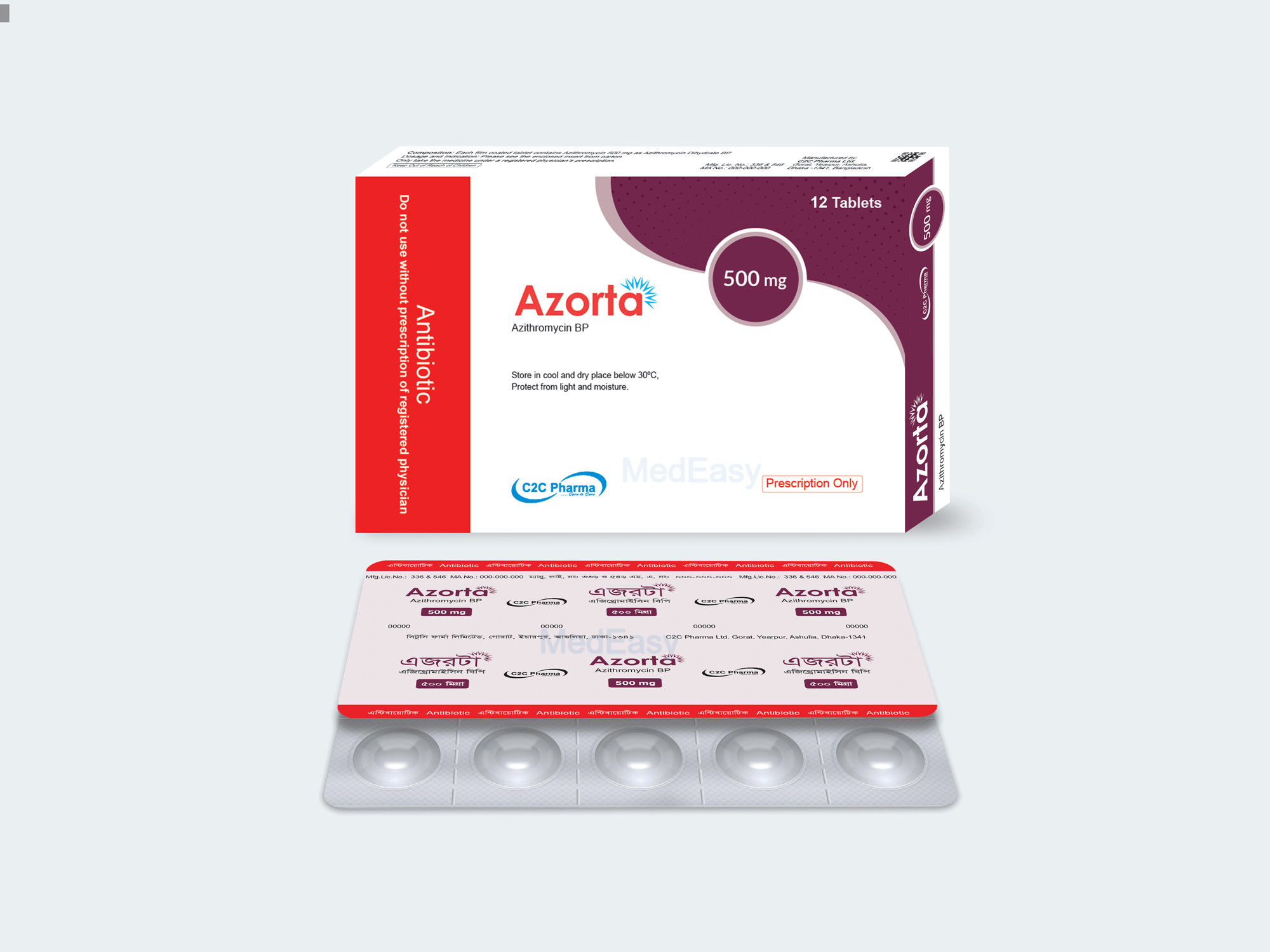
Azorta500 mg
C2C Pharma
৳189.00
Add to cart
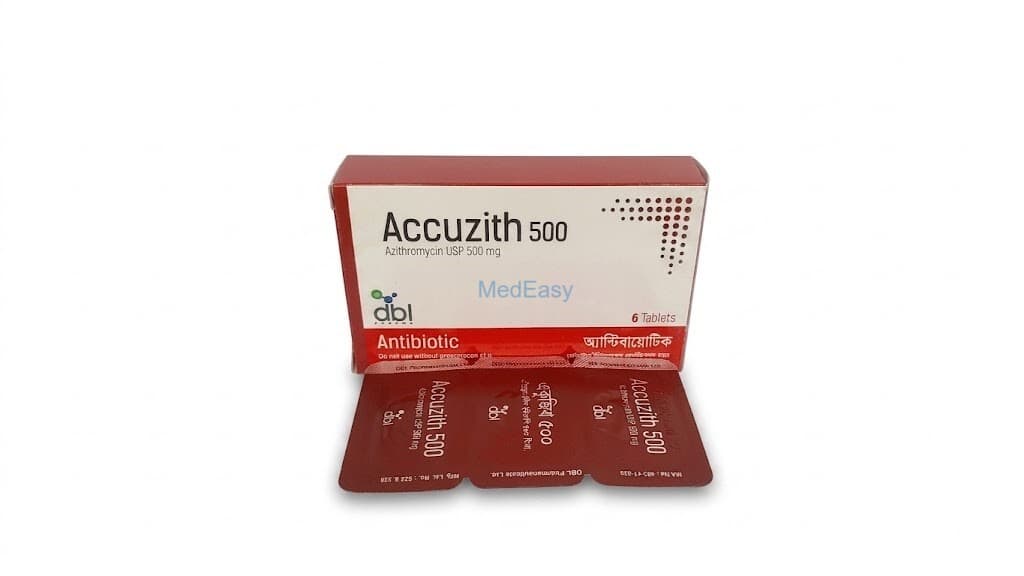
Accuzith 500 mg Tablet is available on MedEasy for ৳165.00 per 3's Strip, with home delivery anywhere in Bangladesh. It is manufactured by DBL Pharmaceuticals Ltd. Its generic name is Azithromycin Dihydrate.

Accuzith is a broad-spectrum macrolide (azalide) antibiotic used to treat a range of bacterial infections caused by susceptible organisms. Indications vary by strength of clinical evidence:
Accuzith is not appropriate for infections known or strongly suspected to be viral in origin, and its use should be guided by local susceptibility patterns and clinical judgment.
Each formulation of Azithromycin Dihydrate contains azithromycin (as the dihydrate salt) as the active ingredient. It is commercially available in several dosage forms and strengths, including:
Exact strengths and available presentations of Azithromycin Dihydrate vary by manufacturer and market; check the product label for the specific formulation dispensed.
Accuzith is a semi-synthetic macrolide antibiotic belonging to the azalide subclass, structurally derived from erythromycin. It was developed to improve acid stability, tissue penetration, and dosing convenience compared with older macrolides.
Accuzith is widely used because of its long tissue half-life, which allows short-course (typically 3-day) or single-loading-dose, once-daily regimens with good patient compliance. It is active against a broad range of Gram-positive and Gram-negative bacteria, as well as certain atypical organisms such as Chlamydia trachomatis, Mycoplasma pneumoniae, and Legionella pneumophila.
Macrolide antibiotic (azalide subclass) — systemic antibacterial agent. Accuzith belongs to this therapeutic class.
Azithromycin Dihydrate inhibits bacterial protein synthesis by binding to the 50S ribosomal subunit (23S rRNA), blocking translocation of peptides during translation and interfering with the assembly of new ribosomal subunits. Depending on the organism and concentration, its action is generally bacteriostatic, though it can be bactericidal against some pathogens at higher concentrations.
The dose and duration of Accuzith depend on the specific infection being treated, the patient's age and weight, and local susceptibility patterns. See the "Dosage" and "Administration" sections below for indication-specific details.
Important: Take Accuzith exactly as prescribed by your physician. Do not stop, extend, skip doses, or share this medicine with others without medical advice, even if symptoms improve before the course is finished, as incomplete courses may lead to treatment failure and contribute to antibiotic resistance.
Accuzith has fewer clinically significant drug interactions than older macrolides (e.g., erythromycin, clarithromycin) because it has minimal effect on the CYP3A4 enzyme system, but important interactions still exist:
Azithromycin Dihydrate is contraindicated in patients with:
Most side effects of Accuzith are mild and gastrointestinal, and it is generally better tolerated than older macrolides such as erythromycin.
Contact your physician if any side effect is severe, persistent, or if you notice signs of an allergic reaction, unusual heartbeat, dark urine, yellowing of the skin/eyes, or severe/persistent diarrhea while taking Accuzith.
Available human data from decades of use of Accuzith have not shown a clear increased risk of major birth defects or miscarriage, and animal reproduction studies have not shown fetal harm. However, Accuzith should be used during pregnancy only if clearly needed and if the potential benefit justifies the potential risk to the fetus. Consult a physician before use during pregnancy.
Accuzith passes into breast milk and may be detectable for an extended period after dosing. Non-serious effects such as diarrhea, vomiting, or rash have been reported in breastfed infants. A physician should be consulted to weigh the benefits of breastfeeding against the possible exposure of the infant, and the infant should be monitored for gastrointestinal symptoms or rash if the mother is taking Accuzith.
Symptoms of Accuzith overdose are generally similar to, but more pronounced than, common side effects, and may include severe nausea, vomiting, diarrhea, and transient hearing impairment. In case of a suspected overdose, seek immediate medical attention or contact a poison control center/emergency services right away. Do not attempt to manage an overdose at home. Management is generally supportive and symptomatic, guided by a healthcare professional; there is no specific antidote for Accuzith overdose.
Store Accuzith at room temperature (below 30°C), away from light and moisture. Keep out of reach of children. Reconstituted oral suspension should be stored as directed on the label (typically at room temperature, away from direct heat) and any unused portion discarded after the period specified by the manufacturer (commonly 10 days).
No dosage adjustment of Accuzith is generally required in mild to moderate renal impairment. Use with caution in patients with severe renal impairment (GFR less than 10 mL/min), as increased systemic exposure has been observed; consult a physician for individualized dosing.
Pharmacokinetics of Accuzith have not been well established in significant hepatic impairment. Use with caution and clinical monitoring; contraindicated in patients with a history of cholestatic jaundice/hepatic dysfunction associated with prior azithromycin use (see Contraindications).
No dosage adjustment is generally required based on age alone, but elderly patients may be more susceptible to QT-interval prolongation and should be monitored accordingly, especially if other risk factors or interacting drugs are present.
See Pediatric Uses for age-specific approved indications and weight-based dosing.
Duration of treatment with Accuzith depends on the indication and typically ranges from a single dose (e.g., for chlamydial urethritis/cervicitis or chancroid) to 3-5 days (e.g., for respiratory tract or skin infections), owing to the drug's long tissue half-life. Some regimens use a single higher loading dose on Day 1 followed by a lower daily dose for several days. The exact duration should be determined by the prescribing physician based on the specific infection, and the full course of Accuzith should always be completed as directed.
For the powder-for-oral-suspension formulation of Accuzith, reconstitute by adding the specified amount of water indicated on the bottle label to the dry powder, then shake well until a uniform suspension forms. Use only the water volume specified for the particular pack size/strength. Once reconstituted, shake well before each dose, use an accurate oral dosing syringe or spoon (not a household spoon), and discard any unused suspension after the period stated on the label (commonly 10 days), storing it as directed (generally at room temperature, away from direct heat and moisture) in the interim. For the powder-for-injection formulation, reconstitution and dilution are performed only by trained healthcare personnel following the manufacturer's instructions for intravenous administration.
Antibacterials; Macrolides; Azalides. Azithromycin Dihydrate is classified within these drug classes.
Azithromycin Dihydrate exerts its antibacterial effect by binding reversibly to the 50S ribosomal subunit of susceptible bacteria, specifically interacting with the 23S ribosomal RNA. This binding inhibits the translocation step of protein synthesis and blocks the formation of new 50S ribosomal subunits, thereby suppressing bacterial protein production. The overall effect is primarily bacteriostatic, although bactericidal activity can occur against certain organisms at higher local concentrations, particularly given the drug's extensive intracellular and tissue accumulation.
B (FDA legacy pregnancy category; current U.S. labeling has transitioned to a narrative risk summary under the Pregnancy and Lactation Labeling Rule)
Safety and effectiveness of Accuzith have been established for specific indications and age groups:
Safety and efficacy of Accuzith in infants younger than 6 months have not been established for these indications. Dosing in children is weight-based (mg/kg) and must be calculated and prescribed by a physician; do not exceed the maximum adult dose. If a child vomits shortly after a single large loading dose, re-dosing safety has not been established, and a physician should be consulted before giving a repeat dose.
Q: What is Accuzith 500 mg Tablet used for?
A: Accuzith 500 mg Tablet is a macrolide antibiotic used to treat bacterial infections such as respiratory tract infections (bronchitis, sinusitis, community-acquired pneumonia), throat infections, skin and soft tissue infections, and certain sexually transmitted infections such as chlamydial urethritis/cervicitis. It works only against bacterial infections, not viral illnesses like the common cold or flu.
Q: How should I take Accuzith 500 mg Tablet?
A: Take Accuzith 500 mg Tablet exactly as prescribed by your physician, with or without food. Swallow tablets/capsules whole, or shake the oral suspension well and measure the dose accurately. Complete the entire prescribed course; do not stop, extend, skip doses, or share this medicine with others without medical advice, even if you start feeling better before finishing it.
Q: Can Accuzith 500 mg Tablet be taken during pregnancy or while breastfeeding?
A: Accuzith 500 mg Tablet should be used during pregnancy only if clearly needed and if the potential benefit justifies the potential risk to the fetus; consult your physician first. It also passes into breast milk, so a physician should be consulted to weigh the benefits of breastfeeding against possible mild effects (such as diarrhea, vomiting, or rash) in the infant, who should be monitored if the mother is taking Accuzith 500 mg Tablet.
Q: What are the common side effects of Accuzith 500 mg Tablet?
A: The most common side effects of Accuzith 500 mg Tablet are gastrointestinal, including diarrhea, nausea, abdominal pain, and vomiting. These are usually mild and temporary. Rare but serious effects include severe allergic reactions, liver problems, irregular heartbeat (QT prolongation), and severe diarrhea caused by Clostridioides difficile infection — seek medical attention promptly if these occur.
Q: Who should not take Accuzith 500 mg Tablet?
A: Accuzith 500 mg Tablet should not be taken by people with known hypersensitivity to azithromycin, erythromycin, or any macrolide/ketolide antibiotic, or by those who previously developed cholestatic jaundice or liver dysfunction after taking Accuzith 500 mg Tablet. Inform your physician about any heart rhythm problems, liver disease, or myasthenia gravis before starting treatment, as extra caution is needed in these situations.
Q: What should I do if I miss a dose or take too much Accuzith 500 mg Tablet?
A: If you miss a dose of Accuzith 500 mg Tablet, take it as soon as you remember unless it is nearly time for your next dose — do not double the dose. If you or someone else has taken more than the prescribed amount of Accuzith 500 mg Tablet, seek immediate medical attention or contact a poison control center/emergency services right away rather than trying to manage it at home.
Disclaimer
The information provided is accurate to the best of our knowledge, but it does not replace professional medical advice. We cannot guarantee its completeness or accuracy, and the absence of specific information about a drug should not be taken as an endorsement. We are not responsible for any consequences arising from this information, so please consult a healthcare professional for any concerns or questions.