
10% Off
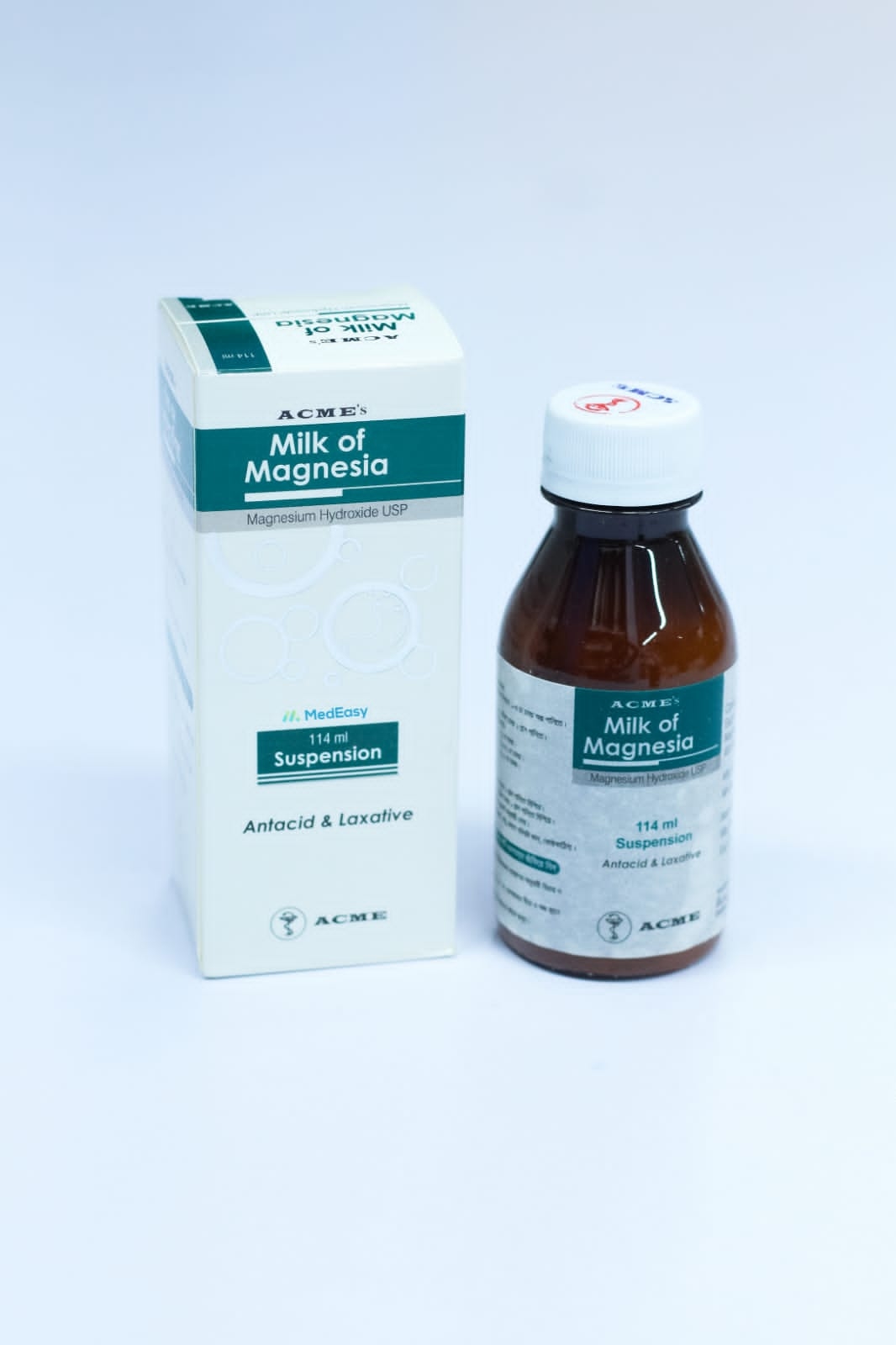
Milk Of Magnesia114 ml
ACME Laboratories Ltd.
৳59.40
Add to cart


Acme's Milk of Magnesia is indicated for:
Acme's Milk of Magnesia is intended for short-term, occasional use for either indication rather than long-term daily therapy.
Each formulation of Magnesium Hydroxide contains magnesium hydroxide as the active ingredient, available as an oral suspension (commonly 400 mg/5 mL), chewable tablets (commonly around 311-622 mg), or caplets. Strength varies by brand and dosage form; refer to the product label for the exact concentration.
Acme's Milk of Magnesia is an inorganic compound that functions as both an antacid and a saline (osmotic) laxative. As an antacid, it neutralizes stomach acid directly. As a laxative, poorly absorbed magnesium ions draw water into the intestinal lumen by osmosis, softening stool and stimulating bowel movement.
Acme's Milk of Magnesia is available over-the-counter in oral suspension, chewable tablet, and caplet forms and is widely used both in Bangladesh and internationally.
Acme's Milk of Magnesia belongs to the therapeutic classes of antacids and saline (osmotic) laxatives.
Mechanism (antacid): Magnesium Hydroxide reacts chemically with hydrochloric acid in the stomach to form magnesium chloride and water, neutralizing gastric acid and raising gastric pH, which relieves symptoms of heartburn and acid indigestion.
Mechanism (laxative): Magnesium ions are poorly absorbed from the gastrointestinal tract. The osmotic effect of unabsorbed magnesium ions draws water into the small and large intestine, increasing intraluminal volume, softening stool, and promoting peristalsis and bowel evacuation, usually within 30 minutes to 6 hours.
A small fraction of ingested magnesium (roughly 15-30%) is absorbed systemically and is excreted renally in patients with normal kidney function; impaired renal clearance can lead to magnesium accumulation.
| Population | Dose |
|---|---|
| Adults and children 12 years and older | Usual oral suspension dose is 5-15 mL (or per product labeling), up to 4 times daily as needed, or as directed by a physician. |
| Children under 12 years | Consult a physician before use. |
| Population | Dose |
|---|---|
| Adults and children 12 years and older | 30-60 mL of oral suspension (400 mg/5 mL), usually taken once daily, preferably at bedtime or with a full glass of water/liquid. |
| Children 6-11 years | 15-30 mL of oral suspension, under adult supervision. |
| Children 2-5 years | 5-15 mL of oral suspension, only on the advice of a physician. |
| Children under 2 years | Use only on the advice of a physician. |
Shake the oral suspension well before each use. Do not use as a laxative for more than 1 week, and do not use as an antacid for more than 2 weeks, without consulting a physician.
Acme's Milk of Magnesia oral suspension should be shaken well before each use. It may be taken with a small amount of water or fruit juice to improve palatability if needed, and may be taken with or without food. Chewable tablets should be chewed thoroughly before swallowing and can be followed with a glass of water or milk. When used as an antacid, doses may be taken after meals and at bedtime as needed for symptom relief.
Acme's Milk of Magnesia raises gastric pH and provides poorly-absorbed magnesium ions, which can significantly reduce the absorption and effectiveness of several medicines if taken together. Clinically significant interactions include:
As a general precaution, other oral medications should be taken at least 2 hours before or after Acme's Milk of Magnesia unless a physician or pharmacist advises otherwise.
Magnesium Hydroxide is contraindicated in patients with:
Common side effects of Acme's Milk of Magnesia, especially at laxative doses, include:
Hypermagnesemia: Excessive or prolonged use of Acme's Milk of Magnesia, or use in patients with impaired renal function, can lead to elevated blood magnesium levels. Symptoms range from mild (nausea, lethargy, facial flushing) to severe (muscle weakness, hypotension, cardiac arrhythmia, respiratory depression), particularly in patients with renal impairment. This is a genuine, well-established safety concern requiring caution — see Contraindications and Precautions.
Acme's Milk of Magnesia is generally considered acceptable for occasional use during pregnancy for both antacid and laxative indications, as systemic absorption of magnesium is minimal in patients with normal renal function. However, Acme's Milk of Magnesia should be used only if clearly needed, and regular or prolonged use during pregnancy should only occur under medical supervision, as excessive magnesium intake close to delivery has rarely been associated with neonatal effects. Acme's Milk of Magnesia is generally considered compatible with breastfeeding at recommended doses, as minimal magnesium is transferred into breast milk relative to normal dietary intake. Pregnant or breastfeeding women should consult a physician before regular or prolonged use.
Use Acme's Milk of Magnesia with caution in the following situations:
Overdose or excessive use of Acme's Milk of Magnesia may cause severe diarrhea, dehydration, electrolyte imbalance, and hypermagnesemia, which can present as muscle weakness, low blood pressure, slowed heart rate, confusion, or in severe cases, respiratory depression and cardiac arrhythmia, particularly in patients with renal impairment. If overdose is suspected, seek immediate medical attention or contact a poison control center right away. Do not attempt specific home treatment; supportive care and medical evaluation are required.
Store at room temperature (below 30°C), away from light and moisture. Shake the oral suspension well before use and do not allow it to freeze. Keep out of reach of children.
Pediatric use: Acme's Milk of Magnesia as a laxative may be used in children 2 years and older at age-appropriate doses (see Dosage and Administration); use in children under 2 years should only be under a physician's direction. Use as an antacid in children under 12 years should be guided by a physician, as safety and efficacy for self-directed antacid use in young children have not been well established.
Elderly: Older adults, who more commonly have age-related decline in renal function, are at higher risk of hypermagnesemia and should use Acme's Milk of Magnesia cautiously, generally avoiding regular or prolonged use without medical supervision.
Renal impairment: See Contraindications and Precautions — regular use is not recommended in significant renal impairment.
Hepatic impairment: No well-established dose adjustment is required, as Acme's Milk of Magnesia is not significantly hepatically metabolized.
Acme's Milk of Magnesia is intended for short-term, occasional use. As a laxative, it should not be used for more than 1 week continuously. As an antacid, it should not be used for more than 2 weeks continuously. If symptoms persist beyond these periods or recur frequently, a physician should be consulted to evaluate for an underlying condition.
Antacid; Saline (Osmotic) Laxative
Magnesium Hydroxide acts as a base that neutralizes gastric hydrochloric acid (antacid effect) and, when insufficiently absorbed in the gut, exerts an osmotic effect that draws water into the intestinal lumen to soften stool and stimulate bowel movement (laxative effect). Both actions arise from the same poorly-absorbed magnesium hydroxide molecule acting at different sites and doses.
Acme's Milk of Magnesia may be used as a laxative in children 2 years of age and older at weight/age-appropriate doses under adult supervision (see Dosage and Administration table). Use in children younger than 2 years should occur only on the advice of a physician. For antacid use in children under 12 years, safety and efficacy of self-directed use have not been well established, and a physician should be consulted before use.
Q: What is Acme's Milk of Magnesia 114 ml Oral Suspension used for?
A: Acme's Milk of Magnesia 114 ml Oral Suspension is used as an antacid to relieve occasional heartburn, acid indigestion, and upset stomach, and as a laxative to relieve occasional constipation, depending on the dose used.
Q: How long can I take Acme's Milk of Magnesia 114 ml Oral Suspension?
A: Acme's Milk of Magnesia 114 ml Oral Suspension is meant for short-term, occasional use. Do not use it as a laxative for more than 1 week or as an antacid for more than 2 weeks without consulting a physician, as prolonged use can mask an underlying condition or increase the risk of side effects.
Q: Can I take Acme's Milk of Magnesia 114 ml Oral Suspension with other medicines?
A: Acme's Milk of Magnesia 114 ml Oral Suspension can reduce the absorption of several medicines, including tetracycline and fluoroquinolone antibiotics, iron supplements, bisphosphonates, and digoxin. As a general rule, take other oral medicines at least 2 hours before or after Acme's Milk of Magnesia 114 ml Oral Suspension unless your doctor or pharmacist advises otherwise.
Q: Is Acme's Milk of Magnesia 114 ml Oral Suspension safe during pregnancy and breastfeeding?
A: Acme's Milk of Magnesia 114 ml Oral Suspension is generally considered acceptable for occasional use during pregnancy and breastfeeding because very little magnesium is absorbed into the bloodstream in people with normal kidney function. However, it should be used only if clearly needed, and regular or prolonged use should be discussed with a physician first.
Q: Who should not take Acme's Milk of Magnesia 114 ml Oral Suspension?
A: Acme's Milk of Magnesia 114 ml Oral Suspension should not be used by anyone with a known allergy to it, by people with severe kidney impairment (due to the risk of magnesium buildup in the blood), or as a laxative in people with appendicitis or undiagnosed abdominal pain, nausea, or vomiting.
Q: What should I do if I take too much Acme's Milk of Magnesia 114 ml Oral Suspension?
A: Taking too much Acme's Milk of Magnesia 114 ml Oral Suspension can cause severe diarrhea, dehydration, and dangerously high blood magnesium levels, which may cause muscle weakness, low blood pressure, or an irregular heartbeat, especially in people with kidney problems. Seek immediate medical attention or contact a poison control center if an overdose is suspected.
Disclaimer
The information provided is accurate to the best of our knowledge, but it does not replace professional medical advice. We cannot guarantee its completeness or accuracy, and the absence of specific information about a drug should not be taken as an endorsement. We are not responsible for any consequences arising from this information, so please consult a healthcare professional for any concerns or questions.
