
8% Off
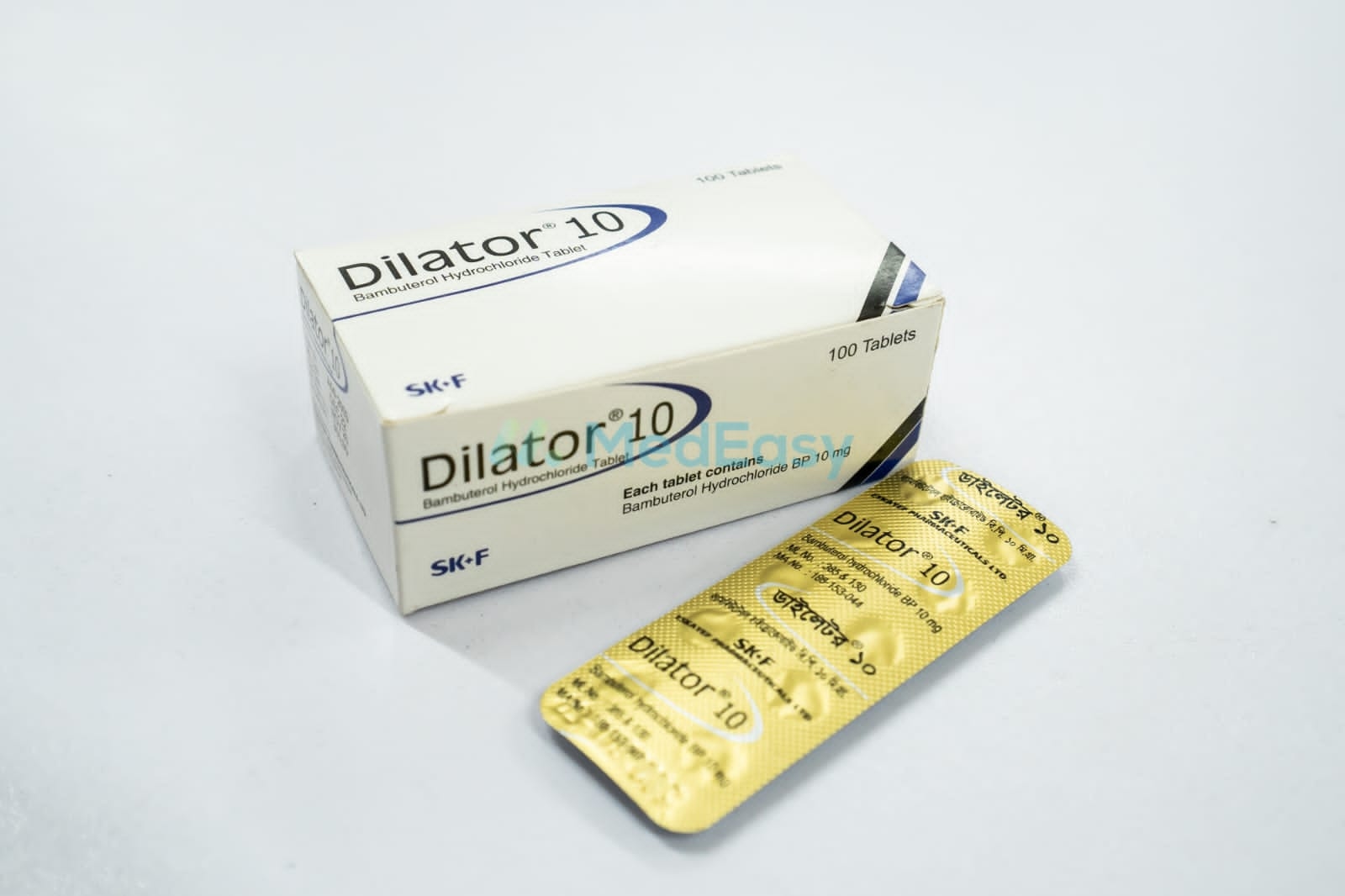
Dilator10 mg
Eskayef Bangladesh Ltd.
৳2.76
Add to cart


Aerodyl is indicated for the long-term maintenance treatment of reversible airway obstruction associated with asthma and chronic obstructive pulmonary disease (COPD), particularly for the control of nocturnal symptoms and early-morning bronchoconstriction.
Each tablet contains Bambuterol Hydrochloride as the active ingredient, commonly available in strengths such as 10 mg and 20 mg, along with pharmaceutically acceptable excipients (e.g., lactose, microcrystalline cellulose, magnesium stearate) used for tablet formulation.
Aerodyl is an orally active, long-acting beta-2 adrenergic agonist (LABA) that acts as a prodrug of terbutaline. After absorption, it is slowly and continuously converted in the body (mainly via plasma and hepatic esterases) to terbutaline, its active bronchodilator metabolite. This slow, sustained conversion gives Aerodyl a long duration of action, allowing once-daily dosing for maintenance bronchodilation in asthma and COPD.
Because of its slow onset, Aerodyl is intended for regular scheduled use to prevent symptoms, not for rapid relief of an acute asthma or COPD flare-up.
Long-acting Beta-2 Adrenergic Agonist (LABA); Bronchodilator (anti-asthmatic / anti-COPD agent). Aerodyl belongs to this class as a prodrug form.
Bambuterol Hydrochloride is a prodrug that is hydrolyzed slowly and continuously, principally by plasma cholinesterase (butyrylcholinesterase) and hepatic esterases, to its active metabolite terbutaline. Terbutaline is a selective beta-2 adrenergic receptor agonist.
Stimulation of beta-2 receptors on bronchial smooth muscle activates adenylate cyclase, increasing intracellular cyclic AMP (cAMP). This relaxes bronchial smooth muscle, producing bronchodilation and relief of airway obstruction. Because Bambuterol Hydrochloride is converted gradually rather than absorbed as an already-active drug, plasma terbutaline concentrations rise slowly and remain sustained, giving a long duration of bronchodilator effect (approximately 24 hours) suited to once-daily, typically bedtime, dosing.
A pharmacologically relevant property of Bambuterol Hydrochloride is that it inhibits plasma cholinesterase activity; this is clinically important because it can prolong the neuromuscular blocking effect of suxamethonium (succinylcholine) if surgery is required (see Interactions).
The usual starting dose of Aerodyl is 10 mg once daily at bedtime. If control of symptoms is inadequate, the dose may be increased after 1–2 weeks to 20 mg once daily, as advised by the physician.
| Age group | Usual dose of Aerodyl |
|---|---|
| 6–12 years | 10 mg once daily at bedtime (may be increased under medical supervision if needed) |
| 2–5 years | 10 mg once daily at bedtime |
| Below 2 years | Safety and efficacy of Aerodyl have not been established; not recommended |
Because the active metabolite (terbutaline) is renally eliminated, a lower starting dose of Aerodyl (e.g., 5 mg once daily) is advised in patients with impaired renal function, with careful monitoring.
Aerodyl is contraindicated in patients with severe hepatic impairment (see Contraindications), as conversion to terbutaline may become unpredictable.
Tablets of Aerodyl should be swallowed whole with water, generally at bedtime, and may be taken with or without food. Dosing should not be adjusted by the patient without medical advice.
Take Aerodyl tablets by mouth, swallowed whole with a glass of water. It is usually taken once daily at bedtime to provide bronchodilation through the night and early morning. It may be taken with or without food. Do not crush or chew unless directed by a physician or pharmacist. Take it regularly, even when feeling well, as it is a maintenance (preventer-supporting) medicine, not a rescue treatment.
Bambuterol Hydrochloride is contraindicated in:
Side effects of Aerodyl are generally dose-related and reflect beta-2 adrenergic stimulation.
Patients should seek medical advice if side effects are severe or persistent.
Pregnancy: There is limited controlled human data on the use of Aerodyl in pregnancy. Aerodyl should be used during pregnancy only if the potential benefit to the mother clearly justifies the potential risk to the fetus, and only under the direction of a physician. Particular caution is advised in late pregnancy/around labor, since beta-2 agonists such as the active metabolite of Aerodyl can theoretically relax the uterus and inhibit contractions.
Lactation: The active metabolite of Aerodyl (terbutaline) passes into breast milk in small amounts. Aerodyl should be used during breastfeeding only if considered necessary by a physician, with the infant monitored for possible effects (irritability, tremor).
Always consult a physician before using Aerodyl during pregnancy or while breastfeeding.
Overdose of Aerodyl may cause exaggerated beta-2 adrenergic effects, including tachycardia, palpitations, tremor, headache, nervousness, hypokalemia, hyperglycemia, and, rarely, arrhythmias or seizures.
If an overdose of Aerodyl is suspected, seek immediate medical attention or contact a poison control center/emergency services right away. Treatment is generally supportive and should be provided in a medical setting (e.g., cardiac monitoring, correction of electrolyte disturbances); do not attempt specific home treatment.
Store at room temperature (below 30°C), away from light and moisture. Keep out of reach of children.
Aerodyl is intended for long-term, regular maintenance use in asthma and COPD, continued for as long as the physician determines ongoing bronchodilator therapy is needed to control symptoms. Treatment should be reviewed periodically by the prescribing physician, who may adjust the dose or therapy based on symptom control; Aerodyl should not be stopped abruptly without medical advice if it is part of an ongoing maintenance regimen, and asthma control should always be reassessed together with concurrent anti-inflammatory therapy.
Long-acting Beta-2 Adrenergic Agonists (LABA); Bronchodilators; Anti-asthmatic and anti-COPD agents
Bambuterol Hydrochloride is a prodrug that is slowly hydrolyzed by plasma and hepatic esterases to terbutaline, a selective beta-2 adrenergic agonist. Terbutaline stimulates beta-2 receptors on bronchial smooth muscle, activating adenylate cyclase and raising intracellular cAMP, which relaxes airway smooth muscle and produces sustained bronchodilation lasting approximately 24 hours after a single dose of Bambuterol Hydrochloride.
Aerodyl can be used in children from 2 years of age for maintenance treatment of asthma, at doses lower than the adult dose (see Dosage and Administration). Because of its slow, sustained onset, Aerodyl is not suitable for relieving acute symptoms in children and must be combined with appropriate anti-inflammatory (e.g., inhaled corticosteroid) therapy rather than used alone. Safety and efficacy of Aerodyl in children below 2 years of age have not been established, and it is not recommended in this age group. Children receiving Aerodyl should be monitored for beta-agonist side effects such as tremor, palpitations, and restlessness.
Q: What is Aerodyl 10 mg Tablet used for?
A: Aerodyl 10 mg Tablet is a long-acting bronchodilator used for the regular maintenance treatment of asthma and chronic obstructive pulmonary disease (COPD), to help keep airways open and control symptoms, particularly overnight and in the early morning. It is not for use during a sudden asthma attack.
Q: Can I use Aerodyl 10 mg Tablet alone to control my asthma?
A: No. Aerodyl 10 mg Tablet is a long-acting beta-2 agonist (LABA) and should not be used as the only treatment for asthma. Using a LABA without a concurrent inhaled corticosteroid or other anti-inflammatory therapy has been linked to a higher risk of serious asthma flare-ups. Your physician will usually prescribe Aerodyl 10 mg Tablet together with an inhaled corticosteroid.
Q: Can I use Aerodyl 10 mg Tablet to relieve a sudden asthma attack?
A: No. Aerodyl 10 mg Tablet has a slow onset of action and is meant for prevention, not rapid relief. You should use a fast-acting rescue inhaler for sudden breathing difficulty and keep Aerodyl 10 mg Tablet only for its intended once-daily maintenance use, as advised by your physician.
Q: What are the common side effects of Aerodyl 10 mg Tablet?
A: The most common side effects of Aerodyl 10 mg Tablet include fine hand tremor, headache, nervousness, palpitations, and muscle cramps. These are usually mild and related to the dose. Contact your physician if side effects are severe, persistent, or if you notice irregular heartbeat.
Q: Is Aerodyl 10 mg Tablet safe during pregnancy or breastfeeding?
A: Aerodyl 10 mg Tablet should be used in pregnancy or while breastfeeding only if your physician decides the benefit outweighs the potential risk, particularly since caution is needed in late pregnancy. Always consult your physician before taking Aerodyl 10 mg Tablet if you are pregnant, planning pregnancy, or breastfeeding.
Q: Are there important interactions I should know about with Aerodyl 10 mg Tablet?
A: Yes. Aerodyl 10 mg Tablet can prolong the effect of the anesthetic muscle relaxant suxamethonium, so always tell your surgeon/anesthesiologist if you take Aerodyl 10 mg Tablet before any operation. Beta-blocker medicines can also reduce the effectiveness of Aerodyl 10 mg Tablet, and combining it with certain diuretics, steroids, or theophylline may increase the risk of low blood potassium. Tell your doctor about all medicines you take.
Disclaimer
The information provided is accurate to the best of our knowledge, but it does not replace professional medical advice. We cannot guarantee its completeness or accuracy, and the absence of specific information about a drug should not be taken as an endorsement. We are not responsible for any consequences arising from this information, so please consult a healthcare professional for any concerns or questions.

