

10% Off
Centoxin0.25 mg
Opsonin Pharma Ltd.
৳0.98
Add to cart
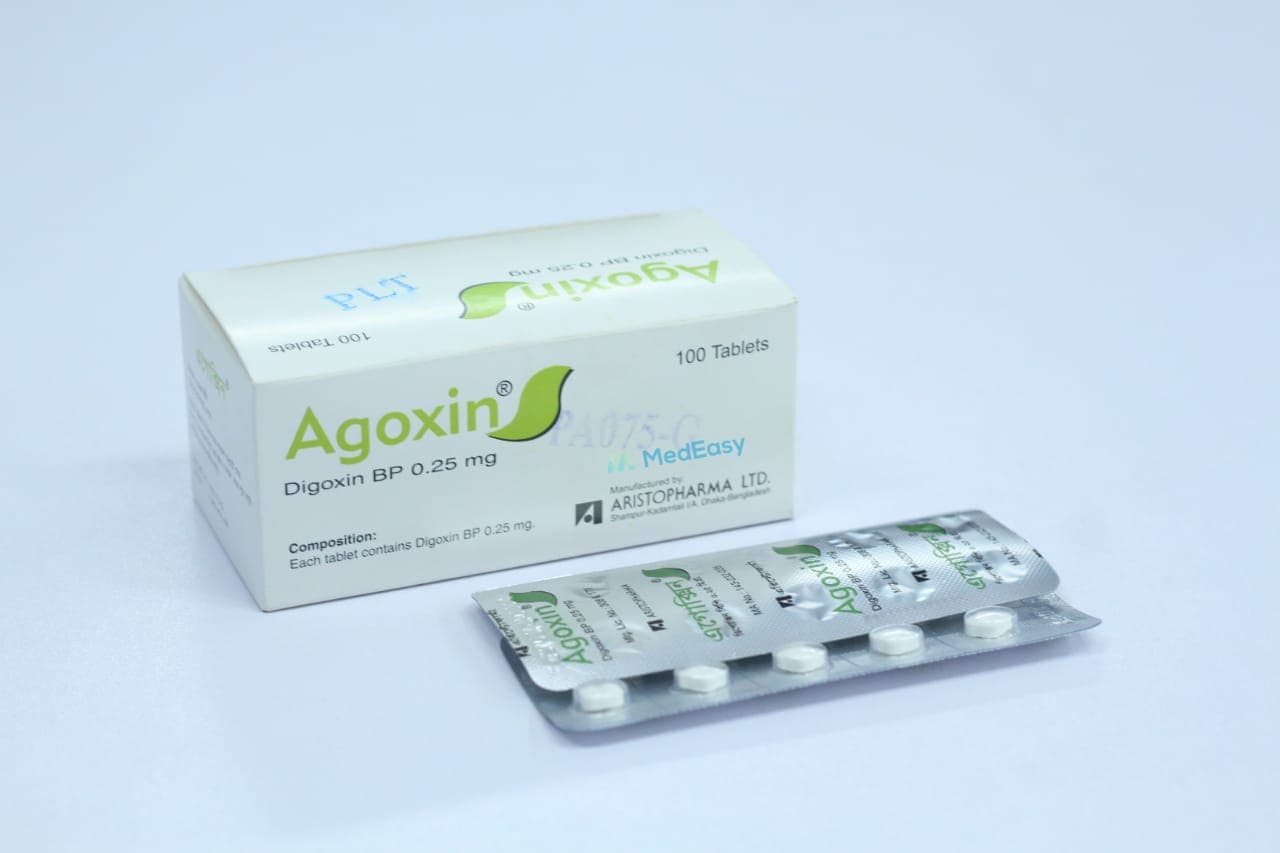
Agoxin 0.25 mg Tablet is available on MedEasy for ৳10.03 per 10's Strip, with home delivery anywhere in Bangladesh. It is manufactured by Aristopharma Ltd. Its generic name is Digoxin.

Agoxin is a cardiac glycoside indicated for the following conditions:
Agoxin is not indicated for ventricular arrhythmias and is not a first-line agent for acute heart failure or for rhythm control (conversion to normal sinus rhythm) of atrial fibrillation.
Each tablet of Digoxin generally contains Digoxin 0.125 mg or 0.25 mg. Digoxin is also available as an oral solution (typically 0.05 mg/mL) and as an injectable solution (typically 0.1 mg/mL or 0.25 mg/mL) for use when oral administration is not feasible or a rapid onset of action is required.
Agoxin is a cardiac glycoside (digitalis glycoside) originally derived from the foxglove plant (Digitalis lanata). It has been used for over a century to increase the force of myocardial contraction in heart failure and to slow the ventricular rate in certain atrial arrhythmias. Agoxin has a narrow therapeutic index, meaning the difference between an effective dose and a toxic dose is small, so careful dosing and monitoring are essential.
Agoxin belongs to the therapeutic class of cardiac glycosides (digitalis glycosides), used as a positive inotropic agent in heart failure and as a rate-control agent in certain supraventricular arrhythmias.
Digoxin works primarily by inhibiting the sodium-potassium ATPase (Na⁺/K⁺-ATPase) pump on the membrane of cardiac muscle cells. This inhibition leads to an increase in intracellular sodium, which in turn reduces the activity of the sodium-calcium exchanger, resulting in higher intracellular calcium concentrations. The increased calcium enhances the force of myocardial contraction (positive inotropic effect).
Digoxin also increases vagal (parasympathetic) tone and reduces sympathetic activity, which slows conduction through the atrioventricular (AV) node. This AV nodal slowing is the basis for its use in controlling ventricular rate during atrial fibrillation or flutter.
| Indication | Typical Dosing |
|---|---|
| Heart failure (maintenance) | 0.125 mg to 0.25 mg orally once daily; lower doses (0.0625 mg to 0.125 mg daily) are often used in elderly patients or those with renal impairment. |
| Atrial fibrillation (rate control) | Loading ("digitalization") is rarely used today; when needed, it is given under close monitoring, followed by a maintenance dose similar to that used in heart failure, individualized using serum Agoxin concentration and clinical response. |
Pediatric dosing of Agoxin is weight- and age-based and must be individualized by a pediatric cardiologist or specialist; per-kilogram doses are generally higher in neonates and infants than in older children and adults, reflecting differences in drug distribution. Safety and efficacy have been established for use in pediatric heart failure and certain supraventricular arrhythmias under specialist supervision; Agoxin should not be dosed in children without specialist guidance.
Agoxin is cleared predominantly by the kidneys, so patients with renal impairment require lower doses and closer monitoring of serum Agoxin concentration, renal function, and electrolytes to avoid accumulation and toxicity.
No specific dose adjustment is generally required for hepatic impairment, since Agoxin undergoes minimal hepatic metabolism; however, clinical monitoring is still advised.
Agoxin tablets and oral solution may be taken with or without food, though consistency (taking it the same way each time) is recommended, and high-fiber meals may slightly reduce absorption. Injectable Agoxin is administered intravenously by a healthcare professional, usually slowly over several minutes, in a hospital or monitored setting. Doses should be taken at the same time each day, and a missed dose should not be doubled up.
Agoxin has several clinically significant drug interactions, mostly due to altered Agoxin levels or additive cardiac effects:
Patients should inform their physician of all medicines, supplements, and herbal products they are taking before starting Agoxin.
Digoxin is contraindicated in:
Additional situations that amount to a near-contraindication and generally warrant avoiding Digoxin unless directed by a cardiac specialist include Wolff-Parkinson-White syndrome with atrial fibrillation (risk of accelerated conduction through an accessory pathway) and certain high-grade atrioventricular blocks in the absence of a pacemaker; see Precautions and Warnings for details.
Side effects of Agoxin are often dose-related and closely tied to serum drug concentration:
Patients should seek prompt medical attention if they notice visual changes, irregular heartbeat, severe nausea/vomiting, or confusion while taking Agoxin.
Pregnancy: Agoxin crosses the placenta. It should be used during pregnancy only if clearly needed and if the potential benefit justifies the potential risk to the fetus; a physician should be consulted, and if used, the dose and serum levels should be closely monitored since pregnancy can alter Agoxin pharmacokinetics.
Lactation: Agoxin passes into breast milk in small amounts. It should be used with caution during breastfeeding; a physician should be consulted to weigh the benefits of treatment against any potential risk to the nursing infant, and the infant should be monitored for any unusual signs.
Agoxin has a narrow therapeutic index; use with caution and enhanced monitoring in the following situations:
Regular monitoring of serum Agoxin concentration, renal function, and electrolytes is recommended throughout treatment, especially after any dose change or when interacting medicines are started or stopped.
Overdose or toxicity with Agoxin is a medical emergency. Signs and symptoms may include severe nausea and vomiting, visual disturbances (blurred vision, yellow-green halos), confusion, and potentially life-threatening cardiac arrhythmias (including a slow heart rate, heart block, or dangerous fast ventricular rhythms), as well as hyperkalemia in acute overdose.
Anyone suspected of having taken an overdose of Agoxin, or showing signs of toxicity, should seek immediate emergency medical attention or contact a poison control center. A specific antidote (Agoxin immune Fab) is available in hospital settings for severe, life-threatening toxicity. Do not attempt to manage a suspected Agoxin overdose at home.
Store Agoxin at room temperature (below 30°C), away from light and moisture. Keep out of reach of children.
Elderly: More sensitive to the effects of Agoxin due to reduced renal function and lean body mass; lower starting doses and close monitoring are recommended.
Renal impairment: Requires dose reduction and monitoring of serum Agoxin levels, renal function, and electrolytes; see Precautions and Warnings.
Hepatic impairment: No specific dose adjustment is generally required, since Agoxin is minimally metabolized by the liver.
Pediatric patients: Used under specialist supervision with weight- and age-based dosing; see Pediatric Uses.
Pregnant or breastfeeding women: See Pregnancy and Lactation.
Agoxin is typically used long-term/chronically for heart failure or atrial fibrillation rate control, for as long as clinically indicated by the treating physician. Treatment duration is individualized, and the ongoing need for Agoxin should be reassessed periodically, particularly as other heart failure or rate-control therapies are optimized.
Digoxin is classified as a cardiac glycoside (digitalis glycoside), functioning as a positive inotropic agent and as an antiarrhythmic/rate-control agent for supraventricular arrhythmias.
Digoxin inhibits the Na⁺/K⁺-ATPase pump in cardiac cell membranes, leading to increased intracellular sodium and, via the sodium-calcium exchanger, increased intracellular calcium. This raises the force of myocardial contraction (positive inotropy). Digoxin also enhances vagal tone, slowing conduction through the AV node and reducing ventricular rate in atrial fibrillation/flutter.
C (FDA legacy pregnancy category)
Agoxin is used in pediatric patients for heart failure and certain supraventricular arrhythmias, but only under the supervision of a pediatric cardiologist or specialist. Dosing is weight- and age-based, since infants and neonates often require higher per-kilogram doses than older children or adults due to differences in drug distribution and elimination. Safety and efficacy in children are established only for these specialist-supervised uses at appropriately individualized doses; Agoxin should never be dosed in a child without specialist guidance, and serum Agoxin level monitoring is often used to guide pediatric therapy given the narrow therapeutic index.
Q: What is Agoxin 0.25 mg Tablet used for?
A: Agoxin 0.25 mg Tablet is used to help the heart pump more effectively in certain patients with heart failure and to slow a fast heart rate in chronic atrial fibrillation.
Q: How should I take Agoxin 0.25 mg Tablet?
A: Take Agoxin 0.25 mg Tablet exactly as prescribed by your physician, at the same time each day, with or without food. Do not change your dose or stop taking Agoxin 0.25 mg Tablet without consulting your doctor, since both too little and too much Agoxin 0.25 mg Tablet can be harmful.
Q: What are the warning signs of Agoxin 0.25 mg Tablet toxicity?
A: Seek medical attention promptly if you experience nausea, vomiting, loss of appetite, visual changes (such as blurred vision or a yellow-green tinge to your vision), confusion, or an irregular or very slow heartbeat while taking Agoxin 0.25 mg Tablet, as these can be signs of toxicity, especially given its narrow therapeutic index.
Q: Can Agoxin 0.25 mg Tablet be taken during pregnancy or breastfeeding?
A: Agoxin 0.25 mg Tablet should be used during pregnancy only if clearly needed, since it crosses the placenta, and only under a physician's guidance; it passes into breast milk in small amounts, so breastfeeding mothers should also consult their physician before using Agoxin 0.25 mg Tablet.
Q: Does Agoxin 0.25 mg Tablet interact with other medicines?
A: Yes. Medicines such as amiodarone, verapamil, and quinidine can raise Agoxin 0.25 mg Tablet levels and increase toxicity risk, while diuretics can cause electrolyte changes that increase the risk of Agoxin 0.25 mg Tablet-related arrhythmias. Always tell your doctor about all medicines and supplements you take alongside Agoxin 0.25 mg Tablet.
Q: What should I do if I miss a dose or take too much Agoxin 0.25 mg Tablet?
A: If you miss a dose of Agoxin 0.25 mg Tablet, take it as soon as you remember unless it is almost time for the next dose — do not double up. If you suspect you have taken too much Agoxin 0.25 mg Tablet, seek immediate emergency medical attention or contact a poison control center, as overdose can cause dangerous heart rhythm problems.
Disclaimer
The information provided is accurate to the best of our knowledge, but it does not replace professional medical advice. We cannot guarantee its completeness or accuracy, and the absence of specific information about a drug should not be taken as an endorsement. We are not responsible for any consequences arising from this information, so please consult a healthcare professional for any concerns or questions.