
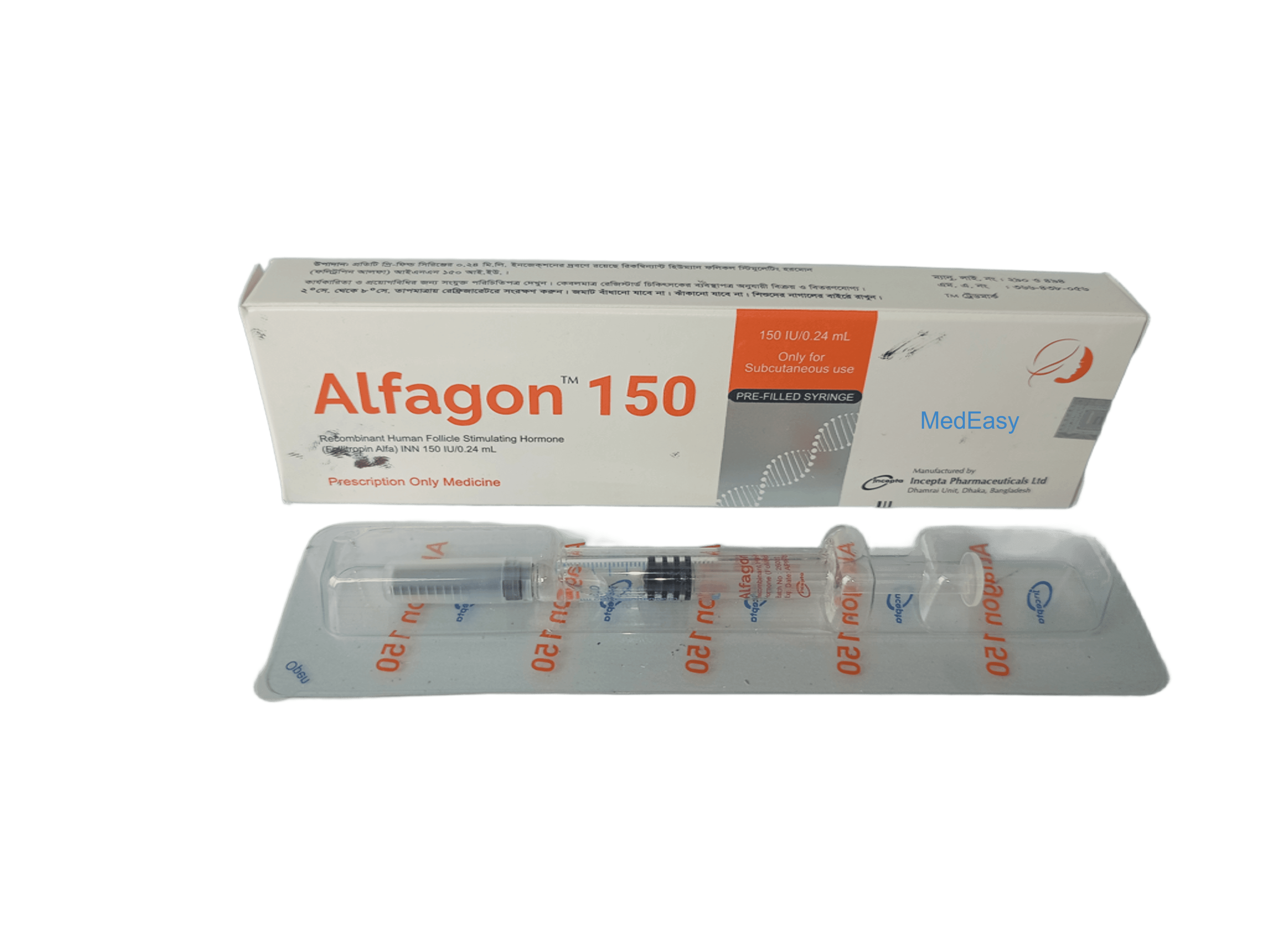

Medicine overview
Indications of Alfagon
Alfagon is a purified preparation of recombinant human follicle-stimulating hormone (r-hFSH) produced by recombinant DNA technology, used in the treatment of infertility.
Established / FDA-approved uses
- Ovulation induction in women with anovulatory infertility (e.g., WHO Group I/II anovulation) who have not responded to other measures such as clomiphene citrate.
- Controlled ovarian stimulation (COS) for the development of multiple follicles in women undergoing assisted reproductive technology (ART) procedures such as in-vitro fertilisation (IVF) and intracytoplasmic sperm injection (ICSI).
- Induction of spermatogenesis in men with hypogonadotropic hypogonadism who have a documented deficiency of FSH; used in combination with human chorionic gonadotropin (hCG).
Adjunct / combination-therapy uses
- Often used together with a GnRH agonist or GnRH antagonist to prevent a premature LH surge during COS cycles.
- May be combined with low-dose hCG or luteinizing hormone (LH) activity in women with profound LH deficiency.
Alfagon is not indicated for use outside specialist-supervised fertility treatment protocols.
Composition
Each vial, ampoule, or pre-filled pen of Recombinant Follicle Stimulating Hormone contains purified recombinant human follicle-stimulating hormone (r-hFSH) manufactured using recombinant DNA technology in a mammalian cell line, commonly available in strengths of 75 IU, 150 IU, 225 IU, 300 IU, 450 IU, and 900 IU, supplied either as a lyophilised powder with diluent for reconstitution or as a ready-to-use injectable solution.
Description
Alfagon is a biotechnology-derived gonadotropin that is structurally and biologically similar to endogenoushuman follicle-stimulating hormone (FSH). It is manufactured using recombinant DNA technology rather thanbeing purified from human urine, giving a highly consistent, high-purity product with minimal batch-to-batchvariability.
In women, Alfagon stimulates the growth and maturation of ovarian follicles; in men, it stimulatesSertoli cell function and spermatogenesis. It is administered exclusively by injection under close medicalsupervision as part of a fertility treatment protocol.
Therapeutic Class
Gonadotropin; Fertility hormone – Follicle-Stimulating Hormone (FSH) analogue (Alfagon)
Pharmacology
Mechanism
Recombinant Follicle Stimulating Hormone binds to FSH receptors located on granulosa cells of ovarian follicles in women and on Sertolicells within the seminiferous tubules of the testis in men.
- In women: stimulates recruitment and growth of a cohort of ovarian follicles, promotesgranulosa cell proliferation, and increases aromatase-mediated conversion of androgens to estradiol.
- In men: stimulates Sertoli cell activity and supports spermatogenesis, typically togetherwith hCG-driven testosterone production.
Pharmacokinetics
After subcutaneous injection, Recombinant Follicle Stimulating Hormone is absorbed slowly, reaching peak serum concentrations withinapproximately 12–24 hours, with an elimination half-life of roughly 24–40 hours, allowing once-daily dosing.
Dosage & Administration of Alfagon
Individualized, specialist-supervised dosing
Dosing of Alfagon must be individualized and titrated according to ovarian or testicular response, monitoredby serial transvaginal ultrasound and serum estradiol (in women) or testosterone/semen parameters (in men).It should only be prescribed and monitored by a physician experienced in fertility treatment.
| Indication | Typical starting dose | Notes |
|---|---|---|
| Ovulation induction (anovulatory infertility) | 75–150 IU subcutaneously once daily | Adjusted at intervals of at least 7 days by increments of 37.5 IU based on ovarian response. |
| Controlled ovarian stimulation for ART/IVF | 150–225 IU subcutaneously once daily, starting on cycle day 2–3 | Continued until adequate follicular development is confirmed by ultrasound/estradiol, then hCG is given to trigger final maturation. |
| Spermatogenesis induction (male hypogonadotropic hypogonadism) | 150 IU 3 times weekly, combined with hCG | Treatment typically continued for a minimum of 3–4 months before response is assessed; often longer. |
See Duration of Treatment and Use in Special Populations for further guidance.
Administration of Alfagon
Alfagon is given by subcutaneous injection, usually self-administered (after training) or given by a caregiver/nurse, using a pre-filled pen, cartridge, or reconstituted vial with the accompanying syringe. Injection sites should be rotated (e.g., abdomen, thigh) to reduce local irritation.
Interaction of Alfagon
No formal drug-drug interaction studies have been conducted for Alfagon, as it is a protein hormone thatis not metabolized by hepatic cytochrome P450 enzymes. Clinically relevant considerations include:
- Clomiphene citrate: commonly used together with or before Alfagon in ovulation inductionprotocols; concurrent use may increase the follicular response, requiring closer monitoring.
- Human chorionic gonadotropin (hCG): used together with Alfagon to trigger final oocyteor sperm maturation; combined use increases the risk of ovarian hyperstimulation syndrome (OHSS) if follicularresponse is excessive.
- GnRH agonists/antagonists: used concurrently in ART cycles to prevent a premature LH surge;may require higher doses of Alfagon due to pituitary down-regulation.
Contraindications
Recombinant Follicle Stimulating Hormone is contraindicated in the presence of any of the following:
- Known hypersensitivity to Recombinant Follicle Stimulating Hormone or any component of the formulation.
- Tumors of the ovary, breast, uterus, testis, pituitary gland, or hypothalamus.
- Undiagnosed vaginal bleeding.
- Ovarian cysts or ovarian enlargement not due to polycystic ovary syndrome (PCOS).
- Primary ovarian failure (in women) or primary testicular failure (in men).
- Pregnancy.
Side Effects of Alfagon
Common
- Injection-site reactions (pain, redness, bruising, swelling)
- Headache
- Abdominal pain, bloating, or discomfort
- Nausea
- Ovarian cyst formation
Serious (require prompt medical attention)
- Ovarian hyperstimulation syndrome (OHSS) – potentially life-threatening; see Precautions and Warnings.
- Multiple pregnancy
- Ovarian torsion
- Thromboembolic events (venous or arterial)
- Hypersensitivity/allergic reactions
Patients on Alfagon should report severe abdominal pain, rapid weight gain, breathlessness, or reduced urination immediately.
Pregnancy & Lactation
Pregnancy: Alfagon is contraindicated once pregnancy has been confirmed, as there is noindication for its continued use during pregnancy and no benefit to the fetus. It should be discontinued assoon as pregnancy is diagnosed. As with all gonadotropins used for ovulation induction/COS, treatment carriesan increased risk of multiple gestation, which itself carries added maternal and fetal risk.
Lactation: There are no adequate data on the excretion of Alfagon into human milk. Becauseits use is specific to achieving pregnancy, it is not indicated during breastfeeding; a physician should beconsulted regarding fertility treatment timing in relation to lactation.
Precautions & Warnings
Ovarian hyperstimulation syndrome (OHSS)
Alfagon can cause OHSS, a potentially life-threatening condition characterized by rapid ovarian enlargement,ascites, pleural effusion, hemoconcentration, and thromboembolic events. Risk is minimized through careful,individualized dosing and close monitoring (serial ultrasound and estradiol levels); treatment should bewithheld or the dose reduced if ovarian response is excessive.
Multiple pregnancy
Use of Alfagon for ovulation induction or COS is associated with a significantly increased risk of multiplepregnancy (twins or higher-order), which carries additional maternal and perinatal risk.
Specialist monitoring required
Alfagon must only be used under the supervision of a physician experienced in the management of fertilitydisorders, with access to ultrasound and hormone (estradiol) monitoring. It should never be self-titrated bypatients without close clinical supervision.
Other precautions
- Increased risk of ectopic pregnancy in women with a history of tubal disease.
- Risk of thromboembolic events, particularly in women with additional risk factors or established OHSS.
- Ovarian torsion has been reported following gonadotropin therapy.
- Congenital malformation rates in ART pregnancies may be slightly higher than in spontaneous conceptions, possibly related to parental characteristics rather than the treatment itself.
Overdose Effects of Alfagon
The effects of overdose with Alfagon are not fully characterized, but excessive dosing is expected toincrease the risk of ovarian hyperstimulation syndrome (OHSS) in women. There is no specific antidote.Any suspected overdose or signs of severe OHSS (severe abdominal pain, marked abdominal distension, nausea,vomiting, rapid weight gain, breathlessness, or reduced urine output) require immediate medical attention;contact a physician or emergency services, or a poison control center, without delay.
Storage Conditions
Store in a refrigerator (2°C–8°C), protected from light, and do not freeze, unless the specific product labeling permits room-temperature storage for a limited period after first use (follow the manufacturer's instructions on the pack). Keep out of reach of children.
Use In Special Populations
Renal/hepatic impairment
The safety and pharmacokinetics of Alfagon have not been specifically established in patients with renal orhepatic impairment; use with caution and under specialist supervision if prescribed in such patients.
Elderly
Alfagon is indicated only for use in the reproductive age group; it has no established use in elderly patients.
Pediatric
See Pediatric Uses.
Duration Of Treatment
Duration of Alfagon therapy is individualized and specialist-supervised: controlled ovarian stimulation cycles for ART typically last about 8–14 days until hCG trigger; ovulation induction courses are individualized per cycle; induction of spermatogenesis in men with hypogonadotropic hypogonadism generally requires a minimum of 3–4 months, and sometimes up to 12–24 months, of combined therapy before a response is assessed.
Reconstitution
For lyophilised powder presentations of Alfagon, reconstitute using only the diluent (sterile water for injection) supplied in the same pack, immediately before administration. Gently swirl the vial to dissolve the powder — do not shake, as vigorous agitation may denature the protein. Use the reconstituted solution immediately; discard any unused portion. Pre-filled pen or cartridge presentations do not require reconstitution.
Drug Classes
Gonadotropins; Fertility / ovulation-inducing agents; Follicle-stimulating hormone (FSH) analogues
Mode Of Action
Recombinant Follicle Stimulating Hormone acts as an FSH receptor agonist, binding FSH receptors on ovarian granulosa cells to stimulate follicular growth and estradiol production in women, and on testicular Sertoli cells to stimulate spermatogenesis in men.
Pregnancy
X
Pediatric Uses
Safety and efficacy of Alfagon have not been established in prepubertal children, and it is not indicated for use in this population. In adolescent males with confirmed hypogonadotropic hypogonadism, use may be considered only under the direct supervision of a pediatric or reproductive endocrinologist, following an individualized specialist protocol.
Frequently Asked Questions
Q: What is Alfagon 150 IU/pre-filled syringe SC Injection used for?
A: Alfagon 150 IU/pre-filled syringe SC Injection is used to stimulate the ovaries in women undergoing ovulation induction or controlled ovarian stimulation for assisted reproduction (such as IVF), and to help induce sperm production in men with a specific hormonal deficiency called hypogonadotropic hypogonadism.
Q: How is Alfagon 150 IU/pre-filled syringe SC Injection given?
A: Alfagon 150 IU/pre-filled syringe SC Injection is given as a subcutaneous injection, typically once daily (or a few times weekly for men), using a pre-filled pen or a reconstituted vial, exactly as directed by your fertility specialist.
Q: What is the most serious risk with Alfagon 150 IU/pre-filled syringe SC Injection?
A: The most serious risk is ovarian hyperstimulation syndrome (OHSS), a potentially life-threatening condition involving painful ovarian swelling, fluid accumulation, and blood clotting problems. Contact your doctor immediately if you develop severe abdominal pain, rapid weight gain, nausea, vomiting, or difficulty breathing while using Alfagon 150 IU/pre-filled syringe SC Injection.
Q: Can Alfagon 150 IU/pre-filled syringe SC Injection cause twins or multiple pregnancy?
A: Yes. Alfagon 150 IU/pre-filled syringe SC Injection increases the chance of releasing more than one egg, which raises the risk of twin or higher-order multiple pregnancy compared with natural conception.
Q: Can I use Alfagon 150 IU/pre-filled syringe SC Injection if I am already pregnant?
A: No. Alfagon 150 IU/pre-filled syringe SC Injection is contraindicated in pregnancy and must be stopped as soon as pregnancy is confirmed, since it has no role once pregnancy has been achieved.
Q: Do I need monitoring while using Alfagon 150 IU/pre-filled syringe SC Injection?
A: Yes. Treatment with Alfagon 150 IU/pre-filled syringe SC Injection requires regular monitoring with ultrasound scans and blood hormone (estradiol) tests so your specialist can adjust the dose and reduce the risk of overstimulation; it should never be self-adjusted without medical supervision.
Disclaimer
The information provided is accurate to the best of our knowledge, but it does not replace professional medical advice. We cannot guarantee its completeness or accuracy, and the absence of specific information about a drug should not be taken as an endorsement. We are not responsible for any consequences arising from this information, so please consult a healthcare professional for any concerns or questions.
