
8% Off
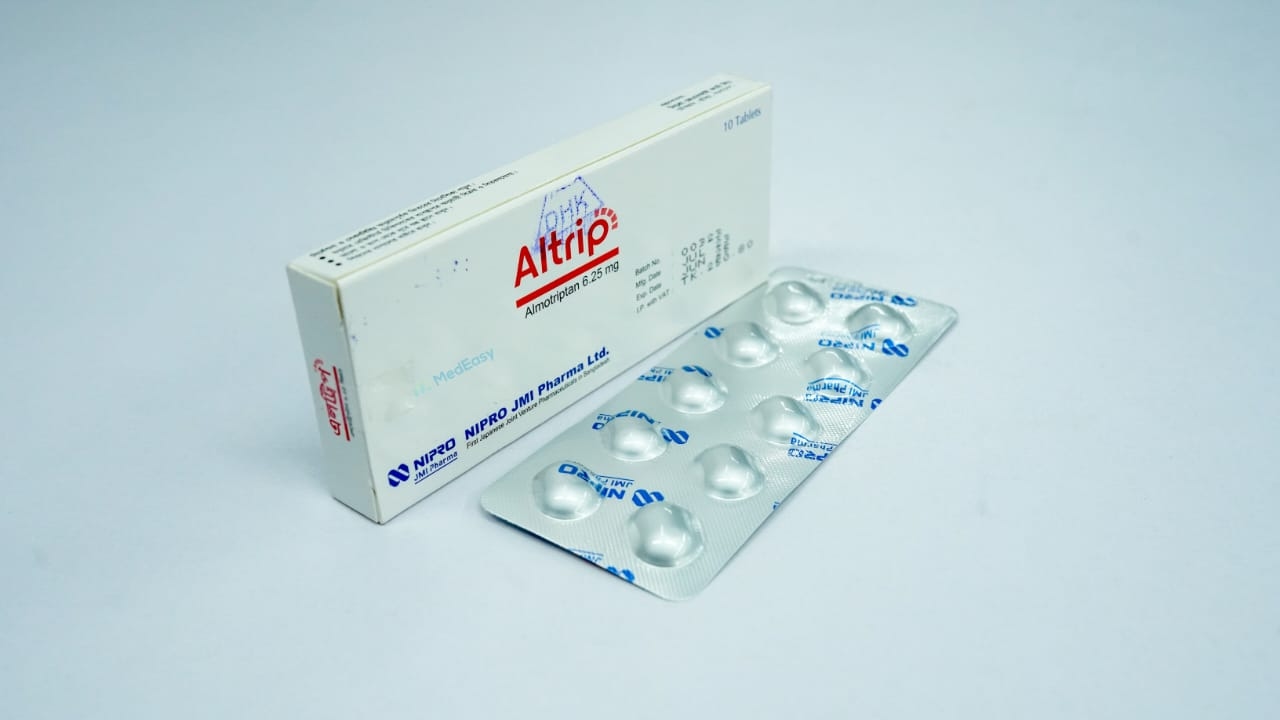
Altrip6.25 mg
NIPRO JMI Pharma Ltd.
৳23.07
Add to cart

Almitan 6.25 mg Tablet is available on MedEasy for ৳23.00 per piece, with home delivery anywhere in Bangladesh. It is manufactured by Opsonin Pharma Ltd. Its generic name is Almotriptan.

Almitan is a selective serotonin (5-HT1B/1D) receptor agonist (triptan) indicated for the following:
Each film-coated tablet contains Almotriptan malate equivalent to Almotriptan 6.25 mg or 12.5 mg base.
Almitan is an orally administered, selective serotonin 5-HT1B/1D receptor agonist belonging to the triptan class of antimigraine agents. It is used for the acute relief of migraine headache and associated symptoms. Almitan is supplied as film-coated tablets for oral use and is intended to be taken as soon as possible after the onset of a migraine attack.
Triptan — Selective serotonin 5-HT1B/1D receptor agonist (antimigraine preparation). Almitan belongs to this class.
Almotriptan is a selective agonist at serotonin 5-HT1B and 5-HT1D receptors. Activation of these receptors on intracranial extracerebral blood vessels causes vasoconstriction, and activation of 5-HT1D receptors on trigeminal sensory nerve terminals inhibits the release of pro-inflammatory neuropeptides (such as CGRP), reducing neurogenic inflammation and pain transmission associated with migraine.
Dosing of Almitan should be individualized based on age, hepatic/renal function, and concomitant medications.
| Population/Condition | Recommended Dosing of Almitan |
|---|---|
| Adults | 6.25 mg or 12.5 mg as a single oral dose at onset of migraine; may repeat once after 2 hours if headache returns (maximum 25 mg in 24 hours). 12.5 mg has shown greater consistency of effect than 6.25 mg. |
| Adolescents (12–17 years) | 6.25 mg or 12.5 mg single dose; no additional benefit has been shown with the higher dose in this age group. Maximum 2 doses in 24 hours. |
| Hepatic impairment | Start with 6.25 mg; maximum 12.5 mg in 24 hours. |
| Severe renal impairment | Start with 6.25 mg; maximum 12.5 mg in 24 hours. |
| With potent CYP3A4 inhibitors (e.g., ketoconazole) | Start with 6.25 mg; maximum 12.5 mg in 24 hours; avoid combination in patients with renal or hepatic impairment. |
If a patient does not respond to the first dose of Almitan for a given attack, the effectiveness of a second dose for the same attack has not been established; consider an alternative treatment for that episode.
Almitan tablets should be swallowed whole with water, with or without food, as soon as possible after the onset of migraine headache. Do not exceed the recommended dose or frequency. Almitan is intended for treatment of an existing attack, not for prevention.
The following clinically significant interactions have been established with Almitan:
Almotriptan is contraindicated in patients with:
The most commonly reported adverse effects of Almitan are generally mild and transient.
Patients experiencing chest, throat, neck, or jaw tightness/pain after taking Almitan should seek prompt medical evaluation.
Pregnancy: There are no adequate and well-controlled studies of Almitan in pregnant women. Animal studies have shown developmental toxicity at doses substantially higher than the maximum recommended human dose. Almitan should be used during pregnancy only if the potential benefit justifies the potential risk to the fetus; consult a physician before use.
Lactation: It is not known whether Almitan is excreted in human milk. Because many drugs are excreted in human milk, caution should be exercised, and a physician should be consulted, when considering Almitan use during breastfeeding.
Cardiovascular risk assessment: Before prescribing Almitan, patients should be evaluated for underlying cardiovascular disease, particularly those with risk factors such as hypertension, hypercholesterolemia, smoking, obesity, diabetes, family history of coronary artery disease, postmenopausal status, or men over 40. For patients with multiple risk factors, consider administering the first dose of Almitan under medical supervision, with ECG monitoring if appropriate.
Chest, throat, neck, or jaw symptoms: Sensations of tightness, pain, or pressure can occur after taking Almitan and typically resolve; if intense or persistent, cardiac evaluation is required before further doses.
Cerebrovascular events: Rare cases of stroke and hemorrhage have been reported with triptans, including Almitan; rule out other causes of the headache before treatment, particularly in patients not previously diagnosed with migraine.
Serotonin syndrome: Risk increases with concurrent SSRIs, SNRIs, or MAOIs (see Interactions and Contraindications).
Blood pressure: Almitan may cause a transient increase in blood pressure; it is contraindicated in uncontrolled hypertension.
Sulfonamide sensitivity: Use with caution in patients with known sulfonamide allergy, as Almitan malate contains a sulfonamide moiety, although cross-reactivity has not been systematically studied.
Renal/hepatic impairment: Dose reduction is required (see Dosage and Administration).
Medication-overuse headache: Frequent or excessive use of Almitan (more than about 10 days per month) can lead to medication-overuse headache; limit the frequency of use and consult a physician if headaches worsen or increase in frequency.
Limited data are available on overdose with Almitan. Based on the pharmacology of triptans, overdose may cause hypertension or other cardiovascular symptoms. In case of suspected overdose of Almitan, seek immediate medical attention or contact emergency services/a poison control center. Clinical and electrocardiographic monitoring should be continued for at least 20 hours, even if symptoms are not evident, due to the possibility of delayed cardiovascular effects. Treatment is supportive; the effect of dialysis on Almitan removal is not established.
Store at room temperature (below 30°C), away from light and moisture. Keep out of reach of children.
Renal impairment: In patients with severe renal impairment, start with a lower dose of Almitan (6.25 mg) with a maximum of 12.5 mg in 24 hours.
Hepatic impairment: In patients with hepatic impairment, start with a lower dose of Almitan (6.25 mg) with a maximum of 12.5 mg in 24 hours.
Elderly: Clinical experience with Almitan in patients over 65 years is limited; cardiovascular risk should be carefully assessed before use, as advanced age is itself a cardiovascular risk factor.
Pediatric patients (under 12 years): Safety and efficacy of Almitan have not been established.
Adolescents (12–17 years): Use is established only for acute headache pain relief, using the same dosing as adults (see Dosage and Administration).
Almitan is intended for short-term, as-needed (per-attack) use only and is not intended for chronic daily administration or migraine prevention. Treatment with Almitan should be limited to no more than about 10 days per month to reduce the risk of medication-overuse headache. If migraine attacks become more frequent or treatment is needed on more days than this, consult a physician for reassessment and consideration of preventive therapy.
Triptans (selective serotonin 5-HT1B/1D receptor agonists); antimigraine agents. Almotriptan is a member of this drug class.
Almotriptan acts as a selective agonist at 5-HT1B and 5-HT1D serotonin receptors. This causes constriction of dilated intracranial extracerebral blood vessels believed to be involved in migraine, and inhibits the release of vasoactive, pro-inflammatory neuropeptides (such as calcitonin gene-related peptide) from trigeminal sensory nerves, thereby reducing neurogenic inflammation and interrupting migraine pain transmission.
C
Safety and efficacy of Almitan in children under 12 years of age have not been established, and Almitan is not recommended for this age group.
In adolescents 12 to 17 years of age, Almitan has been evaluated for the acute treatment of migraine headache pain, with a safety profile similar to that seen in adults; however, efficacy against associated symptoms (nausea, photophobia, phonophobia) has not been established in this age group. Dosing in adolescents follows the same recommendations as for adults (see Dosage and Administration).
Q: What is Almitan 6.25 mg Tablet used for?
A: Almitan 6.25 mg Tablet is used for the acute treatment of migraine headache attacks, with or without aura, in adults and adolescents 12 years and older. It is taken to relieve a migraine that has already started, not to prevent future attacks.
Q: How and when should I take Almitan 6.25 mg Tablet?
A: Almitan 6.25 mg Tablet should be swallowed whole with water as soon as possible after a migraine attack begins. The usual single dose is 6.25 mg or 12.5 mg. If the headache returns, a second dose may be taken after at least 2 hours, up to a maximum of 25 mg in 24 hours.
Q: Who should not take Almitan 6.25 mg Tablet?
A: Almitan 6.25 mg Tablet should not be used by people with ischemic heart disease, a history of stroke or TIA, peripheral vascular disease, uncontrolled high blood pressure, hemiplegic or basilar migraine, or hypersensitivity to the drug. It should also not be used within 24 hours of another triptan or an ergotamine-type medicine, or together with MAOIs.
Q: Can Almitan 6.25 mg Tablet be taken during pregnancy or while breastfeeding?
A: Almitan 6.25 mg Tablet has not been well studied in pregnant or breastfeeding women. It should be used during pregnancy only if the potential benefit clearly justifies the potential risk to the baby, and with caution during breastfeeding. Always consult a physician before using Almitan 6.25 mg Tablet in these situations.
Q: What are the common side effects of Almitan 6.25 mg Tablet?
A: Common side effects of Almitan 6.25 mg Tablet include nausea, dry mouth, tingling sensations, dizziness, and drowsiness. Seek immediate medical attention if you experience chest pain, tightness in the throat or jaw, or signs of an allergic reaction after taking Almitan 6.25 mg Tablet.
Q: Can I take Almitan 6.25 mg Tablet every day for frequent headaches?
A: No. Almitan 6.25 mg Tablet is meant only for treating individual migraine attacks, not for daily prevention. Using Almitan 6.25 mg Tablet too often (more than about 10 days a month) can actually cause medication-overuse headache. If your migraines are frequent, talk to a physician about preventive treatment options.
Disclaimer
The information provided is accurate to the best of our knowledge, but it does not replace professional medical advice. We cannot guarantee its completeness or accuracy, and the absence of specific information about a drug should not be taken as an endorsement. We are not responsible for any consequences arising from this information, so please consult a healthcare professional for any concerns or questions.