8% Off
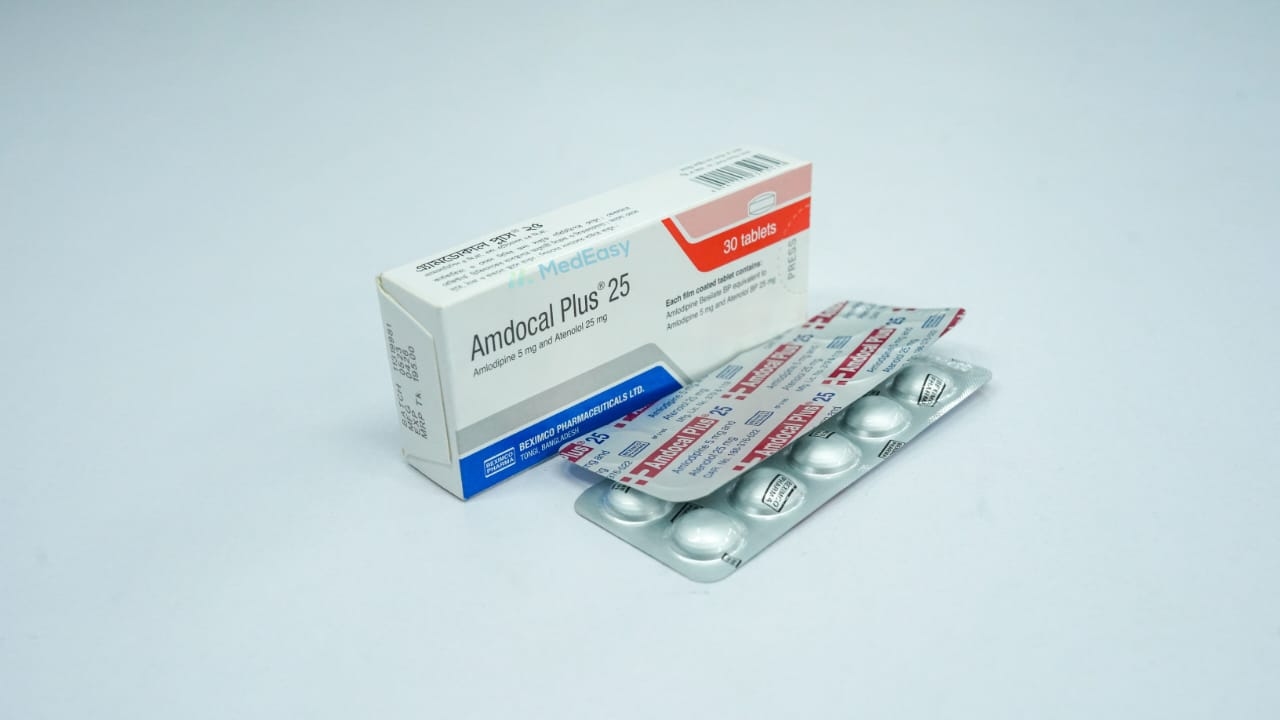
Amdocal Plus5 mg+25 mg
Beximco Pharmaceuticals Ltd.
৳59.80
Add to cart


Aloten is a fixed-dose combination antihypertensive indicated for the treatment of hypertension in patients who require combination therapy for adequate blood pressure control, typically when blood pressure is not adequately controlled on either component alone.
Aloten is not intended as initial single-agent therapy for patients who have not first been tried on, or found intolerant to, monotherapy, unless the treating physician determines combination therapy is appropriate from the outset based on the degree of blood pressure elevation.
Amlodipine + Atenolol is a fixed-dose combination of two active ingredients:
Common marketed strengths include amlodipine 5 mg with atenolol 25 mg, and amlodipine 5 mg with atenolol 50 mg, supplied as oral tablets.
Aloten combines two antihypertensive agents with complementary mechanisms of action in a single tablet. This combination is used when a patient's blood pressure is not adequately controlled by either agent alone, or when the physician determines that initiating combination therapy is clinically appropriate.
By combining a vasodilating calcium channel blocker with a heart-rate-lowering beta-blocker, Aloten addresses blood pressure elevation through two distinct physiological pathways, which can improve overall blood pressure control while allowing lower doses of each individual component than might otherwise be needed.
Aloten belongs to the therapeutic class of combination antihypertensive agents, specifically a calcium channel blocker (dihydropyridine) combined with a beta-1 selective adrenergic blocker.
Amlodipine + Atenolol works through two complementary antihypertensive mechanisms:
Used together in Amlodipine + Atenolol, vasodilation from the calcium channel blocker component is complemented by heart-rate and cardiac-output reduction from the beta-blocker component, providing an additive antihypertensive effect through two distinct mechanisms.
Pharmacokinetics (brief): Amlodipine is slowly and almost completely absorbed orally, is highly protein-bound, and is extensively hepatically metabolized with a long elimination half-life (approximately 30-50 hours) allowing once-daily dosing. Atenolol is incompletely absorbed orally (~50%), is only minimally metabolized, is predominantly renally excreted largely unchanged, and has a shorter half-life (approximately 6-7 hours), which requires dose adjustment in renal impairment.
| Indication | Typical Dose |
|---|---|
| Hypertension requiring combination therapy | One tablet (commonly amlodipine 5 mg + atenolol 25 mg, or amlodipine 5 mg + atenolol 50 mg) once daily, taken at approximately the same time each day. |
| Dose titration | The dose may be increased, or the strength adjusted, by the treating physician based on individual blood pressure response, typically not exceeding a maximum equivalent to amlodipine 10 mg + atenolol 100 mg daily. |
Aloten is not recommended for use in children; safety and efficacy of this fixed-dose combination in pediatric patients have not been established (see Use in Special Populations).
Because atenolol is predominantly renally excreted, dose reduction and/or extended dosing intervals of Aloten are required in patients with reduced renal function; a lower starting dose and close monitoring are advised, and use in severe renal impairment should be under specialist guidance.
Amlodipine is extensively metabolized by the liver; patients with hepatic impairment may need a lower starting dose of Aloten and slower titration, with close monitoring for hypotension and other adverse effects.
Aloten should be taken orally, once daily, with or without food, swallowed whole with water. Do not stop taking Aloten abruptly (see Precautions and Warnings).
Aloten tablets should be swallowed whole with a glass of water, once daily at approximately the same time each day, with or without food. Missed doses should not be doubled up; the next dose should simply be taken at the usual time. Aloten should not be discontinued suddenly without medical advice.
Aloten has clinically significant interactions relevant to both of its components:
Amlodipine + Atenolol is contraindicated in patients with:
Severe bronchospastic disease (e.g., severe asthma) is generally considered a contraindication to beta-blocker-containing products such as Amlodipine + Atenolol, even though atenolol's beta-1 selectivity reduces (but does not eliminate) the risk of bronchospasm; use in such patients should be avoided.
Most patients tolerate Aloten well. Reported adverse effects reflect both components:
Patients should seek prompt medical advice for severe dizziness, fainting, very slow heart rate, marked swelling, or breathing difficulty while taking Aloten.
Pregnancy: Aloten should be used during pregnancy only if clearly needed and only under specialist guidance, and only if the potential benefit to the mother justifies the potential risk to the fetus. The atenolol component in particular has been associated with fetal growth restriction (small-for-gestational-age infants), and with neonatal bradycardia and hypoglycemia when used, especially with prolonged use later in pregnancy; alternative antihypertensive agents with a better-established safety profile in pregnancy are often preferred. A physician should be consulted before continuing or starting Aloten in pregnancy, and its use requires close fetal and maternal monitoring if continued.
Lactation: Both amlodipine and atenolol pass into breast milk, and atenolol may accumulate to relatively higher concentrations in milk than in maternal plasma, with a risk of bradycardia and hypoglycemia in the nursing infant. Breastfeeding while taking Aloten is generally not recommended unless a physician determines the benefit outweighs the risk; if breastfeeding is undertaken, the infant should be monitored closely.
Overdose of Aloten may cause pronounced hypotension, marked bradycardia, cardiac conduction disturbances, heart failure, dizziness, and in severe cases, cardiogenic shock or cardiac arrest. Excessive peripheral vasodilation from the amlodipine component combined with excessive negative chronotropic/inotropic effects from the atenolol component can produce profound and prolonged cardiovascular compromise.
Suspected overdose of Aloten is a medical emergency. Seek immediate medical attention or contact a poison control center/emergency services without delay. Do not attempt to manage an overdose at home; treatment requires hospital-based cardiovascular monitoring and supportive care under medical supervision.
Store at room temperature (below 30°C), away from light and moisture. Keep out of reach of children.
Aloten is typically used as long-term, ongoing therapy for chronic hypertension management, since hypertension generally requires indefinite treatment for cardiovascular risk reduction. Duration should be determined by the treating physician based on blood pressure control and tolerability, with periodic review. Aloten should not be stopped abruptly even if blood pressure has normalized, without medical guidance on tapering.
Combination antihypertensive: dihydropyridine calcium channel blocker + beta-1 selective (cardioselective) adrenergic blocker.
Amlodipine + Atenolol lowers blood pressure via two complementary mechanisms: the amlodipine component blocks L-type calcium channels in vascular smooth muscle, causing arterial vasodilation and reduced peripheral resistance; the atenolol component selectively blocks beta-1 adrenergic receptors, primarily in the heart, reducing heart rate, myocardial contractility, cardiac output, and renin release. Together these mechanisms produce an additive antihypertensive effect.
Safety and efficacy of Aloten have not been established in pediatric patients. This fixed-dose combination is not recommended for use in children or adolescents. If antihypertensive therapy is required in a pediatric patient, a physician should select an agent with established pediatric dosing and safety data, and combination therapy with Aloten should only be considered, if ever, under specialist pediatric cardiology/nephrology guidance.
Q: What is Aloten 5 mg+25 mg Tablet used for?
A: Aloten 5 mg+25 mg Tablet is a combination medicine used to treat high blood pressure (hypertension) in patients who need two medicines together to control their blood pressure adequately, and it may also help patients who have both high blood pressure and angina (chest pain).
Q: How should I take Aloten 5 mg+25 mg Tablet?
A: Aloten 5 mg+25 mg Tablet is usually taken once daily, at the same time each day, with or without food, swallowed whole with water. Do not change your dose or stop taking Aloten 5 mg+25 mg Tablet without talking to your doctor first.
Q: Can I stop taking Aloten 5 mg+25 mg Tablet suddenly if I feel better?
A: No. You should never stop Aloten 5 mg+25 mg Tablet suddenly. Because it contains a beta-blocker component, sudden discontinuation can cause a dangerous rebound in blood pressure, chest pain, or heart rhythm problems, especially if you have underlying heart disease. Your doctor will taper the dose gradually if it needs to be stopped.
Q: Who should not take Aloten 5 mg+25 mg Tablet?
A: Aloten 5 mg+25 mg Tablet should not be used by people who are allergic to amlodipine, atenolol, or similar drugs, or who have a very slow heart rate, certain heart block conditions, cardiogenic shock, decompensated heart failure, or severe low blood pressure. Always tell your doctor about your full medical history before starting Aloten 5 mg+25 mg Tablet.
Q: Is Aloten 5 mg+25 mg Tablet safe during pregnancy or breastfeeding?
A: Aloten 5 mg+25 mg Tablet should be used in pregnancy only if clearly necessary and under specialist supervision, since the atenolol component has been linked to slowed fetal growth and effects on the newborn's heart rate and blood sugar. It is generally not recommended during breastfeeding either, as both components pass into breast milk. Always consult your physician if you are pregnant, planning pregnancy, or breastfeeding.
Q: What are the common side effects of Aloten 5 mg+25 mg Tablet?
A: Common side effects of Aloten 5 mg+25 mg Tablet include swelling of the ankles or legs, tiredness, slow heart rate, dizziness, headache, and cold hands or feet. Contact your doctor if these are severe or persistent, or if you experience fainting, very slow heartbeat, or difficulty breathing.
Disclaimer
The information provided is accurate to the best of our knowledge, but it does not replace professional medical advice. We cannot guarantee its completeness or accuracy, and the absence of specific information about a drug should not be taken as an endorsement. We are not responsible for any consequences arising from this information, so please consult a healthcare professional for any concerns or questions.