
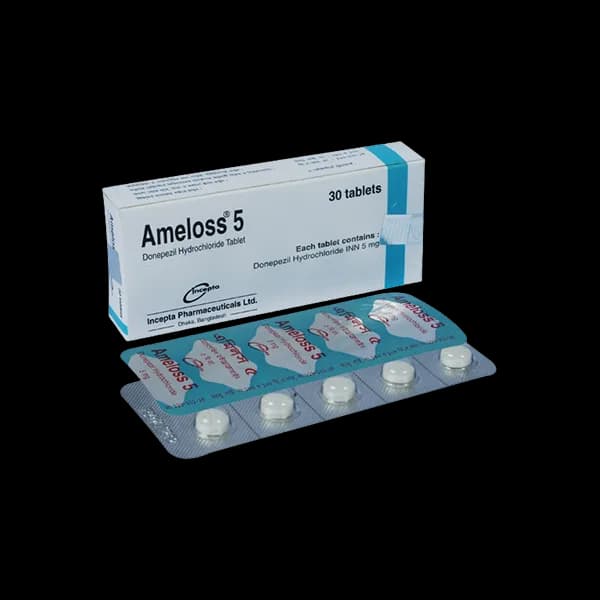

Medicine overview
Indications of Ameloss
Ameloss is a cholinesterase inhibitor used mainly for the symptomatic treatment of Alzheimer's-type dementia. It does not cure or stop the underlying progression of the disease; it helps manage cognitive symptoms.
Established / FDA-approved use
- Treatment of dementia of the Alzheimer's type, including mild, moderate, and severe stages, to improve or stabilize cognitive function and overall clinical function.
Guideline-supported / commonly used off-label
- Cognitive impairment in Parkinson's disease dementia and dementia with Lewy bodies (used off-label in some patients based on specialist judgement).
- Vascular dementia or mixed dementia, sometimes as an adjunct, though evidence is less robust than for Alzheimer's disease.
Any off-label use should only be initiated and monitored by a qualified physician (typically a neurologist or geriatrician).
Composition
Each tablet/capsule contains Donepezil Hydrochloride as the active pharmaceutical ingredient, commonly available in strengths of 5 mg and 10 mg (and in some markets 23 mg extended-release tablets), along with standard pharmaceutical excipients such as fillers, binders, and disintegrants used to formulate the tablet.
Description
Ameloss is a piperidine-derivative, second-generation reversible acetylcholinesterase inhibitor. It is used in the management of Alzheimer's disease, a progressive neurodegenerative disorder characterized by decline in memory and cognitive function.
By slowing the breakdown of acetylcholine in the brain, Ameloss helps compensate for the loss of cholinergic neurons seen in Alzheimer's disease, thereby providing symptomatic (not curative) benefit.
Therapeutic Class
Ameloss belongs to the therapeutic class of anti-dementia agents, specifically the cholinesterase inhibitors (acetylcholinesterase inhibitors), a piperidine-class compound distinct from other cholinesterase inhibitors such as rivastigmine and galantamine.
Pharmacology
Mechanism
Donepezil Hydrochloride is a selective and reversible inhibitor of acetylcholinesterase, the enzyme responsible for breaking down acetylcholine in the central nervous system. By inhibiting this enzyme, Donepezil Hydrochloride increases the concentration of acetylcholine available at cholinergic synapses, which is believed to improve cholinergic neurotransmission that is deficient in Alzheimer's disease.
Pharmacokinetics
- Absorption: Well absorbed orally; peak plasma concentration reached in 3-4 hours; food does not significantly affect absorption.
- Distribution: Approximately 96% bound to plasma proteins.
- Metabolism: Extensively metabolized in the liver via CYP3A4 and CYP2D6 enzymes, and also undergoes glucuronidation.
- Elimination: Long elimination half-life of approximately 70 hours, which supports once-daily dosing; excreted in both urine and feces.
Dosage & Administration of Ameloss
Alzheimer's disease dementia (mild to moderate)
| Population | Typical dose |
|---|---|
| Adults | Initiate at 5 mg once daily at bedtime; may increase to 10 mg once daily after 4-6 weeks based on clinical response and tolerability. |
Alzheimer's disease dementia (moderate to severe)
| Population | Typical dose |
|---|---|
| Adults | After at least 3 months on the 10 mg/day dose, the dose may be further increased to 23 mg once daily, where this formulation is available, under physician supervision. |
Pediatric dose
Not applicable; safety and effectiveness in pediatric patients have not been established (see Pediatric Uses).
Renal impairment
No dose adjustment is required in patients with renal impairment.
Hepatic impairment
Clearance may be reduced in patients with hepatic impairment; dose titration should proceed cautiously and slowly under physician supervision.
Administration
Take once daily in the evening, just before bedtime, with or without food. Tablets should be swallowed with water; do not stop or change the dose without consulting a physician.
Administration of Ameloss
Ameloss is administered orally, once daily, preferably in the evening shortly before bedtime, with or without food. Tablets should be swallowed whole with water. If a dose is missed, it should not be doubled; the next dose should be taken as scheduled, and a physician consulted if several doses are missed since re-titration may be needed.
Interaction of Ameloss
The following interactions with Ameloss are clinically significant and well-documented:
- CYP3A4/CYP2D6 inhibitors (e.g., ketoconazole, itraconazole, quinidine, erythromycin): may increase plasma levels of Ameloss, increasing the risk of cholinergic side effects.
- CYP3A4/CYP2D6 inducers (e.g., rifampin, phenytoin, carbamazepine, chronic alcohol use): may increase the elimination of Ameloss, reducing its effectiveness.
- Anticholinergic drugs: Ameloss may interfere with the activity of anticholinergic medicines, reducing their effect.
- Cholinergic agonists and succinylcholine-type neuromuscular blockers: concurrent use with Ameloss may produce a synergistic effect, exaggerating muscle relaxation during anesthesia; anesthesia providers should be informed if a patient is taking Ameloss.
- NSAIDs: concurrent use may increase the risk of gastrointestinal bleeding, particularly in patients with a history of ulcer disease (see Precautions and Warnings).
- Beta-blockers or other drugs that reduce heart rate: additive risk of bradycardia when combined with Ameloss (see Precautions and Warnings).
Contraindications
Donepezil Hydrochloride is contraindicated in patients with:
- Known hypersensitivity to Donepezil Hydrochloride, piperidine derivatives, or any component of the formulation.
Side Effects of Ameloss
The most commonly reported side effects of Ameloss include:
- Nausea and vomiting
- Diarrhea
- Insomnia and abnormal dreams
- Muscle cramps
- Fatigue
- Anorexia (decreased appetite) and weight loss
- Headache and dizziness
Less common but serious effects that require prompt medical attention include slow heart rate, fainting (syncope), signs of gastrointestinal bleeding (black or bloody stools), difficulty breathing, and seizures (see Precautions and Warnings).
Pregnancy & Lactation
Pregnancy
Alzheimer's disease dementia typically occurs in an age group beyond the reproductive years, so Ameloss is not generally indicated in pregnancy. Adequate and well-controlled human studies are lacking; animal studies have shown adverse effects (including increased stillbirths) at clinically relevant doses in late gestation. Ameloss should be used in pregnancy only if clearly needed and the potential benefit justifies the potential risk to the fetus; a physician must be consulted.
Lactation
It is not known whether Ameloss passes into human breast milk. Because of the potential for serious adverse effects in a nursing infant, breastfeeding is generally not recommended during treatment with Ameloss unless a physician determines it is necessary and safer alternatives are not suitable.
Precautions & Warnings
The following precautions apply to the use of Ameloss:
- Cardiac conduction effects: Ameloss has vagotonic effects on the sinoatrial and atrioventricular nodes and may cause bradycardia, heart block, or syncope, particularly in patients with underlying cardiac conduction abnormalities or those on other heart-rate-lowering drugs.
- Gastrointestinal bleeding risk: Due to increased gastric acid secretion, patients with a history of peptic ulcer disease or those taking NSAIDs concurrently are at increased risk of gastrointestinal bleeding; monitor for symptoms such as black or bloody stools.
- Bladder outflow obstruction: May cause or worsen urinary retention in susceptible patients.
- Seizures: Cholinesterase inhibitors are thought to have some potential to cause generalized convulsions; seizure activity may also be a manifestation of Alzheimer's disease itself.
- Anesthesia: Ameloss is likely to exaggerate succinylcholine-type muscle relaxation during anesthesia; inform the anesthesiologist before any surgical procedure.
- Pulmonary conditions: Use with caution in patients with a history of asthma or obstructive pulmonary disease, as cholinergic effects may worsen these conditions.
- Weight loss: Regular monitoring of body weight is advisable, particularly at higher doses.
Take Ameloss exactly as prescribed by your physician; do not stop, skip doses, alter the dose, or share this medicine with others without medical advice, since abrupt discontinuation may worsen cognitive symptoms.
Overdose Effects of Ameloss
Overdose of Ameloss may cause a cholinergic crisis, with symptoms such as severe nausea, vomiting, salivation, sweating, slow heart rate, low blood pressure, difficulty breathing, muscle weakness, collapse, and convulsions, which can be life-threatening.
Suspected overdose is a medical emergency. Seek immediate medical attention or contact emergency services/poison control; do not attempt home treatment. Management in a hospital setting may include supportive care and administration of an antidote (such as atropine) by trained medical personnel.
Storage Conditions
Store at room temperature (below 30°C), away from light and moisture. Keep out of reach of children.
Use In Special Populations
Elderly
Ameloss is primarily used in the elderly population, as Alzheimer's disease predominantly affects older adults; no specific dose adjustment based on age alone is required, but this population should be monitored closely for cardiac and gastrointestinal side effects.
Renal impairment
No dose adjustment is required (see Dosage and Administration).
Hepatic impairment
Use with caution; clearance may be reduced (see Dosage and Administration).
Pediatric patients
Safety and effectiveness have not been established in pediatric patients (see Pediatric Uses).
Duration Of Treatment
Treatment with Ameloss for Alzheimer's disease is typically long-term/chronic, as it addresses symptoms of an ongoing progressive condition rather than curing it. The physician should periodically reassess whether continued therapy provides clinical benefit, and treatment should not be stopped or changed without medical advice.
Drug Classes
Anti-dementia agent; Cholinesterase inhibitor (Acetylcholinesterase inhibitor); Piperidine derivative.
Mode Of Action
Donepezil Hydrochloride reversibly and selectively inhibits acetylcholinesterase, the enzyme responsible for hydrolyzing acetylcholine in the central nervous system. This inhibition increases the availability of acetylcholine at cholinergic synapses, helping to compensate for the loss of cholinergic neurons that occurs in Alzheimer's disease and thereby improving cholinergic neurotransmission relevant to memory and cognition.
Pregnancy
C
Pediatric Uses
The safety and effectiveness of Ameloss have not been established in pediatric patients. It is not indicated or recommended for use in children or adolescents, and should only be used in adults with a physician-confirmed diagnosis requiring treatment.
Frequently Asked Questions
Q: What is Ameloss 5 mg Tablet used for?
A: Ameloss 5 mg Tablet is used for the symptomatic treatment of mild, moderate, and severe dementia caused by Alzheimer's disease. It helps improve or stabilize memory and thinking abilities but does not cure the disease or stop its underlying progression.
Q: How should I take Ameloss 5 mg Tablet?
A: Ameloss 5 mg Tablet is usually taken once daily in the evening, shortly before bedtime, with or without food. Your physician will start you on a low dose and may gradually increase it based on how well you tolerate the medicine. Do not change your dose or stop the medicine without consulting your physician.
Q: What are the common side effects of Ameloss 5 mg Tablet?
A: Common side effects include nausea, vomiting, diarrhea, difficulty sleeping, muscle cramps, tiredness, and reduced appetite with possible weight loss. Most of these are mild and tend to improve over time, but you should tell your physician if they persist or worsen.
Q: Can Ameloss 5 mg Tablet be used during pregnancy or breastfeeding?
A: Ameloss 5 mg Tablet is not typically needed in women of childbearing age since Alzheimer's disease usually occurs later in life. There is limited human safety data, and animal studies have raised some concerns, so Ameloss 5 mg Tablet should be used in pregnancy only if clearly necessary and the benefit outweighs the potential risk to the fetus. Breastfeeding is generally not recommended during treatment; consult your physician.
Q: Who should not take Ameloss 5 mg Tablet?
A: Ameloss 5 mg Tablet should not be used by anyone with a known hypersensitivity (allergy) to Ameloss 5 mg Tablet or to piperidine derivatives. Patients with certain heart rhythm problems, a history of stomach ulcers or bleeding, seizures, asthma/COPD, or urinary difficulties should discuss these conditions with their physician before starting Ameloss 5 mg Tablet, as extra caution or monitoring may be needed.
Q: What should I do if I take too much Ameloss 5 mg Tablet (overdose)?
A: An overdose of Ameloss 5 mg Tablet can cause a serious cholinergic crisis with symptoms such as severe nausea, vomiting, sweating, a very slow heart rate, difficulty breathing, and convulsions. This is a medical emergency — seek immediate medical attention or contact emergency services or poison control right away rather than trying to manage it at home.
Disclaimer
The information provided is accurate to the best of our knowledge, but it does not replace professional medical advice. We cannot guarantee its completeness or accuracy, and the absence of specific information about a drug should not be taken as an endorsement. We are not responsible for any consequences arising from this information, so please consult a healthcare professional for any concerns or questions.
