10% Off
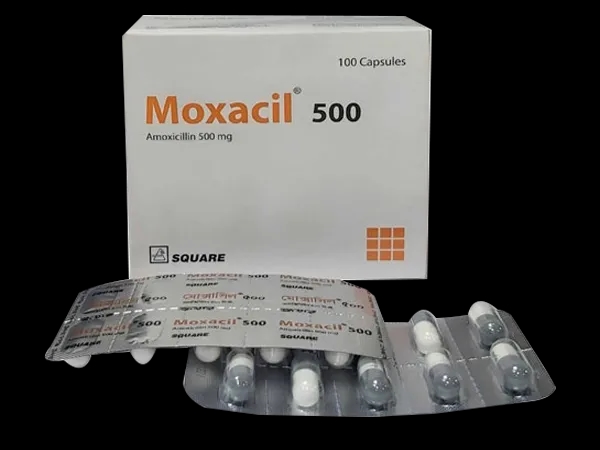
Moxacil500 mg
Square Pharmaceuticals PLC.
৳6.75
Add to cart


Amotid is an established, FDA-approved treatment for infections of the ear, nose, and throat (including acute otitis media, sinusitis, tonsillitis, and pharyngitis) and for lower respiratory tract infections such as bacterial bronchitis and community-acquired pneumonia caused by susceptible, non-beta-lactamase-producing organisms including Streptococcus pneumoniae, Haemophilus influenzae (non-beta-lactamase-producing strains), and Streptococcus pyogenes.
Amotid is established therapy for uncomplicated urinary tract infections caused by susceptible E. coli, Proteus mirabilis, and enterococci, and, at high single-dose regimens combined with probenecid, for uncomplicated gonorrhea (where locally supported by susceptibility data; ceftriaxone-based regimens are now preferred first-line therapy in most current guidelines because of resistance).
Amotid is an established treatment for skin and skin-structure infections caused by susceptible, non-beta-lactamase-producing staphylococci and streptococci.
Amotid is guideline-supported therapy for H. pylori eradication in peptic ulcer disease, but only as part of combination regimens with a proton pump inhibitor and clarithromycin (triple therapy) or with a proton pump inhibitor alone at higher, more frequent dosing (dual therapy); Amotid is never used alone for this indication because monotherapy does not reliably eradicate H. pylori and promotes resistance.
Amotid is commonly used, and supported by dental practice guidance, as short-term therapy for odontogenic (dental) infections and as antibiotic prophylaxis before certain dental procedures in patients at high risk of infective endocarditis, per American Heart Association guidance.
Amotid is a CDC-recognized alternative agent for post-exposure prophylaxis following confirmed susceptible Bacillus anthracis exposure, and for continuation therapy after initial treatment, used under public-health or specialist direction rather than as routine outpatient therapy.
Each tablet or capsule contains Amoxicillin Trihydrate equivalent to 250 mg or 500 mg of amoxicillin. Chewable tablets and oral suspension (powder for reconstitution) formulations of Amoxicillin Trihydrate are also available, commonly providing 125 mg or 250 mg of amoxicillin per 5 mL after reconstitution. Exact strengths and available dosage forms vary by manufacturer.
Amotid is a semi-synthetic, moderate-spectrum, beta-lactam antibiotic of the aminopenicillin subclass. Amotid is bactericidal, acting by inhibiting bacterial cell-wall synthesis, and is active against a range of susceptible gram-positive and gram-negative organisms that do not produce beta-lactamase enzymes. Amotid is chemically and pharmacologically related to ampicillin but is better absorbed after oral administration, allowing less frequent dosing. Amotid is widely used for common bacterial infections of the respiratory tract, ears, urinary tract, skin, and, in combination regimens, for Helicobacter pylori eradication. Amotid does not treat infections caused by viruses, such as the common cold or influenza, and should be taken exactly as prescribed by a qualified healthcare professional.
Antibiotic — Aminopenicillin (beta-lactam antibiotic class)
Amoxicillin Trihydrate is a bactericidal antibiotic that inhibits the biosynthesis of bacterial cell-wall mucopeptide by binding to penicillin-binding proteins (PBPs) located inside the bacterial cell wall, which interferes with cross-linking of the peptidoglycan layer. This weakens the cell wall, ultimately causing bacterial cell lysis and death.
Amoxicillin Trihydrate is stable in gastric acid and is well and rapidly absorbed after oral administration, largely independent of food intake, with peak plasma concentrations typically reached within 1 to 2 hours of dosing. Amoxicillin Trihydrate is widely distributed into most body tissues and fluids, with relatively low plasma protein binding (approximately 20%). Only a small proportion of Amoxicillin Trihydrate is metabolized; the majority is excreted unchanged in the urine via renal tubular secretion and glomerular filtration, giving Amoxicillin Trihydrate a short elimination half-life of approximately 1 to 1.5 hours in patients with normal renal function. Renal impairment prolongs the half-life of Amoxicillin Trihydrate and requires dose-interval adjustment.
The dose, frequency, and duration of Amotid depend on the specific infection being treated, its severity, the causative organism (where known), and the patient's age, weight, and renal function. The regimens below reflect commonly cited, guideline- and label-based dosing and must be individualized by a qualified healthcare professional; the dosing used for one indication is not necessarily appropriate for another.
Amoxicillin Trihydrate is contraindicated in patients with a known history of a serious hypersensitivity reaction (e.g., anaphylaxis, angioedema, or Stevens-Johnson syndrome) to Amoxicillin Trihydrate, to any other penicillin-class antibiotic, or to any component of the formulation. Amoxicillin Trihydrate is also contraindicated in patients with a known history of an immediate-type hypersensitivity reaction to other beta-lactam antibiotics (e.g., cephalosporins), given the risk of cross-reactivity.
Amotid is widely considered one of the preferred antibiotics for use in pregnancy when a susceptible bacterial infection requires treatment, based on extensive clinical experience and reproduction studies that have not demonstrated an increased risk of fetal harm. However, as with any medicine in pregnancy, Amotid should be used only when clearly needed, and the potential benefit should justify the potential risk to the fetus; use of Amotid in pregnancy should always be discussed with and directed by a qualified physician.
Amotid is excreted into human breast milk in small amounts. Amotid is generally considered compatible with breastfeeding by most authorities, but the nursing infant should be monitored for possible effects on gut flora, such as diarrhea, thrush, or, rarely, allergic sensitization/rash. Consult a physician before using Amotid while breastfeeding, particularly for prolonged courses.
Reported effects of Amotid overdose include gastrointestinal symptoms such as nausea, vomiting, diarrhea, and abdominal pain, along with disturbances in fluid and electrolyte balance. Crystalluria, which may rarely lead to renal impairment, has been reported with very high doses of Amotid, particularly with inadequate fluid intake. In patients with renal impairment or after very high doses, Amotid has rarely been associated with seizures.
If an overdose of Amotid is suspected, seek immediate medical attention or contact a poison control center right away. Management is supportive; maintaining adequate fluid intake and urine output may help prevent crystalluria. Amotid can be removed from the circulation by hemodialysis in cases of severe renal impairment. Do not attempt to manage a suspected overdose at home without professional medical guidance.
Store Amotid tablets, capsules, and unreconstituted powder for oral suspension at room temperature (below 30°C/86°F), away from direct light and moisture, in the original container, and out of the reach and sight of children. Once the oral suspension of Amotid has been reconstituted with water, it should be stored in a refrigerator (2–8°C), keeping it away from freezing, and any unused portion should be discarded after 14 days. Do not use Amotid beyond its expiry date.
Amotid is approved for use in infants and children, with dosing based on body weight for those under approximately 40 kg and adult dosing thereafter. Dosing of Amotid in neonates and infants up to 3 months of age is more conservative, reflecting immature renal function; see Pediatric Uses below.
No specific dose reduction of Amotid is required in elderly patients based on age alone, provided renal function is normal. Because renal function commonly declines with age, elderly patients should have renal function assessed, and the dosing interval of Amotid adjusted accordingly if impairment is present.
Because Amotid is eliminated primarily by the kidneys, patients with moderate to severe renal impairment (CrCl below approximately 30 mL/min) require an extended dosing interval of Amotid to avoid drug accumulation; consult a nephrology or pharmacy dosing reference for precise adjustment based on the degree of impairment.
Amotid is metabolized only to a limited extent by the liver, and formal dose adjustment for hepatic impairment is not well established; nonetheless, Amotid should be used with caution and liver function monitored in patients with significant pre-existing liver disease, as hepatic effects have rarely been reported with penicillins.
See the Pregnancy and Lactation section above for detailed guidance on the use of Amotid in this population.
Powder for oral suspension formulations of Amotid must be reconstituted before use. To reconstitute, add the amount of water specified on the manufacturer's label in two portions, shaking well after each addition, to obtain a uniform suspension at the labeled concentration (commonly 125 mg/5 mL or 250 mg/5 mL). Shake the reconstituted suspension of Amotid well before each dose. Store the reconstituted suspension in a refrigerator (2–8°C) and discard any unused portion after 14 days. Do not freeze the reconstituted suspension of Amotid.
Antibiotics > Beta-lactam antibiotics > Penicillins > Aminopenicillins
Amoxicillin Trihydrate exerts its bactericidal effect by binding to specific penicillin-binding proteins (PBPs) located within the bacterial cell wall. This binding inhibits the transpeptidation (cross-linking) step of peptidoglycan synthesis, which is essential for maintaining bacterial cell-wall structure and integrity. Interference with cell-wall synthesis, combined with continued activation of bacterial autolytic enzymes, leads to lysis and death of actively dividing, susceptible bacteria. Amoxicillin Trihydrate lacks activity against organisms that produce beta-lactamase enzymes, which hydrolyze and inactivate the beta-lactam ring of Amoxicillin Trihydrate before it can act.
B (FDA legacy pregnancy category, as previously assigned prior to the current Pregnancy and Lactation Labeling Rule; see Pregnancy and Lactation section for current, narrative-based guidance)
Amotid is approved for use in infants and children for the same categories of susceptible bacterial infections as in adults, with dosing based on body weight (mg/kg/day, divided into 2–3 doses) for children generally weighing less than approximately 40 kg; children at or above this weight are typically dosed using adult regimens of Amotid. For acute otitis media, the American Academy of Pediatrics supports a higher-dose regimen of Amotid (80–90 mg/kg/day) in areas with significant rates of resistant Streptococcus pneumoniae, to improve the likelihood of achieving effective drug concentrations against less-susceptible strains.
In neonates and infants up to 3 months of age, dosing of Amotid is more conservative (maximum 30 mg/kg/day in divided doses every 12 hours) because of immature renal function and reduced drug clearance in this age group; safety and efficacy of specific higher-dose regimens have not been established in this youngest population, and dosing should be directed by a pediatrician or neonatologist. Chewable tablets and oral suspension formulations of Amotid are generally preferred for children who cannot swallow tablets or capsules.
Q: What is Amotid 500 mg Capsule used for?
A: Amotid 500 mg Capsule is an antibiotic used to treat a range of bacterial infections, including infections of the ear, nose, and throat, lower respiratory tract infections such as bronchitis and pneumonia, urinary tract infections, skin infections, and dental infections. Amotid 500 mg Capsule is also used, in combination with other medicines, to help eradicate Helicobacter pylori bacteria in peptic ulcer disease. Amotid 500 mg Capsule does not work against viral infections such as the common cold or flu.
Q: What is the usual dose of Amotid 500 mg Capsule?
A: The dose of Amotid 500 mg Capsule depends on the infection being treated, the patient's age and weight, and kidney function. Common adult doses range from 250 mg every 8 hours to 500 mg every 8–12 hours for standard infections, and up to 1 g twice daily as part of combination therapy for H. pylori. Children are usually dosed by body weight. Only a qualified healthcare professional can determine the correct dose of Amotid 500 mg Capsule for a specific patient; see the Dosage section above for indication-specific detail.
Q: Can Amotid 500 mg Capsule be taken with food?
A: Yes. Amotid 500 mg Capsule can be taken with or without food. Taking Amotid 500 mg Capsule with food may help reduce stomach upset and does not meaningfully reduce how well it is absorbed.
Q: Is Amotid 500 mg Capsule safe during pregnancy?
A: Amotid 500 mg Capsule is widely regarded as one of the preferred antibiotics for use during pregnancy when treatment of a bacterial infection is genuinely needed, and available data have not shown an increased risk of birth defects. Even so, Amotid 500 mg Capsule should be used in pregnancy only when clearly needed, with the potential benefit judged by a physician to justify the potential risk to the fetus, and always under medical supervision.
Q: Can Amotid 500 mg Capsule cause an allergic reaction?
A: Yes. Amotid 500 mg Capsule belongs to the penicillin class of antibiotics, and penicillin allergy is one of the most common drug allergies. Symptoms can range from mild skin rash to severe, life-threatening anaphylaxis (swelling of the face/throat, difficulty breathing). Amotid 500 mg Capsule is contraindicated in anyone with a known serious allergy to penicillins or other beta-lactam antibiotics; tell your doctor about any past drug allergies before starting Amotid 500 mg Capsule.
Q: What should I do if I miss a dose of Amotid 500 mg Capsule?
A: If you miss a dose of Amotid 500 mg Capsule, take it as soon as you remember, unless it is almost time for your next scheduled dose, in which case skip the missed dose and continue your regular dosing schedule — do not take a double dose to make up for a missed one. Take Amotid 500 mg Capsule exactly as prescribed by your physician; do not stop, extend, skip doses, or share this medicine with others without medical advice, and complete the full course even if you feel better.
Disclaimer
The information provided is accurate to the best of our knowledge, but it does not replace professional medical advice. We cannot guarantee its completeness or accuracy, and the absence of specific information about a drug should not be taken as an endorsement. We are not responsible for any consequences arising from this information, so please consult a healthcare professional for any concerns or questions.