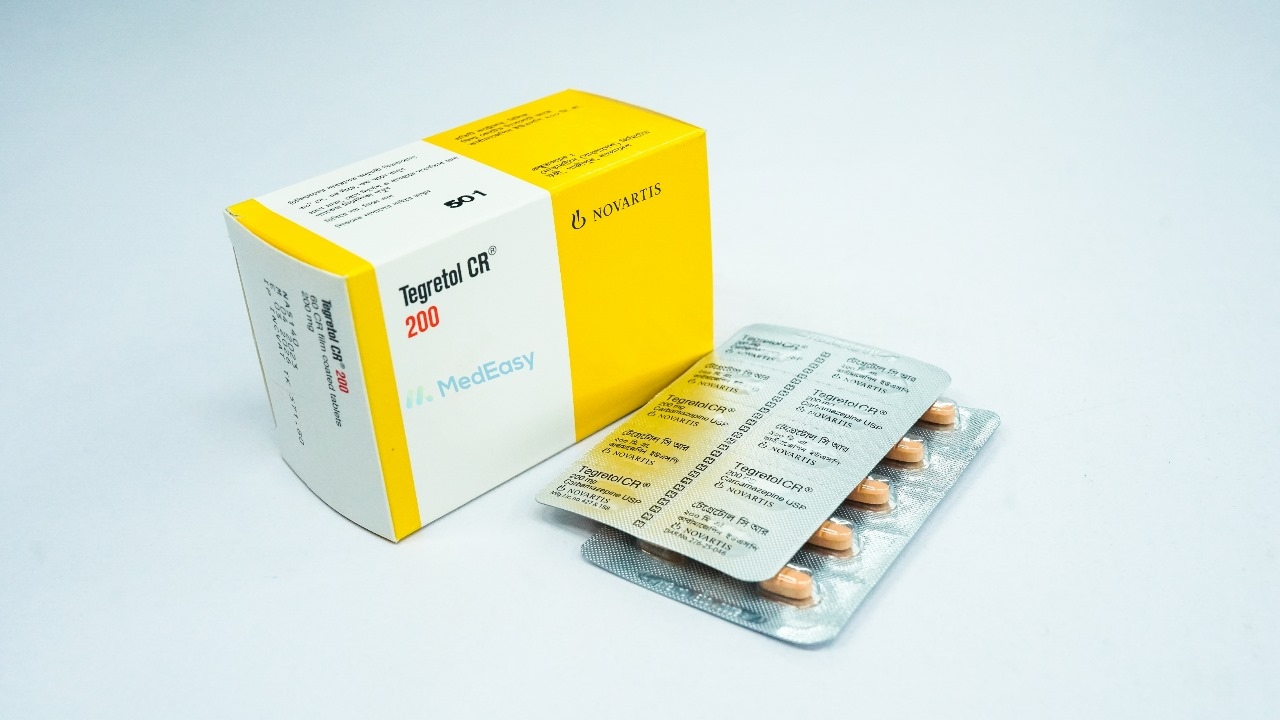
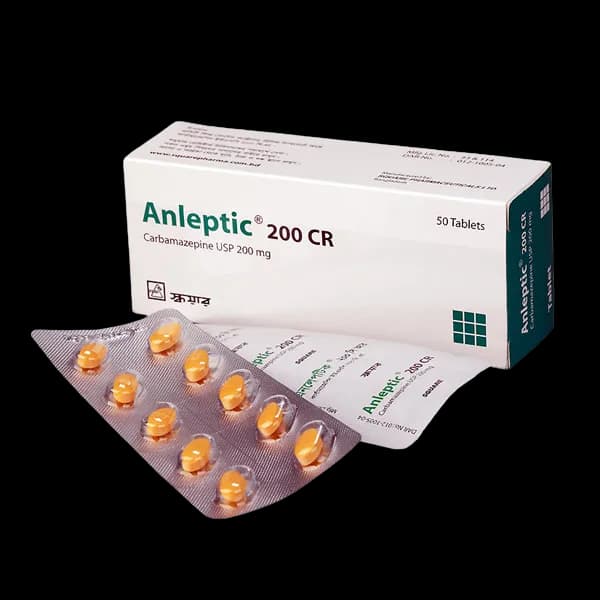
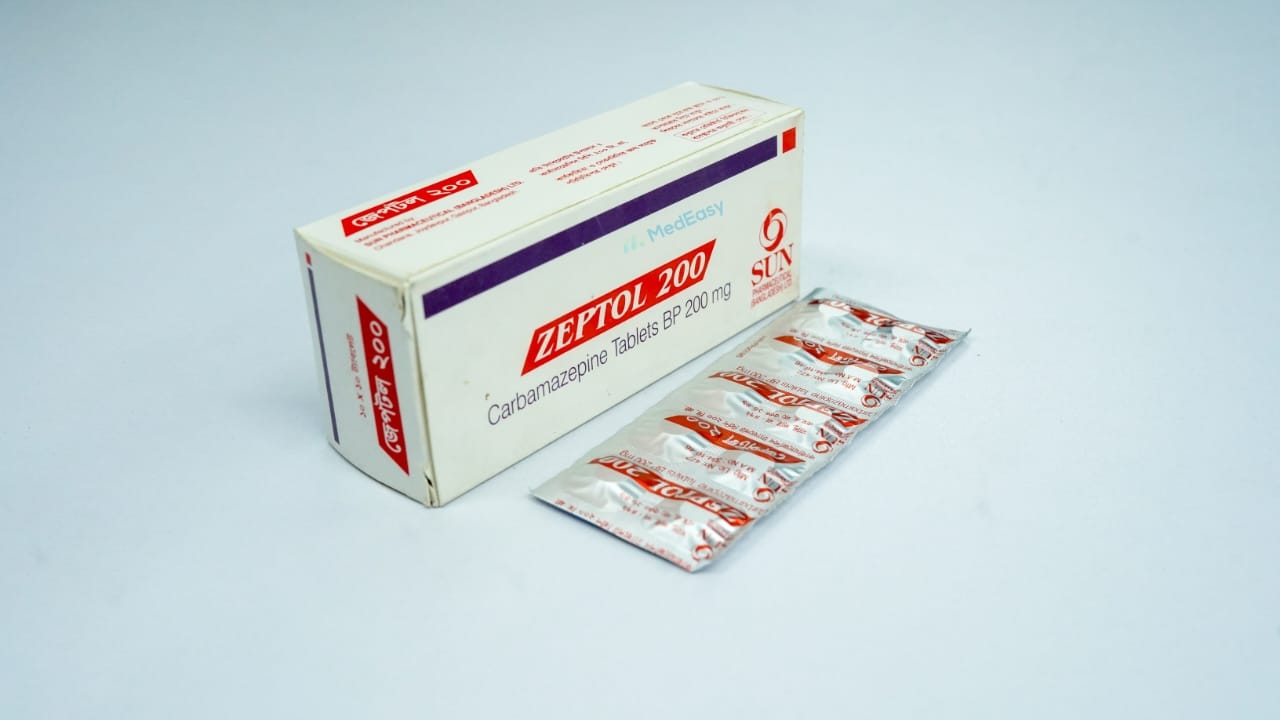
Anleptic CR 200 mg is indicated for-
partial and secondary generalized tonic-clonic seizures
Primary generalized tonic-clonic seizures
Trigeminal neuralgia
Prophylaxis of bipolar disorder
Theropeutic Class
Primary anti-epileptic drugs
Pharmacology
Anleptic CR 200 mg depresses activity in the nucleus ventralis of the thalamus, reduces synaptic propagation of excitatory impulses or decreases summation of temporal stimulation leading to neural discharge by limiting influx of Na ions across cell membrane or other unknown mechanisms. It stimulates the release of antidiuretic hormone (ADH) and potentiates its action in promoting reabsorption of water.
Dosage & Administration of Anleptic CR 200 mg
Epilepsy:
Adults and children over 12 years of age- Initial: Either 200 mg b.i.d. for tablets and controlled release tablets, or 1 teaspoon q.i.d. for suspension (400 mg/day). Increase at weekly intervals by adding up to 200 mg/day using a b.i.d or a t.i.d. or q.i.d. regimen of the either formulations until the optimal response is obtained.
Children 12-15 years of age- Dosage generally should not exceed 1000 mg daily, and 1200 mg daily in patients above 15 years of age. Doses up to 1600 mg daily have been used in adults in rare instances. Maintenance: usually 800-1200 mg daily.
Children 6-12 years of age- Initial: Either 100 mg b.i.d. for tablets or controlled release tablets, or 1/2 teaspoon q.i.d. for suspension (200 mg/day). Increase at weekly intervals by adding up to 100 mg/day using a b.i.d. or a t.i.d.or q.i.d. regimen of the either formulations until the optimal response is obtained. Dosage generally should not exceed 1000 mg daily. Maintenance:usually 400-800 mg daily.
Children under 6 years of age- Initial: 10-20 mg/kg/day b.i.d.or t.i.d. as tablets, or q.i.d. as suspension. Increase weekly to achieve optimal clinical response administered t.i.d. or q.i.d. Maintenance: Ordinarily, optimal clinical response is achieved at daily doses below 35 mg/kg. If satisfactory clinical response has not been achieved, plasma levels should be measured to determine whether or not they are in the therapeutic range. No recommendation regarding the safety of Anleptic CR 200 mg for use at doses above 35 mg/kg/24 hours can be made.
Combination therapy: Anleptic CR 200 mg may be used alone or with other anticonvulsants. When added to existing anticonvulsant therapy, the drug should be added gradually while the other anticonvulsants are maintained or gradually decreased, except phenytoin, which may have to be increased.Trigeminal Neuralgia: Initial: On the first day,either 100 mg b.i.d. for tablets or controlled release tablets, or 1/2 teaspoon q.i.d. for suspension, for a total daily dose of 200 mg. This daily dose may be increased by up to 200 mg/day using increments of 100 mg every 12 hours for tablets or controlled release tablets, or 50 mg (1/2 teaspoon) q.i.d. for suspension, only as needed to achieve freedom from pain. A total dose of 1200 mg daily shouldn't be exceeded. Maintenance: Control of pain can be maintained in most patients with 400-800 mg daily. However, some patients may be maintained on as little as 200 mg daily, while others may require as much as 1200 mg daily. At least once every 3 months throughout the treatment period, attempts should be made to reduce the dose to the minimum effective level or even to discontinue the drug. The tablets or syrup can be taken without regards to meal.
Dosage of Anleptic CR 200 mg
Epilepsy:
Adults and children over 12 years of age- Initial: Either 200 mg b.i.d. for tablets and controlled release tablets, or 1 teaspoon q.i.d. for suspension (400 mg/day). Increase at weekly intervals by adding up to 200 mg/day using a b.i.d or a t.i.d. or q.i.d. regimen of the either formulations until the optimal response is obtained.
Children 12-15 years of age- Dosage generally should not exceed 1000 mg daily, and 1200 mg daily in patients above 15 years of age. Doses up to 1600 mg daily have been used in adults in rare instances. Maintenance: usually 800-1200 mg daily.
Children 6-12 years of age- Initial: Either 100 mg b.i.d. for tablets or controlled release tablets, or 1/2 teaspoon q.i.d. for suspension (200 mg/day). Increase at weekly intervals by adding up to 100 mg/day using a b.i.d. or a t.i.d.or q.i.d. regimen of the either formulations until the optimal response is obtained. Dosage generally should not exceed 1000 mg daily. Maintenance:usually 400-800 mg daily.
Children under 6 years of age- Initial: 10-20 mg/kg/day b.i.d.or t.i.d. as tablets, or q.i.d. as suspension. Increase weekly to achieve optimal clinical response administered t.i.d. or q.i.d. Maintenance: Ordinarily, optimal clinical response is achieved at daily doses below 35 mg/kg. If satisfactory clinical response has not been achieved, plasma levels should be measured to determine whether or not they are in the therapeutic range. No recommendation regarding the safety of Anleptic CR 200 mg for use at doses above 35 mg/kg/24 hours can be made.
Combination therapy: Anleptic CR 200 mg may be used alone or with other anticonvulsants. When added to existing anticonvulsant therapy, the drug should be added gradually while the other anticonvulsants are maintained or gradually decreased, except phenytoin, which may have to be increased.Trigeminal Neuralgia: Initial: On the first day,either 100 mg b.i.d. for tablets or controlled release tablets, or 1/2 teaspoon q.i.d. for suspension, for a total daily dose of 200 mg. This daily dose may be increased by up to 200 mg/day using increments of 100 mg every 12 hours for tablets or controlled release tablets, or 50 mg (1/2 teaspoon) q.i.d. for suspension, only as needed to achieve freedom from pain. A total dose of 1200 mg daily shouldn't be exceeded. Maintenance: Control of pain can be maintained in most patients with 400-800 mg daily. However, some patients may be maintained on as little as 200 mg daily, while others may require as much as 1200 mg daily. At least once every 3 months throughout the treatment period, attempts should be made to reduce the dose to the minimum effective level or even to discontinue the drug. The tablets or syrup can be taken without regards to meal.
Interaction of Anleptic CR 200 mg
Galactorrhoea has been reported in few women on oral contraceptives within the first two months of Anleptic CR 200 mg treatment Hepatic enzyme inducers such as Anleptic CR 200 mg and Phenytoin may interact with Anleptic CR 200 mg by increasing its metabolism. So an increase in dosage of Anleptic CR 200 mg may be required.
Contraindications
This medicine should not be used if anybody is allergic to one or any of its ingredients. It can not be used also in the following conditions:
Problems with the electrical message pathways in the heart (atrioventricular block)
History of decreased blood cell production by the bone marrow (bone marrow depression)
Hereditary blood disorders called porphyrias
Allergy to tricyclic antidepressants
People who have taken a monoamine-oxidase inhibitor antidepressant (MAOI) in the last 14 days
Side Effects of Anleptic CR 200 mg
The common side effects are dizziness, drowsiness, ataxia, dry mouth, abdominal pain, nausea, vomiting, anorexia, leucopenia, proteinuria, bradycardia, heart failure and hypotension. Erythematous skin rash, aplastic anemia may also be observed. The most severe adverse reactions have been observed in the hemopoietic system, the skin and the cardiovascular system.The most frequently observed adverse reactions, particularly during the initial phases of therapy, are dizziness, drowsiness, unsteadiness, nausea, and vomiting. This medicine may cause increased sensitivity to the sun. Exposure to the sun, sunlamps, or tanning booths should be avoided if the increased sensitivity is seen. A sunscreen or protective clothing may be helpful at outside for a prolonged period.
Pregnancy & Lactation
Pregnancy category D. Anleptic CR 200 mg and its epoxide metabolite are transferred to breast milk. Because of the potential serious side effects, decision should me made whether to discontinue nursing or discontinue the drug.
Precautions & Warnings
This medicine may cause dizziness and drowsiness.Special care should be taken while performing potentially hazardous activities, such as driving or operating machinery.This medicine may cause skin reactions. If any rash,skin peeling, itching, or other unexplained skin reaction is seen while taking this medicine the concerned doctor should be informed immediately.This medicine may rarely cause liver problems.For this reason, consultation with doctor is needed if unexplained itching, yellowing of the skin or eyes, unusually dark urine, nausea and vomiting, abdominal pains, and loss of appetite or flu-like symptoms.Anleptic CR 200 mg decreases the blood levels of hormonal contraceptives containing estrogen and/or progesterone, which may make the contraceptive ineffective or result in breakthrough bleeding.Women taking this medicine who require contraception should be prescribed a contraceptive containing at least 50 micrograms of oestrogen,or use non-hormonal methods of contraception, such as condoms.Taking this medicine should not be stopped suddenly unless the doctor tells. Otherwise, as suddenly stopping treatment is likely to make the symptoms return.If this medicine is stopped, it should normally be done gradually, under the supervision of a specialist.Caution should be taken in-
Mixed seizures including absence seizures
Elderly people
History of heart disease
History of kidney disease
History of liver disease
History of psychotic illness
Raised pressure in the eye (intraocular pressure), eg.glaucoma
History of blood disorders that were caused by any other medication
History of previous Anleptic CR 200 mg therapy that was interrupted due to side effects or allergy
Storage Conditions
Keep below 30°C temperature, away from light & moisture. Keep out of the reach of children.
Drug Classes
Primary anti-epileptic drugs
Mode Of Action
Anleptic CR 200 mg depresses activity in the nucleus ventralis of the thalamus, reduces synaptic propagation of excitatory impulses or decreases summation of temporal stimulation leading to neural discharge by limiting influx of Na ions across cell membrane or other unknown mechanisms. It stimulates the release of antidiuretic hormone (ADH) and potentiates its action in promoting reabsorption of water.
Pregnancy
Pregnancy category D. Anleptic CR 200 mg and its epoxide metabolite are transferred to breast milk. Because of the potential serious side effects, decision should me made whether to discontinue nursing or discontinue the drug.
Frequently Asked Questions
What is Anleptic CR 200 mg used for?
Anleptic CR 200 mg is indicated for- partial and secondary generalized tonic-clonic seizures Primary generalized tonic-clonic seizures Trigeminal neuralgia Prophylaxis of bipolar disorder
What is the dosage of Anleptic CR 200 mg?
Epilepsy: Adults and children over 12 years of age- Initial: Either 200 mg b.i.d. for tablets and controlled release tablets, or 1 teaspoon q.i.d. for suspension (400 mg/day). Increase at weekly intervals by adding up to 200 mg/day using a b.i.d or a t.i.d. or q.i.d. regimen of the either formulations until the optimal response is obtained. Children 12-15 years of age- Dosage generally should not …
What are the side effects of Anleptic CR 200 mg?
The common side effects are dizziness, drowsiness, ataxia, dry mouth, abdominal pain, nausea, vomiting, anorexia, leucopenia, proteinuria, bradycardia, heart failure and hypotension. Erythematous skin rash, aplastic anemia may also be observed. The most severe adverse reactions have been observed in the hemopoietic system, the skin and the cardiovascular system.The most frequently observed adverse…
Who should not take Anleptic CR 200 mg?
This medicine should not be used if anybody is allergic to one or any of its ingredients. It can not be used also in the following conditions: Problems with the electrical message pathways in the heart (atrioventricular block) History of decreased blood cell production by the bone marrow (bone marrow depression) Hereditary blood disorders called porphyrias Allergy to tricyclic antidepressants Peop…
What precautions should be taken with Anleptic CR 200 mg?
This medicine may cause dizziness and drowsiness.Special care should be taken while performing potentially hazardous activities, such as driving or operating machinery.This medicine may cause skin reactions. If any rash,skin peeling, itching, or other unexplained skin reaction is seen while taking this medicine the concerned doctor should be informed immediately.This medicine may rarely cause live…
Is Anleptic CR 200 mg safe during pregnancy and breastfeeding?
Pregnancy category D. Anleptic CR 200 mg and its epoxide metabolite are transferred to breast milk. Because of the potential serious side effects, decision should me made whether to discontinue nursing or discontinue the drug.
Disclaimer
The information provided is accurate to our best practices, but it does not replace professional medical advice. We cannot guarantee its completeness or accuracy. The absence of specific information about a drug should not be seen as an endorsement. We are not responsible for any consequences resulting from this information, so consult a healthcare professional for any concerns or questions.