
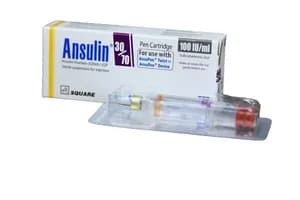
Ansulin30%+70% in 100 IU/ml

Medicine overview
Indications of Ansulin
Ansulin is a premixed (biphasic) suspension of short-acting soluble (regular) human insulincombined with intermediate-acting isophane (NPH) human insulin, used to lower blood glucose in people with diabetes mellitus.
- Type 1 diabetes mellitus (established/FDA-approved use) — as part of a regimen to achieve glycemic control in patients who require exogenous insulin.
- Type 2 diabetes mellitus (established/guideline-supported use) — in patients whose blood glucose is not adequately controlled by diet, exercise, weight management, and/or oral antidiabetic agents alone.
- Stress-related hyperglycemia (e.g., during acute illness, infection, surgery, or corticosteroid therapy) — adjunct use, typically short-term and physician-directed.
Ansulin is a fixed-ratio premixed insulin and is not intended for intravenous use, for treatment of diabetic ketoacidosis, or for use in insulin infusion pumps; a short-acting insulin alone is used for those situations.
Composition
Insulin Human [rDNA] + Isophane Insulin Human is a biosynthetic human insulin produced by recombinant DNA (rDNA) technology, typically supplied as afixed-ratio suspension containing approximately 30% soluble (regular) human insulin and70% isophane (NPH) human insulin per mL (commonly described as a 30/70 premix; other locally availableratios such as 50/50 may also exist). Each mL generally provides 100 IU of total human insulin. Excipients typicallyinclude protamine sulfate, zinc oxide, m-cresol, phenol, glycerin, and water for injection, with pH adjusters as needed.
Description
Ansulin is a biphasic (premixed) insulin preparation combining a rapid-onset, short-duration soluble insulincomponent with a slower-onset, longer-acting isophane (NPH) insulin component in a single fixed-ratio suspension.This combination is designed to provide both prandial (meal-time) and basal (background) insulin coverage from asingle subcutaneous injection, reducing the number of daily injections compared with separate short- andintermediate-acting insulin regimens. Ansulin is manufactured using recombinant DNA technology and is structurallyidentical to endogenous human insulin.
Therapeutic Class
Premixed (biphasic) human insulin — Antidiabetic agent, insulin and insulin analogues (Ansulin)
Pharmacology
Insulin Human [rDNA] + Isophane Insulin Human lowers blood glucose by binding to insulin receptors on skeletal muscle, adipose tissue, and liver cells,stimulating peripheral glucose uptake and glycogen synthesis while suppressing hepatic glucose output, lipolysis,and proteolysis. Because it is a biphasic mixture, its time-action profile reflects both components:
| Parameter | Soluble (regular) component | Isophane (NPH) component |
|---|---|---|
| Onset of action | ~30 minutes | ~1–2 hours |
| Peak effect | 2–4 hours | 4–12 hours |
| Duration of action | up to ~8 hours | up to ~18–24 hours |
Because the two components act together, Insulin Human [rDNA] + Isophane Insulin Human produces an overall glucose-lowering effect lasting up to 24 hours,with an early peak (from the regular component) and a broader intermediate peak (from the isophane component).Individual response varies with injection site, dose, exercise, and other factors.
Dosage & Administration of Ansulin
The dose of Ansulin must be individualized by the treating physician based on blood glucosemonitoring, metabolic needs, target HbA1c, meal pattern, and activity level. Patients must not adjust their owndose without medical advice.
| Indication | Typical dosing guidance |
|---|---|
| Type 1 diabetes mellitus | Usually part of a total daily insulin requirement of about 0.5–1.0 IU/kg/day, individualized; Ansulin is typically given once or twice daily before meals as directed by the physician. |
| Type 2 diabetes mellitus | Often started at a lower total daily dose (e.g., around 0.2–0.6 IU/kg/day) once or twice daily before meals, then titrated by the physician according to blood glucose response. |
| Pediatric patients | Individualized by a pediatric endocrinologist/diabetes specialist; see Use in Special Populations. |
Administration technique
- Give by subcutaneous injection only, generally 15–30 minutes before a meal, into the abdomen, thigh, upper arm, or buttock.
- Rotate injection sites within the same body region with each injection to reduce the risk of lipodystrophy (lumps or pitting under the skin) and to keep insulin absorption consistent.
- Gently roll or invert the vial/pen (do not shake vigorously) to re-suspend the insulin evenly before drawing up or dialing a dose; the suspension should look uniformly cloudy/milky.
- Do not use if the suspension remains clear, contains clumps, or has particles/discoloration after mixing.
- Do not administer intravenously or intramuscularly, and do not use in an insulin infusion pump.
- Do not mix Ansulin with other insulin products in the same syringe unless specifically directed by a physician.
See also Dosage, Administration, Use in Special Populations, and Precautions and Warnings for further detail.
Administration of Ansulin
Ansulin is for subcutaneous injection only. Inject 15–30 minutes before a meal into theabdomen, thigh, upper arm, or buttock, rotating the exact injection point with each dose. Before use, gently rollthe vial/pen between the palms and tip it end-to-end several times to re-suspend the insulin until uniformly cloudy;avoid vigorous shaking, which can cause froth or air bubbles that affect the dose. Use each vial/pen/needle once anddispose of needles safely in a puncture-proof container. Do not share pens or needles between patients, even afterchanging the needle.
Interaction of Ansulin
Many medicines can alter the blood-glucose-lowering effect of Ansulin, increasing the risk of either hypoglycemiaor hyperglycemia. Report all medicines, including over-the-counter drugs and herbal products, to the prescribingphysician.
| Interacting agents | Effect / clinical consequence |
|---|---|
| Oral antidiabetics, ACE inhibitors, angiotensin II receptor blockers, salicylates, MAO inhibitors, alcohol, sulfonamide antibiotics, octreotide | May enhance the glucose-lowering effect and increase risk of hypoglycemia. |
| Corticosteroids, thiazide diuretics, thyroid hormones, danazol, protease inhibitors, some antipsychotics, oral contraceptives/estrogens, sympathomimetics (e.g., epinephrine, albuterol) | May reduce the glucose-lowering effect and increase risk of hyperglycemia, requiring dose adjustment. |
| Beta-blockers, clonidine | May blunt or mask the warning signs (tremor, palpitations) of hypoglycemia, delaying recognition. |
| Pioglitazone/other thiazolidinediones | Combined use with insulin, including Ansulin, increases the risk of fluid retention and heart failure, particularly in patients with cardiac risk factors. |
Contraindications
Insulin Human [rDNA] + Isophane Insulin Human is contraindicated in:
- Patients with a known hypersensitivity to human insulin or to any excipient of the formulation.
- During episodes of hypoglycemia (low blood glucose).
Side Effects of Ansulin
The most common and important adverse effect of Ansulin is hypoglycemia (see Overdose Effects andPrecautions and Warnings). Other reported side effects include:
- Injection-site reactions (redness, swelling, itching, or pain).
- Lipodystrophy (thickening, lumps, or pitting of fat tissue) at sites of repeated injection without rotation.
- Weight gain and, occasionally, peripheral edema (fluid retention), especially when starting insulin or intensifying therapy.
- Hypokalemia (low blood potassium), which can be serious, particularly in patients with cardiac disease or those on potassium-lowering medicines.
- Generalized hypersensitivity reactions — rash, itching, sweating, gastrointestinal upset, and rarely, life-threatening anaphylaxis or angioedema.
- Transient visual disturbance (blurred vision) with initiation of therapy or rapid changes in glucose control, usually resolving with continued treatment.
Pregnancy & Lactation
Insulin, including Ansulin, does not cross the placenta in clinically significant amounts and is generally thepreferred treatment for diabetes during pregnancy when glycemic control cannot be achieved by lifestyle measuresalone; however, Ansulin should be used in pregnancy only under close physician supervision, with the dose adjusted asneeded since insulin requirements often fall in the first trimester and rise during the second and third trimesters,returning toward pre-pregnancy needs after delivery. Use only if clearly needed and as directed by the treatingphysician, with regular blood glucose monitoring.
Insulin passes into breast milk in small amounts but is broken down in the infant's digestive tract and is notexpected to harm a breastfed infant; breastfeeding mothers using Ansulin may need dose and dietary adjustments andshould do so under medical supervision.
Precautions & Warnings
Hypoglycemia is the most frequent and clinically important risk with Ansulin. Patients andcaregivers should be educated to recognize early symptoms (sweating, shakiness, palpitations, hunger, confusion) andto always carry a fast-acting source of sugar. Risk is increased by skipped or delayed meals, unplanned exercise,alcohol intake, and dose errors.
- Do not interchange Ansulin with other insulin products, brands, strengths, or types without aphysician's explicit instruction and dose re-evaluation, as this can lead to serious dosing errors.
- Rotate injection sites systematically to avoid lipodystrophy, which can affect insulin absorption and glucose control.
- Because Ansulin is a fixed-ratio premix, the short- and intermediate-acting components cannot be titratedindependently; if separate adjustment of meal-time and background insulin is needed, the physician may switch toindividual insulin components.
- Monitor for hypokalemia, especially in patients with reduced potassium intake, concurrentpotassium-lowering medicines, or cardiac disease.
- Illness, infection, surgery, changes in diet, exercise, and alcohol use can all alter insulin requirements; donot change the dose without medical advice.
- Ansulin must not be given intravenously, intramuscularly, or through an insulin infusion pump.
- Use caution when driving or operating machinery if hypoglycemia awareness is reduced.
- Inspect the suspension before each use; do not use if it fails to re-suspend to a uniform cloudy appearance or contains particles.
Overdose Effects of Ansulin
Overdose of Ansulin relative to food intake, exercise, or physical demand causes hypoglycemia,which may present as sweating, tremor, palpitations, hunger, confusion, drowsiness, seizures, or loss ofconsciousness. Mild-to-moderate hypoglycemia should be treated promptly with oral fast-acting carbohydrate (e.g.,glucose tablets, juice, sugar), followed by a longer-acting carbohydrate snack. Severe hypoglycemia with confusion,seizure, or unconsciousness is a medical emergency: administer glucagon if available and trained to do so, and seekimmediate medical attention or emergency services without delay; intravenous glucose may be requiredin hospital. Do not attempt to manage severe hypoglycemia at home without professional help.
Storage Conditions
Store unopened vials/pens/cartridges of Ansulin in a refrigerator (2–8°C); do not freeze, and discard if it has been frozen. Once in use, the vial/pen may generally be kept at room temperature (below 30°C), away from direct heat and light, and should be discarded after the period stated on the product label (commonly around 4–6 weeks), even if insulin remains. Keep out of reach of children, and always check the expiry date before use.
Use In Special Populations
Renal impairment: Insulin requirements may be reduced because insulin clearance can decrease withworsening kidney function, increasing hypoglycemia risk; monitor blood glucose closely and adjust the dose of Ansulinunder physician guidance.
Hepatic impairment: Insulin requirements may be reduced due to decreased capacity forgluconeogenesis and insulin metabolism; monitor closely and individualize the dose.
Elderly patients: Use with caution; age-related decline in renal/hepatic function and irregularfood intake can increase hypoglycemia risk. Start conservatively and titrate carefully.
Pediatric patients: See Pediatric Uses.
Pregnancy and lactation: See Pregnancy and Lactation.
Duration Of Treatment
Ansulin is typically used long-term (often lifelong) in type 1 diabetes mellitus, as the body cannot produce itsown insulin. In type 2 diabetes, treatment duration depends on individual disease progression, response to otherglucose-lowering measures, and physician assessment, and may be adjusted, combined with other agents, or in somecases withdrawn if glycemic control is achieved through other means, always under medical supervision. Treatmentshould not be stopped or the regimen changed without consulting the prescribing physician.
Drug Classes
Insulins and analogues for injection, intermediate/short-acting combinations (premixed biphasic human insulin); Antidiabetic agents
Mode Of Action
Insulin Human [rDNA] + Isophane Insulin Human works through the same mechanism as endogenous human insulin. The insulin component binds to theextracellular alpha subunits of the insulin receptor (a receptor tyrosine kinase) on target cells, causingautophosphorylation of the receptor's beta subunits and activation of downstream signaling pathways, includinginsulin receptor substrate (IRS) proteins and the PI3K/Akt pathway. This promotes translocation of GLUT4 glucosetransporters to the cell membrane in skeletal muscle and adipose tissue, increasing cellular glucose uptake. Insulinalso stimulates glycogen, protein, and lipid synthesis, and inhibits hepatic gluconeogenesis, glycogenolysis,lipolysis, and proteolysis, thereby lowering blood glucose. The isophane (NPH) component is complexed with protamineand zinc, which slows its dissolution and absorption from the subcutaneous depot, giving an intermediate-actingprofile, while the soluble regular-insulin component is absorbed rapidly to provide prandial cover — together givingInsulin Human [rDNA] + Isophane Insulin Human its characteristic biphasic time-action profile.
Pregnancy
B
Pediatric Uses
Human insulin, including regular and isophane (NPH) components, is used in children with type 1 diabetes mellitusunder the care of a pediatric endocrinologist or diabetes specialist, with dosing individualized by weight, age,puberty status, and glycemic targets. However, the safety and efficacy of the fixed-ratio premixed formulation ofAnsulin specifically have not been established in all pediatric age groups, and premixed insulin is generally usedwith caution in young children because its fixed ratio does not allow independent adjustment of meal-time andbackground insulin needs, which can be important in children with variable eating patterns. Use in children shouldbe guided and closely supervised by a specialist.
Frequently Asked Questions
Q: What is Ansulin 30%+70% in 100 IU/ml Penfill used for?
A: Ansulin 30%+70% in 100 IU/ml Penfill is a premixed human insulin used to control blood glucose in people with type 1 diabetes and in people with type 2 diabetes who are not adequately controlled by diet, exercise, or oral medicines alone.
Q: How and when should I inject Ansulin 30%+70% in 100 IU/ml Penfill?
A: Ansulin 30%+70% in 100 IU/ml Penfill is injected under the skin (subcutaneously), usually 15 to 30 minutes before a meal, into the abdomen, thigh, upper arm, or buttock. Gently roll and tip the vial or pen to mix it into a uniform cloudy suspension before each dose, and rotate the injection site each time.
Q: Can I switch to a different insulin brand or type on my own?
A: No. Ansulin 30%+70% in 100 IU/ml Penfill should never be switched with another insulin product, brand, strength, or type without your physician's explicit instruction, because doses and timing can differ between products and switching without supervision can cause serious high or low blood sugar.
Q: What is the biggest risk with Ansulin 30%+70% in 100 IU/ml Penfill, and how do I recognize it?
A: The main risk is hypoglycemia (low blood sugar), which can cause sweating, shakiness, palpitations, hunger, confusion, or in severe cases seizures or loss of consciousness. Always carry a fast-acting sugar source, and if severe hypoglycemia occurs, use glucagon if available and seek emergency medical care immediately.
Q: Is Ansulin 30%+70% in 100 IU/ml Penfill safe during pregnancy or breastfeeding?
A: Insulin, including Ansulin 30%+70% in 100 IU/ml Penfill, is generally considered the preferred glucose-lowering treatment during pregnancy and is compatible with breastfeeding, but it should be used only under close physician supervision, as dose needs often change during pregnancy and lactation.
Q: How should I store Ansulin 30%+70% in 100 IU/ml Penfill?
A: Keep unopened vials or pens in the refrigerator (2–8°C) and never freeze them. Once you start using a vial or pen, it can usually be kept at room temperature below 30°C, away from heat and light, and should be discarded after the time stated on the label, even if some insulin remains.
Disclaimer
The information provided is accurate to the best of our knowledge, but it does not replace professional medical advice. We cannot guarantee its completeness or accuracy, and the absence of specific information about a drug should not be taken as an endorsement. We are not responsible for any consequences arising from this information, so please consult a healthcare professional for any concerns or questions.
