
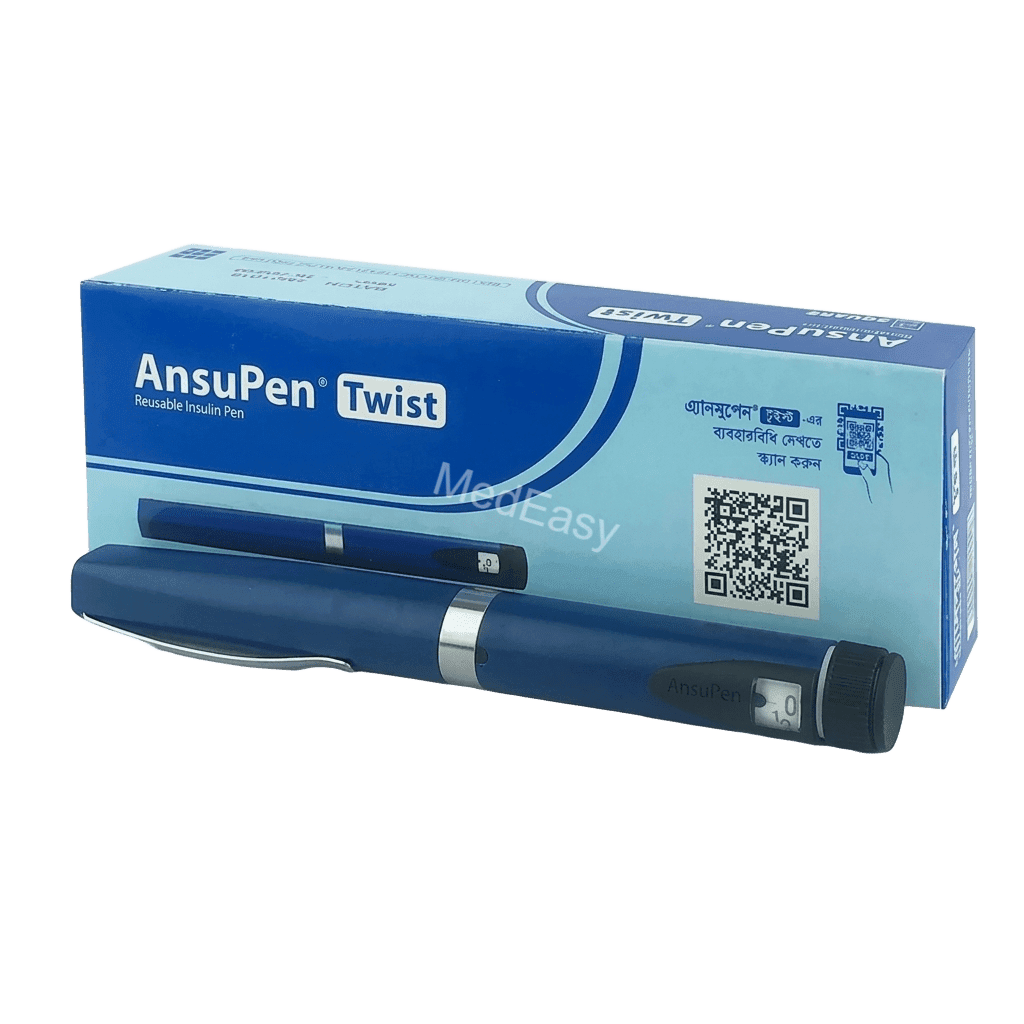

Medicine overview
Indications of AnsuPen
AnsuPen is a premixed (biphasic) insulin preparation combining a rapid/short-acting soluble insulin with an intermediate-acting isophane (NPH) insulin suspension in a fixed ratio (commonly 30:70). It is indicated for:
- Type 1 diabetes mellitus - as part of an insulin regimen to achieve glycemic control, when a fixed combination of prandial and basal coverage from a single injection is appropriate.
- Type 2 diabetes mellitus - in patients who require insulin therapy for glycemic control, either alone or in combination with oral antidiabetic agents, when a premixed regimen suits their meal pattern and lifestyle.
This is an established, guideline-supported use for patients whose insulin requirements are relatively stable and predictable; it is not intended for patients who need flexible, independently adjustable prandial and basal doses.
Composition
Each mL of the suspension contains a fixed-ratio mixture of Insulin regular + Insulin Isophane (short-acting soluble human/analog insulin combined with intermediate-acting isophane [NPH] insulin), most commonly in a 30% regular to 70% isophane ratio, at a strength of 100 IU/mL. Other ratios (e.g., 50:50) may be available depending on the product.
Description
AnsuPen is a biphasic (premixed) insulin suspension that combines two insulin components with different onset and duration of action in a single formulation. The regular (soluble) insulin component acts rapidly to control the post-meal (prandial) rise in blood glucose, while the isophane (NPH, protamine-crystallized) component is absorbed more slowly to provide intermediate, background (basal) glucose control. By combining both actions in one injection, AnsuPen reduces the number of daily injections needed compared with separate regular and NPH insulin doses, while still approximating physiologic insulin coverage across meals and between meals.
Therapeutic Class
AnsuPen belongs to the therapeutic class of antidiabetic agents - premixed (biphasic) human insulin preparations, combining a short-acting and an intermediate-acting insulin component.
Pharmacology
Insulin regular + Insulin Isophane lowers blood glucose by binding to insulin receptors on muscle, adipose, and liver cells, promoting cellular glucose uptake, and suppressing hepatic glucose production. It also inhibits lipolysis and proteolysis and enhances protein synthesis.
Pharmacokinetic profile of the two components
| Component | Onset | Peak effect | Duration |
|---|---|---|---|
| Regular (soluble) insulin | ~30 minutes | 2-4 hours | ~6-8 hours |
| Isophane (NPH) insulin | ~1-2 hours | 4-12 hours | Up to ~18-24 hours |
Because it combines both profiles, Insulin regular + Insulin Isophane provides prandial coverage around the time of injection along with a longer basal tail, but its combined action can make the timing and magnitude of peak effect less predictable than with either component given alone.
Dosage & Administration of AnsuPen
Dosage of AnsuPen is individualized based on blood glucose monitoring, HbA1c targets, body weight, diet, activity level, and concurrent illness. It is administered by subcutaneous injection only (never intravenously or intramuscularly), typically 30 minutes before a meal, usually once or twice daily (e.g., before breakfast and before the evening meal).
Administration technique
- Before each use, gently roll the vial or pen between the palms and/or invert it several times (do not shake vigorously) until the suspension is uniformly cloudy/milky - the isophane component must be fully resuspended for accurate dosing.
- Inject subcutaneously into the abdomen, thigh, upper arm, or buttock; rotate injection sites within the chosen area to reduce the risk of lipodystrophy.
- Doses are typically titrated gradually (every few days) based on self-monitored blood glucose, under physician guidance.
See Use in Special Populations for adjustments in renal/hepatic impairment, and Pediatric Uses for use in children.
Administration of AnsuPen
AnsuPen is given by subcutaneous injection only, using a syringe, prefilled pen, or cartridge device compatible with the specific product. It should not be administered intravenously or intramuscularly. Inject approximately 30 minutes before a meal so that the rapid-acting component coincides with the post-meal glucose rise. Do not mix with other insulins in the same syringe unless specifically directed by a physician, and always resuspend by gentle rolling/inversion immediately before injecting.
Interaction of AnsuPen
AnsuPen has clinically significant interactions with several drug classes:
- Other antidiabetic agents, alcohol, salicylates, ACE inhibitors, and MAO inhibitors - may enhance the glucose-lowering effect and increase the risk of hypoglycemia.
- Corticosteroids, thiazide diuretics, thyroid hormones, oral contraceptives, and sympathomimetics - may reduce the glucose-lowering effect, potentially requiring an insulin dose increase.
- Beta-blockers - may mask the warning symptoms of hypoglycemia (such as tremor and tachycardia), delaying recognition and treatment.
Patients on any of these concurrent medications require closer blood glucose monitoring while using AnsuPen.
Contraindications
Insulin regular + Insulin Isophane is contraindicated in:
- Patients with known hypersensitivity to insulin regular, isophane insulin, or any excipient in the formulation.
- During episodes of hypoglycemia (the drug must not be given while blood glucose is already low).
Side Effects of AnsuPen
The most common and most serious adverse effect of AnsuPen is hypoglycemia, which can present as sweating, tremor, palpitations, hunger, confusion, and, if severe, seizures or loss of consciousness; the mixed action profile can make the timing of peak hypoglycemia risk harder to predict than with a single-acting insulin. Other adverse effects include:
- Injection-site reactions (redness, swelling, itching) and, with repeated injection at the same site, lipodystrophy (fat thickening or atrophy) that can affect insulin absorption.
- Weight gain.
- Hypokalemia (low blood potassium), particularly with higher doses or in combination with other potassium-lowering factors.
- Rarely, generalized hypersensitivity reactions such as rash, urticaria, or, very rarely, anaphylaxis.
- Peripheral edema, especially at the start of insulin therapy.
Pregnancy & Lactation
Insulin, including AnsuPen, is a preferred option for achieving glycemic control during pregnancy when insulin therapy is needed, because it does not cross the placenta in clinically significant amounts. However, insulin requirements often change substantially during pregnancy (typically decreasing in the first trimester and increasing later), so dosing must be closely monitored and adjusted by the treating physician. Use only under medical supervision, with the dose individualized so that the benefit of glycemic control outweighs any risk. Insulin is generally considered compatible with breastfeeding, as it is not expected to pass into breast milk in a way that affects the infant; nursing mothers may need dose and dietary adjustments, so consult a physician.
Precautions & Warnings
Use AnsuPen with the following precautions:
- Hypoglycemia is the most common and most serious risk; because the mixed formulation combines a rapid and an intermediate component, the timing and severity of peak effect can be less predictable, so blood glucose should be monitored regularly, especially when changing dose, diet, activity, or during intercurrent illness.
- The suspension must be gently resuspended (rolled/inverted) immediately before each use, since the isophane component settles on standing; inadequate resuspension can cause under- or over-dosing.
- Rotate injection sites to reduce the risk of lipodystrophy, which can alter insulin absorption.
- Monitor for hypokalemia, particularly in patients on other potassium-lowering medications or with reduced oral intake.
- Dose requirements may change with intercurrent illness, stress, changes in physical activity, diet, or concomitant medications; do not adjust the dose without medical advice.
- Do not switch between insulin brands/types without physician guidance, as this may require a dose adjustment.
Overdose Effects of AnsuPen
Overdose of AnsuPen causes hypoglycemia, which may present as sweating, weakness, confusion, tremor, palpitations, seizures, or loss of consciousness. Mild hypoglycemia can often be managed by promptly consuming a fast-acting source of sugar (such as glucose tablets or juice) followed by a longer-acting carbohydrate/meal. Severe hypoglycemia with confusion, seizure, or unconsciousness is a medical emergency - seek immediate medical attention or contact emergency services; a caregiver may need to administer glucagon if trained to do so while awaiting help. Do not attempt to manage severe or persistent hypoglycemia at home without professional medical guidance.
Storage Conditions
Store unopened (unused) AnsuPen in a refrigerator (2°C-8°C); do not freeze, and do not use if it has been frozen. Once in use, the vial or pen may generally be kept at room temperature (below 30°C), away from direct heat and light, and should be discarded after the period specified on the product labeling (commonly around 4 weeks). Keep out of reach of children.
Use In Special Populations
Renal impairment: insulin requirements may decrease because insulin is cleared more slowly, increasing the risk of hypoglycemia; dose reduction and closer monitoring are often needed.
Hepatic impairment: insulin requirements may also decrease due to reduced gluconeogenesis and slower insulin metabolism; monitor closely and adjust dose as needed.
Elderly patients: generally more susceptible to hypoglycemia and its consequences; conservative dosing with close monitoring is recommended.
See Pediatric Uses below for use in children.
Duration Of Treatment
AnsuPen is generally used long-term as part of ongoing diabetes management, since diabetes mellitus is a chronic condition. The dose and regimen are reviewed and adjusted periodically (based on blood glucose monitoring and HbA1c) by the treating physician; treatment is not typically stopped without medical supervision, as doing so can lead to significant hyperglycemia.
Drug Classes
Antidiabetic agent; premixed (biphasic) insulin combining short-acting (regular) and intermediate-acting (isophane/NPH) human insulin.
Mode Of Action
Insulin regular + Insulin Isophane works through the combined mechanisms of its two components. The soluble regular insulin binds rapidly to insulin receptors, stimulating glucose uptake into skeletal muscle and adipose tissue and suppressing hepatic glucose output shortly after injection, mimicking prandial (mealtime) insulin release. The isophane (NPH) component consists of insulin crystallized with protamine, which dissolves and is absorbed gradually from the subcutaneous injection site, providing a more sustained, intermediate-duration insulin effect that mimics basal insulin secretion. Together, the two components provide combined prandial and basal glycemic control from a single injection.
Pregnancy
B
Pediatric Uses
AnsuPen can be used in children and adolescents with diabetes mellitus who require insulin therapy, under close pediatric/endocrinology supervision. Dosing must be individualized based on body weight, growth, diet, activity, and blood glucose monitoring, and is typically started and adjusted conservatively to minimize the risk of hypoglycemia. Because a fixed premixed ratio offers less flexibility than separate rapid- and intermediate-acting insulin, its suitability in young or very active children should be assessed by the treating physician on a case-by-case basis. Safety and efficacy in very young children (e.g., infants) have not been well established, and specialist guidance should always be sought.
Frequently Asked Questions
Q: What is AnsuPen 30/70 + 50/50 Reusable Insulin Pen used for?
A: AnsuPen 30/70 + 50/50 Reusable Insulin Pen is a premixed insulin used to control blood sugar in people with type 1 or type 2 diabetes mellitus, providing both rapid mealtime coverage and longer-lasting background insulin from a single injection.
Q: How should I prepare AnsuPen 30/70 + 50/50 Reusable Insulin Pen before injecting it?
A: Before each injection, gently roll the vial or pen between your palms and/or turn it upside down several times until the liquid looks uniformly cloudy. Do not shake it vigorously, as this can cause air bubbles or affect the dose. Proper resuspension is essential because the isophane component settles when left standing.
Q: What is the biggest risk with AnsuPen 30/70 + 50/50 Reusable Insulin Pen?
A: The most common and most serious risk is hypoglycemia (low blood sugar), which can cause sweating, shakiness, confusion, and, if severe, seizures or loss of consciousness. Because this product combines a fast-acting and an intermediate-acting insulin, the timing of peak effect - and therefore the peak risk of low blood sugar - can be harder to predict, so regular blood glucose monitoring is important.
Q: Can AnsuPen 30/70 + 50/50 Reusable Insulin Pen be used during pregnancy or breastfeeding?
A: Insulin, including AnsuPen 30/70 + 50/50 Reusable Insulin Pen, is generally a preferred choice for controlling blood sugar during pregnancy when insulin therapy is needed, since it does not cross the placenta in significant amounts, but doses often need to be adjusted as pregnancy progresses. It is generally considered compatible with breastfeeding. In both cases, use should be supervised closely by a physician.
Q: What should I do if I take too much AnsuPen 30/70 + 50/50 Reusable Insulin Pen?
A: Taking too much can cause hypoglycemia. For mild symptoms, eat or drink a fast-acting sugar source right away. If you or someone else experiences confusion, seizures, or loss of consciousness, this is a medical emergency - seek immediate medical attention or contact emergency services.
Q: How should AnsuPen 30/70 + 50/50 Reusable Insulin Pen be stored?
A: Unopened supplies should be kept refrigerated (2°C-8°C) and never frozen. Once you start using a vial or pen, it can usually be kept at room temperature below 30°C, away from heat and light, and should be discarded after the time period stated on the product label.
Disclaimer
The information provided is accurate to the best of our knowledge, but it does not replace professional medical advice. We cannot guarantee its completeness or accuracy, and the absence of specific information about a drug should not be taken as an endorsement. We are not responsible for any consequences arising from this information, so please consult a healthcare professional for any concerns or questions.
