
Key facts
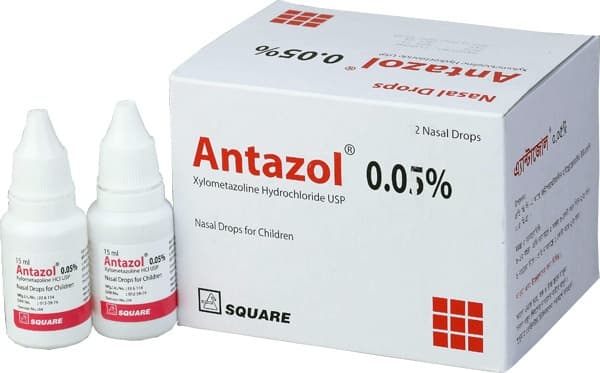
Antazol 0.05% Nasal Drop is available on MedEasy for ৳16.20 per 15 ml drop, with home delivery anywhere in Bangladesh. It is manufactured by Square Pharmaceuticals PLC. Its generic name is Xylometazoline.
- Pack sizes
- 15 ml drop, 12's pack
- Prescription
- Not required (over-the-counter).
- Delivery
- Home delivery across Bangladesh. Same-day delivery in Dhaka, Chattogram, Sylhet and Bogura city areas; 2-3 days elsewhere.
- Payment
- Cash on delivery, bKash, cards and mobile banking.
- Brand
- Antazol
- Generic name
- Xylometazoline
- Manufacturer
- Square Pharmaceuticals PLC.
- Form & strength
- Nasal Drop 0.05%
- Availability
- In stock
- Authenticity
- Sourced from licensed suppliers and the manufacturer's authorised distributors in Bangladesh.

Medicine overview
Indications of Antazol
Antazol is a topical nasal decongestant indicated for:
- Established/OTC-approved use: Temporary relief of nasal congestion associated with the common cold, allergic rhinitis (hay fever), and sinusitis.
- Guideline-supported adjunct use: As a short-term adjunct, under medical supervision, to reduce nasal mucosal swelling before examination of the nasal passages, sinus drainage procedures, or to improve penetration of other intranasally administered medications (e.g., intranasal corticosteroids) in a blocked nose.
- Off-label/limited-evidence use: Occasionally used briefly to relieve eustachian tube congestion associated with otitis media, or before air travel/diving in individuals prone to barotrauma; evidence for this use is limited and it is not an approved indication.
Antazol is intended only for short-term, symptomatic relief and does not treat the underlying cause of nasal congestion.
Composition
Xylometazoline is formulated as Xylometazoline Hydrochloride, available as nasal drops or a metered nasal spray in two standard strengths:
- 0.05% w/v (0.5 mg/mL) – pediatric strength
- 0.1% w/v (1 mg/mL) – adult strength
Formulations typically also contain excipients such as benzalkonium chloride (preservative), sodium chloride, disodium edetate, and purified water used to adjust tonicity and pH.
Description
Antazol is a topical alpha-adrenergic agonist belonging to the imidazoline class of sympathomimetic decongestants. Applied directly to the nasal mucosa as drops or spray, Antazol constricts the dilated blood vessels of the nasal passages, reducing swelling and congestion so that airflow through the nose improves.
Onset of action typically occurs within 5–10 minutes of application, with an effect that can last up to 10 hours, allowing twice-daily dosing. Antazol is widely available as an over-the-counter product for short-term symptomatic relief of nasal congestion.
Therapeutic Class
Antazol belongs to the therapeutic class of Topical Nasal Decongestants, specifically the imidazoline-derivative subclass of alpha-adrenergic (sympathomimetic) agonists.
Pharmacology
Xylometazoline acts directly on alpha-adrenergic receptors (predominantly alpha-1, with some alpha-2 activity) located in the smooth muscle of the nasal mucosal arterioles. Stimulation of these receptors produces localized vasoconstriction, which reduces blood flow to the engorged nasal turbinates, decreases mucosal edema, and reopens the nasal airway.
The decongestant effect of Xylometazoline begins within 5–10 minutes and persists for up to 10 hours per application. Systemic absorption through the nasal mucosa is normally minimal at recommended doses, but can increase significantly with excessive dosing, prolonged use, or in young children, raising the risk of systemic adrenergic effects.
Dosage & Administration of Antazol
The dose of Antazol depends on the patient's age and the strength of the formulation used. Antazol should not be used for more than 3–5 consecutive days.
| Indication / Age group | Strength | Recommended Dose |
|---|---|---|
| Nasal congestion (cold, allergic rhinitis, sinusitis) – Adults and children ≥ 12 years | 0.1% | 1–2 sprays or drops per nostril, once or twice daily (morning and evening); do not repeat more often than every 8–10 hours |
| Nasal congestion – Children 2 to under 12 years | 0.05% | 1 spray or drop per nostril, once or twice daily, under adult supervision |
| Children under 2 years | Not applicable | Not recommended; safety and efficacy not established (see Contraindications) |
Renal/hepatic impairment: No formal dose adjustment has been established for Antazol because systemic absorption after intranasal use is normally minimal; caution is nonetheless advised (see Use in Special Populations).
Administration of Antazol
For intranasal use only. Before use, gently blow the nose to clear the nasal passages.
- Nasal spray: With the head upright, insert the tip into one nostril and spray while gently inhaling; repeat in the other nostril as directed.
- Nasal drops: Tilt the head back slightly, instill the prescribed number of drops into each nostril, then remain still for a few moments.
- Avoid contact of Antazol with the eyes.
- Wipe the tip clean after each use and do not share the container with another person, to avoid spreading infection.
- Do not exceed the recommended dose or frequency, and do not use Antazol for more than 3–5 consecutive days (see Precautions and Warnings).
Interaction of Antazol
Antazol has the following clinically significant interactions:
- Monoamine oxidase inhibitors (MAOIs): Concurrent use, or use within 14 days of MAOI therapy, is contraindicated due to the risk of a hypertensive crisis (see Contraindications).
- Tricyclic antidepressants: May potentiate the pressor (blood pressure–raising) effect of Antazol if it is systemically absorbed; use with caution.
- Other sympathomimetic agents (e.g., other decongestants, stimulants, appetite suppressants): Concurrent use may produce additive cardiovascular effects such as increased heart rate and blood pressure.
- Antihypertensive agents: Systemic absorption of Antazol, particularly with excessive or prolonged use, may reduce the effectiveness of antihypertensive medications.
Contraindications
Xylometazoline is contraindicated in:
- Patients with known hypersensitivity to Xylometazoline or any component of the formulation.
- Patients who are using, or have used within the past 14 days, a monoamine oxidase inhibitor (MAOI), because of the risk of a hypertensive crisis.
- Children under 2 years of age, for whom safety and efficacy have not been established and serious systemic adverse effects have been reported (see Use in Special Populations).
Side Effects of Antazol
Antazol is generally well tolerated with short-term, correctly dosed use. Reported side effects include:
- Common (local): Nasal irritation, burning or stinging sensation, dryness of the nasal mucosa, sneezing, and a transient increase in nasal discharge.
- Rebound congestion (rhinitis medicamentosa): Worsening nasal congestion that recurs as the decongestant effect wears off, typically with use of Antazol beyond the recommended 3–5 days; this is a well-established and clinically important limitation of this drug class (see Precautions and Warnings).
- Uncommon/rare (systemic): Headache, palpitations, tachycardia, and elevated blood pressure, particularly with excessive or prolonged use, or in young children in whom systemic absorption is more likely.
Pregnancy & Lactation
Pregnancy: Data on the use of Antazol in pregnancy are limited. Because it is a vasoconstrictor with potential for systemic absorption, Antazol should be used during pregnancy only if clearly needed, at the lowest effective dose and for the shortest possible duration, and only after consulting a physician, as potential benefit must be weighed against potential risk to the fetus.
Lactation: It is not known whether Antazol passes into breast milk in clinically significant amounts. Given limited data, breastfeeding women should use Antazol only if clearly needed and under medical advice, limiting the dose and duration of use.
Precautions & Warnings
Do not use Antazol for more than 3–5 consecutive days. Prolonged or excessive use can cause rebound nasal congestion (rhinitis medicamentosa), in which the nasal passages become increasingly congested as the drug wears off, potentially leading to dependence on the decongestant. If congestion persists beyond this period, stop use and consult a physician.
- Use with caution in patients with cardiovascular disease (e.g., hypertension, coronary artery disease), hyperthyroidism, or diabetes mellitus, as systemic absorption of Antazol – especially with excessive or prolonged use – can produce sympathomimetic effects such as increased heart rate and blood pressure.
- Use with caution in patients with narrow-angle glaucoma or significant prostatic enlargement, given the potential for systemic alpha-adrenergic effects if Antazol is absorbed.
- Antazol should be used with particular caution, and generally avoided, in infants and young children because of a higher risk of serious systemic toxicity (see Use in Special Populations).
- Do not share a single container of Antazol between different users, as this can spread infection.
- Avoid concurrent use of other topical or oral decongestants unless advised by a physician.
Overdose Effects of Antazol
Overdose or excessive use of Antazol, particularly in young children, can cause serious systemic toxicity. Symptoms may include drowsiness, lethargy, sweating, hypothermia, bradycardia, hypotension, and, in severe cases, respiratory depression or coma in young children; adults may instead experience stimulant-type effects such as tachycardia, hypertension, agitation, and headache.
If overdose is suspected, whether from accidental ingestion or excessive nasal use, seek immediate medical attention or contact a poison control center right away. There is no specific antidote for Antazol overdose; treatment is supportive and symptomatic and should only be provided by a healthcare professional.
Storage Conditions
Store Antazol at room temperature (below 30°C), away from light and moisture. Keep the container tightly closed and out of the reach and sight of children. Discard any remaining Antazol nasal spray or drops after the period stated on the label following opening, or after the expiry date, whichever comes first, to reduce the risk of contamination.
Use In Special Populations
Children: Dosing of Antazol is strength- and age-based – 0.05% for children 2 to under 12 years, and 0.1% for those 12 years and older. Antazol is not recommended in children under 2 years of age because of a higher risk of serious systemic adverse effects (see Contraindications).
Elderly: Use with caution, particularly in those with underlying cardiovascular disease, as age-related comorbidities may increase sensitivity to any systemically absorbed Antazol.
Renal/Hepatic impairment: Specific dose adjustment has not been established; because systemic absorption of Antazol after intranasal use is normally minimal, formal adjustment is generally not required, but caution is advised with excessive or prolonged use.
Duration Of Treatment
Treatment with Antazol should be limited to a maximum of 3–5 consecutive days. If nasal congestion persists beyond this period, use should be stopped and a physician consulted before resuming, in order to avoid rebound congestion (rhinitis medicamentosa) (see Precautions and Warnings).
Drug Classes
Nasal Decongestants; Sympathomimetic (Alpha-Adrenergic) Agonists; Imidazoline Derivatives.
Mode Of Action
Xylometazoline is a direct-acting alpha-adrenergic receptor agonist. When applied to the nasal mucosa, it stimulates alpha-1 (and, to a lesser extent, alpha-2) adrenergic receptors in the smooth muscle of the nasal blood vessels, causing local vasoconstriction. This reduces blood flow and fluid leakage into the nasal mucosa, decreasing swelling of the nasal turbinates and relieving congestion, typically within 5–10 minutes, with effects lasting up to 10 hours.
Pediatric Uses
Use of Antazol in children follows strength- and age-based dosing:
- Children 2 to under 12 years: 0.05% strength, 1 spray/drop per nostril once or twice daily under adult supervision, for no more than 3–5 consecutive days.
- Children 12 years and older: Adult (0.1%) strength and dosing may be used.
- Children under 2 years: Antazol is not recommended; safety and efficacy have not been established in this age group, and serious systemic adverse effects (including sedation, bradycardia, and hypotension) have been reported with imidazoline decongestants in young children.
Frequently Asked Questions
Q: What is Antazol 0.05% Nasal Drop used for?
A: Antazol 0.05% Nasal Drop is a nasal decongestant used for short-term relief of nasal congestion caused by the common cold, allergic rhinitis (hay fever), or sinusitis. It works by narrowing the blood vessels in the nose to reduce swelling and open the airway.
Q: How long can I use Antazol 0.05% Nasal Drop?
A: Antazol 0.05% Nasal Drop should not be used for more than 3–5 consecutive days. Using it for longer can cause rebound congestion (rhinitis medicamentosa), where the nose becomes more blocked once the medicine wears off, sometimes leading to a cycle of dependence on the spray. If congestion has not improved after this time, stop use and see a doctor.
Q: Can children use Antazol 0.05% Nasal Drop?
A: Yes, but the strength and dose depend on age. Children 2 to under 12 years should use the lower-strength (0.05%) formulation, while those 12 years and older can use the adult (0.1%) strength. Antazol 0.05% Nasal Drop is not recommended for children under 2 years old because of a higher risk of serious side effects such as excessive sleepiness, slow heart rate, and low blood pressure.
Q: Is it safe to use Antazol 0.05% Nasal Drop during pregnancy or while breastfeeding?
A: Antazol 0.05% Nasal Drop should be used during pregnancy or breastfeeding only if clearly needed, at the lowest effective dose and for the shortest possible time, after talking to a physician, because safety data are limited and it works by narrowing blood vessels.
Q: What should I do if too much Antazol 0.05% Nasal Drop is used by mistake?
A: If too much Antazol 0.05% Nasal Drop is used, or it is accidentally swallowed – especially by a child – seek immediate medical attention or contact a poison control center right away, since excessive amounts can cause serious effects such as drowsiness, a slow heart rate, or low blood pressure in children, or a fast heart rate and high blood pressure in adults.
Q: Can Antazol 0.05% Nasal Drop be used with other decongestants or medicines?
A: Antazol 0.05% Nasal Drop must not be used with, or within 14 days of, a monoamine oxidase inhibitor (MAOI) medicine, as this combination can cause a dangerous rise in blood pressure. It should also be used cautiously with other decongestants, certain antidepressants, or blood pressure medicines, so tell a doctor or pharmacist about all medicines being taken before using Antazol 0.05% Nasal Drop.
Disclaimer
The information provided is accurate to the best of our knowledge, but it does not replace professional medical advice. We cannot guarantee its completeness or accuracy, and the absence of specific information about a drug should not be taken as an endorsement. We are not responsible for any consequences arising from this information, so please consult a healthcare professional for any concerns or questions.