
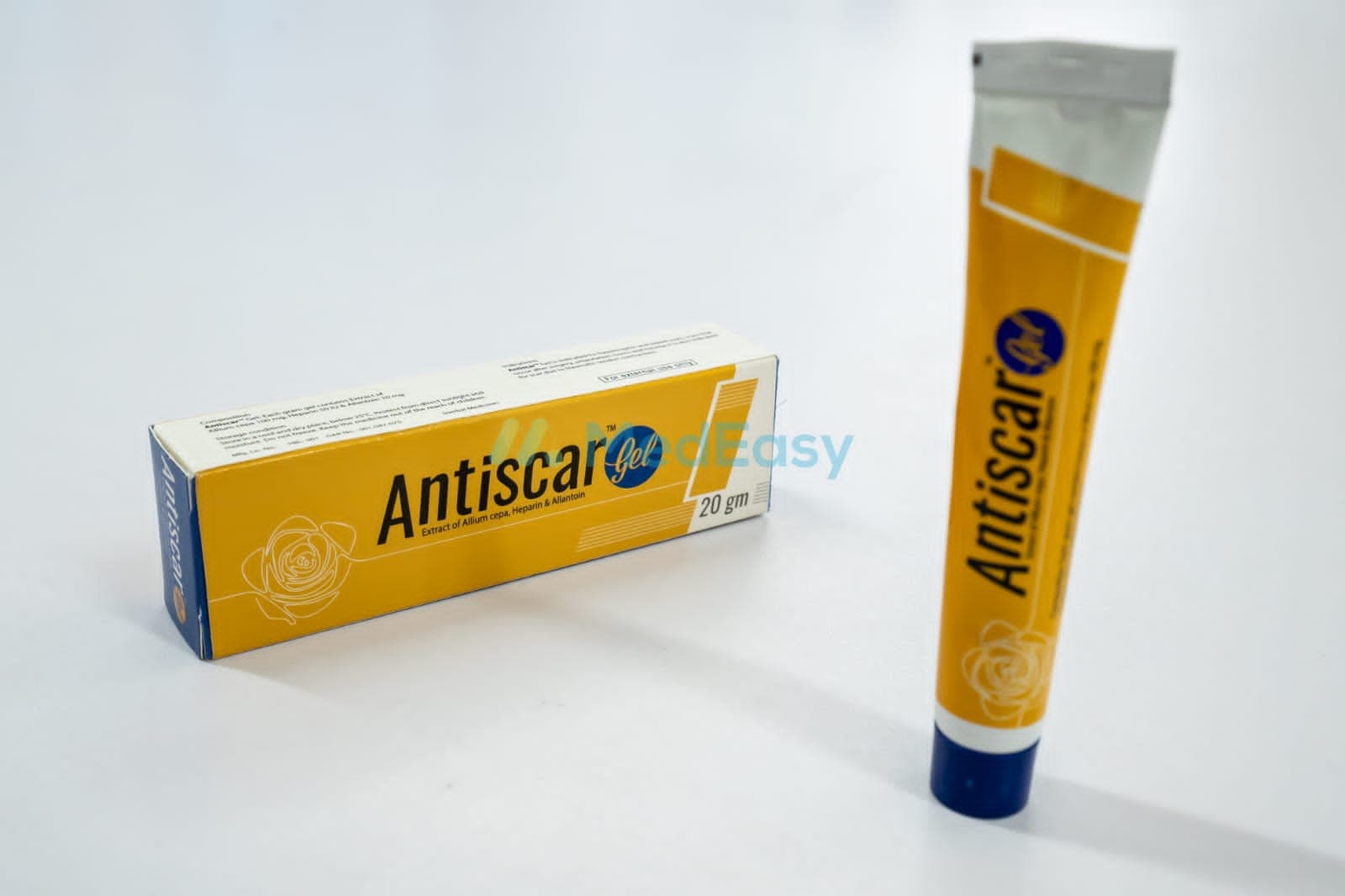

Medicine overview
Indications of Antiscar
Antiscar is a topical gel used in the management of scars. Established/common uses include:
- Improving the appearance of post-surgical and post-traumatic scars
- Softening and flattening hypertrophic scars and keloid scars, and reducing associated redness
- Adjunct (supportive) treatment for scar-related tissue contractures, such as Dupuytren's contracture, alongside standard medical/surgical management
It is sometimes used off-label, on a physician's advice, to help improve the appearance of stretch marks. Antiscar should only be applied once a wound or incision has fully closed and healed — it is not intended for open or actively healing wounds.
Composition
Allium cepa + Heparin + Allantoin is a fixed-dose topical combination containing an extract of Allium cepa (onion bulb), Heparin (sodium), and Allantoin in a gel base intended for external use. The precise concentration of each component can vary slightly between manufacturers/brands; refer to the specific product packaging for exact strengths.
Description
Antiscar is a topical combination gel widely used in scar management. It combines a plant-derived extract (Allium cepa), an anticoagulant-class ingredient used here for its local skin-conditioning and anti-inflammatory action (Heparin), and a skin-protectant/keratolytic agent (Allantoin). Together these ingredients are intended to soften, flatten, and reduce the redness of healing scar tissue, including hypertrophic and keloid scars, when used consistently over an extended period.
Therapeutic Class
Antiscar belongs to the class of topical dermatological preparations for scar management (wound-healing/scar-modifying agents).
Pharmacology
The pharmacological effect of Allium cepa + Heparin + Allantoin results from the combined action of its three components:
- Allium cepa extract has anti-inflammatory properties and is thought to inhibit excessive fibroblast proliferation and collagen synthesis, helping to soften scar tissue.
- Heparin, applied topically, helps maintain local skin hydration and contributes a mild anti-inflammatory/antiproliferative effect on fibroblasts; at standard topical doses it is not expected to produce systemic anticoagulant activity.
- Allantoin is a mild keratolytic and skin-protectant agent that softens the skin and supports tissue regeneration during wound healing.
Together, these actions help Allium cepa + Heparin + Allantoin soften, flatten, and reduce the redness of scar tissue over time.
Dosage & Administration of Antiscar
Antiscar gel is applied to the affected scar area 2–3 times daily; older or firmer scars may require up to 3–4 applications per day, as advised by a physician.
| Aspect | Instruction |
|---|---|
| Amount | A thin layer sufficient to cover the scar area |
| Technique | Gently massage into the skin until fully absorbed |
| Duration | Consistent use over several weeks to several months, depending on scar age and severity |
Apply only to fully closed, healed skin. Do not apply to open wounds or actively infected skin.
Administration of Antiscar
Antiscar is for external (topical) use only. Clean and dry the affected area, apply a thin layer of gel directly onto the scar, and massage gently until absorbed. Avoid contact with the eyes, mouth, and other mucous membranes. Wash hands after application unless the hands are the treated area.
Interaction of Antiscar
Because Antiscar is applied topically with minimal systemic absorption, no clinically significant systemic drug interactions are well established. As a general precaution, avoid applying other topical products (creams, ointments, or lotions) to the same area at the same time without consulting a physician or pharmacist, to avoid altered absorption or additive skin irritation.
Contraindications
Allium cepa + Heparin + Allantoin is contraindicated in:
- Known hypersensitivity to Allium cepa extract, Heparin, Allantoin, or any other component of the formulation
- Application to open wounds or actively infected skin — this product is intended for use only after a wound or incision has fully closed and healed, not on open injuries
Side Effects of Antiscar
Antiscar is generally well tolerated. Possible side effects include:
- Local redness or a mild burning/stinging sensation at the application site
- Itching
- Uncommonly, allergic contact dermatitis
If any of these occur, discontinue use and consult a physician.
Pregnancy & Lactation
Data on the use of Antiscar during pregnancy and lactation are limited. Although it is applied topically and systemic absorption is expected to be minimal, it should be used during pregnancy and breastfeeding only if clearly needed and the potential benefit justifies the potential risk, and only on the advice of a physician.
Precautions & Warnings
Observe the following precautions when using Antiscar:
- For external use only — avoid contact with the eyes and mucous membranes
- Discontinue use if local irritation or an allergic reaction develops
- Patients with known bleeding disorders should exercise caution if applying this product over very large body-surface areas or onto broken skin, although systemic anticoagulant effects are not expected with standard topical use
- Optimal scar-improvement results typically require consistent use over an extended period — often several weeks to months — and patients should have realistic expectations about the degree of improvement
- Begin use only once the wound has fully closed, per product labeling
Overdose Effects of Antiscar
As Antiscar is a topical preparation, the risk of systemic toxicity from excessive application is low. If accidentally ingested, or if a severe local or systemic reaction occurs after extensive application, seek immediate medical attention or contact a poison control center/emergency services.
Storage Conditions
Store at room temperature (below 30°C), away from light and moisture. Keep out of reach of children.
Use In Special Populations
Renal/hepatic impairment: No specific dose adjustment is established for topical use, as systemic absorption of Antiscar is minimal; use with the same general precautions.
Elderly: No specific dose adjustment is required; monitor for local skin irritation, as elderly skin may be more sensitive.
Bleeding disorders: See Precautions and Warnings.
Duration Of Treatment
Treatment duration with Antiscar is individualized based on scar type, age, and severity, but consistent application over several weeks to several months (commonly 3–6 months or longer for mature or keloid scars) is typically needed to see optimal improvement.
Drug Classes
Topical combination product: plant-derived extract (Allium cepa) + anticoagulant-class agent used topically (Heparin) + skin protectant/keratolytic (Allantoin), classified together as a dermatological scar-management preparation.
Mode Of Action
Allium cepa + Heparin + Allantoin acts through the combined anti-inflammatory, antiproliferative, and skin-conditioning effects of its three components — reducing excessive fibroblast activity and collagen buildup, maintaining local hydration, and supporting softening and remodeling of scar tissue — to reduce the thickness, firmness, and redness of scars over time.
Pediatric Uses
Antiscar may be used in children under a physician's guidance. Safety and efficacy in infants and very young children have not been well established, so a physician should be consulted before use in this age group.
Frequently Asked Questions
Q: What is Antiscar 100 mg+50 IU+10 mg Topical Gel used for?
A: Antiscar 100 mg+50 IU+10 mg Topical Gel is a topical gel used to improve the appearance of scars, including surgical, traumatic, hypertrophic, and keloid scars, by helping to soften, flatten, and reduce redness of the healing scar tissue.
Q: How long does it take to see results?
A: Noticeable improvement with Antiscar 100 mg+50 IU+10 mg Topical Gel typically requires consistent use over several weeks to several months; results vary by scar type, age, and severity, so realistic expectations should be maintained.
Q: Is it safe to use during pregnancy?
A: Data on Antiscar 100 mg+50 IU+10 mg Topical Gel in pregnancy are limited. Although systemic absorption from topical use is expected to be minimal, it should be used during pregnancy only if clearly needed, when the potential benefit justifies the potential risk, and on a physician's advice.
Q: Can I apply it on an open wound?
A: No. Antiscar 100 mg+50 IU+10 mg Topical Gel is contraindicated on open wounds or actively infected skin. It should be applied only after the wound or incision has fully closed and healed.
Q: What should I do if irritation occurs?
A: If redness, burning, itching, or an allergic reaction develops after applying Antiscar 100 mg+50 IU+10 mg Topical Gel, stop using it and consult a physician.
Q: Can children use this product?
A: Antiscar 100 mg+50 IU+10 mg Topical Gel may be used in children under a physician's guidance; however, safety and efficacy in infants and very young children have not been well established, so medical advice should be sought first.
Disclaimer
The information provided is accurate to the best of our knowledge, but it does not replace professional medical advice. We cannot guarantee its completeness or accuracy, and the absence of specific information about a drug should not be taken as an endorsement. We are not responsible for any consequences arising from this information, so please consult a healthcare professional for any concerns or questions.
